ETF基金

Search documents
桥水最新13F出炉:狠砍2/3英伟达持仓 微软谷歌齐遭减持
Xin Lang Cai Jing· 2025-11-14 13:13
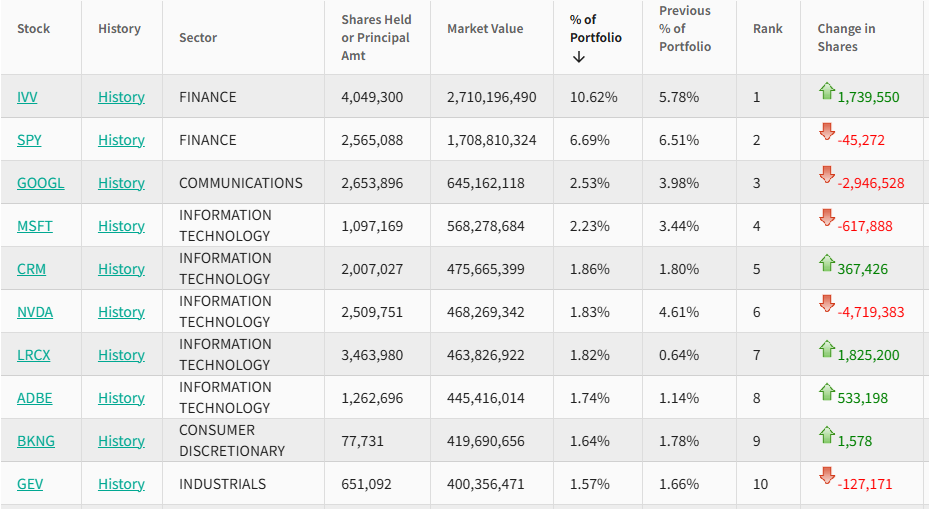
Core Insights - Bridgewater Associates, one of the largest hedge funds globally, reported a total holding of $25.5 billion as of September 30, 2025, an increase from $24.8 billion at the end of the previous quarter [1]. Holdings Summary - In Q3, Bridgewater increased its positions in 325 securities, reduced its holdings in 194, initiated positions in 493 new securities, and completely exited 64 positions [2]. - The concentration of Bridgewater's top ten holdings was 32.54%, with iShares Core S&P 500 ETF (IVV) and SPDR S&P 500 ETF (SPY) remaining the top two holdings [2]. Top Holdings - The top holdings included: - IVV: 4,049,300 shares valued at approximately $2.71 billion, representing 10.62% of the portfolio, an increase from 5.78% [3]. - SPY: 2,565,088 shares valued at approximately $1.71 billion, representing 6.69% of the portfolio, a slight decrease from 6.51% [3]. - GOOGL: 2,653,896 shares valued at approximately $645.16 million, representing 2.53% of the portfolio, down from 3.98% [3]. - MSFT: 1,097,169 shares valued at approximately $568.28 million, representing 2.23% of the portfolio, down from 3.44% [3]. - NVDA: 2,509,751 shares valued at approximately $468.27 million, representing 1.83% of the portfolio, down from 4.61% [3]. Notable Changes - Bridgewater significantly reduced its position in NVIDIA by approximately 4.72 million shares, bringing its total to 2.51 million shares, a decrease of 65.3% from the previous quarter [3][4]. - In Q2, Bridgewater had increased its NVIDIA holdings by 154.37%, indicating a shift to a more cautious outlook on the stock [4]. Top Buys and Sells - The top buys in Q3 included: - IVV: Increased by 4.83% [5]. - LRCX: Increased by 1.17% [5]. - ADBE: Increased by 0.61% [5]. - The top sells included: - IEMG: Decreased by 3.86% [5]. - NVDA: Decreased by 2.77% [5]. - GOOGL: Decreased by 1.45% [5]. Market Outlook - Ray Dalio, the founder of Bridgewater, warned that the U.S. economy may be entering the later stages of a "big debt cycle," with potential bubbles forming due to the Federal Reserve's loose monetary policy [6]. - Dalio believes that the current bull market driven by technology stocks will continue in the short term, primarily fueled by ongoing interest in artificial intelligence [6].


ETF观察日志(2025-11-13):麦高视野
Mai Gao Zheng Quan· 2025-11-14 09:35
1. Report Industry Investment Rating - Not mentioned in the provided content 2. Core View of the Report - The report provides daily tracking data of various ETFs, including information such as tracking index, RSI, net purchase, trading volume, institutional holding ratio, etc., but does not explicitly state a core view [2][4][6] 3. Summaries Based on Related Catalogs 3.1 Data Explanation - The table tracks daily frequency data of ETFs, divided into "broad - based" and "theme" sub - tables according to the tracking index type. The "broad - based" ETFs track mainstream broad - based indices like CSI 300, and "theme" ETFs track industry/style indices like non - bank and dividend. A fund pool is constructed by selecting one or more large - scale ETFs in each type. The RSI is calculated based on a 12 - day average rise - fall ratio, with RSI>70 indicating an overbought market and RSI<30 indicating an oversold market. Net purchase is calculated based on the formula NETBUY(T) = NAV(T)–NAV(T - 1)*(1 + R(T)). Some data may have deviations or be null due to factors such as new listings and late disclosure [2][3] 3.2 Broad - based ETFs - **CSI 300**: Multiple ETFs like Huatai - Berry CSI 300 ETF (510300.SH) with a circulation market value of 428.929 billion yuan, RSI of 57.93, and net purchase of 5.17 billion yuan are presented. Different funds have different performance in terms of market value, RSI, net purchase, etc. [4] - **CSI 500**: For example, Southern CSI 500 ETF (510500.SH) has a circulation market value of 135.661 billion yuan, RSI of 55.28, and net purchase of 3.62 billion yuan [4] - **SSE 50**: Huaxia SSE 50 ETF (510050.SH) has a circulation market value of 184.021 billion yuan, RSI of 63.28, and net purchase of 6.95 billion yuan [4] - Other broad - based indices such as CSI 800, CSI 1000, CSI 2000, CSI A50, etc. also have corresponding ETFs with different performance indicators [4] 3.3 Theme ETFs - **Consumption Electronics**: ETFs like Huaxia Guozheng Consumption Electronics Theme ETF (159732.SZ) with a circulation market value of 297.7 million yuan, RSI of 43.54, and net purchase of 0.19 billion yuan are included [6] - **Non - bank**: Guotai CSI All - Index Securities Company ETF (512880.SH) has a circulation market value of 63.432 billion yuan, RSI of 48.79, and net purchase of 9.60 billion yuan [6] - **Bank**: Huabao CSI Bank ETF (512800.SH) has a circulation market value of 20.596 billion yuan, RSI of 65.52, and net purchase of - 1.04 billion yuan [6] - **Dividend**: Huatai - Berry SSE Dividend ETF (510880.SH) has a circulation market value of 17.911 billion yuan, RSI of 75.44, and net purchase of - 0.50 billion yuan [6] - **New Energy**: Guangfa Guozheng New Energy Vehicle Battery ETF (159755.SZ) has a circulation market value of 15.868 billion yuan, RSI of 65.71, and net purchase of 9.04 billion yuan [6] - **Chip Semiconductor**: Huaxia Guozheng Semiconductor Chip ETF (159995.SZ) has a circulation market value of 28.815 billion yuan, RSI of 47.52, and net purchase of 5.58 billion yuan [6] - Other themes such as photovoltaic, military, ESG, robot, AI, real estate, etc. also have corresponding ETFs with various performance data [6]
A500ETF基金(512050)近20日“吸金”27亿元,港股创新药ETF本周领涨
Ge Long Hui· 2025-11-14 08:31
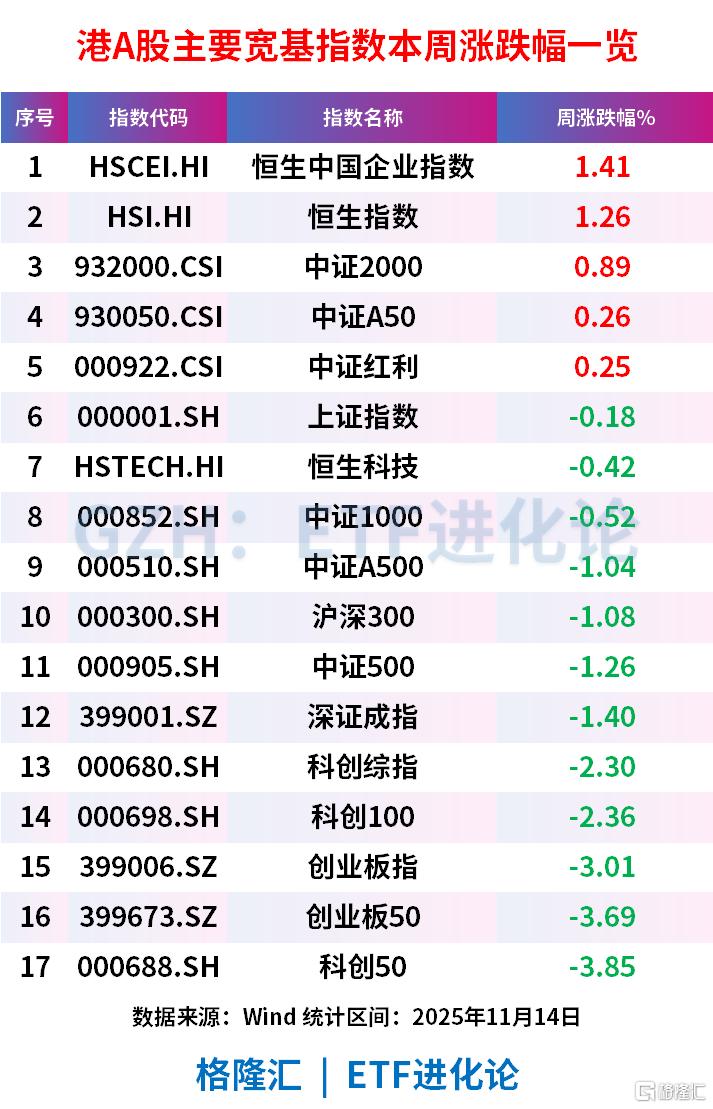
Market Performance - The Shanghai Composite Index fell by 0.97%, closing below 4000 points, while the ChiNext Index dropped by 2.82% [1] - The Hang Seng Index and the Hang Seng Tech Index experienced significant declines, with the latter falling by 2.83% and reaching a low of 3.1% during trading [1] - For the week, the Hang Seng China Enterprises Index and the Hang Seng Index rose by 1.4% and 1.26%, respectively, while the Shanghai Composite Index saw a slight decline of 0.18% [1][2] ETF Performance - The "Global Vision, Betting on China" top ten core ETFs saw a minor pullback of 0.325% this week but recorded a year-to-date increase of 32.62%, outperforming the CSI 300 Index by 15 percentage points [3] - The Hong Kong Innovative Drug ETF was the best performer this week, rising by 5.9% and achieving a year-to-date increase of 93% [7] - The A500 ETF (512050) experienced a slight decline of 1.02% this week but had a net inflow of 2.36 billion yuan over the first four days of the week, totaling 27.07 billion yuan over the past 20 days [3][6] Innovative Drug Sector - The innovative drug sector is showing strong fundamentals, with companies like BeiGene reporting a 41.1% year-on-year revenue increase in Q3, reaching 10.077 billion yuan [9] - The sector is benefiting from a surge in overseas licensing deals, with total transaction amounts exceeding 100 billion USD by October 2025, indicating a significant revaluation of domestic innovative drugs [9] - Policy support, performance realization, and accelerated internationalization are driving improvements in the innovative drug sector's fundamentals, enhancing its medium to long-term investment value [9] U.S. Market Dynamics - The U.S. stock market is facing liquidity challenges due to a prolonged government shutdown and increased debt issuance, which has led to a significant cash drain from the market [12][13] - Hedge funds and institutions have been net sellers of U.S. stocks and ETFs, with over 67 billion USD sold this year, exacerbating liquidity pressures [13] - The Federal Reserve's mixed signals on interest rates have created volatility, particularly affecting technology stocks, as the market adjusts to changing rate expectations [12][14]
ETF午评 | 跨境ETF全线飘绿,恒生互联网ETF、巴西ETF、中韩半导体ETF领跌
Ge Long Hui· 2025-11-14 06:19
Market Overview - The three major A-share indices experienced fluctuations, with the Shanghai Composite Index down by 0.16%, the Shenzhen Component Index down by 1.10%, and the ChiNext Index down by 1.74% [1] - The total trading volume in the Shanghai, Shenzhen, and Beijing markets reached 12,468 billion yuan, a decrease of 266 billion yuan compared to the previous day [1] - Over 2,800 stocks in the market saw an increase [1] Sector Performance - The computing power industry chain showed widespread weakness, with storage chips, HBM, CPO, and advanced packaging leading the decline, while the chemical and non-ferrous metal sectors also experienced pullbacks [1] - Conversely, sectors such as oil and gas, banking, and pharmaceuticals saw gains despite the overall market downturn [1] ETF Performance - Oil and gas stocks performed well, with the Silver Hua Fund Oil and Gas ETF and the Bosera Oil and Gas ETF rising by 2.04% and 1.75%, respectively [1] - The flu sector was active, with the Silver Hua Fund Traditional Chinese Medicine 50 ETF and the CMB Vaccine Leaders ETF increasing by 1.45% and 1.26%, respectively [1] - Cross-border ETFs faced significant declines, with the Hang Seng Internet ETF, Hang Seng Internet Technology ETF, Brazil ETF, and China-Korea Semiconductor ETF dropping by 3.05%, 3.04%, 2.88%, and 2.66%, respectively [1] - The semiconductor sector weakened, with the Integrated Circuit ETF falling by 2.52% [1] - The battery sector also retreated, with both the Battery ETF and the Invesco Battery ETF declining by 2.5% [1] - The computing hardware sector continued to decline, with the ChiNext Artificial Intelligence ETF from both Fortune and Guotai dropping by 2.5% and 2.49%, respectively [1]
电池ETF领涨;多因素驱动ETF市场特色化发展丨ETF晚报
2 1 Shi Ji Jing Ji Bao Dao· 2025-11-13 12:22
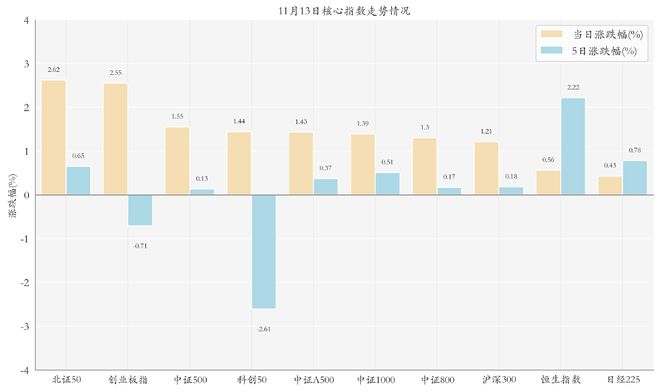
ETF Industry News - The three major indices collectively rose, with battery ETFs leading the gains. The Shanghai Composite Index increased by 0.73%, the Shenzhen Component Index rose by 1.78%, and the ChiNext Index surged by 2.55%. Notably, the battery ETFs such as Invesco Battery ETF (159757.SZ) rose by 7.30%, while the other battery ETFs (159755.SZ and 159840.SZ) increased by 7.14% and 6.94% respectively [1][3][9]. Market Overview - The total number of ETFs has reached 31.7 billion shares, with a total scale of 5.74 trillion yuan and over 1,300 products available. The market is diversifying, expanding from traditional stock ETFs to include bonds, commodities, currencies, and REITs. New ETFs focusing on emerging sectors like carbon neutrality, metaverse, and artificial intelligence have been launched [2][3]. Sector Performance - In today's market, the power equipment, non-ferrous metals, and comprehensive sectors performed well, with daily increases of 4.31%, 4.01%, and 3.3% respectively. Conversely, the public utilities, communication, and oil and petrochemical sectors saw declines of -0.27%, -0.21%, and -0.12% [5]. ETF Performance - Among various ETF categories, the stock-themed ETFs showed the best performance with an average increase of 1.55%, while bond ETFs had the worst performance with an average change of 0.00% [7]. The top-performing ETFs included battery ETFs, with significant daily gains [10]. Trading Volume - The top three ETFs by trading volume today were the A500 ETF Fund (512050.SH) with a trading volume of 5.184 billion yuan, the CSI A500 ETF (159338.SZ) at 5.062 billion yuan, and the ChiNext ETF (159915.SZ) at 5.045 billion yuan [12][14].
南向资金累计净买入突破5万亿港元,港股科技ETF天弘(159128)今日上市交易,一键布局港股“估值修复+成长溢价”的慢牛行情
Mei Ri Jing Ji Xin Wen· 2025-11-13 06:34
Group 1 - The core viewpoint is that despite recent fluctuations in the Hong Kong stock market, significant capital inflow is occurring, particularly from southbound funds, indicating a strategic interest in undervalued assets [1][2] - As of November 10, the cumulative net inflow of southbound funds since the launch of the Hong Kong Stock Connect has exceeded 50 billion HKD, marking a record high since the mechanism's inception [1] - The newly listed Hong Kong Technology ETF Tianhong (159128) provides investors with a favorable opportunity to invest in the technology sector, showing resilience and recovery potential in the performance of major tech companies [1] Group 2 - Analysts suggest that the continuous record-breaking net purchases of Hong Kong stocks by southbound funds signify a transformation in market liquidity and activity, highlighting a strategic demand for undervalued assets [2] - The Hong Kong market is expected to maintain a "valuation repair + growth premium" slow bull market trend, supported by policy backing, industrial upgrades, and global liquidity easing [2] - Investors without a Hong Kong Stock Connect account can access core Chinese AI assets through the Hong Kong Technology ETF Tianhong (159128) [2]
大盘全线上涨,A500ETF易方达(159361)、沪深300ETF易方达(510310)等助力布局A股核心资产
Sou Hu Cai Jing· 2025-11-13 05:09
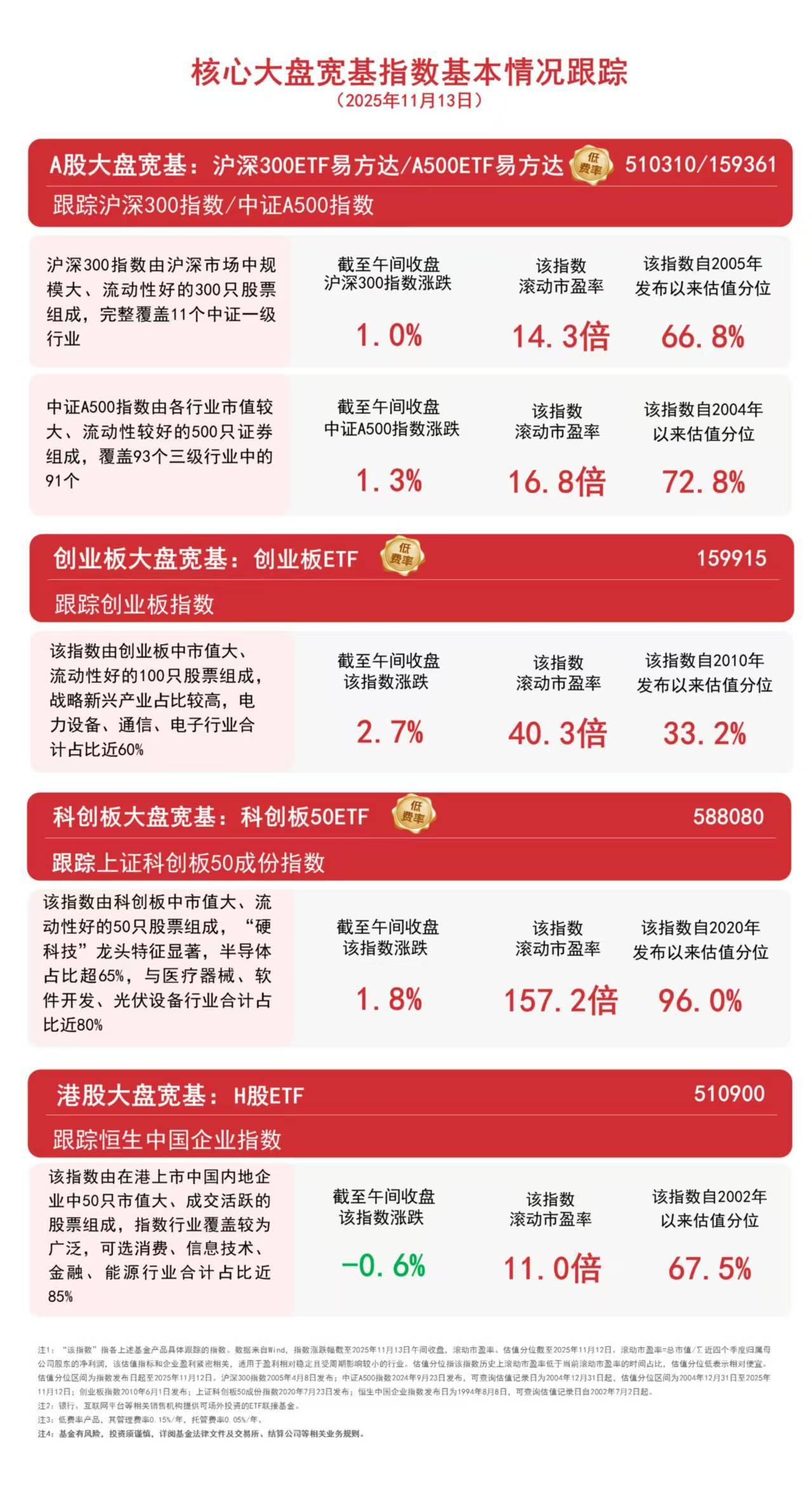
Market Overview - A-shares experienced a collective rise in the three major indices, with a total market turnover of 12,733 billion, showing a slight increase compared to the previous day, and over 3,800 stocks rising [1] - The leading sectors included battery supply chain, non-ferrous metals, chemicals, photovoltaic equipment, and storage chips, while banking, transportation, traditional Chinese medicine, insurance, gas, and retail sectors lagged behind [1] Index Performance - The CSI 300 Index rose by 1.0% to a rolling P/E ratio of 14.3 times [3] - The CSI A500 Index increased by 1.3%, with a rolling P/E ratio of 16.8 times [3] - The ChiNext Index surged by 2.7%, and the STAR Market 50 Index rose by 1.8% [1] - The Hang Seng China Enterprises Index fell by 0.6% [1] Sector Analysis - The H-share ETF tracks the Hang Seng China Enterprises Index, which consists of 50 large-cap, actively traded stocks from mainland China listed in Hong Kong, covering nearly 85% of the consumer discretionary, information technology, financial, and energy sectors [6]
一键配置AI+智能车+创新药!港股科技ETF天弘(159128)今日重磅上市,可T+0交易,不受QDII额度限制
Ge Long Hui· 2025-11-13 01:28
Core Viewpoint - The Hong Kong stock market is experiencing a strong rebound in the innovative drug sector, following a significant surge in Xpeng's stock, with the launch of the Hong Kong Technology ETF Tianhong (159128) that focuses on AI, smart vehicles, and innovative drugs [1] Group 1: ETF Launch and Composition - The Hong Kong Technology ETF Tianhong (159128) tracks the Guozheng Hong Kong Stock Connect Technology Index, which focuses on the top 30 core technology assets in Hong Kong [1] - The top ten constituent stocks of the index account for over 75% of its total weight, with a focus on cutting-edge fields such as AI, smart vehicles, and innovative drugs [1] - Compared to the Hang Seng Technology Index, the Guozheng Hong Kong Stock Connect Technology Index has a higher allocation to innovative drugs, and compared to the Hong Kong Internet Index, it has a higher allocation to smart vehicles and biomedicine [1] Group 2: Performance Metrics - As of November 11, the Guozheng Hong Kong Stock Connect Technology Index has increased by 44.83% year-to-date, outperforming the Hong Kong Internet Index and Hang Seng Technology Index, which rose by 39.34% and 32.59% respectively [1] - The annualized return since 2020 for the Guozheng Hong Kong Stock Connect Technology Index is 11.7%, also exceeding the returns of the Hang Seng Technology and Hong Kong Internet indices [1] Group 3: Market Dynamics - The fundamentals of Hong Kong technology giants are showing resilience and recovery momentum, with increasing AI penetration and a recovering domestic economy expected to drive quarterly earnings growth for constituent stocks [1] - There has been a continuous inflow of southbound funds, with a net inflow exceeding 50 billion HKD this year, marking a historical high [1] - The recent weak ADP data has increased the probability of a Federal Reserve rate cut in December, which may further influence market dynamics [1] Group 4: Valuation Metrics - As of November 11, the PE valuation of the Guozheng Hong Kong Stock Connect Technology Index is at the 36th percentile of the past five years, indicating a high safety margin and significant investment value [2] - The Hong Kong Technology ETF Tianhong (159128) has substantial elastic space, with all constituent stocks being eligible for the Shanghai-Hong Kong Stock Connect, thus not subject to QDII quota restrictions and allowing T+0 trading [2]
ETF午间收盘:标普生物科技ETF涨3.87% 科创新能源ETF跌5.91%
Shang Hai Zheng Quan Bao· 2025-11-12 06:44
Core Viewpoint - The performance of various ETFs shows a mixed trend, with biotechnology ETFs experiencing gains while renewable energy ETFs face declines [1] Group 1: Biotechnology ETFs - The S&P Biotechnology ETF (159502) increased by 3.87% [1] - The Hong Kong Stock Connect Innovative Drug ETF (159217) rose by 2.94% [1] - The NASDAQ Biotechnology ETF (513290) saw a gain of 2.86% [1] Group 2: Renewable Energy ETFs - The Sci-Tech Innovation New Energy ETF (588830) decreased by 5.91% [1] - The Photovoltaic ETF Index Fund (159618) fell by 5.82% [1] - The Sci-Tech Innovation Board New Energy ETF (588960) dropped by 5.68% [1]
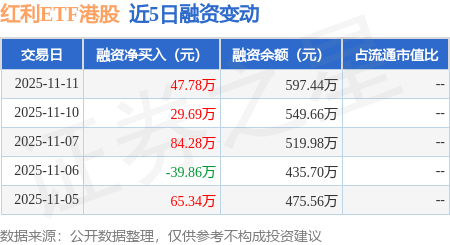
红利ETF港股:11月11日融资净买入47.78万元,连续3日累计净买入161.75万元
Sou Hu Cai Jing· 2025-11-12 02:28
证券之星消息,11月11日,红利ETF港股(520900)融资买入349.05万元,融资偿还301.27万元,融资 净买入47.78万元,融资余额597.44万元,近3个交易日已连续净买入累计161.75万元,近20个交易日中 有11个交易日出现融资净买入。 | 交易日 | 融资净买入(元) | 融资余额(元) | 占流通市值比 | | --- | --- | --- | --- | | 2025-11-11 | 47.78万 | 597.44万 | | | 2025-11-10 | 29.69万 | 549.66万 | | | 2025-11-07 | 84.28万 | 519.98万 | | | 2025-11-06 | -39.86万 | 435.70万 | | | 2025-11-05 | 65.34万 | 475.56万 | | 小知识 融资融券:目前,个人投资者参与融资融券主要需要具备2个条件:1、从事证券交易至少6个月;2、账 户资产满足前20个交易日日均资产50万。融资融券标的:上交所将主板标的股票数量由现有的800只扩 大到1000只,深交所将注册制股票以外的标的股票数量由现有的800只扩大 ...