
证券

Search documents
复旦张江:更换持续督导保荐代表人
Zheng Quan Ri Bao· 2026-02-09 12:19
Core Viewpoint - Fudan Zhangjiang announced the appointment of new representatives for the ongoing supervision of its initial public offering (IPO) project on the Sci-Tech Innovation Board, following a change in personnel at the sponsoring institution, Guotai Junan Securities [1] Group 1: Project Details - The IPO project is sponsored by Guotai Junan Securities, with a legal supervision period from June 19, 2020, to December 31, 2023 [1] - The company has not yet fully utilized the raised funds, necessitating continued supervision by Guotai Junan [1] Group 2: Personnel Changes - Zheng Qiangguo, one of the original supervising representatives, will no longer serve due to a job change [1] - Li Qinhang has been appointed to replace Zheng Qiangguo as a supervising representative, alongside Chen Hengrui [1]

三大交易所,官宣!
Zhong Guo Ji Jin Bao· 2026-02-09 12:12
深交所表示,一是加大对优质上市公司支持力度;二是提高对科技创新企业的包容性、适应性;三是着力提升再融资机制灵活性、便利性;四是加强再融 资全链条监管。 2月9日,沪深北交易所相继宣布推出优化再融资一揽子措施。 进一步提高再融资便利性和灵活性 具体举措上,上交所表示,一是进一步支持优质上市公司创新发展;二是更好适应科技创新企业再融资需求;三是提升再融资灵活性、便利度;四是加强 再融资全过程监管。 上交所提到,对经营治理、信息披露规范,具有代表性与市场认可度的优质上市公司,优化再融资审核,进一步提高再融资效率。研究推出交易所主板上 市公司"轻资产、高研发投入"认定标准。优化再融资间隔期要求,按照未盈利标准上市且尚未盈利的科技型上市公司再融资,前次募集资金基本使用完毕 或未改变募集资金投向的,前次募集资金到位日6个月后,可以启动再融资预案公告等程序。存在破发情形的上市公司,可以通过竞价定增、发行可转债 等方式合理融资,募集资金需投向主营业务。 北交所表示,一是大力支持优质上市公司再融资;二是提高对创新型中小企业再融资的制度包容性;三是提高再融资制度便利性;四是强化再融资全链条 监管。 北交所提到,对经营治理、信息披 ...

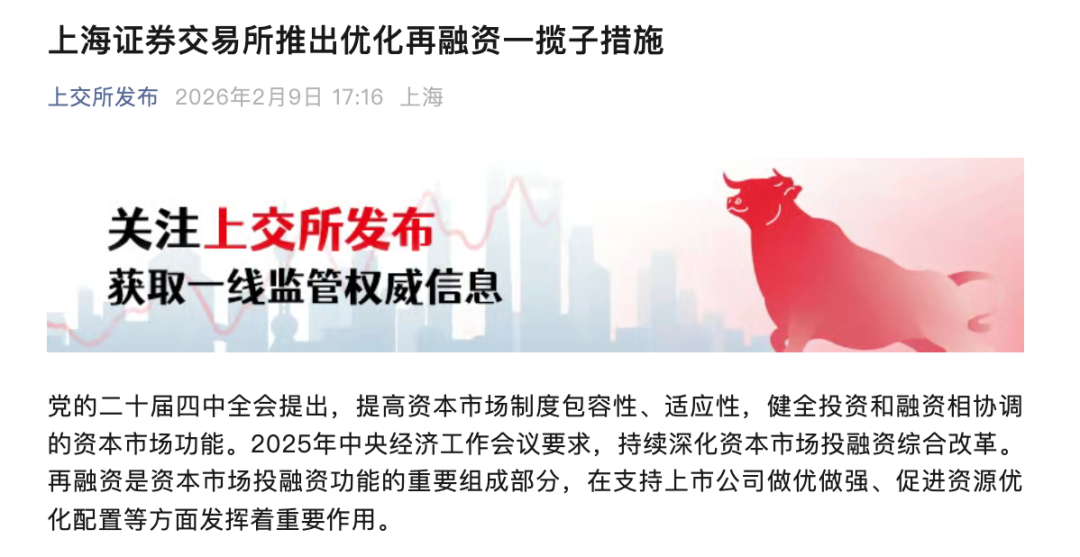
北交所:严防将募集资金盲目跨界投资、多元化投资
Bei Ke Cai Jing· 2026-02-09 11:52
新京报贝壳财经讯 2月9日,北京证券交易所推出优化再融资一揽子措施。其中提出,大力支持优质上 市公司再融资。对经营治理、信息披露规范,具有代表性与市场认可度的优质上市公司,优化再融资审 核,进一步提高再融资效率。过程中,将坚持优中选优、宁缺毋滥。支持优质上市公司将募集资金用于 与主营业务紧密相关或高度协同的新产业、新业态、新技术领域,投向第二增长曲线业务,同时严防盲 目跨界投资、多元化投资。 ...
流动性&交易拥挤度&投资者温度计周报:公募基金仍为当前市场主要增量资金-20260209
Huachuang Securities· 2026-02-09 11:46
Group 1: Liquidity - The issuance of equity public funds has decreased to 8.42 billion units, down from 32.79 billion units, but remains at a historically high level[8] - The net outflow of margin financing has increased to 52.1 billion CNY, marking a 2% percentile over the past three years[13] - The net inflow of southbound funds has surged to 49.83 billion CNY, reaching a historical high and representing a 96% percentile[40] Group 2: Trading Congestion - The trading heat for the non-ferrous metals sector has increased by 17 percentage points to 49%[46] - The trading heat for the liquor sector has risen by 10 percentage points to 15%[53] - The trading heat for the communication sector has also increased by 10 percentage points to 47%[66] - The trading heat for the home appliance sector has decreased by 12 percentage points to 47%[53] Group 3: Investor Sentiment - The net inflow of retail investor funds in the A-share market was 162.44 billion CNY, a decrease of 54.4 billion CNY from the previous value, placing it at the 87.4% percentile over the past five years[2] - The Shanghai Composite Index fell by 2.5% on February 2, leading to an increase in self-media search interest in A-shares[73]
华泰证券完成发行40亿元公司债券
Zhi Tong Cai Jing· 2026-02-09 11:46
华泰证券(06886)公布,华泰证券股份有限公司2026年面向专业投资者公开发行公司债券(第一期)发行工 作已于2026年2月9日结束。本期债券最终品种一发行规模为40亿元,票面利率为1.85%,认购倍数为 2.96倍;品种二未实际发行。 ...

港股IPO新观察:布局“新周期”的中资投行
Sou Hu Cai Jing· 2026-02-09 11:43
Group 1 - The Hong Kong IPO market is undergoing a significant structural adjustment due to increased global capital market volatility and macroeconomic influences, with a clear trend towards "value-driven" transformation in the market [2] - Despite the overall market pressure, sectors such as biotechnology, high-end manufacturing, and new consumption are showing resilience, indicating active listing activity [2][4] - The total amount raised from IPOs in Hong Kong is projected to exceed HKD 280 billion in 2025, with a 251% increase in equity financing scale, and over 300 companies currently in the IPO queue [2] Group 2 - The valuation system in the Hong Kong market is undergoing correction, with a rational return to pricing for previously high-growth but unprofitable companies, leading to a more prudent valuation management before IPO submissions [5][6] - The Hong Kong Stock Exchange's listing system reforms since 2018 continue to provide structural support, particularly benefiting companies in AI, advanced hardware, and green technology [6] - The normalization of the China Securities Regulatory Commission's overseas listing filing management provides clearer compliance expectations for companies, enhancing Hong Kong's attractiveness as an international financing center for new economy enterprises [6] Group 3 - Investment banks are shifting from a channel-based model focused on relationships and execution speed to a comprehensive service model centered on value discovery, shaping, and realization [6][8] - Industry specialization is becoming a core competitive advantage for investment banks, requiring teams to deeply understand the technical barriers, business models, and market positions of companies [7] - The demand for integrated capital service capabilities, including private financing, IPO guidance, and post-listing research support, is increasing among clients [8] Group 4 - In a buyer's market, the strength of an investment bank's sales network is crucial for the success of an IPO, necessitating a broad coverage of international long-term funds and the ability to engage with investors who understand long-term value [9] - The ongoing deepening of the interconnection between mainland and Hong Kong capital markets reinforces Hong Kong's position as a "pricing center for Chinese assets" and a "bridgehead for international capital investing in China" [9][10] - The long-term strategic value of the market remains intact despite short-term fluctuations, emphasizing the importance for companies to solidify their business foundations and choose partners that understand their value [10]
华泰证券(06886)完成发行40亿元公司债券
智通财经网· 2026-02-09 11:42
智通财经APP讯,华泰证券(06886)公布,华泰证券股份有限公司 2026 年面向专业投资者公开发行公司 债券(第一期)发行工作已于 2026 年 2 月 9 日结束。本期债券最终品种一发行规模为 40 亿元,票面利率 为 1.85%,认购倍数为 2.96 倍;品种二未实际发行。 ...
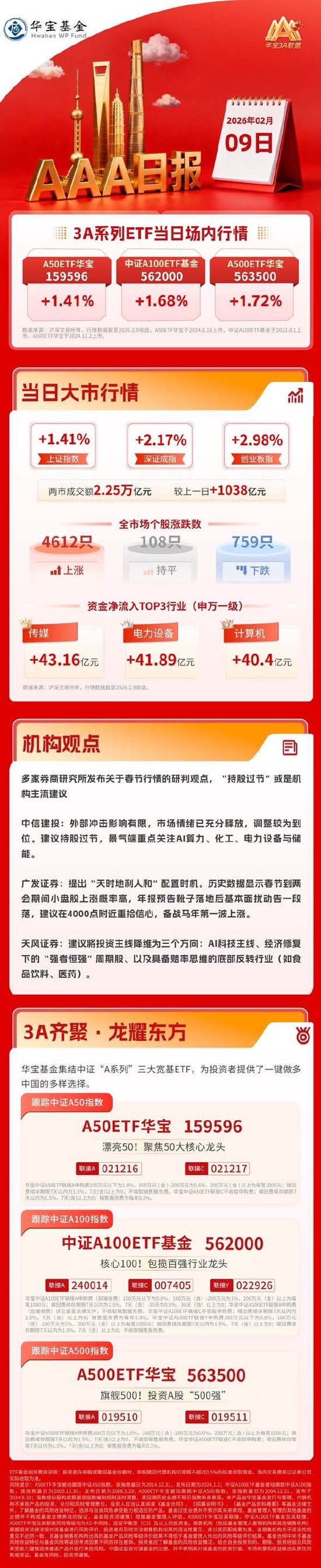
创业板指大涨近3%,多家机构建议“持股过节” | 华宝3A日报(2026.2.9)
Xin Lang Cai Jing· 2026-02-09 11:39
Core Viewpoint - The article discusses the performance of various ETFs and market sentiment leading up to the Chinese New Year, highlighting investment strategies and sector focus for the upcoming period [2][6][7]. Market Performance - The A50ETF, A100ETF, and A500ETF showed positive daily returns of +1.68%, +1.72%, and +1.41% respectively [6]. - The overall market saw a trading volume of 2.25 trillion yuan, an increase of 103.8 billion yuan from the previous day [6]. Institutional Insights - Multiple brokerage firms recommend "holding stocks over the holiday," indicating a positive market sentiment despite external shocks being deemed limited [2][6]. - CITIC Securities suggests focusing on sectors such as AI computing power, chemicals, electric equipment, and energy storage [2][6]. - GF Securities emphasizes the historical trend of small-cap stocks performing well from the Spring Festival to the Two Sessions, advising investors to regain confidence around the 4000-point mark [7]. - Tianfeng Securities recommends three main investment themes: AI technology, strong cyclical stocks under economic recovery, and industries with potential for bottom reversal such as food and beverage and pharmaceuticals [7]. ETF Offerings - Huabao Fund has launched three major broad-based ETFs tracking the China A50, A100, and A500 indices, providing investors with diverse options to invest in Chinese equities [8]. - The A50ETF focuses on the top 50 core leading companies, while the A100ETF encompasses the top 100 industry leaders, and the A500ETF targets the top 500 companies in the A-share market [8].

四季度主动权益基金主动加仓前四大行业:金属、化学品、保险和机械设备
Changjiang Securities· 2026-02-09 11:38
[Table_Title] 四季度主动权益基金主动加仓前四大行业: 金属、化学品、保险和机械设备 金融工程丨深度报告 %% %% %% %% research.95579.com 1 丨证券研究报告丨 报告要点 [Table_Summary] 与 2025 年三季报相比,2025 年四季度主动权益基金增持最多的四个行业为电信业务(1.90 pct)、金属材料及矿业(1.90pct)、化学品(1.10 pct)和保险(0.94 pct)。从主动调仓角度来 看,主动加仓最多的四个行业分别是金属材料及矿业(0.99 pct)、化学品(0.86 pct)、保险(0.77 pct)和机械设备(0.59 pct)。剔除行业主题基金影响后,主动加仓最多的四个行业分别是保险 (1.03pct)、金属材料及矿业(0.90pct)、化学品(0.86pct)和机械设备(0.62pct)。 分析师及联系人 [Table_Author] 覃川桃 杨凯杰 SAC:S0490513030001 SAC:S0490525080004 SFC:BUT353 请阅读最后评级说明和重要声明 2 / 31 %% %% %% %% research. ...
股票行情快报:中银证券(601696)2月9日主力资金净卖出4936.45万元
Sou Hu Cai Jing· 2026-02-09 11:34
中银证券2025年三季报显示,前三季度公司主营收入24.38亿元,同比上升26.95%;归母净利润8.54亿 元,同比上升29.28%;扣非净利润8.18亿元,同比上升35.05%;其中2025年第三季度,公司单季度主营 收入9.33亿元,同比上升38.33%;单季度归母净利润2.89亿元,同比上升22.37%;单季度扣非净利润 2.89亿元,同比上升57.23%;负债率79.44%,投资收益2.76亿元。中银证券(601696)主营业务:公司 根据业务类型将公司业务划分成投资银行业务、证券经纪业务、资产管理业务、证券自营业务、私募股 权投资业务、期货业务和其他业务。其中,公司通过全资子公司中银国际期货从事期货业务,通过全资子 公司中银国际投资从事私募投资基金业务,通过全资子公司中银资本投控从事另类投资业务(中银资本投 控尚未开展业务,中银国际投资的自有资金投资存量项目后续将逐步划转至中银资本投控)。 资金流向名词解释:指通过价格变化反推资金流向。股价处于上升状态时主动性买单形成的成交额是推 动股价上涨的力量,这部分成交额被定义为资金流入,股价处于下跌状态时主动性卖单产生的的成交额 是推动股价下跌的力量,这部 ...

