
旅游业

Search documents
寒潮影响持续 多部门积极应对
Xin Hua She· 2025-11-17 16:53
Core Viewpoint - The article discusses the impact of a nationwide cold wave and strong winds on various sectors, including agriculture, transportation, energy, and market supply, highlighting the measures taken by relevant departments to address these challenges [1][2][3]. Energy Supply and Demand - The cold wave is expected to increase energy demand, with daily gas consumption reaching 1.18 billion cubic meters and peak electricity load at 1.13 billion kilowatts, although still below peak winter levels [3][4]. - National energy supply remains sufficient, with coal reserves at 230 million tons, enough for 35 days, and gas storage at high levels to ensure stable operations [3][4]. Market Supply of Essential Goods - The Ministry of Commerce is focused on ensuring stable supply of essential goods during the cold wave, enhancing market monitoring and increasing the organization of goods to meet basic consumer needs [5][6]. - Prices for vegetables and fruits have risen by 1.7% and 1.9% respectively since the beginning of the month, while pork prices have decreased by 1.4%, indicating a mixed market response [6]. Agricultural Impact - The cold wave poses risks to agricultural production, particularly for facilities and crops, with warnings issued for snow and frost damage [7]. - The Ministry of Agriculture is coordinating with meteorological authorities to prepare for adverse weather effects, advising on crop management and facility protection [7]. Transportation and Logistics - The Ministry of Transport is implementing measures to ensure road and waterway safety during the cold wave, enhancing monitoring and response capabilities for extreme weather conditions [8]. - Specific focus is on maintaining traffic flow on critical routes and ensuring the safety of vessels during adverse weather [8]. Public Health Recommendations - The cold wave is expected to increase flu risks in several regions, prompting health officials to recommend reduced outdoor activities and increased indoor ventilation [9]. - Vulnerable populations, including the elderly and children, are advised to take precautions against cold-related health issues [9].
赴日游降温 谁会是平替
Bei Jing Shang Bao· 2025-11-17 16:40
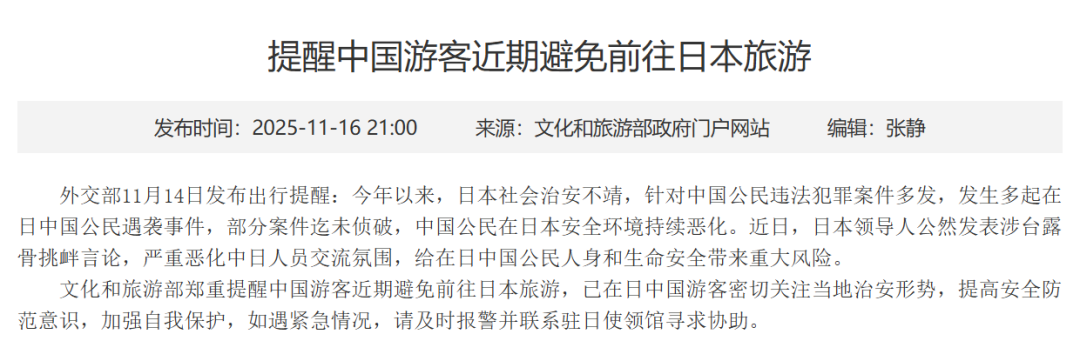
Core Viewpoint - The Chinese Ministry of Culture and Tourism has advised tourists to avoid traveling to Japan, leading to a decline in the Japan travel market and an increase in inquiries about cancellations from travelers [1][3][4]. Travel Market Impact - Following the advisory, travel agencies reported a rise in cancellation inquiries, with some travelers changing their destinations from Japan to safer alternatives like Southeast Asia and domestic locations [3][5]. - The travel market is expected to take time to adjust, with potential changes in travel patterns during the New Year and Spring Festival periods [5][6]. Airline and Travel Agency Responses - Major airlines, including Air China and China Eastern Airlines, have announced special handling policies for tickets to Japan, allowing free cancellations for eligible travelers [3][4]. - Travel agencies are actively managing cancellations and are in communication with local service providers to facilitate changes for affected customers [4][6]. Shifts in Tourist Preferences - Many travelers are redirecting their plans to destinations perceived as safer and more stable, such as Singapore, the UAE, and various domestic locations [5][6]. - The demand for winter island vacations and other themed travel products is expected to increase as agencies adapt to the changing market [7]. Economic Impact on Japan - The Japanese stock market reacted negatively to the travel advisory, with the Nikkei 225 index dropping over 1% and tourism-related stocks experiencing significant declines [4].


【财经分析】激活“秦文化IP” 古都咸阳书写非遗经济新篇章
Xin Hua Cai Jing· 2025-11-17 15:50
新华财经西安11月17日电(记者张天源李亭吕昂)当千年技艺遇上重点产业链,会迸发出怎样的发展动 能?咸阳以"文化IP"为笔,在"保护"与"发展"的双重命题下,书写了一份非遗经济创新发展的高质量答 卷。 咸阳市位于陕西省关中平原中部,是秦文化核心区。近年来,当地深挖人文资源提升区域知名度、辨识 度,强化文商旅多业态跨界融合,推动文旅产业快速发展。据咸阳市文化和旅游局统计,2025年1-9月 全市累计接待国内游客9084.6万人次,同比增长5.6%,接待国内游客总花费618.78亿元,同比增长 7.17%。 挖掘独有文化打造特色IP 文化产业和旅游产业密不可分。近年来,随着国内旅游市场逐步提档升级,如何挖掘地区独有文化IP, 成为各地文旅产业差异化竞争的重点。 作为秦朝建都之地,咸阳拥有秦咸阳城遗址、汉阳陵等国家级文化地标,以及茯茶制作、弦板腔、旬邑 彩贴剪纸等600多项非遗资源。咸阳以秦文化为魂,以非遗活化为脉,在"守正"与"创新"的双重命题 下,探索了一条文化遗产带动文旅产业高质量发展的新路径。 "咸阳打造文旅IP的核心是'秦文化+'战略。"咸阳市文旅局相关负责人介绍,近年来,当地以"秦文化"为 核心,辅以" ...
内外需不振 日本经济再现负增长
Bei Jing Shang Bao· 2025-11-17 15:17
内外需同时"哑火",日本经济在年末拉响警报。受美国关税政策的影响逐步显现,今年第三季度日本国内生产总值(GDP)实际按年率计算下降1.8%,这是 日本经济在六个季度中首次呈现负增长态势。外需急剧收缩是此轮负增长的核心推手,但还面临着内需疲软局面,叠加近期新任首相高市早苗表态引起政治 波动,本就步履维艰的日本经济陷入三重困局。 外需收缩、内需疲软 日本内阁府17日发布的初步统计结果显示,日本三季度实际国内生产总值(GDP),剔除物价变动因素后的实际GDP较上季度减少0.4%,按年率计算下降 1.8%。这是自2024年第一季度以来,日本季度GDP增速首次呈现负增长。 具体数据显示,三季度,日本个人消费环比增幅仅为0.1%;在进出口方面,三季度日本出口增速下降1.2%,进口增速下降0.1%。此外住房投资继续疲软, 与二季度相比下降9.4%。 旅游经济冲击 日本内需不振的态势已趋于长期化。日本内阁府近期将2025财年经济增长预期从1.2%下调至0.7%,显示出对经济前景的深度忧虑。而高市早苗近期的言 论,更令日本经济雪上加霜。 高市早苗7日在国会答辩时就"台湾有事"表示,如果伴随出动军舰和使用武力,可能会构成"存亡危 ...

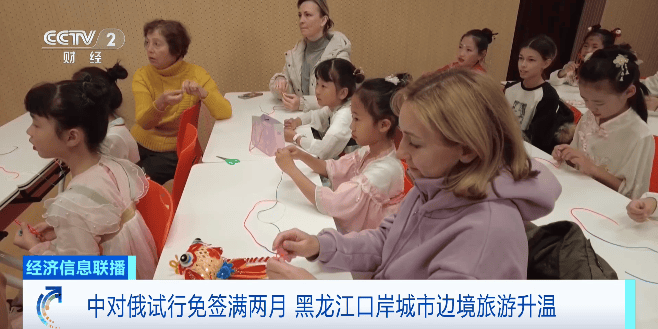
“边境风情+文化体验”吸引外国游客,黑龙江口岸城市边境游升温
Sou Hu Cai Jing· 2025-11-17 15:00
Group 1 - The implementation of the visa-free policy between China and Russia has led to a significant increase in the number of Russian tourists entering China, particularly through the Suifenhe port [1][5] - Since the visa-free policy was enacted, 15 groups of Russian students have entered through the Suifenhe port, totaling over 1,000 students, indicating a growing interest in cross-border educational experiences [5] - The city of Heihe has developed customized health and wellness travel routes that combine traditional Chinese medicine and shopping, shifting the focus of cross-border tourism from mere sightseeing to health and wellness vacations [5][7] Group 2 - The hospitality and service industries in Heihe are adapting to the influx of Russian tourists by enhancing their offerings, such as adjusting breakfast menus to include items favored by Russian guests, like freshly brewed coffee [9] - Local businesses, including restaurants and supermarkets, are actively improving service details to create a more convenient and welcoming experience for Russian visitors [7]
日本突发!集体跳水!
Sou Hu Cai Jing· 2025-11-17 14:14
Market Overview - The Tokyo stock market indices continued to decline on November 17, with the Nikkei 225 index closing down 0.10% and the Tokyo Stock Exchange index down 0.37% [1][2] - The Nikkei index fell by 52.62 points to close at 50,323.91 points, while the Tokyo Stock Exchange index dropped by 12.28 points to 3,347.53 points [2] Economic Indicators - Japan's GDP for the third quarter of this year decreased by 1.8% on an annualized basis, marking the first negative growth in six quarters [7] - The GDP decline was attributed to external demand, which reduced GDP by 0.2 percentage points, and a significant drop in housing investment by 9.4% compared to the previous quarter [7] Sector Performance - Tourism-related stocks, including department stores and transportation, experienced widespread declines due to concerns over deteriorating China-Japan relations affecting tourist numbers [1] - Notable declines included: - Mitsukoshi Isetan Holdings down 11.31% - Takashimaya down 6.18% - Shiseido down 9% - Oriental Land Company, operator of Tokyo Disneyland, down 5.68% [1][4] Trade Relations - China remains Japan's largest trading partner, with a projected trade total of $308.3 billion in 2024, including $156.25 billion in imports from China [6] - A significant reduction in Chinese tourists to Japan could lead to an estimated economic loss of 2.2 trillion yen, approximately 101.16 billion yuan [5]

焦点访谈 | 如何让春秋假兼顾温度与实效?各地多元探索新可能
Yang Shi Wang· 2025-11-17 13:31
Core Viewpoint - The introduction of spring and autumn breaks in primary and secondary schools across various provinces in China aims to enhance family bonding, provide students with a much-needed respite from their studies, and stimulate the tourism and educational sectors [1][5][9]. Group 1: Implementation and Structure - Spring and autumn breaks have been implemented in provinces such as Hubei, Guangdong, and Zhejiang, with Sichuan recently announcing a comprehensive rollout of a 3-day break for each season [3][5]. - The policy in Sichuan allows schools to adjust the timing of breaks based on local conditions, provided they consult with parents and report to the education bureau [3][5]. Group 2: Educational and Social Considerations - The rationale behind spring and autumn breaks includes addressing the accelerated learning pace of students and providing them with opportunities to recharge, akin to a breather during a long-distance run [5]. - These breaks also create valuable time for parent-child interactions, as traditional long holidays often coincide with peak travel times, making experiences less enjoyable due to overcrowding [7][9]. Group 3: Economic Impact - The establishment of spring and autumn breaks is seen as a new driver for social consumption, with government initiatives encouraging localities to explore this option to boost service consumption [7][9]. - Following the announcement of autumn breaks in Sichuan, there was a reported 32% increase in the browsing of leisure products and a 39% increase in bookings compared to the previous year [9]. Group 4: Challenges and Solutions - A significant concern is the mismatch between student holidays and parental work schedules, leading to difficulties in family bonding during these breaks [10][12]. - Various regions are addressing this issue through school-based care programs, study camps, and collective outings, with cities like Hangzhou establishing numerous care points for students during the autumn break [12][14]. - Rural areas face challenges such as a lack of care facilities and resources, leading to a higher proportion of children being left unsupervised during breaks [19][22]. Group 5: Future Considerations - Experts suggest that successful implementation of spring and autumn breaks requires collaboration among schools, families, and communities, as well as the establishment of paid leave policies to align parental and student schedules [22][24]. - The broader significance of these breaks extends beyond mere time off; they represent a shift in educational philosophy, emphasizing learning experiences outside the classroom and addressing the needs of working families and left-behind children [24].

日本汽车、家电边缘化,这些产业仰仗中国
Di Yi Cai Jing· 2025-11-17 13:30
Group 1: Japanese Automotive Industry in China - Japanese automotive brands are experiencing a decline in competitiveness in the Chinese market, with potential further market share shrinkage if the Japanese government does not correct its course [1][3] - The market share of Japanese automakers in China has dropped to 11.2% in 2024, a decrease of 3.2 percentage points from 2023, with major companies like Toyota, Honda, and Nissan facing significant sales declines [3] - Toyota's sales in China for 2024 are projected at 1.776 million units, down 6.9%, while Honda's sales have plummeted by 30.9% to approximately 852,000 units, marking the lowest level since 2014 [3] Group 2: Impact of Political Relations - The deterioration of Sino-Japanese political relations, influenced by provocative statements from Japanese politicians, is expected to adversely affect Japanese industries reliant on the Chinese market, including automotive, alcohol, and tourism [1][8] - Analysts suggest that if political tensions continue, Japanese automotive exports and local sales in China will be significantly impacted [3][4] Group 3: Japanese Consumer Goods and Retail - Japanese retail and consumer goods companies are seeing stock price declines due to their reliance on Chinese consumers, with Shiseido's stock dropping by 11% following political tensions [1] - The import of Japanese household appliances to China has been decreasing, with a drop from $1.016 billion in 2022 to an estimated $708 million in 2024 [5] Group 4: Japanese Alcohol and Tourism - Japan's whiskey imports to China have shown significant growth, with a 41.9% increase in import value in the first eight months of 2025, amounting to $2.436 million [6] - Chinese tourists are a major consumer of Japanese sake, with exports to China growing by 495.9% over the past decade, making China the largest export market for Japanese sake [7] Group 5: Economic Impact of Reduced Tourism - A significant reduction in Chinese tourists visiting Japan could lead to a 0.36% decrease in Japan's GDP, equating to an estimated economic loss of 2.2 trillion yen (approximately 101.16 billion yuan) [9]


日本游“凉了”?旅行社回应退订咨询激增!多家航司称机票免费退改
Bei Jing Shang Bao· 2025-11-17 13:25
Group 1 - The Chinese Ministry of Culture and Tourism has issued a warning for tourists to avoid traveling to Japan, leading to a decline in the Japan travel market [2][3][5] - There has been an increase in inquiries about cancellations from tourists who had planned trips to Japan, with some changing their travel destinations [2][5] - Major airlines have announced special handling policies for tickets to Japan, allowing free cancellations for flights before December 31 under certain conditions [5] Group 2 - Tourists are shifting their focus to safer and more certain destinations such as Southeast Asia and the UAE, as well as domestic locations suitable for family travel [6][8] - Travel agencies are preparing alternative travel products to cater to the changing preferences of tourists, especially for the upcoming New Year and Spring Festival [6][8] - The demand for winter island tours and other themed travel products is expected to increase as travel agencies adapt to market changes [8] Group 3 - The Japanese stock market has reacted negatively, with the Nikkei 225 index dropping over 1% on November 17, particularly affecting tourism-related stocks [5] - The travel market is expected to take time to adjust, with potential impacts on the Japan travel market during the peak travel season from New Year to Spring Festival [6][7] - Tourists are advised to pay attention to cancellation policies for flights and hotels, especially during the busy travel periods [9]
凯撒旅业:11月17日召开董事会会议
Mei Ri Jing Ji Xin Wen· 2025-11-17 12:37
Core Viewpoint - Caesar Travel Industry announced the convening of its 11th Board of Directors meeting on November 17, 2025, to discuss the proposal for establishing an internal control system [1] Financial Performance - For the first half of 2025, the revenue composition of Caesar Travel Industry is as follows: catering business accounts for 45.89%, tourism services for 40.56%, food and beverage for 8.35%, and destination services for 5.2% [1] - As of the report date, the market capitalization of Caesar Travel Industry is 13.1 billion yuan [1]
