
数据中心

Search documents
公用事业AI带动数据中心景气向上,电力需求有多少?
Tianfeng Securities· 2025-09-08 02:49
Industry Rating - The report maintains an "Outperform" rating for the public utility sector [1] Core Insights - The data center industry in China is expected to reach a market size of 304.8 billion yuan and over 10 million standard racks by 2024, both achieving a year-on-year growth of over 20% [2][25] - The emergence of AI technologies, particularly large models, is driving significant demand for computing power, which is expected to enhance the growth of data centers [3][65] - The increasing electricity demand from data centers is projected to lead to a transformation towards greener computing solutions [4][111] Summary by Sections 1. Progress of China's Data Center Industry - The development of China's data center industry has evolved through four stages, with computing power becoming the driving force in the digital economy since 2020 [9][18] - The market is characterized by a significant regional distribution, with the "East Data West Computing" initiative promoting a balanced development across eight hubs and ten clusters [32][38] 2. AI's Impact on Data Center Demand - The launch of DeepSeek in January 2025 is expected to significantly increase the rack utilization rate in third-party data centers [3][79] - The average rack utilization rate in China was 56.4% by the end of 2023, indicating a mismatch between supply and demand [56] - The global demand for computing power is projected to grow at a rate exceeding 50% annually, with AI applications driving this growth [65][71] 3. Electricity Demand and Green Transformation - Data centers' electricity costs typically account for over 50% of their total operating costs, with some internet clients seeing this figure rise to 70-80% [95] - The International Energy Agency (IEA) predicts that global data center electricity consumption will double from 415 TWh in 2024 to approximately 945 TWh by 2030, with a compound annual growth rate of about 15% [101] - By 2030, China's data center electricity demand is expected to reach between 300 billion and 700 billion kWh, representing 2.3% to 5.3% of the total electricity consumption [108][109]




科华数据(002335):IDC产品成长性突出,算能协同拓展可期
Shenwan Hongyuan Securities· 2025-09-07 03:44
Investment Rating - The report maintains a "Buy" rating for the company [2][7]. Core Insights - The company reported its 2025 mid-year results, which met expectations, with a revenue of 3.733 billion yuan for H1 2025, essentially flat compared to H1 2024, and a net profit attributable to shareholders of 244 million yuan, reflecting a year-on-year growth of 7.94% [7]. - The data center business is highlighted as the company's core competitive advantage and long-term growth driver, with revenue from data center products reaching 784 million yuan in H1 2025, a year-on-year increase of 34.19% [7]. - The company is actively building a heterogeneous computing power platform in collaboration with domestic AI firms, which is expected to create a second growth curve for its IDC services [7]. - The smart energy and new energy segments are focusing on high-quality development, with smart energy products generating 439 million yuan in revenue for H1 2025, a year-on-year decline of 22.56%, while new energy products generated 1.852 billion yuan, down 4.22% year-on-year [7]. - The company is positioned as a core player in the AI wave, benefiting from its deep understanding of power supply products and long-term partnerships with major firms, which may allow it to capture a unique market position similar to that of Vertiv [7]. - The profit forecast for 2025-2027 has been adjusted, with expected net profits of 682 million yuan, 971 million yuan, and 1.281 billion yuan respectively, reflecting a PE ratio of 42, 29, and 22 for those years [7]. Financial Data and Profit Forecast - Total revenue projections for 2025 are set at 9.369 billion yuan, with a year-on-year growth rate of 20.8% [6]. - The company anticipates a significant increase in net profit for 2025, with a forecasted growth rate of 116.5% compared to the previous year [6]. - The gross margin is expected to improve from 25.2% in 2024 to 26.3% in 2025, indicating enhanced profitability [6].

贵州做优做强数字经济
Jing Ji Ri Bao· 2025-09-07 01:15
Group 1 - Guizhou's digital economy is projected to reach a scale of 254.94 billion yuan in 2024, with a year-on-year growth of 18.3% [1] - The province has established 49 key data centers, achieving a computing power scale of 92.6 EFLOPS, with nearly 97% being intelligent computing [1][2] - Guizhou is becoming a national hub for computing power, with over 60,000 Gbps of outbound bandwidth and the construction of the world's first 400G all-optical network computing channel [2] Group 2 - The integration of digital and real economies is being supported by robust computing resources, with initiatives like "Ten Thousand Enterprises Integration" promoting digital transformation across various industries [2][3] - Guizhou is focusing on the development of intelligent computing, high-quality data sets, and industry-specific AI models to enhance its digital economy [3] - The province has launched 22 major AI model projects, including "Guizhou AI Doctor" and "Guizhou Smart Office," to facilitate intelligent upgrades and digital transformation in key sectors [3]
算力、数据、应用、产业协同联动 贵州做优做强数字经济
Jing Ji Ri Bao· 2025-09-06 22:04
Group 1 - Guizhou's digital industry scale is projected to reach 254.94 billion yuan in 2024, with a year-on-year growth of 18.3% [1] - The province has established 49 key data centers, achieving a computing power scale of 92.6 EFLOPS, with nearly 97% being intelligent computing [1] - Guizhou has become one of the eight national integrated computing network hubs, with outbound bandwidth exceeding 60,000 Gbps and a low-latency network connecting to 42 major cities [1] Group 2 - Guizhou's computing resources are serving over 50 countries and regions, providing cloud rendering computing services to more than 200,000 users [2] - The province is promoting deep integration of the real economy and digital economy, with a 17.3% increase in integration levels compared to the end of the 13th Five-Year Plan [2] - The implementation of automated production lines in companies like Guizhou Yaguang Electronics has led to a 40% increase in production capacity and a 20% reduction in manufacturing costs [2] Group 3 - Guizhou is focusing on 24 key industries to develop nearly 100 typical application scenarios for large models, enhancing industry intelligence and digital transformation [3] - Future development will emphasize intelligent computing, high-quality data sets, industry large models, and digital information industries to strengthen the digital economy [3]
OpenAI的00后“叛徒”正在碾压华尔街“老江湖”
Hu Xiu· 2025-09-06 07:41
Core Insights - A new hedge fund, SALP, founded by 23-year-old Leopold Aschenbrenner, achieved a remarkable 47% return in just six months, significantly outperforming Wall Street averages by 700% [2][20][21] - Aschenbrenner, previously associated with OpenAI, was dismissed for raising concerns about security vulnerabilities, leading him to establish SALP focused entirely on AGI (Artificial General Intelligence) investments [3][12][14] Fund Overview - SALP is characterized as a pure AI-native fund, with 100% of its investments directed towards AI-related opportunities, distinguishing it from traditional funds that diversify across various sectors [4][22] - The fund's assets reportedly exceeded $1.5 billion by 2025, allowing for a concentrated investment strategy in a few high-confidence areas [23][24] Investment Philosophy - SALP operates under a mission-driven philosophy, focusing on AGI and its implications, rather than merely seeking high-growth companies [26][29] - The fund's strategy includes significant investments in AI infrastructure, such as computing power and energy, which are deemed essential for the future of AGI [32][34] Key Investments - SALP's notable investment includes Core Scientific, a cryptocurrency mining company that transitioned to AI computing services, highlighting the fund's ability to identify undervalued assets [3][35] - The fund also holds positions in major chip manufacturers like Broadcom and Intel, as well as energy companies like Vistra, anticipating a surge in demand for power due to AI advancements [35] Future Outlook - Aschenbrenner predicts that AGI could emerge around 2027, with a potential "intelligence explosion" following its realization, which would drastically alter economic and social structures [15][16][29] - The fund's approach is to leverage financial tools for both long and short positions, aiming to profit regardless of market conditions [27][28]



硅谷扛不住了、撬动华尔街 “AI军备竞赛”开始扩散 风险也是!
智通财经网· 2025-09-06 06:02
Group 1 - The core viewpoint of the articles highlights that the AI arms race among tech giants is evolving into a complex financial game, with companies like Amazon, Google, Meta, Microsoft, and Oracle feeling unprecedented financial pressure due to massive capital expenditures [1][2] - Tech giants are shifting from relying solely on internal cash flows for infrastructure development to seeking external capital, leading to innovative financing strategies to manage costs and risks while maintaining healthy financial statements [2][3] Group 2 - Three innovative financial strategies have emerged to externalize risks and costs: joint ventures, syndicated loans, and backstop agreements [3] - Meta's strategy involves a joint venture for its Hyperion data center project, raising $29 billion, with a significant portion of the debt structured to be off its balance sheet [4] - Oracle is utilizing syndicated loans for a $22 billion data center project, distributing risk among multiple lenders to facilitate large-scale financing [5] Group 3 - Google's approach is characterized by a backstop agreement, providing a $3.2 billion guarantee for a lease contract, which is contingent on a default, thus potentially avoiding immediate liability on its balance sheet [6][7] - The influx of capital into data center projects is significant, with lenders willing to cover 80% to 90% of total project costs, indicating a robust funding environment [8][9] Group 4 - However, this capital frenzy raises concerns about market overheating, high concentration risk among a few tech giants, and the potential for increased leverage risks, particularly highlighted by Oracle's high leverage ratio [9][10]



硅谷扛不住了、撬动华尔街,“AI军备竞赛”开始扩散,风险也是!
Hua Er Jie Jian Wen· 2025-09-06 05:27
Group 1 - The core viewpoint is that the AI arms race among tech giants is evolving into a complex financial game, with companies feeling unprecedented financial pressure despite having substantial cash reserves [1][2] - Tech giants are shifting from relying solely on internal cash flow for infrastructure development to seeking external capital, leading to innovative financing strategies [2][3] - The need for external financing is driven by the rapid pace and scale of AI development, prompting companies to collaborate with banks to design complex financial solutions [2][3] Group 2 - Three innovative financial strategies have emerged to externalize risk and costs: joint ventures, syndicated loans, and backstop agreements [3] - Meta's strategy involves a joint venture for its Hyperion data center project, raising $29 billion, with a significant portion of the debt being managed off its balance sheet [4][5] - Oracle is utilizing syndicated loans for a $22 billion data center project, distributing risk among multiple lenders to facilitate large-scale financing [5] - Google's approach includes a backstop agreement, providing a $3.2 billion guarantee for a lease, which is contingent on a startup's default, thus minimizing immediate liabilities [6] Group 3 - The influx of capital into data center projects is significant, with lenders covering 80% to 90% of total project costs, indicating a robust funding environment [7] - However, this capital influx raises concerns about market overheating, high concentration risk among a few tech giants, and elevated leverage risks for some companies [7][8] - Moody's and S&P have issued warnings regarding Oracle's high leverage ratio, which is currently at 4.3 times, indicating potential credit rating risks if not managed [8]
严重财务造假!监管出手,重罚
Zhong Guo Ji Jin Bao· 2025-09-06 02:41
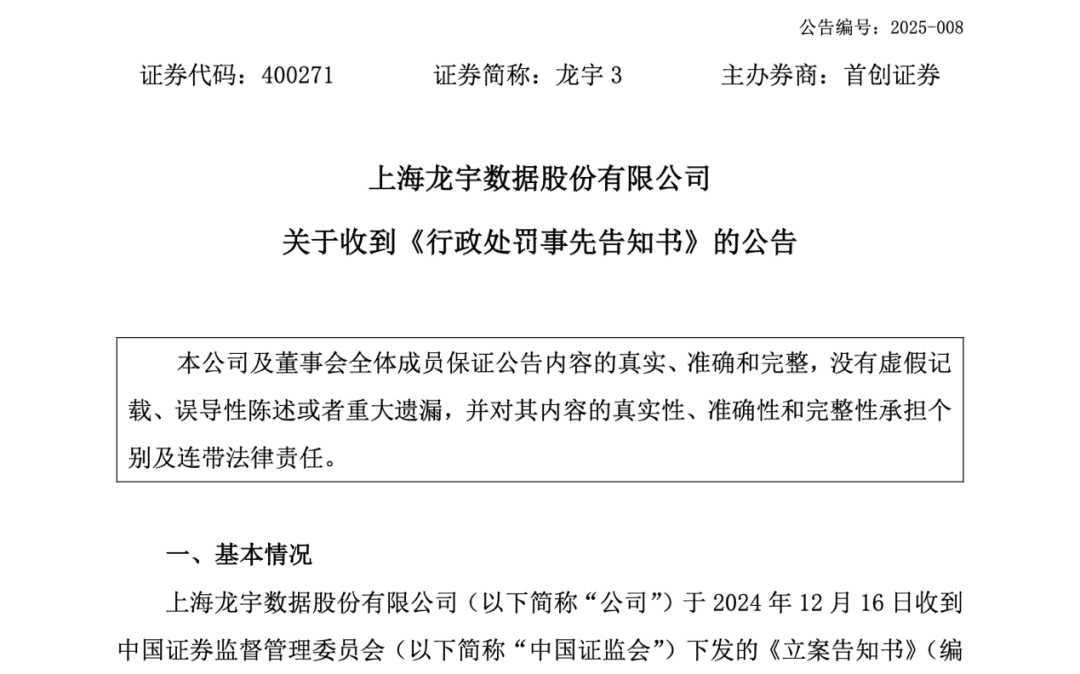
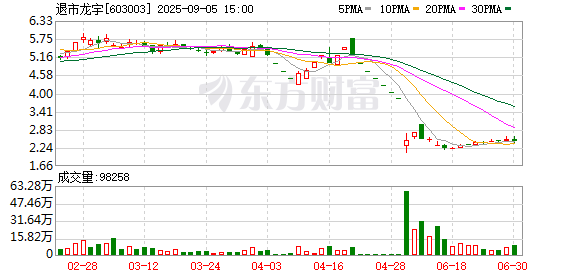
Core Viewpoint - Shanghai Longyu Data Co., Ltd. (Longyu Co.) has been severely penalized by regulators for significant financial fraud, including inflated revenue and profits over four consecutive years [1][2][3]. Group 1: Financial Misconduct - Longyu Co. was found to have inflated its operating revenue and profits in its annual reports for 2019, 2020, 2021, and 2022 [5][6]. - The inflated figures included 2.242 billion yuan in 2019 (16.61% of reported revenue), 3.986 billion yuan in 2020 (44.57%), 4.024 billion yuan in 2021 (50.46%), and 4.288 billion yuan in 2022 (42.95%) [5][6]. - Profit inflation was also significant, with 5.73 million yuan in 2019 (60.48%), 11.137 million yuan in 2020 (10.36%), 9.5195 million yuan in 2021 (7.48%), and 10.9332 million yuan in 2022 (23.92%) [5][6]. Group 2: Regulatory Actions - The China Securities Regulatory Commission (CSRC) plans to impose a fine of 11.5 million yuan on Longyu Co. and issue warnings to the company and its responsible individuals [2][7]. - Key executives, including the actual controller Xu Zengzeng, face significant fines and a ten-year ban from the securities market due to their involvement in the fraudulent activities [7][8]. - Longyu Co. has been terminated from the stock exchange and will be transferred to the National Equities Exchange and Quotations system for management [8]. Group 3: Business Operations - Longyu Co.'s main business includes data center (IDC) services and bulk commodity trading, with a strategic focus on building standardized professional computer rooms and providing a stable operating environment for client servers [8].
严重财务造假!监管出手 重罚!
Zhong Guo Ji Jin Bao· 2025-09-06 02:00
Core Viewpoint - Shanghai Longyu Data Co., Ltd. (Longyu) has been severely penalized by regulators for significant financial fraud, including inflated revenue and profits over four consecutive years [2][4]. Group 1: Financial Misconduct - Longyu inflated its reported revenue and profits in annual reports from 2019 to 2022, with the following discrepancies: - 2019: Revenue inflated by 2.242 billion, 16.61% of reported revenue; profit inflated by 5.73 million, 60.48% of reported profit [4]. - 2020: Revenue inflated by 3.986 billion, 44.57% of reported revenue; profit inflated by 11.1369 million, 10.36% of reported profit [4]. - 2021: Revenue inflated by 4.024 billion, 50.46% of reported revenue; profit inflated by 9.5195 million, 7.48% of reported profit [4]. - 2022: Revenue inflated by 4.288 billion, 42.95% of reported revenue; profit inflated by 10.9332 million, 23.92% of reported profit [4]. Group 2: Regulatory Actions - The China Securities Regulatory Commission (CSRC) plans to impose a fine of 11.5 million on Longyu and issue warnings to responsible individuals, including fines of 16.9 million for the actual controller Xu Zengzeng and 4.7 million for the general manager Liu Ce [6][7]. - Xu Zengzeng will face a ten-year ban from the securities market due to the severity of the violations [7]. Group 3: Corporate Structure and Operations - From June 2021 to November 2023, Xu Zengzeng established and controlled 13 companies that are considered related parties to Longyu, which were used to facilitate non-operational fund occupation and related party transactions [5][6]. - Longyu failed to disclose non-operational fund occupation transactions, with balances of 333 million, 875 million, and 882 million from 2022 to 2024, representing 9.19%, 23.64%, and 26.53% of net assets respectively [6]. Group 4: Listing Status - Longyu's stock was terminated and delisted from the Shanghai Stock Exchange following the regulatory actions and the issuance of a notice regarding the termination of its listing [9][10].
严重财务造假!监管出手,重罚!
Zhong Guo Ji Jin Bao· 2025-09-06 01:45
Core Viewpoint - Longyu Co., Ltd. has been severely penalized by regulators for significant financial fraud, including inflated revenue and profits over four consecutive years [1][2][5]. Group 1: Financial Misconduct - Longyu Co. inflated its operating revenue and profits in annual reports from 2019 to 2022, with the following discrepancies: - 2019: Revenue inflated by 2.242 billion, 16.61% of reported revenue; profit inflated by 5.73 million, 60.48% of reported profit [5]. - 2020: Revenue inflated by 3.986 billion, 44.57% of reported revenue; profit inflated by 11.1369 million, 10.36% of reported profit [5]. - 2021: Revenue inflated by 4.024 billion, 50.46% of reported revenue; profit inflated by 9.5195 million, 7.48% of reported profit [5]. - 2022: Revenue inflated by 4.288 billion, 42.95% of reported revenue; profit inflated by 10.9332 million, 23.92% of reported profit [5]. Group 2: Regulatory Actions - The China Securities Regulatory Commission (CSRC) plans to impose a fine of 11.5 million on Longyu Co. and issue warnings to responsible individuals, including fines of 16.9 million for the chairman and 4.7 million for the general manager [6][7]. - The chairman, Xu Zengzeng, will face a ten-year ban from the securities market due to the severity of the violations [7]. Group 3: Related Transactions - Longyu Co. failed to disclose non-operating fund occupation related to transactions with 13 associated companies controlled by Xu Zengzeng, with fund occupation balances of 333 million, 875 million, and 882 million from 2022 to 2024, representing 9.19%, 23.64%, and 26.53% of net assets respectively [6][7]. Group 4: Company Operations - Longyu Co.'s main business includes data center (IDC) operations and bulk commodity trading, with a strategic focus on building standardized professional server rooms and trading in petroleum and chemical products [11].
