
银行

Search documents
美股三大指数集体收跌:道指跌逾1%,英伟达跌超4%
Feng Huang Wang· 2026-02-27 22:23
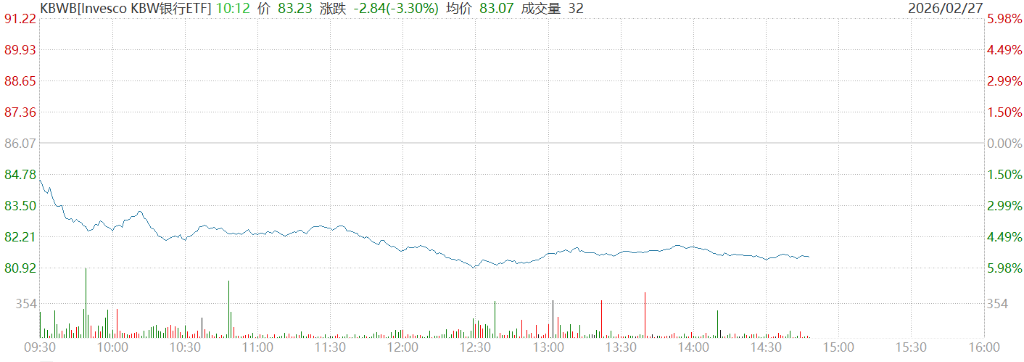
美国1月PPI同比增长2.9%,预估为增长2.6%,前值为增长3%。美国1月PPI环比增长0.5%,预估为增长 0.3%,前值为增长0.5%。 2月28日,美股三大指数集体收跌,道指跌1.05%,本周累跌1.31%,2月份累涨0.17%,月线10连涨;纳 指跌0.92%,本周累跌0.95%,2月份累跌3.38%;标普500指数跌0.43%,本周累跌0.44%,2月份累跌 0.87%。 纳斯达克中国金龙指数跌1.81%。爱奇艺跌超6%,世纪互联跌超5%,蔚来跌超4%,唯品会、陆金所跌 超3%;金山云涨逾6%,网易有道涨逾2%。 美国KBW银行指数跌近5%,创去年4月来最大单日跌幅。 大型科技股多数下跌,英伟达跌超4%,苹果跌逾3%,微软跌超2%,特斯拉、Meta跌超1%;奈飞涨超 13%,创2023年10月以来最佳单日表现;谷歌涨超1%,亚马逊小幅上涨。 高盛跌逾7%,摩根士丹利跌超6%,富国银行、花旗集团跌超5%,美国银行跌超4%。戴尔科技涨约 22%,创2024年3月份以来最大单日涨幅。Block涨近17%,创2022年以来最大单日涨幅。 全球要闻 美国1月PPI同比增长2.9% 预估为增长2.6% 历经近 ...

第一社区股价下跌4%至28.82美元,成交额约123.7万美元
Xin Lang Cai Jing· 2026-02-27 22:21
个股技术性调整:此前该股20日内累计跌幅仅0.27%,而2月27日换手率0.46%,成交清淡,可能存在短 期获利了结或流动性不足导致的波动。 无突发利空事件:公开信息中未提及公司当日有财报、并购或监管处罚等重大公告,下跌更可能源于市 场整体风险偏好下降。 以上内容基于公开资料整理,不构成投资建议。 来源:经济观察网 经济观察网 2026年2月27日,第一社区(FCCO.OQ)股价下跌4.00%,收盘报28.82美元,日内振幅 4.96%,成交额约123.7万美元。同期美股银行板块下跌1.97%,道琼斯指数下跌1.05%,纳斯达克指数下 跌0.92%,显示整体市场情绪偏弱。 股价异动原因 行业板块拖累:银行板块当日普遍承压,机构数据显示银行板块整体跌幅近2%,反映出利率政策预期 变化或宏观经济担忧对金融股的影响。 ...
摩根大通称债券与其他资产走势“完全脱钩”
Xin Lang Cai Jing· 2026-02-27 21:59
Core Insights - The global government bond market has seen significant growth this week, breaking the long-standing correlation between this asset class and other cyclical sensitive assets, leading to a "significant and widening gap" between bonds and other asset classes [1][1]. Group 1 - Jason Hunter, a technical strategist at JPMorgan, is monitoring the resistance level of the 5-year U.S. Treasury yield, which is approaching 3.5%, for potential bearish reversal signals [1][1]. - Current price trends do not indicate any imminent signs of such a bearish reversal [1].
美联储:美国上周银行存款18.778万亿美元,之前一周18.764万亿美元。
Sou Hu Cai Jing· 2026-02-27 21:27
Core Insights - The Federal Reserve reported that total bank deposits in the United States reached $18.778 trillion last week, an increase from $18.764 trillion the previous week [1] Group 1 - Total bank deposits increased by $14 billion week-over-week [1]
纽约汇市:美元指数抹去PPI数据后涨幅 2月料基本持平收官
Xin Lang Cai Jing· 2026-02-27 21:25
Group 1 - The US dollar index fell to a near-flat level due to a decline in the US stock market, erasing gains from a stronger-than-expected Producer Price Index (PPI) report [1][3] - The January PPI increased by 0.5% month-on-month, exceeding the 0.3% expectation, while the core PPI rose by 0.8%, also above the forecast [1][3] - The report may not help improve the weak risk appetite in the stock market, as noted by Shaun Osborne, Chief Foreign Exchange Strategist at Scotiabank [1][3] Group 2 - The benchmark 10-year US Treasury yield fell by 4 basis points to 3.96%, continuing to decline after the PPI data release, while major US stock indices also extended their losses [4] - The Canadian dollar continued to strengthen despite disappointing economic data, with Canada's Q4 GDP annualized rate declining by 0.6% [4] - The euro against the US dollar rose by 0.2% to 1.1819, with a weekly increase of 0.3%, although it fell by 0.3% in February [4] Group 3 - Inflation rates in France and Spain exceeded expectations, supporting the European Central Bank's stance on not needing further rate cuts [2][4] - The euro against the British pound rose by 0.5% to 0.87893, the highest since December 17 [2][4] - The most hawkish member of the Bank of Japan, Takeda, called for an increase in the benchmark interest rate, indicating a shift in Japan's previously stagnant inflation trend [2][4]
“蟑螂出没”,私人信贷问题叠加AI担忧冲击,银行股指暴跌6%
Hua Er Jie Jian Wen· 2026-02-27 21:14
Core Insights - The KBW Bank Index experienced a significant drop of 6% during intraday trading on February 27, with all 23 constituent stocks declining by over 2.9%, marking the largest single-day drop since April's market turmoil [1] - The investment-grade bond market, previously seen as a safe haven during AI-induced market volatility, has seen a widening of global comparable investment-grade bond spreads by nearly 4 basis points this week, the largest weekly fluctuation since November [3] - Concerns over the private lending sector have intensified following the bankruptcy of Market Financial Solutions, a UK mortgage institution, and liquidity issues faced by several private credit funds [3][13] Financial Sector Performance - The financial sector's downturn can be traced back to early February, with wealth management-related stocks being the first to suffer due to the launch of a tool by Altruist aimed at personalizing client strategies [6] - Following this, an online platform introduced an auto insurance comparison application based on OpenAI's ChatGPT, leading to a sell-off in insurance brokerage stocks [7] - The release of a new model by Anthropic for automating financial research and legal services has caused significant disruptions in related stocks, with Block announcing layoffs of nearly half its workforce, further heightening fears about AI's impact on financial jobs [7] Credit Market Concerns - Analysts warn that banks are entering a period of increased volatility, with the pace of AI adoption and disruption remaining uncertain [8] - Professional investors are particularly focused on American Express due to the direct impact of rising white-collar unemployment on its business [9] - The private credit market is showing signs of systemic risk, with warnings from creditors about a $1.3 billion shortfall in collateral for MFS loans and significant stock price declines for BlackRock's private debt fund [13] Alternative Asset Management - Apollo Global Management's stock plummeted by 9%, while KKR and Ares Management saw declines exceeding 6% [11] - The collapse of Market Financial Solutions has had ripple effects on institutions like Apollo Group and Jefferies, raising concerns about the potential for negative sentiment to spread within the credit market [13]

易方达中证港股通综合指数量化增强型证券投资基金基金份额发售公告
Xin Lang Cai Jing· 2026-02-27 20:31
Fund Overview - The fund is named "E Fund CSI Hong Kong Stock Connect Comprehensive Index Quantitative Enhanced Securities Investment Fund" with A-class and C-class share codes being 026847 and 026848 respectively [20] - It is an open-ended, equity-type index fund with an indefinite duration [20] - The initial share value is set at RMB 1.00 [20] Fund Raising Details - The fund's initial fundraising cap is set at RMB 8 billion, excluding interest accrued during the fundraising period [2] - The fundraising period is from March 4, 2026, to March 17, 2026, with the possibility of adjustments based on subscription conditions [23] - Investors can subscribe multiple times during the fundraising period, with no upper limit on the total amount for individual investors, but measures will be taken to control holdings exceeding 50% [5][23] Subscription Process - Minimum subscription amounts are RMB 1 for initial and additional subscriptions through non-direct sales institutions, and RMB 50,000 for direct subscriptions [5] - The fund will not allow conversions between different share classes at this time [2] - Subscription fees will be charged for A-class shares, while C-class shares will not incur subscription fees but will have service fees during the holding period [25][28] Index and Investment Strategy - The fund aims to achieve returns that exceed its performance benchmark while controlling the average tracking deviation and annualized tracking error [21] - The underlying index is the CSI Hong Kong Stock Connect Comprehensive Index, which includes securities within the Hong Kong Stock Connect range [10][11] Fund Management and Administration - The fund is managed by E Fund Management Co., Ltd., with China Agricultural Bank as the custodian [1][63] - The fund's registration and management are subject to the approval of the China Securities Regulatory Commission [1] Investor Eligibility - The fund is open to individual investors, institutional investors, qualified foreign investors, and other investors permitted by laws and regulations [22]

招商中证新能源汽车交易型开放式指数证券投资基金基金份额发售公告
Shang Hai Zheng Quan Bao· 2026-02-27 19:13
Group 1 - The core point of the news is the launch of the "Zhaoshang CSI New Energy Vehicle ETF," which has received regulatory approval and will be available for subscription from March 5 to March 13, 2026 [1][47][51]. - The fund aims to closely track its benchmark index, with a target to minimize tracking deviation and tracking error, aiming for an absolute daily tracking deviation of no more than 0.2% and an annualized tracking error of no more than 2% [49]. - The total fundraising cap for the fund is set at 2 billion RMB, and if the subscription approaches or exceeds this amount, the fundraising will be closed early [2][3]. Group 2 - Investors can subscribe to the fund through online cash subscription or offline cash subscription methods, with specific procedures outlined for each [4][62][64]. - The fund's management and custody are handled by Zhaoshang Fund Management Co., Ltd. and Zhejiang Commercial Bank, respectively [1][47]. - Investors must have a Shenzhen securities account to participate in the subscription, and those without an account must open one prior to subscribing [59][60]. Group 3 - The fund's subscription fees will be borne by investors, with a maximum commission rate of 0.3% applicable for online subscriptions [55]. - Interest generated during the fundraising period will be converted into fund shares for the investors [53][56]. - The fund's shares will be issued at a par value of 1.00 RMB each [47].

支持地方高水平对外开放 银行深耕跨境金融稳外贸
Zhong Guo Jing Ying Bao· 2026-02-27 18:51
Group 1: Core Insights - The Chinese government emphasizes the need for high-level opening-up to promote high-quality development and create a new development pattern, as highlighted in the 20th Central Committee's Fourth Plenary Session [1] - Local government work reports consistently prioritize "expanding high-level opening-up" as a key task for economic and social development [1][2][3] Group 2: Regional Initiatives - Shenzhen's 2026 government work report focuses on enhancing internationalization and open capabilities, promoting high-quality international economic cooperation, and deepening bilateral investment [2] - Heilongjiang's report identifies high-level opening-up as a critical task for the 14th Five-Year Plan, aiming to create a new high ground for northern opening and enhance international economic cooperation [3] - Shandong's report emphasizes trade innovation and the development of new markets, aiming to stabilize traditional markets while expanding into emerging ones [3] Group 3: Financial Sector Support - Financial institutions like Industrial and Commercial Bank of China and Bank of China are enhancing their service capabilities for export and multinational enterprises to improve domestic companies' competitiveness in international markets [1][6] - Banks are focusing on providing comprehensive financial solutions for cross-border operations, including international trade financing and cross-border loans [6][7] - The demand for cross-border financial services is increasing, prompting banks to innovate and adapt their service models to meet the diverse needs of enterprises [7][8]



金融助力乡村振兴:从“应急输血”到“长效造血”
Zhong Guo Jing Ying Bao· 2026-02-27 18:51
Core Viewpoint - The People's Bank of China and other regulatory bodies have issued guidelines to establish a normalized financial support mechanism aimed at preventing poverty and promoting rural revitalization, emphasizing the importance of long-term support rather than short-term aid [1][2] Financial Support Mechanism - The guidelines prioritize the establishment of a long-term financial support system, focusing on preventing poverty and revitalizing rural areas, with an emphasis on optimizing microcredit policies and directing resources to key rural areas [2][7] - Financial institutions are encouraged to transition from emergency support to institutionalized mechanisms to address potential risks and stimulate internal growth [2][8] Bank Initiatives - Agricultural Bank of China has implemented a "one county, one file" mechanism to accurately assess financial needs in poverty-stricken areas, with a loan balance of 603.3 billion yuan supporting nearly 920,000 impoverished individuals [3] - Industrial and Commercial Bank of China has increased its loan balance to poverty-stricken areas to approximately 1.36 trillion yuan, with a 12.1% increase in loans to key rural revitalization counties [4] Challenges in Implementation - Financial institutions face challenges such as risk management, high operational costs, and the need for a more collaborative approach among banks to avoid fragmented funding [5][9] - The lack of a robust credit system and insufficient digital integration hinder the effective delivery of financial services to rural areas [9] Recommendations for Improvement - Banks are advised to leverage digital transformation to reduce costs and improve efficiency, and to innovate financial products tailored to local needs [6][8] - Collaboration with government and guarantee institutions is essential to establish risk-sharing mechanisms and enhance the sustainability of financial support [6][8]
