
资产管理

Search documents
金价已突破4200美元,别恐高,有底层逻辑支撑|财富与资管
清华金融评论· 2025-10-15 09:00
Core Viewpoint - The recent surge in gold prices, surpassing $4200 per ounce, is driven by several underlying factors, including the Triffin Dilemma and the intertwining of political and financial dynamics, leading to a trend of "de-dollarization" [2][3][10]. Group 1: Factors Influencing Gold Prices - Gold has seen a significant increase of nearly $1600 per ounce this year, representing a rise of approximately 60% [3]. - The four main factors affecting gold prices are: 1. The weakening of the US dollar due to global de-dollarization trends [3]. 2. Expectations of lower US interest rates, which enhance gold's appeal [3]. 3. Increased market risk appetite due to escalating geopolitical conflicts [3]. 4. Central banks' ongoing purchases of gold for safety reasons [3]. Group 2: Political and Economic Context - The recent rise in gold prices is partly attributed to renewed tariff threats from the Trump administration against Chinese goods, which has created market volatility [5]. - The US government shutdown has heightened concerns about economic growth, leading to increased expectations for interest rate cuts by the Federal Reserve [7]. - The ongoing geopolitical tensions and trade wars have prompted countries to reduce their reliance on the US dollar, further supporting gold's attractiveness as a safe-haven asset [10]. Group 3: The Triffin Dilemma - The Triffin Dilemma highlights the conflict faced by a country whose currency serves as a global reserve, where it must balance trade deficits to provide liquidity while maintaining currency stability [9]. - As US debt continues to grow, confidence in the dollar is waning, contributing to the rise in gold prices [10]. Group 4: Investment Strategies - The TACO trading strategy, which capitalizes on the cyclical nature of Trump's tariff threats, has gained attention as a method for investors to buy assets during market downturns and sell when conditions improve [5]. - Bridgewater Associates' founder Ray Dalio suggests that investors should allocate up to 15% of their portfolios to gold, emphasizing its superior safe-haven qualities compared to the dollar [10].


长城资产新董事长到位,不良资产处置收益处在下行通道
Qi Lu Wan Bao· 2025-10-15 08:11
Core Points - The appointment of Xiang Dang as the new chairman of China Great Wall Asset Management Co., Ltd. has been officially announced, pending regulatory approval [1][2] - Xiang Dang has extensive experience in the non-performing asset industry, having worked for 26 years in this field, including significant roles at China Cinda Asset Management [2][3] - The company has undergone significant changes in its shareholding structure, with Central Huijin Investment Co., Ltd. increasing its stake in Great Wall Asset from 73.53% to 94.34% following a series of capital adjustments [4] Company Leadership Changes - Xiang Dang is the fourth chairman since the company's restructuring in December 2016, succeeding Li Junfeng, who retired due to age [2][3] - During his interim period as chairman, Xiang Dang has also served as the acting president of the company [2] Financial Performance - As of June 2025, Great Wall Asset reported a total asset of 6,309 billion yuan, with a significant increase in net profit to 999 million yuan, marking a 528% increase year-on-year [6] - The company has seen a decline in operating revenue by 54% year-on-year, totaling 39.2 billion yuan for the first half of 2025 [6] Asset Management and Strategy - Great Wall Asset has been active in acquiring non-performing financial assets, with a total of 433 billion yuan in new acquisitions in the first half of 2025 [6] - The company has initiated the sale of non-performing debts from major real estate firms, including approximately 11.3 billion yuan from Evergrande [6][7] - The issuance of the first asset-backed securities (ABS) product backed by non-performing assets in June 2025 represents a significant innovation in asset disposal strategies [7] Challenges Ahead - Despite recent successes, Great Wall Asset faces ongoing challenges in managing and revitalizing its real estate-related non-performing assets amid economic pressures [7]
摩根大通:将贝莱德目标价从1242美元上调至1244美元。
Xin Lang Cai Jing· 2025-10-15 04:39
摩根大通:将贝莱德目标价从1242美元上调至1244美元。 来源:滚动播报 ...


招银国际每日投资策略-20251015
Zhao Yin Guo Ji· 2025-10-15 02:13
Market Overview - The global stock markets showed mixed performance, with the Hang Seng Index closing at 25,441, down 1.73% for the day but up 26.83% year-to-date [1] - The US markets experienced slight declines, with the Dow Jones up 0.44% and the S&P 500 down 0.16% [1] - The Chinese stock market saw a third consecutive day of decline, particularly in sectors like materials, healthcare, and information technology, while utilities, telecommunications, and financials outperformed [3] Sector Performance - In the Hong Kong market, the Hang Seng Financial Index remained stable with a slight decrease of 0.01%, while the Hang Seng Industrial Index fell by 2.70% [2] - The public utilities sector showed resilience with a 0.66% increase, contrasting with the declines in real estate and industrial sectors [2] Company Insights - J&T Express reported a 23% year-on-year increase in parcel volume for Q3 2025, driven by a significant 79% growth in Southeast Asia, while growth in China slowed to 10% [5] - Baidu is expected to report Q3 2025 core business revenue of 24.6 billion RMB, a 7% decline year-on-year, primarily due to the ongoing transformation of its advertising business [5] - Baidu's cloud business is anticipated to grow by 20% year-on-year, partially offsetting the decline in advertising revenue [5] Economic Indicators - China's tax revenue data indicates an improvement in corporate revenue growth, with year-on-year growth rates of 2.6% and 6.9% for the second and third quarters, respectively [3] - The IEA's monthly report suggests a potential record oil surplus next year, estimated at nearly 4 million barrels per day [4] Investment Sentiment - Investor sentiment in the US stock market has shifted to an overweight position, reaching an eight-month high, with cash holdings dropping to a low of 3.8% [3] - Concerns about potential bubbles in AI stocks and high global stock valuations were noted, with 54% of surveyed investors expressing such concerns [3]

中国长城资产管理股份有限公司四川省分公司与许彪文债权转让通知暨债务催收联合公告
Si Chuan Ri Bao· 2025-10-14 22:30
Core Points - The announcement details the transfer of debt rights from China Great Wall Asset Management Co., Ltd. Sichuan Branch to Xu Biaowen, including all related agreements and obligations [1][2] - Xu Biaowen is now the assignee of the rights and is requesting all debtors and guarantors listed in the asset list to fulfill their repayment obligations immediately [1][2] Summary by Sections Debt Transfer Agreement - China Great Wall Asset Management Co., Ltd. Sichuan Branch has signed a debt transfer agreement with Xu Biaowen, transferring all rights related to the listed debtors and guarantors [1] - The asset list includes principal and interest balances as of November 20, 2020, and any changes in amounts should be based on actual figures as of the announcement date [2] Obligations of Debtors and Guarantors - Debtors and guarantors are required to pay interest according to the loan and guarantee contracts, as well as relevant regulations from the People's Bank of China [2] - In cases where debtors or guarantors undergo name changes, restructuring, or lose their civil subject qualifications, relevant parties must ensure obligations are fulfilled or assume liquidation responsibilities [2] Additional Notes - The list of guarantors includes "guarantors, mortgagors, and pledgers" [2] - Any discrepancies between the announcement and the signed debt transfer agreement will be governed by the agreement's content [2]


'UK Has the Opportunity To Be a Tokenization World-Leader', FCA Markets Chief Simon Walls Declares
Yahoo Finance· 2025-10-14 15:52
Core Insights - The U.K. aims to become a global leader in tokenization, working to catch up with the EU in digital finance regulations [1][4] - The Financial Conduct Authority (FCA) has introduced guidelines to facilitate the adoption of tokenization in the £14 trillion asset management sector [2][6] - Tokenization is expected to enhance efficiency in fund management, reduce costs, and broaden access to private markets [3][4] Regulatory Developments - The FCA's guidelines include a "Blueprint" model for operating tokenized fund registers and a roadmap to overcome barriers like public blockchain usage [2][3] - The U.K. is responding to the EU's Markets in Crypto-Assets (MiCA) framework, which provides clearer rules for digital assets [4][5] - Simon Walls, FCA's Executive Director of Markets, emphasizes the transformative potential of tokenization for asset management [4][6] Global Context - There is a pressing need for global regulatory harmony to support asset managers in issuing tokenized products [5][6] - Experts warn that regulatory progress should not overburden innovators, advocating for a balanced approach to compliance [7]
三大股指期货齐跌,大行业绩出炉后股价平淡,鲍威尔今夜演讲或改写全球风险情绪
Zhi Tong Cai Jing· 2025-10-14 12:18
Market Overview - US stock index futures are all down, with Dow futures down 0.54%, S&P 500 futures down 0.85%, and Nasdaq futures down 1.11% [1] - European indices also show declines, with Germany's DAX down 1.07%, UK's FTSE 100 down 0.31%, France's CAC40 down 0.89%, and the Euro Stoxx 50 down 0.94% [2][3] - WTI crude oil prices fell by 1.98% to $58.31 per barrel, while Brent crude oil dropped by 1.86% to $62.14 per barrel [3][4] Economic Events and Market Sentiment - Federal Reserve Chairman Jerome Powell is scheduled to speak on "Economic Outlook and Monetary Policy," which may influence market expectations regarding interest rate cuts amid global market volatility [5] - The US-China tariff tensions have strengthened the US dollar against most major currencies, leading investors to seek safe-haven assets [5] Company Earnings and Performance - Goldman Sachs predicts that US households will become the largest buyers of US stocks by 2026, with net purchases expected to reach $520 billion, a 19% increase year-on-year [6] - Morgan Stanley reported Q3 trading and investment banking performance exceeding expectations, with GAAP EPS of $5.07 and revenue of $47.1 billion, up $1.53 billion year-on-year [8] - Ericsson's Q3 profit doubled despite a decline in sales, with adjusted EBIT reaching 15.5 billion SEK (approximately $1.62 billion), exceeding analyst expectations [9] - BlackRock reported a record $13.46 trillion in assets under management, with net inflows of $205 billion in Q3, driven by a rebound in global markets [10] - Johnson & Johnson raised its full-year sales forecast, reporting Q3 revenue of $24 billion, a 6.7% increase year-on-year [11] - Goldman Sachs achieved record Q3 revenue of $15.18 billion, a 20% increase year-on-year, with investment banking fees significantly surpassing expectations [12] - Wells Fargo's Q3 net interest income was $11.95 billion, slightly below expectations, but investment banking fees rose 25% year-on-year [13] Legal and Regulatory Issues - Microsoft faces a consumer class-action lawsuit alleging it engaged in anti-competitive practices with OpenAI, leading to inflated prices for generative AI products [14] Technological Developments - Nvidia is launching a compact AI supercomputer, which could significantly boost its performance and market position in the AI sector [15]

贝莱德(BLK.US)Q3吸金2050亿美元 资产管理规模创新高达13.46万亿美元
Zhi Tong Cai Jing· 2025-10-14 11:20
Core Insights - BlackRock reported a significant increase in third-quarter profits, driven by a recovery in global markets and a record asset management scale of $13.46 trillion [1] - The firm experienced net inflows of $153 billion into stocks, bonds, and ETFs, with its ETF assets surpassing $5 trillion for the first time [1] - BlackRock's long-term investment funds saw net inflows of $171 billion, exceeding analyst expectations, while total client net inflows reached $205 billion [1] Financial Performance - Adjusted net profit for BlackRock in Q3 was $1.91 billion, up from $1.72 billion year-over-year, with adjusted earnings per share increasing by 1% to $11.55, surpassing analyst expectations [3] - Revenue grew by 25% year-over-year, reaching $6.5 billion [3] Strategic Acquisitions - In Q3, BlackRock completed the acquisition of HPS Investment Partners for $12 billion, marking its third major acquisition in 18 months as part of its strategy to lead in alternative assets [4] - The acquisition added $165 billion in client assets, bringing the total alternative asset management scale to $663 billion [4] - BlackRock aims to add an additional $400 billion in alternative assets by 2030 [4] Market Performance - BlackRock's stock price has increased by 17% over the past year, outperforming the S&P 500 index, which rose by 14% during the same period [4]
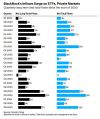
花旗下调黑石集团目标价至170美元
Ge Long Hui A P P· 2025-10-14 10:55
格隆汇10月14日|花旗集团(C.US):将黑石集团(BX.US)目标价从185美元下调至170美元。 ...


贝莱德三季度吸金2050亿美元 资产管理规模创纪录达13.5万亿美元
Ge Long Hui A P P· 2025-10-14 10:35
Core Insights - BlackRock, the world's largest asset management company, attracted $205 billion in client inflows during Q3 2023, driven by its expansion in private credit and alternative assets [1] - The total assets under management (AUM) reached a record $13.5 trillion, benefiting from a market rebound [1] - The company reported a 1% year-over-year increase in adjusted EPS to $11.55, surpassing market expectations of $11.47, and a 25% year-over-year revenue growth to $6.5 billion [1] Inflows and Fund Performance - Investors net invested $153 billion into equities, bonds, and other ETFs during the quarter, leading to BlackRock's ETF total surpassing $5 trillion for the first time [1] - Long-term investment funds saw net inflows of $171 billion, exceeding market expectations of $161.6 billion [1] - Cash management and money market funds contributed $34 billion to inflows, with this business's asset size exceeding $1 trillion for the first time [1]