
光模块

Search documents
成交额逼近2万亿!资金流向这些ETF
Zhong Guo Zheng Quan Bao· 2025-08-18 01:20
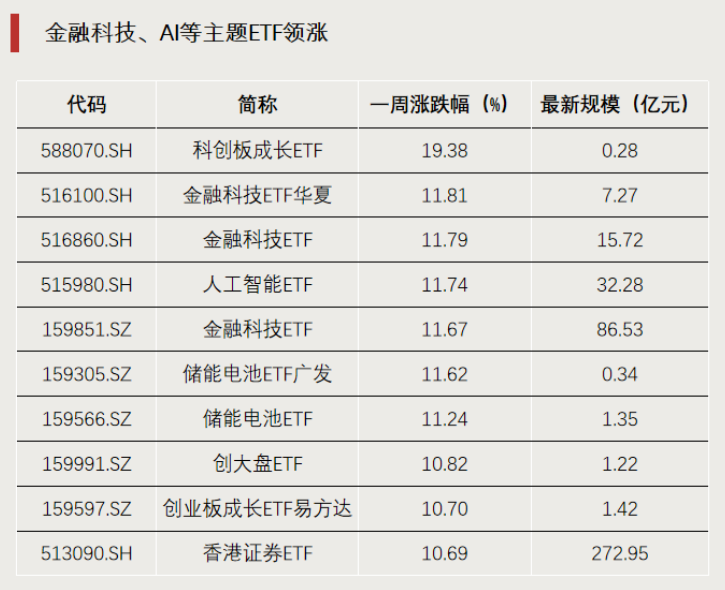
Core Insights - The A-share market has shown strong performance in sectors such as fintech, AI, batteries, and optical modules, with multiple ETFs in these themes rising over 10% last week [1][4] - The Shanghai Composite Index has reached new highs for the year, with ETF trading activity significantly increasing, approaching a total transaction volume of 2 trillion yuan, marking the second-highest record in history [2][8] - The 2025 World Humanoid Robot Games took place from August 14 to 17, with the E Fund Robotics ETF (159530) gaining attention and nearing a scale of 5 billion yuan [3][12] ETF Performance - Several thematic ETFs, particularly in fintech and AI, experienced substantial weekly gains, with notable performers including the Science and Technology Innovation Board Growth ETF (588070) up 19.38% and the Financial Technology ETF (516100) up 11.81% [5][4] - The Hong Kong Securities ETF (513090) saw a weekly increase of over 10% and a record weekly transaction volume of nearly 120 billion yuan, marking its highest since its launch in March 2020 [8][9] - The overall ETF market has shown a trend of increased trading activity, with significant inflows into broad-based and Hong Kong index-related ETFs, while some thematic ETFs experienced net outflows [10][11] Market Trends - Analysts suggest that the current market rally is driven by a combination of policy support and technological advancements, particularly in AI, which is creating new business opportunities and valuation enhancements in the fintech sector [4][6] - The market is expected to continue seeing structural opportunities, with a focus on emerging sectors benefiting from policy support and technological dividends [15] - The recent changes in the Hang Seng Hong Kong Stock Connect Innovative Drug Index aim to focus on innovative pharmaceutical companies, enhancing the purity of the index for ETFs tracking it [13][14]

当前时点如何看光模块?
2025-08-18 01:00
Summary of Conference Call on Optical Module Industry Industry Overview - The optical module industry is experiencing a significant shift due to the explosive demand from the North American inference market, which is expected to enhance the sustainability of capital expenditures in 2025 [1][4] - Chinese companies are playing an increasingly important role in the technological iteration of optical modules, particularly in high-end products like 800G and 1.6T, leading to a growing market share and concentration towards leading firms [1][6] Key Insights and Arguments - The demand for pluggable optical modules in the inference market has been underestimated, with a notable increase in the ratio of ASIC chips to optical modules, such as Meta and Amazon's ratios of 1:6 to 1:8, and Huawei's Cloud Matrix reaching 1:18 [1][7] - The second quarter of 2025 saw a sharp increase in the optical module market, primarily driven by the North American inference demand and the ramp-up in 800G laser module demand, with expectations for continued growth in the third and fourth quarters [1][8] - Major tech companies in North America are making substantial investments in AI computing, which supports the demand for optical modules, with leading companies currently undervalued [1][10] Market Performance and Investor Sentiment - Since May, the optical module industry has seen a significant rise, particularly with companies like Xuchuang showing outstanding performance. However, investors have mixed views on future trends, focusing on market saturation, short-term positioning, and future development [2] - The optical module industry underwent adjustments from June to November 2023 due to slowing user growth for GPT-4 and concerns over the sustainability of capital expenditures, but a recovery is anticipated with the rise of Sora optical interconnect technology [3] Supporting Evidence for Industry Growth - Three key pieces of evidence support the growth of the optical module industry: performance guidance from inference chips like ASICs, growth in enterprise leasing in computing, and the significant increase in token consumption by major companies like Google [5] - The trend towards optical interconnect technology is expected to increase hardware demand significantly, as the industry shifts from copper to optical connections in scale-up networks [14] Future Investment Opportunities - The outlook for investment in the optical module sector remains optimistic, with accelerated AI model iterations and substantial investments in AI computing by major U.S. companies [9][10] - The upcoming 1.6T product upgrade cycle is expected to bring significant changes, with major companies likely to see accelerated performance [12] Company-Specific Insights - Taiyuan Optical's recent performance showed a net profit of approximately 94 million yuan, which, while not meeting expectations, remains within a reasonable range. Concerns about revenue and profit margins are considered short-term issues [19][25] - The revenue share of Taiyuan Optical in Corning's optical communication enterprise network business has fluctuated between 8% and 12% over the past several years, with a recent increase to 9% in Q2 2025 [20] - Despite lower revenue growth compared to Corning, Taiyuan Optical's performance in Q2 2025 indicates a healthy trajectory, with expectations for continued growth in the latter half of the year [21][25] Conclusion - The optical module industry is poised for growth driven by technological advancements and increased demand from the AI sector, with significant contributions from both North American and Chinese companies. The market dynamics suggest a favorable environment for investment, particularly in leading firms within the sector.
当前光模块板块观点更新
2025-08-18 01:00
Summary of Conference Call on Optical Module Industry Industry Overview - The optical module industry is experiencing optimistic growth trends, driven by increased capital expenditures from cloud vendors and intensified overseas procurement from domestic suppliers [1][4] - The demand for 800G optical modules is expected to exceed market expectations by 15%-20% in 2026, with a stable forecast of 8 million units for 1.6T products [1][4] Key Insights - The demand for optical modules is projected to grow two to three times by 2026, but supply constraints due to difficulties in expanding core chips (EML and DSP) may lead to a supply-demand imbalance [1][5] - If production capacity is capped at 40 million units for 800G products without increasing shipment volumes, price declines for optical module companies will be less than the normal range of 15%-20%, potentially even below 10% [1][5] - Major companies like Meta are actively purchasing, which may lead to price increases in the optical module market [5] Investment Recommendations - Focus on second-tier companies that are confirmed to enter the North American market and face limited competition in the short term, as they are likely to experience rapid valuation recovery and explosive growth in the next two to three years [2] - The optical module sector is expected to strengthen in the coming months, with significant events like the September Optical Expo and October order placements likely to boost market sentiment [6][7] Profitability and Valuation - There are concerns about maintaining a net profit margin above 30%, but the current market conditions, surging demand, and potential price increases suggest that profitability may improve further [3][8] - The optical module industry is currently undervalued, with a typical valuation of 20 times earnings being considered low in a bullish market, especially given the anticipated high growth rates over the next three years [3][11] - The market has not fully reflected the trend of computational power expansion, leading to undervaluation of domestic core module companies [11][12] Market Dynamics - The rapid pace of technological upgrades in the optical module industry allows companies to maintain high profit margins, as the time between iterations has decreased significantly [10] - The disparity in market valuations between Chinese and American computational power companies highlights the need for increased attention on undervalued domestic assets [12] Conclusion - The optical module industry is poised for significant growth, driven by increased demand and capital expenditures from cloud service providers, while supply constraints may lead to favorable pricing dynamics. Investors are encouraged to focus on second-tier companies with strong market positions and growth potential.
Scale up带来增量,液冷渗透加速
2025-08-18 01:00
Summary of Conference Call Records Industry Overview - The conference call primarily discusses the optical module industry and advancements in related technologies, particularly focusing on the trends of "skill up" and "liquid cooling" in the AI and telecommunications sectors [1][2][4][21]. Key Points and Arguments 1. **Optical Module Demand Growth** - Continuous growth in optical module demand, with core suppliers like Zhongji Xuchuang and Xinyi Sheng actively increasing upstream material orders. The optimistic booking situation for Marvell's DSP260 is highlighted, indicating a tight supply of optical chips leading to price increases from upstream suppliers, which collectively enhance the market outlook for 2026 [1][2]. 2. **Increased GPU Interconnect Bandwidth Demand** - The demand for GPU interconnect bandwidth has significantly increased, with Nvidia's NVLink and Broadcom's Ethernet solutions competing fiercely. The single-card bandwidth has reached 7.2T and 6.4T respectively, resulting in an approximately 8-fold increase in fiber demand per card, tightly linking market capacity to GPU shipment volumes [1][4]. 3. **Domestic Progress in Switch Solutions and FPGA Chips** - Domestic manufacturers have made progress in switch solutions and self-developed FPGA chips, gradually moving towards domestic alternatives for Ethernet and PCIe technologies. Huawei showcased its AI Cloud cluster 384, while Tencent, Alibaba, and ByteDance launched solutions targeting the Sky network protocol [1][6][7]. 4. **Advancements in PCIe Technology** - Significant advancements in PCIe technology have been noted, with Broadcom and Extra Lab's PCIe 7.0 products expected to enter mass production between the second half of 2025 and the first half of 2026, achieving a single-channel rate of 128GT and doubling transmission efficiency through PAM-4 modulation [1][8]. 5. **Market Capacity Linked to GPU Shipments** - The market capacity for optical products is projected to be closely tied to GPU shipments, with an estimated annual demand of tens of millions of related products, potentially reaching a market scale of several billion dollars [1][5]. 6. **Impact of UA Link Alliance** - The establishment of the UA Link Alliance by major companies like AMD, Amazon, Google, Meta, and Microsoft aims to develop new interconnect technologies based on Ethernet, indicating a shift in networking protocols to support AI accelerators [3][11]. 7. **Performance of Major Telecom Operators** - Major telecom operators reported over 5% profit growth in the first half of the year, driven by AI developments that significantly boosted IDC business and AI-related revenues. The transition to cloud-based AI deployment is expected to further enhance growth [14][15]. 8. **Satellite Communication Developments** - The National Grid's plan to launch approximately 50 satellites has doubled its satellite count to around 100, improving market expectations for launch progress. Despite setbacks, such as the recent rocket explosion, the long-term outlook remains positive with continued support for satellite deployment [16][17]. 9. **Liquid Cooling Technology in AI** - Liquid cooling technology is gaining attention in the AI industry, with recent deployments of GB200, CB300, and NL72 cabinets catalyzing demand. Companies like Invec are expected to benefit significantly, as the cost of CDU components constitutes about 50% of the overall system cost [21]. Other Important Insights - The rapid advancements in optical and electrical interconnect technologies are crucial for meeting the increasing demands of AI and high-performance computing [4][5]. - The domestic industry's shift towards self-developed technologies and solutions reflects a strategic response to global trends and competitive pressures [6][10]. - The financial performance of telecom operators indicates a robust market environment, with AI-related services emerging as a new growth driver [14][15].


A股开启“欢乐派对” 公募机构“冷静而持稳”
Zhong Guo Zheng Quan Bao· 2025-08-17 20:07
Group 1 - The equity market shows significant signs of recovery, with the Shanghai Composite Index breaking through 3700 points, driven by multiple favorable factors including policy support and increased liquidity from various investors [1][2][3] - Public fund institutions highlight that the recent market rally is supported by improved external conditions and a potential interest rate cut by the Federal Reserve, which could benefit the A-share market [2][3] - The technology sector is experiencing positive momentum, with leading companies in the optical module space reporting better-than-expected earnings, and advancements in AI technology further boosting investor sentiment [2][3][7] Group 2 - There is a notable increase in trading activity and liquidity in the market, with retail investors showing heightened interest and institutional investors maintaining a long-term investment perspective [1][3][4] - Recent data indicates a surge in inquiries about equity products, with many investors shifting from bond funds to stock funds, reflecting a rising risk appetite [4][6] - The current market environment is characterized by a structural rally, with many undervalued sectors and companies identified as key investment opportunities [5][6][8] Group 3 - The strong market performance is attributed to supportive policies and liquidity measures, including accelerated special bond issuance and relaxed real estate policies [6][7] - Fund managers express optimism about maintaining a high-risk appetite, with a focus on sectors that may benefit from strong earnings reports and thematic catalysts [7][8] - The innovative drug sector is gaining attention, with many companies reaching performance inflection points, suggesting potential for further investment [8]
Coherent(COHR.US)财报后股价重挫 机构却齐声唱多:数据通信业务隐忧难掩长期利好
智通财经网· 2025-08-15 07:38
Core Viewpoint - Coherent's stock dropped nearly 20% after the earnings report due to investor concerns over its data communication business share, although most institutions remain optimistic about the company's long-term prospects, maintaining or raising target prices and ratings [1]. Group 1: Financial Performance - Coherent's first-quarter revenue is expected to grow by 15% year-over-year, but this is significantly lower than Lumentum's 6% growth in its network business [1]. - B. Riley reported that the network business revenue increased by 5% quarter-over-quarter to $945 million, with the data communication segment growing by only 3%, down from 11% in the previous quarter [2]. - Stifel predicts that Coherent's adjusted gross margin will reach approximately 40.5% by fiscal year 2027 [3]. Group 2: Analyst Ratings and Target Prices - Needham raised its earnings per share forecast for fiscal year 2026 while lowering revenue expectations, maintaining a "Buy" rating with a target price of $120 [1]. - B. Riley upgraded its target price from $77 to $85 while maintaining a "Neutral" rating [2]. - Stifel raised its target price from $100 to $118, reiterating a "Buy" rating [3]. - Raymond James maintained a "Strong Buy" rating and increased its target price from $120 to $134, citing strong demand trends in data center and data communication interconnects [3]. Group 3: Operational Strategies - Coherent is enhancing its profit margins through cost reduction, sales expansion, and pricing optimization, exemplified by the $400 million sale of its aerospace and defense business to Advent International [2]. - The construction of a 6-inch wafer fab in Sherman, Texas, is expected to further improve profit margins as production begins in August [3].

创业板人工智能ETF华夏(159381)近1月新增规模居可比基金头部,成交额超9000万元
Xin Lang Cai Jing· 2025-08-15 06:11
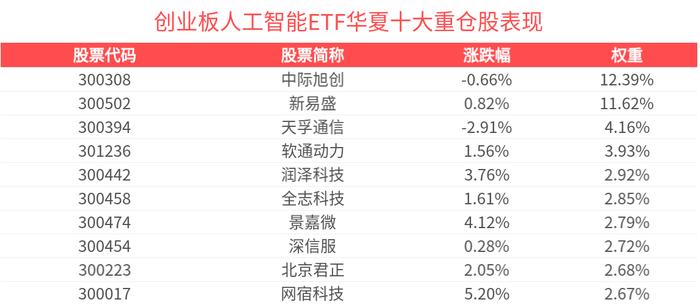
Group 1 - The A-share technology sector remains active, with the ChiNext AI Index rising by 0.84% as of 13:41 on August 15, 2025, driven by significant gains in stocks such as Tonghuashun (up 16.21%), Wangsu Science & Technology (up 5.20%), and Jingjia Micro (up 4.12%) [1] - The North American hyperscalers have reported their Q2 2025 earnings, showing continued capital expenditure expansion, with Google raising its full-year forecast, indicating positive signals for future AIDC construction demand [1] - The Huaxia ChiNext AI ETF has seen a notable increase in scale, growing by 43.14 million yuan in the past month, ranking it among the top funds in its category [1] Group 2 - The Huaxia ChiNext AI ETF has the lowest management fee of 0.15% and a custody fee of 0.05% among comparable funds [2] - As of August 14, 2025, the tracking error of the Huaxia ChiNext AI ETF over the past two months is 0.018%, indicating high tracking precision compared to similar funds [2] Group 3 - The performance of key stocks within the ChiNext AI sector includes: - Zhongji Xuchuang: -0.66% (12.39% weight) - Xinyi Sheng: +0.82% (11.62% weight) - Tianfu Communication: -2.91% (4.16% weight) - Ruize Technology: +3.76% (2.92% weight) - Jingjia Micro: +4.12% (2.79% weight) - Wangsu Science & Technology: +5.20% (2.67% weight) [4]

通宇通讯:参股公司四川光为近期在高速光模块领域取得重要突破
Zheng Quan Shi Bao Wang· 2025-08-15 04:24
Core Viewpoint - Tongyu Communication (002792) announced a significant breakthrough in the high-speed optical module sector through its affiliate Sichuan Guangwei, with the successful small-scale delivery of the first batch of 800G OSFP2×DR4 optical modules [1] Group 1: Product Development - The 800G OSFP2×DR4 optical module utilizes silicon photonics technology and low power consumption design, featuring high bandwidth and high reliability [1] - The primary applications of this product include 800G Ethernet, data centers, artificial intelligence (AI), and cloud computing networks [1] Group 2: Market Positioning - The successful delivery marks an advancement in Sichuan Guangwei's research and industrialization capabilities in high-speed optical modules [1] - Sichuan Guangwei plans to continue optimizing the 800G product series and advance the research and mass production of more models to enhance market competitiveness [1]

光模块CPO热度降温,太辰光跌超10%,5G通信ETF(515050)逆市翻红
Mei Ri Jing Ji Xin Wen· 2025-08-15 02:20
Group 1 - The core viewpoint of the articles highlights the strong performance and recovery of the optical module CPO concept stocks amidst a high demand for computing power driven by AI model training and inference [1] - The 5G Communication ETF (515050) has a scale exceeding 6 billion yuan, focusing on key players in the AI computing hardware and 6G industry, with optical module CPO stocks accounting for 31% of its weight [2] - The overall market for optical modules is expected to maintain a high level of prosperity due to continuous investment in computing infrastructure and the rapid advancement of the overseas computing power industry chain [1] Group 2 - The top ten weighted stocks in the 5G Communication ETF include major companies such as Zhongji Xuchuang, Xinyi Sheng, and Luxshare Precision, indicating a strong focus on leading firms in the optical module and PCB sectors [2] - The entrepreneurial board artificial intelligence ETF (159381) has a weight of over 41% in optical modules, with its top three constituent stocks being Zhongji Xuchuang, Xinyi Sheng, and Tianfu Communication [2] - The management fee rate for the entrepreneurial board artificial intelligence ETF is 0.15%, with a custody fee rate of 0.05%, making it one of the lowest in its category [2]



【盘前三分钟】8月15日ETF早知道
Xin Lang Ji Jin· 2025-08-15 01:29
Core Insights - The article discusses the performance of various sectors and ETFs in the market as of August 14, 2025, highlighting both gains and losses across different industries [1][2][4][6]. Market Performance - The market temperature indicator shows a 75% level, indicating a relatively high valuation based on the historical P/E ratio of the last ten years [1]. - The Shanghai Composite Index, ChiNext Index, and Shenzhen Component Index experienced slight declines of -0.46%, -0.87%, and -1.08% respectively [1]. Sector Performance - The top three sectors with capital inflow are: - Banking: 0.07 billion - The top three sectors with capital outflow are: - Machinery: -71.67 billion - National Defense and Military Industry: -57.33 billion - Electronics: -52.38 billion [2]. ETF Performance - The article lists several ETFs with their respective performance: - Hong Kong Stock Connect Innovative Drug ETF: +0.65% - Financial Technology ETF: +0.57% - A50 ETF: +0.43% [4][6]. - The article notes that the Artificial Intelligence ETF on the ChiNext has a significant turnover rate of 19.42% [4]. Investment Opportunities - The article suggests that the brokerage sector has not shown significant excess returns this year, indicating potential for catch-up opportunities in a bull market [6]. - The article highlights the ongoing demand for computing power in the AI sector, particularly with the anticipated release of GPT-5 in Q3 2025, which may drive investment opportunities in the computing power supply chain [6].
