
光伏设备及元器件制造

Search documents
9月份核心CPI同比上涨1.0% 涨幅连续第5个月扩大
Zheng Quan Ri Bao· 2025-10-15 15:46
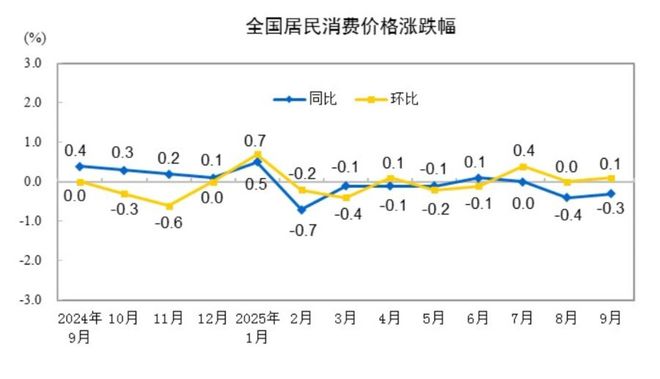
Core Insights - In September, the Consumer Price Index (CPI) increased by 0.1% month-on-month, while year-on-year it decreased by 0.3%. The core CPI, excluding food and energy, rose by 1.0%, marking the fifth consecutive month of growth and the first time in 19 months it returned to 1% [1][3] - The Producer Price Index (PPI) remained flat month-on-month and decreased by 2.3% year-on-year, with the decline narrowing by 0.6 percentage points compared to August [1][5] CPI Analysis - The month-on-month CPI increase was driven by a 0.7% rise in food prices, which contributed approximately 0.13 percentage points to the CPI increase. Industrial consumer goods prices, excluding energy, rose by 0.5%, contributing about 0.12 percentage points [2] - Year-on-year, the CPI decline of 0.3% was primarily influenced by a 4.4% drop in food prices and a 2.7% decrease in energy prices, which together accounted for a significant portion of the CPI decrease [2][3] Core CPI Insights - The core CPI's year-on-year increase of 1.0% reflects a sustained improvement, with industrial consumer goods prices, excluding energy, rising by 1.8%. Notably, gold and platinum jewelry prices surged by 42.1% and 33.6%, respectively [3] - The increase in core CPI is attributed to the effects of consumption promotion policies, with rising prices in home appliances and mobile phones contributing positively [3] PPI Insights - The PPI's year-on-year decline of 2.3% shows signs of stabilization in certain industries, with improved supply-demand dynamics leading to reduced price declines in sectors like coal processing and non-metallic mineral products [5] - The expected annual PPI decline is projected at 2.7%, influenced by ongoing market competition optimization and the effects of "anti-involution" policies [5]
【新华解读】核心CPI重回1% 9月物价数据透出哪些信号?
Xin Hua She· 2025-10-15 14:02
Core Insights - The overall consumer price index (CPI) in September showed a slight increase of 0.1% month-on-month, while the core CPI, excluding food and energy, rose by 1% year-on-year, marking the first return to a 1% increase in 19 months [1][2] - The producer price index (PPI) decreased by 2.3% year-on-year in September, but the decline was less severe than the previous month, indicating improvements in market conditions and the effectiveness of macroeconomic policies [3] - Emerging industries are experiencing growth, with new consumption patterns and models driving positive price changes in related sectors [4][5] Consumer Market Dynamics - The CPI's month-on-month increase was influenced by a 0.7% rise in food prices, particularly in fresh vegetables, eggs, and meats, due to seasonal factors and supply chain disruptions [1] - The year-on-year CPI decline of 0.3% was primarily due to base effects from the previous year, with a negative impact of approximately 0.8 percentage points from tail effects [2] Producer Price Index Trends - The PPI's year-on-year decline of 2.3% reflects a narrowing of price drops in various industries, including coal processing and black metal smelting, as a result of improved market competition and capacity management [3] - Specific sectors, such as coal processing and black metal industries, saw month-on-month price increases of 3.8% and 0.2%, respectively, indicating a stabilization in prices [3] New Consumption Patterns - The growth of new industries and consumption models is contributing to a dual upgrade in industrial consumption, with significant price increases in sectors like aircraft manufacturing (1.4% year-on-year) and electronic materials (1.2% year-on-year) [5][6] - The shift in consumer demand from quantity to quality is evident, with notable price increases in high-quality goods such as arts and crafts (14.7% year-on-year) and nutritional foods (1.8% year-on-year) [7]
9月核心CPI,19个月来涨幅首次回到1%
21世纪经济报道· 2025-10-15 13:50
Core Insights - The article discusses the recent trends in China's Consumer Price Index (CPI) and Producer Price Index (PPI), highlighting a decrease in CPI and a narrowing decline in PPI, indicating potential economic recovery and price stabilization [1][10]. CPI Analysis - In September, the national CPI decreased by 0.3% year-on-year, with urban areas down 0.2% and rural areas down 0.5% [4][6]. - Food prices fell by 4.4%, while non-food prices increased by 0.7%, contributing to the overall CPI decline [4][7]. - The core CPI, excluding food and energy, rose by 1.0%, marking the first return to this level in 19 months and indicating a continuous expansion for five consecutive months [7][9]. - The month-on-month CPI increased by 0.1%, with urban prices stable and rural prices rising by 0.2% [8][10]. PPI Analysis - The PPI for September showed a year-on-year decline of 2.3%, but the rate of decline narrowed by 0.6 percentage points compared to the previous month [10][12]. - The industrial producer purchase price index decreased by 3.1% year-on-year, with a month-on-month increase of 0.1% [10][12]. - The decline in PPI is attributed to a low comparison base from the previous year and the positive effects of macroeconomic policies [12][13]. Sector-Specific Insights - Certain industries, such as coal processing and photovoltaic equipment manufacturing, experienced a reduction in price decline, contributing to the overall narrowing of PPI [13]. - The modernization of the industrial system and the release of consumer potential have led to price increases in sectors like aircraft manufacturing and electronic materials [13]. - The article anticipates that the PPI decline will first widen and then narrow in 2025, influenced by ongoing market competition improvements [14].


核心CPI重回1%,9月物价数据透出哪些信号?
Xin Hua She· 2025-10-15 13:31
Group 1 - The core CPI has returned to 1%, marking the first increase in nearly 19 months, indicating a stable price environment supported by policies aimed at expanding domestic demand and promoting consumption [1] - In September, the CPI increased by 0.1% month-on-month, with food prices rising by 0.7%, contributing approximately 0.13 percentage points to the CPI increase [1] - Seasonal price increases were observed in fresh vegetables, eggs, fruits, lamb, and beef due to weather impacts and holiday demand [1] Group 2 - The PPI decreased by 2.3% year-on-year in September, with the decline narrowing by 0.6 percentage points compared to the previous month, reflecting the effectiveness of macroeconomic policies and the progress of a unified national market [3] - Improvements in supply and demand structures have led to price stabilization in certain industries, with coal processing prices rising by 3.8% and black metal smelting prices increasing by 0.2% [3] Group 3 - Emerging industries are thriving, with new consumption patterns and models driving positive price changes in related sectors [4] - The manufacturing sector is experiencing upgrades, with aircraft manufacturing prices increasing by 1.4% and electronic materials prices rising by 1.2% year-on-year [5] Group 4 - Consumer demand is shifting from quantity expansion to quality enhancement, with significant price increases in high-quality goods such as arts and crafts (14.7%) and sports equipment (4%) [6] - Policies aimed at boosting consumption are expected to further support the development of certain consumer goods and manufacturing sectors, improving market supply-demand relationships [6]
财经聚焦丨核心CPI重回1%,9月物价数据透出哪些信号?
Xin Hua Wang· 2025-10-15 13:01
Core Insights - The core Consumer Price Index (CPI) has returned to a 1% year-on-year increase in September, marking the first time in 19 months that the growth rate has reached this level, indicating a stabilization in prices [2][4] - The Producer Price Index (PPI) shows a 2.3% year-on-year decline in September, but the rate of decline has narrowed by 0.6 percentage points compared to the previous month, reflecting improvements in market conditions [5][6] Group 1: CPI Analysis - The CPI increased by 0.1% month-on-month in September, with food prices rising by 0.7%, contributing approximately 0.13 percentage points to the CPI increase [2] - The year-on-year CPI decline of 0.3% was primarily influenced by base effects from the previous year, with the tail effect accounting for approximately -0.8 percentage points [4] Group 2: PPI Insights - The narrowing decline in PPI is attributed to the effectiveness of macroeconomic policies and the ongoing development of a unified national market, which has improved price stability in various industries [5][6] - Specific industries such as coal processing and black metal smelting have shown price increases, with coal processing prices rising by 3.8% month-on-month [6] Group 3: Emerging Industries and Consumption Trends - New emerging industries are thriving, with innovative consumption models driving positive price changes in related sectors [7][10] - The demand for quality consumption is increasing, with significant price increases in sectors such as arts and crafts (14.7% year-on-year) and sports equipment (4% year-on-year) [10]

9月物价数据解读:CPI边际改善,PPI延续回升
Yin He Zheng Quan· 2025-10-15 09:46
Group 1: CPI Analysis - In September, CPI increased by 0.1% month-on-month, with a year-on-year decline narrowing from 0.4% to 0.3%[1] - Food prices rose by 0.7% month-on-month, while year-on-year they decreased by 4.4%, contributing approximately 0.83 percentage points to the CPI decline[1] - Core CPI remained flat month-on-month and increased by 1.0% year-on-year, marking the fifth consecutive month of growth[1] Group 2: PPI Analysis - In September, PPI remained flat month-on-month and the year-on-year decline narrowed to -2.3% from -2.9%[2] - Production demand improved, supporting price increases in some energy and raw material sectors[2] - The coal processing price rose by 3.8% month-on-month, while the prices for coal mining and washing increased by 2.5%[2] Group 3: Market Outlook - The improvement in CPI may continue into October due to tailwind factors, with a focus on the progress of pig production capacity reduction[2] - The real estate market remains weak, with property sales area and sales value down 4.7% and 7.3% year-on-year, respectively[2] - M1 growth has been rising, which is expected to support PPI improvement, although the overall PPI is unlikely to turn positive this year[2]
9月核心CPI重返1%,物价修复态势延续
2 1 Shi Ji Jing Ji Bao Dao· 2025-10-15 09:42
Group 1: Consumer Price Index (CPI) Insights - In September, the national Consumer Price Index (CPI) decreased by 0.3% year-on-year, while it increased by 0.1% month-on-month [1][2] - The core CPI, excluding food and energy prices, rose by 1.0% year-on-year, marking the first return to a 1% increase in nearly 19 months [1][4] - The decline in CPI was primarily attributed to the "carryover effect," with food prices dropping by 4.4%, significantly impacting the overall CPI [4][6] Group 2: Producer Price Index (PPI) Insights - The Producer Price Index (PPI) decreased by 2.3% year-on-year in September, with the month-on-month figure remaining flat [1][6] - The year-on-year decline in PPI has narrowed by 0.6 percentage points compared to the previous month, indicating a potential stabilization in producer prices [6][9] - The prices of production materials showed a year-on-year decline of 2.4%, but the decrease has lessened compared to previous months, suggesting some recovery in production material pricing [8][10] Group 3: Economic Factors and Market Trends - The improvement in price indices is attributed to the release of consumer potential, industrial structure upgrades, and the continuous optimization of market competition [1][10] - Various macroeconomic policies are showing positive effects, leading to a reduction in the year-on-year price decline in several industries, including coal processing and photovoltaic equipment manufacturing [10][11] - The overall market is expected to see a gradual recovery, with projections indicating that the PPI decline will narrow in the latter half of 2025 due to improved market conditions [11]
9月中国PPI同比降幅收窄 部分行业产能治理见效
Zhong Guo Xin Wen Wang· 2025-10-15 08:54
Core Insights - In September, China's Producer Price Index (PPI) decreased by 2.3% year-on-year, with the decline narrowing by 0.6 percentage points compared to the previous month [1] - The effects of macroeconomic policies are becoming evident, leading to positive price changes in certain industries [1] Industry Analysis - The price declines in several industries have narrowed, indicating effective capacity management and improved market competition. The following industries saw reduced year-on-year price declines: - Coal processing: down 8.3 percentage points - Black metal smelting and rolling: down 3.4 percentage points - Coal mining and washing: down 3.0 percentage points - Photovoltaic equipment and components manufacturing: down 2.4 percentage points - Battery manufacturing: down 0.5 percentage points - Non-metallic mineral products: down 0.4 percentage points - The combined downward impact on PPI from these six industries decreased by approximately 0.34 percentage points compared to the previous month [1] Price Trends - Structural upgrades and the release of consumer potential have led to price increases in related industries: - Aircraft manufacturing: up 1.4% year-on-year - Electronic special materials manufacturing: up 1.2% year-on-year - Wearable smart devices manufacturing: up 0.1% year-on-year - Policies aimed at boosting consumption are showing effects, with prices for arts and crafts and ceremonial goods rising by 14.7% year-on-year, and nutritional food manufacturing prices increasing by 1.8% year-on-year [1] Month-on-Month Analysis - The improvement in supply-demand structure has stabilized prices in certain industries: - Coal processing prices increased by 3.8% month-on-month - Coal mining and washing prices rose by 2.5% month-on-month - Black metal smelting and rolling prices increased by 0.2% month-on-month - Non-metallic mineral products and lithium-ion battery manufacturing prices decreased by 0.4% and 0.2% month-on-month, respectively, with declines narrowing by 0.6 and 0.3 percentage points compared to the previous month [2]
19个月首次破1%!9月核心CPI等指标走势释放重要信号
证券时报· 2025-10-15 08:30
Core Insights - The article highlights that the Consumer Price Index (CPI) remains low in September, but core inflation is showing signs of recovery, while the Producer Price Index (PPI) is experiencing a narrowing decline, indicating marginal improvement in industrial demand [1][2]. CPI Analysis - In September, the CPI increased by 0.1% month-on-month but decreased by 0.3% year-on-year. The core CPI, excluding food and energy, rose by 1.0% year-on-year, marking the fifth consecutive month of growth and the first time in 19 months that it has surpassed 1% [2][4]. - The decline in CPI is primarily driven by food prices, which fell by 4.4% year-on-year, with significant drops in pork, fresh vegetables, and eggs, down 17.0%, 13.7%, and 13.5% respectively [6][4]. - Analysts suggest that the high base effect will gradually diminish, and there is potential for the CPI to turn positive year-on-year within the year [7]. PPI Analysis - The PPI remained flat month-on-month and saw a year-on-year decline of 2.3%, with the rate of decline narrowing by 0.6 percentage points compared to the previous month [2][10]. - The improvement in PPI is attributed to the "anti-involution" policies that have led to price stabilization in several industries, including coal and steel, with coal processing prices rising by 3.8% month-on-month [9][10]. - The overall market environment is improving due to regulatory measures aimed at curbing disorderly competition, which is expected to enhance industrial capacity utilization and support a re-inflationary trend [11].

解读:2025年9月份核心CPI同比涨幅持续扩大 PPI同比降幅继续收窄
Guo Jia Tong Ji Ju· 2025-10-15 08:18
Group 1 - The consumer market in September showed overall stability, with the Consumer Price Index (CPI) rising by 0.1% month-on-month and decreasing by 0.3% year-on-year, while the core CPI excluding food and energy prices increased by 1.0%, marking the fifth consecutive month of growth [1][2][3] - Food prices rose by 0.7% month-on-month, with seasonal increases in fresh vegetables, eggs, fresh fruits, lamb, and beef prices ranging from 0.9% to 6.1%, while pork and aquatic product prices fell by 0.7% and 1.8% respectively [2][3] - The year-on-year CPI decline of 0.3% was primarily due to the tail effect, with food prices dropping by 4.4%, significantly impacting the CPI [3][5] Group 2 - The Producer Price Index (PPI) remained flat month-on-month, with a year-on-year decline of 2.3%, but the rate of decline narrowed by 0.6 percentage points compared to the previous month [4][5] - Improvements in supply-demand structure led to price stabilization in certain industries, such as coal processing and black metal smelting, which saw price increases of 3.8% and 0.2% respectively [4][5] - The implementation of macroeconomic policies and the deepening of the national unified market construction contributed to a reduction in the year-on-year price decline in various sectors, with notable improvements in coal processing and black metal industries [5]