
铁矿石

Search documents
必和必拓上半财年铁矿石产量创新高,维持全年产量预期不变
Xin Lang Cai Jing· 2026-01-20 00:03
Core Viewpoint - BHP Group reported record iron ore production for the first half of the fiscal year ending December 31, with a total output of 146.6 million tons, a 1% increase year-over-year [1][2]. Production Performance - In the December quarter, iron ore production reached 76.3 million tons, up from 70.2 million tons in the September quarter [3][7]. - The company maintained its full-year iron ore production forecast at 284 million to 296 million tons, indicating a strong start to the typically rainy third quarter [3][7]. - BHP raised the lower end of its copper production forecast to between 1.9 million and 2 million tons, slightly above the previous estimate of 1.8 million to 2 million tons, due to strong operational performance from its copper assets [3][7]. Project Cost Updates - BHP announced a 20% increase in the estimated total investment for its Jansen potash project in Canada, raising the range from $7 billion to $7.4 billion to $8.4 billion [2][4]. - The cost increase reflects previously unaccounted construction hours and material usage, with the initial investment cost approved in August 2021 being $5.7 billion [4][8]. Upcoming Financial Reporting - BHP is scheduled to release its half-year financial report on February 17 [4][8].

银河期货铁矿石日报-20260119
Yin He Qi Huo· 2026-01-19 09:58
1. Report Industry Investment Rating - No relevant content provided 2. Core View of the Report - No explicit core view presented in the given content 3. Summary of Relevant Catalogs Futures and Spot Prices and Changes - DCE01 dropped from 806.5 to 762.5, a decrease of 44.0; DCE05 fell from 812.0 to 794.0, a decline of 18.0; DCE09 decreased from 793.5 to 776.5, a drop of 17.0 [2] - The optimal delivery product is Carajás fines, with a price of 848, a 01-factory basis of 34, a 05-factory basis of 28, and a 09-factory basis of 47 [2] - Most spot iron ore prices decreased by 1 yuan per ton, while Carajás fines and KUMBA remained unchanged [2] Price Spreads and Import Profits - The spread between Carajás fines and PB fines increased by 1 to 81; the spread between Newman fines and Jimbob fines remained at 43 [2] - Import profits of most iron ore varieties increased, such as Carajás fines increasing by 4 to -1; Newman fines rising by 3 to 60 [2] Index Changes - The Platts 61% iron ore price decreased from 106.5 to 105.9, a drop of 0.5; the Platts 65% price fell from 122.2 to 121.7, a decline of 0.5; the Platts 58% price decreased from 96.0 to 95.5, a drop of 0.5 [2] - The difference between SGX main contract and DCE01 increased by 2.9 to 2.8; the difference between SGX main contract and DCE05 decreased by 0.3 to 2.1; the difference between SGX main contract and DCE09 decreased by 0.4 to 4.5 [2]
铁矿日报:库存持续累库,铁水稍有回落-20260119
Guan Tong Qi Huo· 2026-01-19 09:52
Report Summary 1. Investment Rating No investment rating provided in the report. 2. Core View The iron ore market is currently in a state of weak adjustment. Although the port is still accumulating inventory, it is gradually shifting to downstream steel mills. With the futures contract in a back structure and positive basis, the futures are at a discount. In the short - term, it shows a slightly weak oscillation, but the overall downside space is limited [1][2][5]. 3. Summary by Directory Market行情态势回顾 - **Futures Price**: The main contract of iron ore futures continued to fluctuate narrowly during the day, closing at 794 yuan/ton, down 18 yuan/ton or 2.22% from the previous trading day. The trading volume was 396,000 lots, the open interest was 616,000 lots, and the settled funds were 10.766 billion yuan. The futures market is expected to test the support around 780 in the short - term [1]. - **Spot Price**: The prices of mainstream port spot varieties, such as PB powder at Qingdao Port and Super Special powder, both dropped by 8 yuan. The price of the main swap contract was 104.65 (-1.35) US dollars/ton [1]. - **Basis and Spread**: The price of PB powder at Qingdao Port converted to the futures price was 841.2 yuan/ton, with a basis of 47.2 yuan/ton, and the basis slightly widened. The iron ore 2 - 5 spread was 16 yuan, and the 5 - 9 spread was 17.5 yuan. The iron ore futures contracts showed a back structure and a positive basis [1]. Fundamental Analysis - **Supply**: The shipping is relatively stable. There may be hurricane and rainfall disturbances in Australia and Brazil. The high - volume shipments in the early stage are arriving at ports one after another. Attention should be paid to the impact of weather disturbances [2]. - **Demand**: The molten iron output decreased month - on - month, the profitability rate of steel mills recovered, and the rigid demand was still supported. Steel mills were in the process of replenishing inventory, but the enthusiasm was still weak, and the game between upstream and downstream was strong [2]. - **Inventory**: The port continued to accumulate inventory, the berthing inventory increased slightly, and the steel mill inventory also accumulated. The overall inventory pressure was still building up. The downstream replenishment demand and market sentiment supported the futures and spot prices [2]. Macro - level - **Overseas**: Consumption provides support, inflation declines, and the Federal Reserve maintains a wait - and - see attitude. The US economy is in a "light to moderate" expansion range, with regional performance differentiation. Employment is mainly for filling vacancies, and labor employment is relatively stable. Price pressure has generally eased, but there are still differences in tariff - related categories [4]. - **Domestic**: Incremental policies are continuously introduced to ensure a good start. The current fundamental reality is still in the off - season, but the incremental policies issued since the fourth quarter have entered a critical period of implementation. The incremental policy statements and the implementation of early - batch projects since January are also expected to continue. The central bank announced a 900 - billion - yuan outright reverse repurchase operation on January 15 [4].
铁矿石到货、发运周度数据-20260119
Bao Cheng Qi Huo· 2026-01-19 09:20
期货研究报告 投资咨询业务资格:证监许可【2011】1778 号 铁矿石到货、发运周度数据(2026 年第 3 周) 一、简评 1、国内 47 港到货量为 2897.70 万吨,环比减 117.30 万吨,高位有所回落;其中澳矿、巴西矿分别降 160.70、94.40 万吨,非澳巴矿环比增 137.80 万吨,继续高位运行。 2、海外矿石发运持续减量,全球矿石发运总量为 2929.80 万吨,环比减 251.10 万吨,降幅扩大。减 量主要是主流矿商发运减量,四大矿商均环比下降,合计减 426.81 万吨,关注持续性;细分地区看澳 矿、巴西矿分别降 243.60 万吨、116.20 万吨,非澳巴矿环比增 108.70 万吨,低位显著回升。 3、按船期推算国内港口澳巴矿到货量将回落,海外供应季节性收缩,关注降幅情况。 二、矿石到货与发运数据 | | | | | | 铁矿石周度到货和发运数据 | | | | | | | | --- | --- | --- | --- | --- | --- | --- | --- | --- | --- | --- | --- | | | 指标 | 本期值 | 上期值 | 周度变 ...
商品日报(1月19日):贵金属再现强势国内外金价齐创历史新高 情绪降温沪锡连续第二日大幅回调
Xin Lang Cai Jing· 2026-01-19 08:58
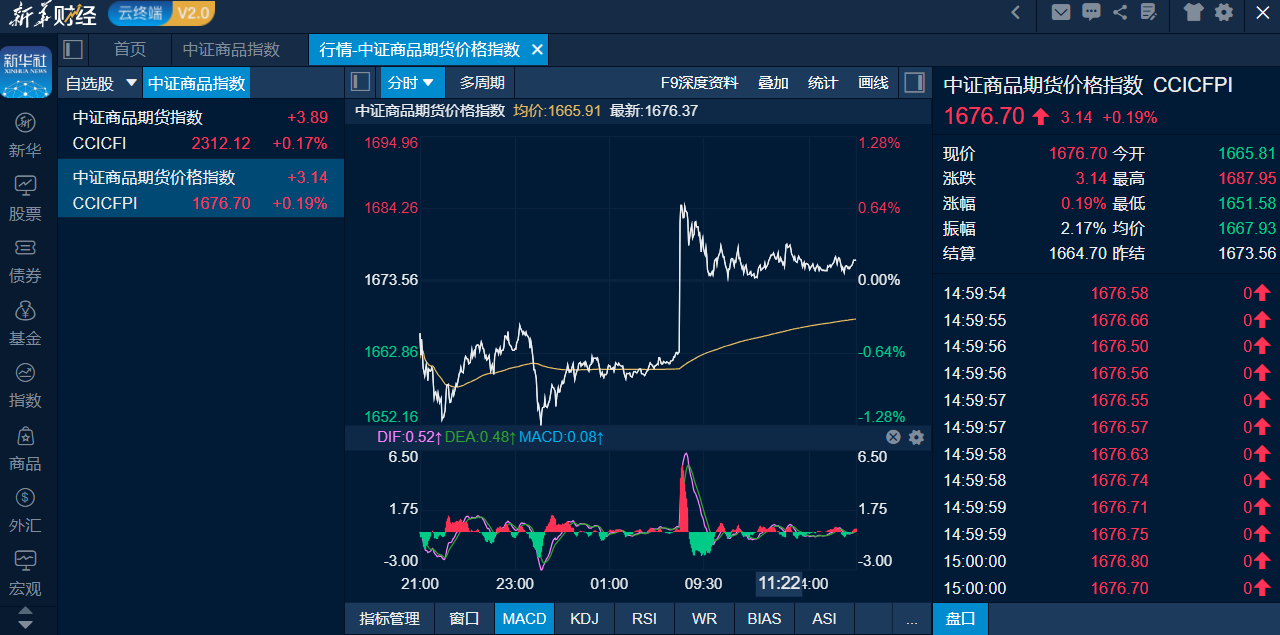
Market Overview - The domestic commodity futures market experienced a weak trend on January 19, with significant differentiation among sectors, resulting in most varieties closing lower. The China Securities Commodity Futures Price Index closed at 1676.70 points, up 3.14 points or 0.19% from the previous trading day, while the China Securities Commodity Futures Index closed at 2312.12 points, up 3.89 points or 0.17% [1]. Precious Metals - The precious metals sector was notably active, with international gold and silver prices reaching historical highs, which boosted domestic gold and silver futures. Shanghai gold hit a new historical high, while Shanghai silver rose nearly 3% by the end of the day [1][3]. Chemical Sector - In the chemical sector, pure benzene and styrene showed strong performance, closing up 3.48% and 1.84% respectively, leading the chemical sector. The strong performance of styrene is attributed to multiple maintenance shutdowns and export factors, which have increased its profitability [4]. Industrial Metals - The industrial metals sector faced widespread pressure, with Shanghai tin leading the decline, falling 5.98% after a significant drop of over 6% the previous Friday. The market sentiment cooled rapidly, leading to a correction in tin prices after reaching historical highs [5]. Other major industrial metals, including copper, aluminum, and zinc, also saw declines ranging from 0.39% to 2.33% [5]. Agricultural Products - The agricultural products sector, particularly rapeseed meal and oil, experienced significant declines, with rapeseed meal dropping 2.37% and rapeseed oil falling 1.50%. Concerns over potential increases in supply due to improved Sino-Canadian relations contributed to this downturn [6]. The overall weak supply-demand dynamics are expected to keep rapeseed meal prices under pressure [6].

《黑色》日报-20260119
Guang Fa Qi Huo· 2026-01-19 07:47
1. Report Industry Investment Ratings No investment ratings are provided in the reports. 2. Core Views Steel - Steel supply and demand are both weak, with controllable real - inventory pressure and limited industrial contradictions. Prices follow raw material fluctuations, and the steel price is expected to fluctuate within a range. The reference range for the May contract of rebar is 3050 - 3250 yuan, and for hot - rolled coils is 3200 - 3350 yuan [1]. Iron Ore - Iron ore faces a situation of weak supply and demand. The price is suppressed by high inventory on the upside and supported by steel mill restocking expectations and hot - metal复产 on the downside. It is expected to maintain high - level volatility, with a reference range of 770 - 830 [4]. Coke - After the fourth round of price cuts for coke, some coke enterprises resist further cuts and initiate price increases, which are expected to be implemented. It is recommended to go long on the dips and pay attention to the strategy of going long on coking coal and short on coke [6]. Coking Coal - Driven by pre - Spring Festival restocking demand, it is recommended to go long on the dips and pay attention to the strategy of going long on coking coal and short on coke [6]. Ferrosilicon - Short - term ferrosilicon supply - demand contradictions are limited, and there is a lack of upward drivers at the industrial level. After a pullback, one can try to go long on the dips, with a bottom support reference of around 5500 [7]. Silicomanganese - Silicomanganese is in a situation of weak supply and demand. High inventory suppresses prices in the short term, but manganese ore provides support. It is expected to fluctuate widely, with a local support reference of around 5800 [7]. 3. Summary by Directory Steel Prices and Spreads - Rebar and hot - rolled coil spot and futures prices in different regions have varying degrees of increase or decrease. The spread between the May contracts of hot - rolled coils and rebar has widened to 161 [1]. Cost and Profit - Steel billet and slab prices remain unchanged. The costs of different types of steel production have different changes, and the profits of different regions and varieties also vary [1]. Supply - The daily average hot - metal output has decreased by 0.7%, and the output of the five major steel products has increased slightly by 0.1%. The output of rebar and hot - rolled coils has different trends [1]. Inventory - The inventory of the five major steel products has decreased by 0.6%. The inventory of rebar remains unchanged, and the inventory of hot - rolled coils has decreased by 1.6% [1]. Demand - The demand has decreased month - on - month, mainly due to the seasonal weakening of rebar demand. The apparent demand for rebar remains low, while that for hot - rolled coils has recovered month - on - month, better than the seasonal average in previous years [1]. Iron Ore Prices and Spreads - The warehouse - receipt costs and 05 - contract basis of various iron ore varieties have slightly decreased. The 5 - 9 spread and 1 - 5 spread have changed to different extents [4]. Supply - The 45 - port arrival volume has increased by 5.9%, the global shipment volume has decreased by 1.0%, and the national monthly import volume has increased by 8.2% [4]. Demand - The daily average hot - metal output of 247 steel mills has decreased by 0.6%, the 45 - port daily average desulfurization volume has decreased by 1.0%, and the national monthly pig iron and crude steel output have decreased [4]. Inventory - The 45 - port inventory has increased by 1.7%, the 247 steel mills' imported ore inventory has increased by 3.0%, and the inventory - available days of 64 steel mills have increased by 10.5% [4]. Coke Prices and Spreads - Coke and coking coal spot and futures prices have decreased to different extents. The basis and spreads of different contracts have also changed [6]. Supply - The daily average output of all - sample coking plants has decreased by 0.2%, and the daily average output of 247 steel mills has decreased by 0.3% [6]. Demand - The hot - metal output of 247 steel mills has decreased by 0.6% [6]. Inventory - The total coke inventory has increased by 0.5%, and the coking coal inventory of different entities has different trends [6]. Supply - Demand Gap - The coke supply - demand gap has increased by 188.0% [6]. Ferrosilicon Prices and Spreads - Ferrosilicon and silicomanganese futures and spot prices have decreased. The spreads between different regions and contracts have changed [7]. Cost and Profit - The production costs of ferrosilicon in different regions have slightly changed, and the production profits have decreased. The prices of manganese ore raw materials remain stable [7]. Supply - The weekly output of ferrosilicon has decreased slightly, and the production enterprises' operating rate has decreased by 1.4% [7]. Demand - The weekly demand for ferrosilicon has decreased, and the iron - making - related demand indicators have also decreased [7]. Inventory - The inventory of 60 sample ferrosilicon enterprises has decreased by 7.5%, and the average available days of downstream ferrosilicon have decreased [7]. Silicomanganese Prices and Spreads - Silicomanganese futures and spot prices have decreased, and the spreads between different regions and contracts have changed [7]. Cost and Profit - The production costs of silicomanganese in different regions remain stable, and the manganese ore prices are strong [7]. Supply - The weekly output of silicomanganese remains unchanged, and the operating rate has decreased by 0.1% [7]. Demand - The demand for silicomanganese has decreased, and the iron - making - related demand indicators have also decreased [7]. Inventory - The inventory of 63 sample silicomanganese enterprises has decreased by 2.5%, and the average available days of silicomanganese inventory have decreased [7].
日度策略参考-20260119
Guo Mao Qi Huo· 2026-01-19 05:27
Industry Investment Ratings - Macrofinance: Index (Long-term bullish, short-term shock adjustment), Treasury bonds (Shock), Copper (Shock), Aluminum (Shock), Alumina (Shock), Zinc (Shock), Nickel (High-level shock), Stainless steel (High-level shock), Tin (Potential for increase), Precious metals (High-level wide-range shock), Industrial silicon and polysilicon (Bearish), Lithium carbonate (No clear rating), Rebar (Shock), Iron ore (Shock), Coke (Shock), Coking coal (Bullish), Anthracite (Bullish), Palm oil (Shock), Soybean oil (Bullish), Rapeseed oil (Bearish), Cotton (Shock), Sugar (Bearish), Corn (Shock), Soybeans (Bearish), Pulp (Shock), Logs (Shock), Live pigs (Shock), Fuel oil (Shock), Bitumen (Shock), BR rubber (Bullish), PTA (Shock), Ethylene glycol (Shock), Styrene (Bearish), Urea (Shock), PF (Shock), PVC (Shock), LPG (Bullish), Container shipping European line (Shock) [1] Core Views - The policy aims for a "slow bull" in the stock index rather than suppressing the market. The short-term shock adjustment space is expected to be limited, and long-term bulls can choose opportunities to layout. Asset shortages and a weak economy are beneficial to bond futures, but the central bank has recently warned of interest rate risks. The downstream demand is relatively pressured, and with the US suspending the tax on key minerals, the short-term concern about copper hoarding has eased, causing copper prices to fall from high levels. The supply of nickel ore remains tight, but the continuous accumulation of global nickel inventories may restrict the rise of nickel prices. The prices of precious metals are expected to shift to high-level wide-range shocks. The prices of industrial silicon and polysilicon are bearish. The prices of black metals are affected by weak reality and strong expectations. The prices of agricultural products are affected by various factors such as supply and demand, policies, and weather. The prices of energy and chemical products are affected by factors such as supply and demand, geopolitical situations, and cost support [1] Summary by Directory Macrofinance - Index: The stock index rose strongly in the first half of the week and then adjusted with policy regulation. The short-term shock adjustment space is limited, and long-term bulls can choose opportunities to layout [1] - Treasury bonds: Asset shortages and a weak economy are beneficial to bond futures, but the central bank has recently warned of interest rate risks. Pay attention to the interest rate decision of the Bank of Japan [1] Non-ferrous Metals - Copper: The downstream demand is relatively pressured, and with the US suspending the tax on key minerals, the short-term concern about copper hoarding has eased, causing copper prices to fall from high levels [1] - Aluminum: The recent industrial drive is limited, and the macro sentiment has weakened, causing aluminum prices to fall from high levels [1] - Alumina: The alumina production capacity still has a large release space, and the industrial side weakens the price. However, the current price is basically near the cost line, and the price is expected to fluctuate [1] - Zinc: The cost center of the zinc fundamentals is stable, but the inventory pressure is obvious. The current price has insufficient fundamental support, and the zinc price fluctuates in a range under the repeated macro sentiment [1] - Nickel: The supply of nickel ore remains tight, but the continuous accumulation of global nickel inventories may restrict the rise of nickel prices. The short-term nickel price fluctuates at a high level and is still affected by the resonance of the non-ferrous metal sector. It is recommended to pay attention to the policy changes in Indonesia, the macro sentiment, and the futures positions [1] - Stainless steel: The price of raw material nickel iron continues to rise, the social inventory of stainless steel decreases slightly, and the steel mill's production schedule in January increases. Pay attention to the actual production situation of the steel mill. The stainless steel futures fluctuate at a high level, and it is recommended to go long at low levels in the short term [1] - Tin: The short-term macro sentiment is repeated, and the tin price has corrected. However, the supply vulnerability of tin ore still exists, and it still has the driving force to rise. Pay attention to the opportunity of low absorption [1] - Precious metals: The geopolitical situation has cooled down, and the rise of precious metal prices has slowed down. The silver price has fallen under pressure. The short-term gold and silver prices are expected to shift to high-level wide-range shocks. In the long term, it is recommended to allocate platinum at low levels or choose the arbitrage strategy of [long platinum, short palladium] [1] Black Metals - Rebar: The expectation is strong, but the spot is weak, and the sentiment transmission to the spot is not smooth. The continuous rise kinetic energy is insufficient. Unilaterally long orders should leave the market and wait and see; participate in the positive arbitrage position in the spot and futures [1] - Iron ore: The sector rotates, but the upper pressure of iron ore is obvious. It is not recommended to chase long at this position. The weak reality and strong expectation are intertwined. The actual supply and demand continue to be weak, and the energy consumption double control and anti-involution may disturb the supply [1] - Coke: The short-term market sentiment warms up, and the supply and demand are supported, but the medium-term supply and demand continue to be surplus, and the price is under pressure [1] - Coking coal: If the expectation of "capacity reduction" continues to ferment and the spot replenishes the inventory before the Spring Festival, coking coal may still have room to rise, but the actual rise space is difficult to judge, and the volatility increases after a large rise. It is necessary to be cautious [1] - Anthracite: The logic is the same as that of coking coal [1] Agricultural Products - Cotton: The domestic new crop production expectation is strong, but the purchase price of seed cotton supports the cost of lint. The downstream start-up maintains a low level, but the yarn mill inventory is not high, and there is a rigid replenishment demand. The cotton market is currently in a situation of "supported but no driving force." Pay attention to the tone of the No. 1 Central Document on direct subsidy prices and cotton planting areas in the first quarter of next year, the intention of cotton planting areas next year, the weather during the planting period, and the peak season demand from March to April [1] - Sugar: The global sugar is in surplus, and the domestic new crop supply increases. The short consensus is relatively consistent. If the disk continues to fall, the lower cost support is strong, but the short-term fundamentals lack continuous driving force. Pay attention to the changes in the capital side [1] - Corn: The grain sales progress of Northeast corn is relatively fast, the port inventory is low, and the middle and lower reaches have a certain replenishment demand before the festival. The short-term spot is still relatively strong, and the disk is expected to fluctuate in a range [1] - Soybeans: With the progress of the Brazilian harvest, the Brazilian CNF premium is expected to reflect the selling pressure of the soybean harvest. Coupled with the pressure on the rapeseed sector from the Sino-Canadian easing, the MO5 is expected to be under pressure, and the MO5 - M09 is expected to be in a reverse arbitrage [1] - Pulp: The pulp fell today due to the decline of the commodity macro. The overall did not break through the shock range. The short-term commodity sentiment fluctuates greatly. It is recommended to wait and see cautiously [1] - Logs: The spot price of logs has recently shown a certain sign of bottoming out and rebounding. It is expected that the further decline space of the futures price is limited. However, the external quotation in January still shows a slight decline, and the spot and futures markets of logs lack driving factors for rising. It is expected to fluctuate in the range of 760 - 790 yuan/m³ [1] - Live pigs: The spot and futures of live pigs gradually stabilize. The demand support and the unsold slaughter weight, and the production capacity still needs to be further released [1] Energy and Chemical Products - Fuel oil: OPEC+ suspends production increase until the end of 2026. The uncertainty of the Russia-Ukraine peace agreement affects. The US sanctions the Venezuelan crude oil export. The short-term supply and demand contradiction is not prominent, and it follows the crude oil. The demand for the 14th Five-Year Plan rush work is likely to be falsified, and the supply of Ma Rui crude oil is not short. The asphalt profit is high [1] - Bitumen: The raw material cost support is strong. The spot-futures price difference rebounds greatly. The intermediate inventory increases [1] - BR rubber: The disk position decreases, and the new warehouse receipts increase. The BR increase slows down periodically. The spot leads the rise to repair the basis, and the BR continues to pay attention to the upward driving force above 12,000. The BD/BR listing price continues to be raised, and the processing profit of butadiene rubber narrows. The overseas cracking device capacity is cleared, which is beneficial to the long-term export expectation of domestic butadiene. The naphtha tax also has a positive support for the butadiene price. Fundamentally, butadiene rubber maintains high operation and high inventory, and the transaction center is average. Styrene-butadiene rubber is relatively better than butadiene rubber [1] - PTA: The PX market has experienced a rapid rise, and this round of rise is not due to a fundamental change. The PX fundamentals are indeed supported, and the market is expected to continue to tighten in 2026, driven by the new PTA production capacity in India and the organic growth of demand. The domestic PTA maintains high operation. The gasoline price difference is still at a high level, which supports the aromatics [1] - Ethylene glycol: The market spreads the news that two sets of MEG devices in Taiwan, China, with a total annual production capacity of 720,000 tons, plan to stop production next month due to efficiency reasons. Ethylene glycol rebounded rapidly during the continuous decline due to the stimulation of supply-side news. The current polyester downstream start-up rate maintains above 90%, and the demand performance slightly exceeds expectations [1] - Styrene: The Asian styrene market is generally stable. The suppliers are reluctant to reduce prices due to continuous losses, while the buyers insist on pressing prices due to the weak downstream polymer demand and profit compression. Although the downstream demand is weak, the domestic market has a bullish sentiment due to the export support. The market is in a weak balance state, and the short-term upward driving force needs to pay attention to the drive of the overseas market [1] - Urea: The export sentiment eases slightly, and the domestic demand is insufficient. The upper space is limited. The lower has the support of anti-involution and the cost side [1] - PF: The geopolitical conflict intensifies, and the crude oil has a rising risk. The maintenance decreases, and the operation load is at a high level. The long-distance arrival increases the supply. The downstream demand operation weakens. The price returns to a reasonable range [1] - PVC: There is less global production in 2026, and the future expectation is optimistic. The fundamentals are poor. The export tax rebate is cancelled, and there may be a phenomenon of rushing to export later. The differential electricity price in the northwest region is expected to be implemented, forcing the PVC production capacity to be cleared [1] - LPG: The January CP rises unexpectedly, and the cost support of imported gas is strong. The geopolitical conflict in the Middle East escalates, and the short-term risk premium rises. The EIA weekly C3 inventory accumulation trend slows down, and it is expected to gradually turn to destocking. The domestic port inventory also decreases [1] - Container shipping European line: It is expected to peak in mid-January. The airlines are still cautious in their tentative re-navigation. The pre-festival replenishment demand still exists [1]
黑色金属数据日报-20260119
Guo Mao Qi Huo· 2026-01-19 04:20
| | | | | | | | HE STATE W | | | | | --- | --- | --- | --- | --- | --- | --- | --- | --- | --- | --- | | | | | | | | | 2026/01/19 | 国贸期货出品 TG国贸期货 | | | | | | | | | | | | 投资咨询业务资格:证监许可[2012] 31号 | | | | | | | | | | | 黑色金属研究中心 | 执业证号 | 投资咨询证号 | | | | | | | | | | 张宝慧 | F0286636 | Z0010820 | | | | | | | | | | 黄志鸿 | F3051824 | Z0015761 | | | | | | | | | | 董子勖 | F03094002 | Z0020036 | | | | | | | | | | 薛夏泽 | F03117750 | Z0022680 | | | | 远月合约收盘价 (元/吨) 元 | RB2610 | HC2610 | 12609 | J2609 | JM2609 | 6000 | | | 400 3 ...
铁矿石早报-20260119
Yong An Qi Huo· 2026-01-19 02:38
Group 1: Spot Market Data - Newman powder price is 809, with a daily change of -1 and a weekly change of -5, and the import profit is 19.32 [1] - PB powder price is 819, with a daily change of -1 and a weekly change of -3 [1] - Macfarlane powder price is 812, with a daily change of -1 and a weekly change of -12, and the import profit is 47.16 [1] - Jinbuba powder price is 772, with a daily change of -1 and a weekly change of -3, and the import profit is 55.23 [1] - Mixed powder price is 754, with a daily change of -1 and a weekly change of -2, and the import profit is 13.74 [1] - Super special powder price is 688, with a daily change of -5 and a weekly change of -13, and the import profit is 2.12 [1] - Carajás powder price is 905, with a daily change of -1 and a weekly change of -10, and the import profit is -1.75 [1] - Brazilian mixed powder price is 850, with a daily change of -1 and a weekly change of -13, and the import profit is 13.32 [1] - Brazilian coarse IOC6 price is 774, with a daily change of -1 and a weekly change of -12 [1] - Brazilian coarse SSFG price is 779, with a daily change of -1 and a weekly change of -12 [1] - Ukrainian concentrate price is 892, with a daily change of -1 and a weekly change of -15 [1] - 61% Indian powder price is 761, with a daily change of -1 and a weekly change of -3 [1] - Karara concentrate price is 896, with a daily change of -1 and a weekly change of -11 [1] - Roy Hill powder price is 806, with a daily change of -1 and a weekly change of -3, and the import profit is 65.68 [1] - KUMBA powder price is 878, with a daily change of -1 and a weekly change of -3 [1] - 57% Indian powder price is 623, with a daily change of -5 and a weekly change of -13 [1] - Atlas powder price is 749, with a daily change of -1 and a weekly change of -2 [1] - Tangshan iron concentrate price is 977, with a daily change of 0 and a weekly change of 1 [1] Group 2: Futures Market Data - i2601 contract price is 806.5, with a daily change of -26.0 and a weekly change of -45.5, and the monthly spread is -13.0 [1] - i2605 contract price is 812.0, with a daily change of -1.0 and a weekly change of -2.5, and the monthly spread is -5.5 [1] - i2609 contract price is 793.5, with a daily change of -0.5 and a weekly change of 0.5, and the monthly spread is 18.5 [1] - FE01 contract price is 107.39, with a daily change of -0.61 and a weekly change of -0.46, and the monthly spread is -2.04 [1] - FE05 contract price is 106.74, with a daily change of -0.75 and a weekly change of -0.02, and the monthly spread is 0.65 [1] - FE09 contract price is 105.35, with a daily change of -0.48 and a weekly change of 0.51, and the monthly spread is 1.39 [1]
铁矿周报:港库持续增加,铁矿震荡承压-20260119
Tong Guan Jin Yuan Qi Huo· 2026-01-19 01:50
1. Report Industry Investment Rating - No relevant content provided 2. Core Views of the Report - Supply is generally loose with the arrival of the first shipment of Simandou iron ore in China; overseas shipments declined last week, but recent concentrated arrivals of iron ore have led to a continuous increase in port inventories. On the demand side, last week's hot metal production declined, iron ore daily consumption decreased, and in - plant inventories increased. Overall, supply is stronger than demand, and the futures price is expected to be under pressure with fluctuations. Attention should be paid to the impact of steel mills' restocking before the Spring Festival [1][6] 3. Summary by Related Catalogs 3.1 Transaction Data - SHFE rebar closed at 3163 yuan/ton, up 19 yuan or 0.60% with a total trading volume of 5178836 lots and a total open interest of 2320984 lots - SHFE hot - rolled coil closed at 3315 yuan/ton, up 21 yuan or 0.64% with a total trading volume of 2077198 lots and a total open interest of 1448345 lots - DCE iron ore closed at 812.0 yuan/ton, down 2.5 yuan or - 0.31% with a total trading volume of 1331049 lots and a total open interest of 652402 lots - DCE coking coal closed at 1171.0 yuan/ton, down 24.5 yuan or - 2.05% with a total trading volume of 6677833 lots and a total open interest of 625637 lots - DCE coke closed at 1717.0 yuan/ton, down 31.0 yuan or - 1.77% with a total trading volume of 116309 lots and a total open interest of 38799 lots [2] 3.2 Market Review - **Demand side**: Last week, hot metal production declined, iron ore daily consumption decreased, and in - plant inventories increased. The blast furnace operating rate of 247 steel mills was 78.84%, a decrease of 0.47 percentage points from the previous week and an increase of 1.66 percentage points from the same period last year. The blast furnace iron - making capacity utilization rate was 85.48%, a decrease of 0.56 percentage points from the previous week and an increase of 1.20 percentage points from the same period last year. The steel mill profitability rate was 39.83%, an increase of 2.17 percentage points from the previous week and a decrease of 10.39 percentage points from the same period last year. The daily average hot metal production was 228.01 tons, a decrease of 1.49 tons from the previous week and an increase of 3.53 tons from the same period last year - **Supply side**: Overseas shipments declined last week, but recent concentrated arrivals of iron ore have led to a continuous increase in port inventories. On January 17, the first shipment of nearly 200,000 tons of Simandou iron ore arrived at China Baowu's Majishan Port. The total global iron ore shipments last week were 31.809 million tons, a decrease of 328,000 tons from the previous week. The total shipments from Australia and Brazil were 26.064 million tons, a decrease of 1.364 million tons from the previous week. The inventory of imported iron ore at 47 ports across the country was 172.887 million tons, an increase of 2.4426 million tons from the previous week; the daily average port clearance volume was 3.3502 million tons, a decrease of 194,000 tons [4][5] 3.3 Industry News - The State Council executive meeting deployed a package of policies for fiscal and financial coordination to boost domestic demand, including optimizing loan discount policies for service - sector business entities and personal consumption loans, implementing loan discount policies for small and medium - sized enterprises, establishing a special guarantee plan for private investment, and optimizing the fiscal discount policy for equipment renewal loans - The Ministry of Finance and other three departments announced that from January 1, 2026, to December 31, 2027, taxpayers who sell their self - owned housing and repurchase a housing in the market within one year after the sale of their current housing will be eligible for a tax refund on the individual income tax paid for the sale of their current housing - The central bank launched a "combination punch" to support high - quality economic development, including lowering the re - loan and re - discount rates by 0.25 percentage points, merging the use of re - loans for supporting agriculture and small businesses with re - discount quotas, increasing the re - loan quota for supporting agriculture and small businesses by 500 billion yuan, setting up a 1 - trillion - yuan re - loan for private enterprises in the total quota, expanding the support scope of the carbon emission reduction support tool, and lowering the minimum down - payment ratio for commercial housing purchase loans to 30%. The central bank said there is still room for reserve requirement ratio cuts and interest rate cuts this year - According to China Baowu, the first shipment of Simandou iron ore arrived at China Baowu's Majishan Port. On January 17, the first shipment of nearly 200,000 tons of Simandou iron ore successfully arrived at a Chinese port [10] 3.4 Related Charts - The report provides multiple charts showing data such as the profitability rate of steel mills across the country, daily average pig iron production, global iron ore shipments, port inventories, and domestic mine iron ore production from 2022 to 2026 [8][11][26]