跨境电商

Search documents
八马茶业通过港交所上市聆讯 | 10月14日早报
Sou Hu Cai Jing· 2025-10-14 02:16
Star Brands - Ye Guofu, the founder of Miniso and non-independent director of Yonghui Supermarket, emphasized the importance of direction in the company's transformation, stating that progress is key and that they will achieve great success [2] - Yonghui Supermarket's CEO Wang Shoucheng reported an average customer traffic increase of 80% in the transformed stores, with 102 stores achieving a net promoter score (NPS) average exceeding 40, and 19 stores surpassing 50 [3] - Yonghui plans to develop 100 billion-yuan-level flagship products over the next three years, collaborating with 200 core strategic partners to create compelling reasons for consumers to choose Yonghui [4] Consumer Platforms - Alibaba's cross-border e-commerce platform Lazada has integrated with Tmall to facilitate easier access for Tmall merchants to Southeast Asian markets, indicating a growing trend in cross-border e-commerce [5] - AliExpress has reported over 100,000 artificial Christmas trees being shipped overseas in preparation for the Double 11 and Black Friday sales, marking a new high in holiday inventory [6] - A report on outdoor sports consumption revealed that 60% of users on the Dewu app spend over 8,000 yuan annually, with a significant portion of users being from Generation Z [7] Investment and Financial Reports - Nanchao Foods reported a September consolidated revenue of 276 million yuan, reflecting a slight year-on-year increase of 0.0016% [12] - Eight Horses Tea has passed the listing hearing at the Hong Kong Stock Exchange, with joint sponsors including Huatai International and Agricultural Bank of China International [13] Macro News - The General Administration of Customs reported that China exported over 50 billion yuan worth of holiday goods, dolls, and animal-shaped toys in the first three quarters, highlighting the global appeal of domestic products [15]



前三季度我国货物贸易顶住压力实现平稳增长,同比增速达4%
Ren Min Ri Bao· 2025-10-14 01:32
Core Viewpoint - China's foreign trade has shown resilience and steady growth in the first three quarters of the year, with a year-on-year growth rate of 4% in total goods trade [2] Group 1: Trade Performance - In the first three quarters, China's total goods trade reached 33.61 trillion yuan, with exports at 19.95 trillion yuan (up 7.1%) and imports at 13.66 trillion yuan (down 0.2%) [2] - The import and export growth rates have accelerated quarterly, with growth rates of 1.3%, 4.5%, and 6% in the first, second, and third quarters respectively [2][3] - The number of foreign trade entities with import and export performance reached 700,000 for the first time, exceeding last year's total [2][3] Group 2: Market Diversification - Trade with countries involved in the Belt and Road Initiative reached 17.37 trillion yuan, growing by 6.2% and accounting for 51.7% of total trade [2] - Exports to ASEAN, Latin America, Africa, and Central Asia grew by 9.6%, 3.9%, 19.5%, and 16.7% respectively [2] Group 3: Export Product Trends - Exports of mechanical and electrical products reached 12.07 trillion yuan, growing by 9.6% and accounting for 60.5% of total exports [3] - High-tech product exports, including electronic information and high-end equipment, saw significant growth rates of 8.1%, 22.4%, and 15.2% respectively [3] Group 4: Import Trends - Imports began to recover, with a growth rate of 4.7% in the third quarter, driven by increased demand for raw materials and high-tech equipment [3][6] - The import quantity index increased by 0.6% year-on-year, despite a 0.2% decline in total import value [6] Group 5: Cross-Border E-commerce - Cross-border e-commerce imports and exports reached approximately 2.06 trillion yuan, growing by 6.4%, with exports at about 1.63 trillion yuan [7] - Major export categories included apparel, digital products, and home appliances, while imports were primarily beauty products, food, and healthcare items [7] Group 6: Regional Trade Developments - The western region of China saw foreign trade growth of 10.2%, with total trade reaching 3.21 trillion yuan in the first three quarters [8] - The western region's trade through the New Western Land-Sea Corridor grew by 19.3%, contributing significantly to overall trade growth [8]
三个关键词, 看我国外贸何以量质齐升
Mei Ri Shang Bao· 2025-10-13 23:22
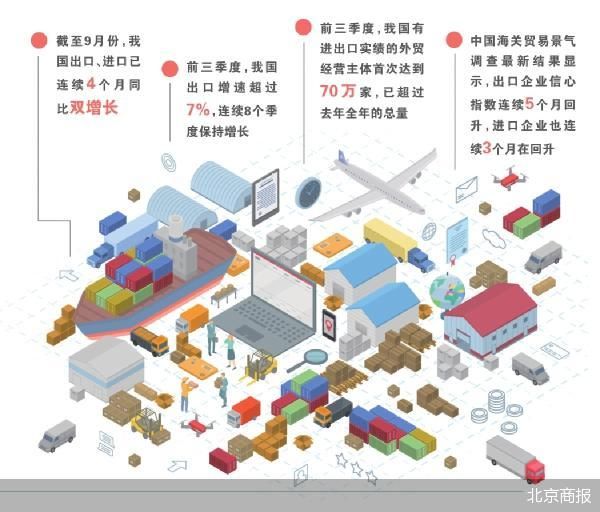
Core Viewpoint - China's foreign trade has shown resilience and a positive development trend in the first three quarters of the year, with a total import and export value of 33.61 trillion yuan, a year-on-year increase of 4% [1] Group 1: Resilience - The strong resilience of China's foreign trade is reflected in its stable performance, with China's share of global goods trade at 11.8% in the first seven months, maintaining its position as the world's largest goods trader [2] - The overall growth rate of imports and exports has accelerated, with quarterly growth rates of 1.3%, 4.5%, and 6% respectively, marking eight consecutive quarters of year-on-year growth [2] - In September alone, imports and exports reached 4.04 trillion yuan, a year-on-year increase of 8%, the highest monthly growth rate of the year [2] Group 2: Growth Momentum - The growth momentum is driven by the continuous development of new productive forces and the upgrading of key industries, with high-tech product exports increasing by 11.9% year-on-year, contributing over 30% to overall export growth [3] - The export of industrial robots surged by 54.9%, and green products like wind power equipment and electric locomotives also saw significant growth [3] - Cross-border e-commerce has emerged as a new driving force for foreign trade growth, with exports primarily in apparel, jewelry, and digital products [3][4] Group 3: Market Expansion - The number of foreign trade entities has reached 700,000, surpassing last year's total, indicating a robust and proactive approach among trade participants [5][6] - China has expanded its trade partnerships, being among the top three trading partners for 166 countries and regions, an increase of 14 from the previous year [6] - Trade with countries involved in the Belt and Road Initiative reached 17.37 trillion yuan, a year-on-year increase of 6.2%, accounting for 51.7% of total trade [6][7] Group 4: Future Outlook - Despite the positive trends, the external environment remains complex and challenging, with uncertainties and difficulties increasing, necessitating continued efforts to stabilize foreign trade in the fourth quarter [8]
下单“中国服务”
Ren Min Ri Bao Hai Wai Ban· 2025-10-13 22:53
Core Insights - China's service exports are experiencing significant growth, with an average annual increase of 7.3% projected from 2014 to 2024, rising from $219.1 billion to $445.9 billion [15][18] - The Ministry of Commerce and nine other departments have introduced new policies to promote service exports, focusing on digital services, high-end design, and supply chain services [15][16] - The global service trade is expected to maintain growth, with the WTO forecasting a 4.0% increase in global service exports by 2025 [18] Service Trade Growth - In the first eight months of this year, China's service trade reached a total of 52,476.9 billion yuan, a year-on-year increase of 7.4%, with exports growing by 14.7% to 23,004.4 billion yuan [12][18] - Knowledge-intensive service exports accounted for over 50% of total service exports, with a 9.4% year-on-year growth, highlighting the increasing competitiveness of high-tech services [12][15] Policy Support - The new policies aim to streamline export tax refund processes and enhance financial services for small and medium-sized enterprises, improving the overall efficiency of service exports [16][19] - Specific measures include optimizing the declaration process for service export tax refunds and expanding export credit insurance coverage [16][19] Market Opportunities - The cultural and creative sectors, including gaming and digital content, are expanding internationally, with companies like NetEase successfully launching over 30 games in global markets [17] - Various provinces are actively developing service trade, with Zhejiang aiming for service imports and exports to exceed 850 billion yuan by 2027, accounting for over 10% of the national total [19] Future Outlook - The service trade sector is expected to benefit from favorable conditions in the second half of the year, with continued growth in travel services and knowledge-intensive exports [18][19] - The Ministry of Commerce is committed to implementing policies that support high-quality development in service trade, ensuring a conducive environment for growth [18][19]

前三季度外贸增速何以逐季加快(权威发布)
Ren Min Ri Bao· 2025-10-13 22:20
Core Viewpoint - China's foreign trade has shown resilience and steady growth in the first three quarters of the year, with a total import and export value of 33.61 trillion yuan, reflecting a year-on-year increase of 4% [1][2]. Trade Performance - Exports reached 19.95 trillion yuan, growing by 7.1%, while imports totaled 13.66 trillion yuan, a slight decline of 0.2% [1][2]. - In September, the total trade value was 4.04 trillion yuan, marking an 8% increase [2]. Growth Trends - The growth rate of imports and exports has accelerated each quarter, with increases of 1.3%, 4.5%, and 6% in the first, second, and third quarters respectively [2]. - The number of foreign trade entities with import and export performance reached 700,000 for the first time, surpassing last year's total [2][3]. Market Diversification - Trade with countries involved in the Belt and Road Initiative amounted to 17.37 trillion yuan, a growth of 6.2%, accounting for 51.7% of total trade [2]. - Exports to ASEAN, Latin America, Africa, and Central Asia grew by 9.6%, 3.9%, 19.5%, and 16.7% respectively [2]. Export Product Quality - Exports of mechanical and electrical products reached 12.07 trillion yuan, increasing by 9.6% and comprising 60.5% of total exports [3]. - High-tech product exports, including electronic information and high-end equipment, saw significant growth rates of 8.1%, 22.4%, and 15.2% respectively [3]. Import Recovery - Imports began to recover, with a 0.3% increase in the second quarter and a further acceleration to 4.7% in the third quarter [3]. - Notable increases in import volumes were seen for crude oil and metal ores, with year-on-year growth of 4.9% and 10.1% respectively [3]. Active Trade Entities - The number of active foreign trade entities increased by 5.2 million year-on-year, with private enterprises accounting for 613,000 and foreign-invested enterprises for 80,000 [3][5]. Global Trade Position - China maintained its position as the world's largest goods trader, accounting for 11.8% of global trade in the first seven months [4]. - Exports of industrial robots surged by 54.9%, and wind power equipment exports grew by 23.9% [4]. Cross-Border E-commerce - Cross-border e-commerce trade reached approximately 2.06 trillion yuan, growing by 6.4%, with exports of about 1.63 trillion yuan and imports of 425.54 billion yuan [7]. - Major export categories included apparel, jewelry, and electronics, while imports were primarily beauty products, food, and healthcare items [7]. Western Region Trade Growth - The western region's trade maintained strong momentum, with imports and exports totaling 3.21 trillion yuan, a year-on-year increase of 10.2% [8]. - The western land-sea new corridor facilitated 611.5 billion yuan in trade, contributing to a 3.4 percentage point increase in the region's foreign trade growth [8].
前三季度外贸“成绩单”发布:出口企业信心指数连续5个月回升
Zhong Guo Jing Ying Bao· 2025-10-13 16:48
Group 1: Core Insights - China's manufacturing sector is experiencing significant growth, with exports of industrial robots increasing by 54.9% and wind power equipment exports rising by 23.9% in the first three quarters [1] - Trade with Shanghai Cooperation Organization (SCO) member countries has deepened, with imports and exports reaching 2.75 trillion yuan, a year-on-year increase of 2.4% [1] - The total value of China's goods trade reached 33.61 trillion yuan in the first three quarters, reflecting a 4% year-on-year growth, with exports growing by 7.1% and imports declining by 0.2% [2] Group 2: Export Trends - The export structure is continuously optimizing, with over 500 billion yuan worth of festive goods, toys, and animal-shaped products exported to over 200 countries, many of which are original Chinese products [2] - The popularity of Chinese cultural products, such as lanterns and bamboo crafts, has surged internationally, showcasing the appeal of original Chinese IP [3] - The number of foreign trade enterprises has increased to 700,000, a rise of 5.2% year-on-year, with private enterprises accounting for 61.3% of total trade [3] Group 3: Economic Stability and Challenges - China's foreign trade has shown resilience, with both exports and imports achieving year-on-year growth for four consecutive months [4] - Major provinces like Guangdong, Jiangsu, and Zhejiang contributed significantly to national trade growth, accounting for over 80% of the total increase [4] - Despite global economic uncertainties and rising protectionism, China's economic fundamentals remain strong, supporting sustained trade growth [4] Group 4: Cross-Border E-commerce - Cross-border e-commerce has emerged as a vital growth driver, with imports and exports reaching 1.37 trillion yuan in the first half of the year, a 10.3% increase [5] - The structure of cross-border e-commerce exports is dominated by apparel, jewelry, and electronics, while imports focus on beauty products and fresh food [5] - Customs reforms and innovations, such as electronic tax payment systems and streamlined logistics, are enhancing the efficiency and quality of cross-border e-commerce [6]
进出口超33万亿元 前三季度外贸稳中向好
Bei Jing Shang Bao· 2025-10-13 15:33
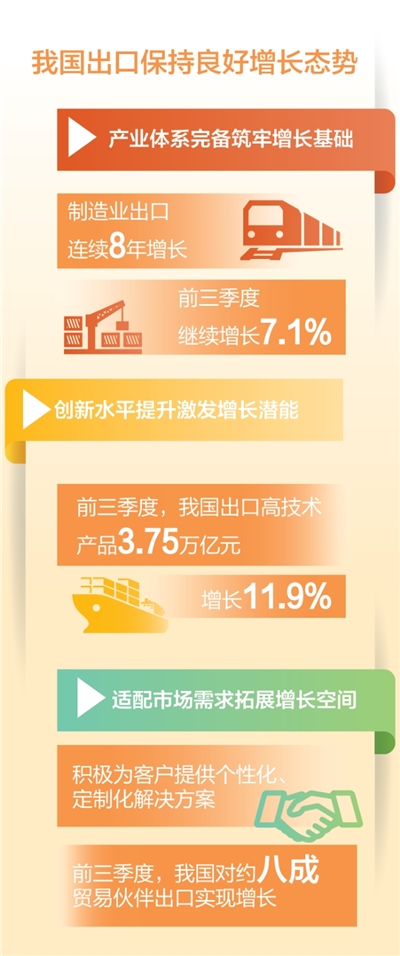
Core Viewpoint - China's foreign trade has shown resilience and growth in the face of complex external challenges, with a total import and export value of 33.61 trillion yuan, representing a year-on-year increase of 4% in the first three quarters of this year [1] Group 1: Trade Growth and Performance - China's import and export growth rate has accelerated quarterly, with increases of 1.3%, 4.5%, and 6% in the first, second, and third quarters respectively, marking eight consecutive quarters of year-on-year growth [3] - Approximately 80% of China's trade partners have experienced growth in exports, with the manufacturing sector showing a continuous increase in exports for eight years, including a 7.1% growth in the first three quarters of this year [3][4] - The export of high-tech products reached 3.75 trillion yuan, growing by 11.9%, contributing over 30% to the overall export growth [4] Group 2: Key Industries and Products - The export of industrial robots surged by 54.9%, while wind power equipment exports grew by 23.9%, indicating a shift towards advanced manufacturing and innovation [5] - Traditional cultural products, such as festival items and toys, have gained popularity overseas, with exports exceeding 50 billion yuan to over 200 countries and regions [8][9] Group 3: Cross-Border E-commerce - Cross-border e-commerce imports and exports reached approximately 2.06 trillion yuan, with exports growing by 6.6% and imports by 5.9% in the first three quarters [7] - The main export products include apparel, jewelry, and electronics, while imports focus on beauty products, food, and healthcare items [7] Group 4: Future Outlook and Support - The customs authority plans to enhance policy communication and training for businesses, aiming to improve the regulatory environment for cross-border e-commerce and facilitate smoother customs processes [7][9]
川普关税政策又生变,消费出海公司一线反馈
2025-10-13 14:56
Summary of Conference Call on U.S.-China Trade Tariffs Impact on Chinese Consumer Export Companies Industry Overview - The conference call discusses the impact of recent U.S. tariff policies on Chinese consumer export companies, particularly in the context of the ongoing U.S.-China trade tensions [1][2][3]. Key Companies and Their Strategies 1. 小商品城 (Small Commodity City) - Exports to the U.S. account for only 2% of its total, making it less affected by tariffs [1][3]. - Acts as a strategic asset in U.S.-China trade relations, leveraging a market procurement model and providing scalable services [3]. 2. 安克创新 (Anker Innovations) - Approximately 45% of exports are directed to the U.S. [5]. - Over 50% of production capacity has been relocated to Southeast Asia, expected to reach over 70% by year-end [5]. - Anticipates only a single-digit percentage impact on profit margins even if a 100% tariff is imposed, with potential price increases to mitigate effects [5]. 3. 名创优品 (Miniso) - Increased local sourcing in the U.S. to 30%-40% and raised prices on non-local products to offset tariff costs [6]. - Achieved growth in the North American market, with quarterly GMV accounting for about 10% of global sales [6]. - High gross margins (60%-70%) allow for effective cost transfer [6]. 4. 绿联科技 (Ugreen) - U.S. revenue comprises about 15%-20% of total sales, with 70%-80% of North American orders sourced from Southeast Asia [7]. - Maintains sufficient inventory to meet year-end demand, resulting in limited impact from tariffs [7]. 5. 智欧科技 (Zhiou Technology) - U.S. market revenue accounts for approximately 34% [8]. - Has transferred 70%-80% of production capacity to Southeast Asia and plans further increases [8]. - May seek local sourcing alternatives or cease related operations if tariffs are fully implemented [8]. General Industry Insights - The overall impact of U.S. tariffs on Chinese consumer export companies is considered limited, as many have already optimized their supply chains and relocated production [2][9]. - Companies like 赛维时代 (Saiwei Times) and 恒林股份 (Henglin) have also moved significant portions of their manufacturing to Southeast Asia [9]. Competitive Advantages - Chinese cross-border e-commerce companies possess advantages in brand building, product quality, and global market positioning [10]. - These companies are not solely reliant on Chinese manufacturing, enhancing their resilience against trade tensions [10]. Investment Outlook - Investors are encouraged to maintain confidence in the consumer export sector, as market panic may present opportunities to acquire shares in strong brands like Anker, Ugreen, and Miniso [11][12]. - The long-term potential of the consumer export sector remains significant, driven by brand value and global strategies rather than just production costs [12]. Conclusion on U.S. Policy Impact - The Trump administration's policies introduce short-term uncertainties but are manageable for leading companies that have adapted their strategies [13]. - The core competitiveness of these companies lies in their brand value and operational capabilities, allowing them to sustain growth despite policy fluctuations [13].



跨境电商新思路:巧用海外仓,应对仓储成本与库存压力
Sou Hu Cai Jing· 2025-10-13 14:16
Core Insights - The article discusses the emerging trend of combining "FBA (Fulfillment by Amazon) and overseas warehouses" as a strategy for cross-border e-commerce sellers to manage costs and maintain operational flexibility in light of tightening platform policies [1][3]. Group 1: Cost Management - Many sellers previously relied solely on FBA, but rising storage fees and changing inventory management rules have increased costs and risks associated with this model [3]. - Overseas warehouses offer a cost advantage, being 30% to 50% cheaper than FBA, without seasonal surcharges [4]. Group 2: Operational Flexibility - The combination of FBA for driving traffic and overseas warehouses for flexible inventory management enhances sellers' ability to respond to sales fluctuations [3]. - The dual-track model allows sellers to improve inventory flexibility and risk resilience while controlling costs [3]. Group 3: Inventory Management - Overseas warehouses provide more lenient storage policies, accommodating large items and slow-moving products [4]. - Automated replenishment suggestions based on sales data and real-time inventory classification during returns help streamline operations [4]. Group 4: Seller Considerations - Sellers with diverse product structures, multiple sales channels (e.g., Amazon, TikTok, independent sites), and frequent return handling issues may benefit from the "FBA + overseas warehouse" model [4].

技术驱动下的跨境电商新范式:Mera Mart以智能系统重构全球分销生态
Sou Hu Cai Jing· 2025-10-13 14:01
(来源:衡水日报) 此外,Mera Mart在风险控制与用户体验优化方面也展现出强大的技术实力。平台部署了智能风控模型,对交易行为进行实时监测,有效防范欺诈 与异常操作,保障资金安全。同时,区块链技术被应用于关键交易环节的数据存证与商品溯源,增强了终端消费者的信任感。对于分销商而言, 平台提供的数据看板可清晰展示销售趋势、用户画像与收益明细,帮助其科学决策,提升运营效率。 业内观察人士指出,Mera Mart的技术架构不仅提升了平台自身的运营效率,更重要的是,它为全球范围内的小微创业者提供了可复制、可持续的 创业工具。相比依赖资本投入和团队规模的传统电商路径,Mera Mart通过技术平权,让更多普通人得以低成本参与全球化分工。 随着平台业务规模的扩大,Mera Mart正进一步加大在技术研发上的投入,探索生成式AI在多语言内容生成、智能客服响应等场景的应用,持续降 低跨文化运营的门槛。其背后来自亚马逊、谷歌、阿里巴巴等科技巨头的核心团队,也为技术创新提供了坚实支撑。 编辑:牟玉珍 在全球电子商务持续增长的背景下,传统跨境分销模式正面临效率瓶颈与运营复杂度上升的双重挑战。越来越多的创业者渴望参与全球贸易,却 ...