
风力发电机组及零件

Search documents
视频丨产业链升级+制度护航 绿色贸易成我国外贸发展新动能
Yang Shi Xin Wen· 2025-11-24 23:28
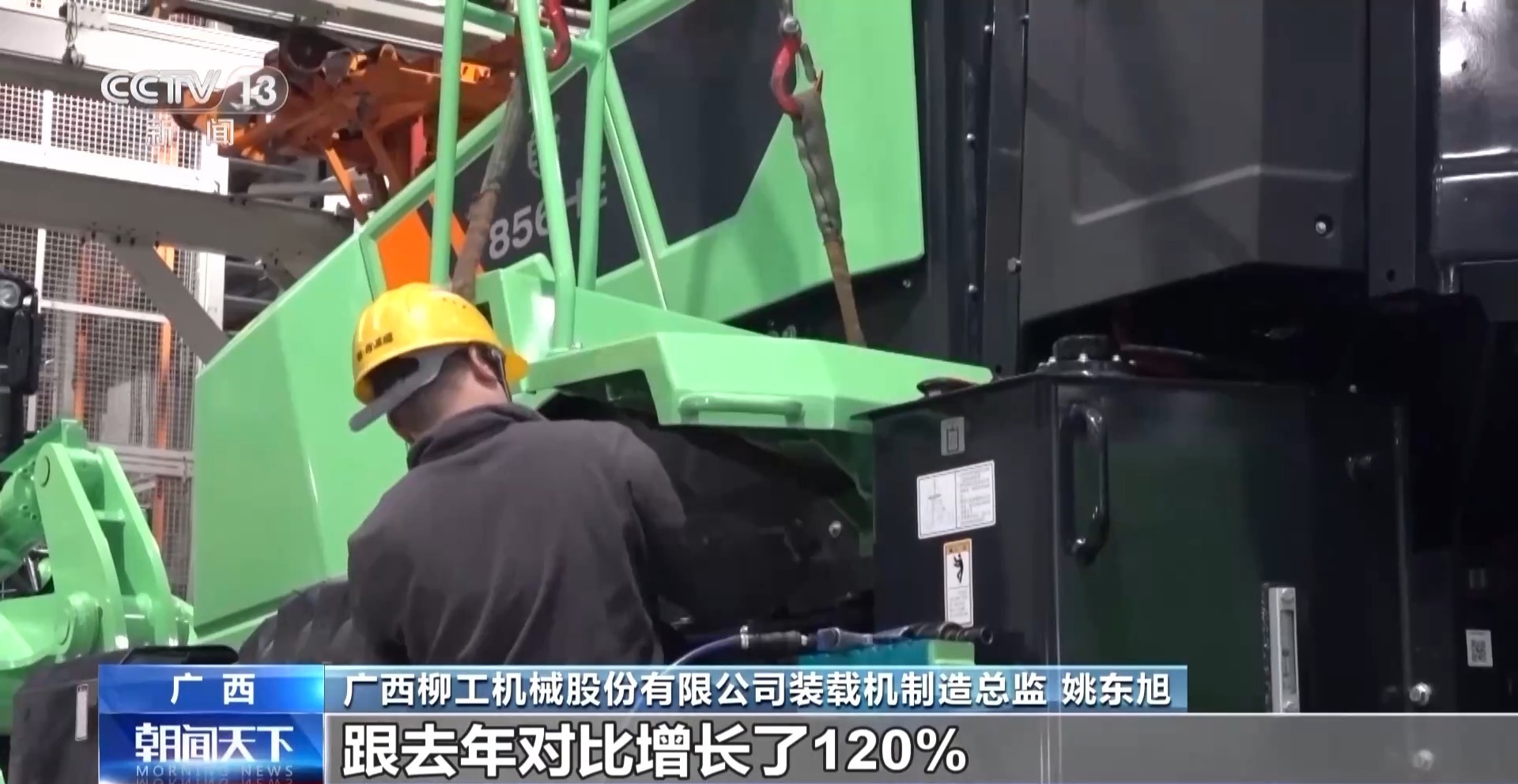
Core Viewpoint - China is actively expanding green trade to support its "dual carbon" goals, with green trade becoming a new driving force for foreign trade development as more green low-carbon products and services enter the international market [1][10]. Group 1: Green Product Export Growth - The export volume of electric loaders from Guangxi Liugong Machinery Co., Ltd. has increased by 120% compared to last year, with production capacity expanded from one to three production lines [3]. - In Zhejiang, a company is producing eco-friendly trademark belts made from recycled plastic bottles, showcasing the shift towards sustainable materials [5][8]. - In the first three quarters of this year, exports of wind turbine units and parts from China grew by over 30%, while photovoltaic products have maintained an export value exceeding 200 billion yuan for four consecutive years [10]. Group 2: Comprehensive Green Transformation - China's green product appeal in international markets stems from a comprehensive green transformation across the entire industrial chain, covering design, manufacturing, operation, and recycling [12]. - A refrigerator factory in Qingdao is producing energy-efficient refrigerators for the European market, with over 80% of its buildings equipped with solar panels, generating over 50 million kWh of green electricity annually [16][18]. - The factory expects to produce over 2 million refrigerators this year, saving approximately 10,000 tons of standard coal and reducing carbon dioxide emissions by over 26,000 tons [18]. Group 3: Institutional Support for Green Trade - The establishment of a green trade public service platform in Hubei aims to help export companies understand international carbon rules, addressing challenges in green transformation [28][31]. - China has accelerated the development of its green trade system, issuing 49 national standards for greenhouse gas emission accounting and 13 standards for carbon footprints [33]. - The Ministry of Commerce plans to promote high-quality development of green trade and enhance the green low-carbon development capabilities of enterprises [35].

今年前三季度我国海洋生产总值实现7.9万亿元 同比增长5.6%
Yang Guang Wang· 2025-11-04 01:29
Core Viewpoint - China's marine economy shows a stable and progressive trend with a marine GDP of 7.9 trillion yuan, reflecting a year-on-year growth of 5.6% in the first three quarters of the year [1] Marine Shipbuilding Industry - The overall development of China's marine shipbuilding industry remains stable, with the completion of marine vessels and the volume of orders on hand increasing by 6.7% and 25.7% year-on-year, respectively [1] - China's market shares in newly received orders, completed shipbuilding, and orders on hand are 63.5%, 47.3%, and 58.6%, respectively, maintaining a global leading position [1] Green Ship Technology - Continuous improvement in the innovation and supply capacity of green ship products, with China's share of newly received green ship orders in the international market reaching 70.6% [1] - The first carbon capture system (OCCS) for newly built ships has successfully completed trials on an 82,000-ton bulk carrier, contributing to emissions reduction in the shipping industry [1] Marine Engineering Equipment - China continues to lead the world in new orders, delivered orders, and orders on hand for marine engineering equipment [1] - The marine engineering equipment manufacturing sector is developing steadily, with positive progress in the research and development of marine pharmaceuticals and biological products [1] Maritime Trade - The competitive advantages of high-end, intelligent, and green marine products are evident, aiding in the optimization of foreign trade structure [1] - Exports of wind turbine generators and parts, as well as ships, have increased by 23.9% and 22.4% year-on-year, respectively, showcasing the resilience of China's marine foreign trade [1]
前三季度我国海洋生产总值7.9万亿元 海洋新兴产业加速发展
Zhong Guo Zheng Quan Bao· 2025-11-03 23:39
Core Insights - China's marine economy showed steady progress in the first three quarters of the year, with a marine GDP of 7.9 trillion yuan, representing a year-on-year growth of 5.6% [1] Traditional Marine Industries - The traditional marine industries maintained a stable foundation, with shipbuilding output and orders increasing by 6.7% and 25.7% respectively [2] - China's market share in new ship orders, completed shipbuilding, and orders on hand reached 63.5%, 47.3%, and 58.6% respectively, maintaining a global leading position [2] - The marine tourism sector experienced a 7.0% increase in value added, with passenger transport volume rising by 3.0% and traveler turnover by 3.8% [2] - Cruise tourism saw significant growth, with 344 cruise ship entries and exits and 2.05 million passengers, marking increases of 17% and 28% respectively [2] Emerging Marine Industries - The marine engineering equipment manufacturing sector showed stable development, with offshore wind power capacity increasing by 42.1% [3] - New orders and delivery amounts for marine engineering equipment accounted for 60.0% and 50.8% of the international market share, respectively [3] - Significant advancements were made in marine pharmaceuticals, with the approval of LY104 injection for clinical trials [3] Business Confidence in Marine Enterprises - Overall business performance in marine enterprises improved, with 55.6% of companies reporting revenue growth and 54.2% reporting profit increases [4] - The marine foreign trade maintained stability, with a 1.7% increase in import and export volume, reflecting a recovery trend [4] - Exports of wind turbine components and ships grew by 23.9% and 22.4% respectively, highlighting competitive advantages in high-end, intelligent, and green marine products [4]
海洋新兴产业加速发展 前三季度我国海洋生产总值7.9万亿元
Zhong Guo Zheng Quan Bao· 2025-11-03 20:11
Core Insights - China's marine economy showed steady progress in the first three quarters of the year, with a marine GDP of 7.9 trillion yuan, reflecting a year-on-year growth of 5.6% [1] Traditional Marine Industries - The traditional marine industries maintained a stable foundation, with shipbuilding output and orders increasing by 6.7% and 25.7% respectively [2] - China's market share in new ship orders, completed shipbuilding, and orders on hand reached 63.5%, 47.3%, and 58.6% respectively, maintaining a global leading position [2] - The marine tourism sector experienced a robust growth, with a 7.0% increase in value added, and cruise tourism saw a significant rise in both the number of cruises and passengers [2] Emerging Marine Industries - The marine engineering equipment manufacturing sector developed steadily, with offshore wind power capacity increasing by 42.1% year-on-year [3] - China's market share in new orders, delivered orders, and orders on hand for marine engineering equipment reached 60.0%, 50.8%, and 61.9% respectively, continuing to rank first globally [3] - Significant advancements were made in marine pharmaceuticals and bioproducts, with the approval of clinical trials for a new injection [3] Business Confidence in Marine Enterprises - Overall business performance in marine enterprises improved, with 55.6% of companies reporting revenue growth and 54.2% reporting profit increases [4] - A significant portion of enterprises expressed optimism about the economic environment, with 24.4% and 64.5% of companies holding optimistic and neutral views for the fourth quarter [4] - Marine foreign trade remained stable, with a 1.7% year-on-year increase in total import and export volume, indicating a recovery trend [4]
前三季度海洋生产总值同比增5.6%,海洋原油、天然气产量双增
2 1 Shi Ji Jing Ji Bao Dao· 2025-11-03 14:22
Core Insights - The marine economy in China achieved a production value of 7.9 trillion yuan in the first three quarters, growing by 5.6% year-on-year, which is 0.4 percentage points higher than the GDP growth rate [1] Marine Resource Supply - The approved marine and island area reached 262,000 hectares, a year-on-year increase of 19.2%, with investments exceeding 641.9 billion yuan [1] - Significant breakthroughs in oil and gas exploration were reported, including a 211-meter oil and gas layer in the Weizhou 10-5 South oil field and high-yield oil and gas wells in the Bohai Bay Basin [1] - Marine oil and gas production saw increases of 3.0% for crude oil and 17.7% for natural gas in the first three quarters [1] Marine Renewable Energy - Offshore wind power generation increased by 3.7%, with new grid-connected capacity rising by 42.1% [2] - Major offshore wind projects, such as the Jiangsu Dafeng (800 MW) and the Jinshan Offshore Wind Farm (306 MW), achieved significant milestones in grid connection [2] Traditional Marine Industries - The shipbuilding industry showed stable growth, with completed ship volumes and hand-held orders increasing by 6.7% and 25.7% respectively [2] - The marine transportation sector experienced growth in cargo volume (5.7%) and cargo turnover (6.2%), with total maritime import and export value rising by 1.7% [2] Marine Tourism - The marine tourism sector saw a value-added increase of 7.0%, with passenger transport volume and turnover rising by 3.0% and 3.8% respectively [2] - Cruise tourism gained popularity, with a 17% increase in cruise ship arrivals and a 28% increase in total passengers [2] Emerging Marine Industries - The marine engineering equipment manufacturing sector maintained a strong position, with new orders, delivered orders, and hand-held orders accounting for 60.0%, 50.8%, and 61.9% of the international market share respectively [3] - Progress was made in marine pharmaceuticals, with the approval of LY104 injection for clinical trials, marking a significant development in marine small molecule drugs [3] - The resilience of marine foreign trade was evident, with a 1.7% increase in maritime import and export value, and notable growth in exports of wind turbine generators and ships by 23.9% and 22.4% respectively [3]
多措并举 推动我国绿色贸易高质量发展
Xin Hua Wang· 2025-10-28 14:33
Core Viewpoint - Developing green trade is a crucial measure to promote trade optimization and upgrading, assist in achieving carbon peak and carbon neutrality goals, and accelerate the construction of a strong trading nation [1] Group 1: Policy and Institutional Framework - The State Council's executive meeting proposed to accelerate the improvement of the green trade policy system and strengthen coordination with industrial, technological, fiscal, and financial policies to create a favorable environment for green trade development [1] Group 2: Role of Enterprises - Enterprises play a vital role in the process of exploring green trade development, exemplified by Inner Mongolia Daxing'anling Carbon Sink Technology Co., Ltd., which focuses on forestry's response to climate change and promotes the marketization of forestry carbon sink resources [1] Group 3: Trade Statistics and Trends - According to customs statistics, in the first three quarters of this year, China's export products have shifted towards higher quality, with high-end equipment related to new quality productivity increasing by 22.4% year-on-year, and green products such as wind turbine sets and parts, "new three types" products, and electric locomotives also experiencing double-digit growth [1] - Capturing the new trend of global energy transition, Chinese foreign trade enterprises will continue to increase the supply of high-quality green products and accelerate the exploration of new fields and tracks [1]

谁将成为绿色贸易“新主力”
Jin Rong Shi Bao· 2025-10-28 00:34
Core Viewpoint - The Chinese government is prioritizing the development of green trade as a strategic initiative to enhance trade optimization, achieve carbon neutrality goals, and accelerate the construction of a strong trade nation in response to climate change and international competition [1][2]. Group 1: Green Trade Development in China - The State Council, led by Premier Li Qiang, has outlined measures to expand green trade, positioning it as essential for economic transformation and international competitiveness [1]. - China's green trade exports have seen significant growth, with high-end equipment related to new production capabilities increasing by 22.4% year-on-year in the first three quarters of the year [1]. - In 2022, China's green trade import and export total reached $1,079.28 billion, accounting for 12.2% of global green trade, an increase of 2.3 percentage points since 2013 [2]. Group 2: Global Green Trade Trends - Global green trade has shown stable growth, with an average annual growth rate of 0.85% from 2013 to 2022, reaching $6.5 trillion in the first three quarters of 2023 [2]. - Green trade accounted for approximately 18.17% of total global trade in 2022, reflecting a slight decrease despite overall trade growth [2]. Group 3: Challenges in Green Trade Mechanisms - Existing green trade mechanisms face challenges, including limited effectiveness and slow progress, with non-tariff barriers becoming significant obstacles to green trade liberalization [3][4]. - Non-tariff barriers, such as inconsistent technical standards and complex certification processes, are major hindrances to the free trade of green products, particularly in the electric vehicle sector [4][7]. Group 4: RCEP as a Platform for Green Trade - The Regional Comprehensive Economic Partnership (RCEP) is seen as a potential optimal platform for promoting regional green trade due to its members' consensus on trade liberalization and diverse economic structures [5][6]. - Experts suggest that RCEP can facilitate the establishment of green product standards and streamline customs processes for electric vehicles and related components [6][7]. Group 5: Recommendations for Enhancing Green Trade - Recommendations include eliminating tariffs on green and low-carbon products, as current tariffs can be as high as 20% in the RCEP region [7]. - Reducing non-tariff barriers is crucial, with suggestions for measures such as simplifying import/export quotas, coordinating standards, and utilizing digital tools for data sharing [7].
中国外贸“新特质”愈加清晰
Jing Ji Ri Bao· 2025-10-24 22:09
Core Viewpoint - China's economic foundation remains stable, with multiple advantages, strong resilience, and significant potential, supporting the long-term positive trend and conditions for achieving high-quality foreign trade goals for the year [1][4]. Trade Performance - In the first three quarters of this year, China's total goods trade import and export value reached 33.61 trillion yuan, a year-on-year increase of 4%. The growth rate has accelerated each quarter, from 1.3% in Q1 and 4.5% in Q2 to 6% in Q3, marking eight consecutive quarters of year-on-year growth [1][2]. - In September, foreign trade achieved a monthly growth rate of 8%, the highest monthly increase of the year, demonstrating strong resilience in external trade [2]. Business Dynamics - The number of foreign trade entities with import and export performance reached 700,000 for the first time in the first three quarters, surpassing the total for the previous year. Among these, 613,000 are private enterprises, which have become a significant force in China's foreign trade [2]. - Continuous optimization of trade layout and diversification strategies have effectively mitigated external market risks, injecting new momentum into China's foreign trade exports [2]. Product and Market Trends - The export scale of industrial robots grew by 54.9% in the first three quarters, while the export of wind turbine generators and parts increased by 23.9%. Domestic products like blind box figurines have become global bestsellers, indicating a shift towards high-quality supply that meets international market demands [2]. - The proportion of exports from independent brand products is increasing year by year, reflecting a continuous optimization of the export product structure [2]. Trade Events and Future Outlook - The upcoming Autumn Canton Fair showcases a variety of smart products, highlighting the transition from single products to comprehensive solutions in Chinese manufacturing. This event emphasizes the global appeal of China's industrial and supply chain systems [3]. - The 8th China International Import Expo will feature six major exhibition areas, focusing on cutting-edge achievements in low-altitude economy, new materials, and smart healthcare, aligning with the structural changes observed in foreign trade [3]. - Despite the positive trends, challenges such as weak global economic recovery, shrinking market demand, and existing trade barriers remain as pressures to be addressed in the fourth quarter [3].
前三季度货物贸易出口19.95万亿元,增长7.1%——我国外贸延续稳中向好势头
Jing Ji Ri Bao· 2025-10-23 02:42
Core Viewpoint - Despite a complex external environment, China's foreign trade has shown resilience, achieving growth in imports and exports in the first three quarters of the year, with total trade reaching 33.61 trillion yuan, a year-on-year increase of 4% [1] Group 1: Trade Performance - In the first three quarters, exports amounted to 19.95 trillion yuan, growing by 7.1%, while imports were 13.66 trillion yuan, a slight decline of 0.2% [1] - In September alone, total trade reached 4.04 trillion yuan, marking an 8% increase [1] - The trade performance is characterized by a steady increase in both exports and imports for four consecutive months [2] Group 2: Regional Contributions - Major provinces such as Guangdong, Jiangsu, Zhejiang, Shanghai, and Shandong contributed significantly, with a combined growth of 5.2% in trade, accounting for over 80% of the national growth [2] - China's share of global goods trade stood at 11.8% in the first seven months, maintaining its position as the world's largest goods trader [2] Group 3: Emerging Trends - The export structure is evolving, with significant growth in industrial robots (54.9%) and wind power equipment (23.9%) [2] - Traditional crafts like dragon boats and wood carvings are gaining popularity in international markets [2] Group 4: Trade Entities and Confidence - The number of foreign trade entities reached 700,000, surpassing last year's total [3] - Export confidence has been rising for five consecutive months, while import confidence has increased for three months [3] - China has become a top trading partner for 166 countries and regions, an increase of 14 from the previous year [3] Group 5: Cross-Border E-commerce - Cross-border e-commerce has emerged as a new growth driver, with trade volume reaching approximately 2.06 trillion yuan, a 6.4% increase [3] - Exports in this sector were about 1.63 trillion yuan (up 6.6%), while imports were around 425.54 billion yuan (up 5.9%) [3] - Popular export items include clothing, jewelry, and electronics, while imports mainly consist of beauty products, food, and healthcare items [3] Group 6: Future Outlook - Despite challenges, the fundamentals of China's economy remain strong, with a stable market and complete industrial system expected to support future trade growth [4]
我国外贸企业绿色动能澎湃 绿色贸易蓬勃发展
Yang Guang Wang· 2025-10-23 01:27
Core Insights - The development of green trade in China is accelerating, supported by increasing supply of high-quality green products and favorable policies [1][2] - In the first three quarters of this year, exports of high-end equipment related to new production capacities grew by 22.4%, with significant growth in green products such as wind power generators and electric locomotives [1] - A notable example includes the completion of a large BRT bus order for Africa, enhancing local commuting efficiency [1] Group 1 - China's foreign trade enterprises are expanding the supply of high-quality green products, leading to robust growth in green trade [1] - Exports of high-end equipment related to new production capacities increased by 22.4% year-on-year [1] - The first batch of 100 BRT buses from Xiamen has been deployed in Tanzania, significantly improving local commuting [1] Group 2 - A recent State Council meeting emphasized the need to enhance the green trade policy framework and support the green low-carbon development of foreign trade enterprises [2] - The certification process for charging stations exported to Vietnam has been streamlined from three months to two weeks, facilitating green trade [2] - Experts suggest that establishing clear green standards and providing targeted financial and policy support will drive the deep green transformation of China's industrial structure [2]