
影视

Search documents
物流运输维持增长态势
Hua Tai Qi Huo· 2025-08-08 03:30
Group 1: Industry Overview - The logistics and transportation industry maintains a growth trend. In the first seven months of this year, China's total goods trade value reached 25.7 trillion yuan, a year-on-year increase of 3.5%, with the growth rate accelerating by 0.6 percentage points compared to the first half of the year. Exports to ASEAN, the EU, Africa, and Central Asia increased by 9.4%, 3.9%, 17.2%, and 16.3% respectively [1]. - International oil prices dropped significantly compared to the previous day, and egg prices declined [2]. - The PTA operating rate decreased [3]. - The sales of commercial housing in first - and second - tier cities decreased seasonally and are at a near - three - year low. The box office of popular summer movies increased [3]. Group 2: Industry Credit Spreads - The industry credit spreads of various sectors such as agriculture, forestry, animal husbandry, and fishery, mining, chemical, and others showed different trends. For example, the industry credit spread of agriculture, forestry, animal husbandry, and fishery decreased from 85.16 last year to 45.21 this week [47]. Group 3: Key Industry Price Indicators - The prices of various products in different industries showed different trends. For example, the spot price of corn was 2324.3 yuan/ton on August 7, a year - on - year decrease of 0.37%; the spot price of WTI crude oil was 64.4 dollars/barrel on August 7, a year - on - year decrease of 8.07% [48].
西湖财政护航文化产业高质量发展
Hang Zhou Ri Bao· 2025-08-08 02:51
Group 1 - The core viewpoint of the article highlights the successful launch of the historical drama "Palace Wall Discontent," produced by Migu Shumedia, which achieved an average rating of 2.166% on Oriental TV, ranking first in its time slot [1] - The West Lake District has implemented a series of targeted support policies for cultural and creative industries, which have effectively revitalized cultural resources and fostered the growth of creative enterprises [1] - Migu Shumedia has signed over 20,000 full copyright online literary works and more than 1,000 scripts, showcasing the impact of supportive policies on content creation [1] Group 2 - In terms of financial support, the West Lake District has allocated 25.5 million yuan for cultural industry cluster development, with 17.75 million yuan already disbursed to 81 enterprises from January to July this year [2] - The district awarded 1 million yuan each to the works "The Long Journey Home" and "The Four Seasons of Tao Sanyuan," which received the "Five One Project" award, and provided 630,000 yuan in IP adaptation rewards to five enterprises [2] - The establishment of a multi-level support system includes various incentives for film and television works, digital culture, and music, ensuring comprehensive policy support throughout the lifecycle of enterprises [1][2]
幸福蓝海股价下跌1.35% 参与出品《南京照相馆》票房突破18亿元
Jin Rong Jie· 2025-08-07 16:36
Group 1 - The stock price of Happiness Blue Sea is 17.60 yuan, down 0.24 yuan or 1.35% from the previous trading day [1] - The stock reached a high of 17.72 yuan and a low of 17.21 yuan during the trading session, with a trading volume of 377,301 hands and a transaction amount of 658 million yuan [1] - The company is primarily engaged in film production, distribution, and screening, and is a cultural enterprise owned by Jiangsu Province [1] Group 2 - Happiness Blue Sea participated in the investment of the recently released film "Nanjing Photo Studio," which has achieved a cumulative box office of 1.873 billion yuan in 14 days, ranking first in the summer box office [1] - The company stated on August 5 that although it invested in "Nanjing Photo Studio," the investment proportion is low, and the expected revenue from the film will not have a significant impact on the company's operating performance [1] - For 2024, the company expects revenue of 654 million yuan, a year-on-year decrease of 40.53%, with a net loss attributable to shareholders of 192 million yuan [1] Group 3 - In terms of capital flow, the net outflow of main funds for Happiness Blue Sea is 70.08 million yuan, with a cumulative net outflow of 589.64 million yuan over the past five days [1]

助力文旅企业出海 首场培训活动在穗举办
Guang Zhou Ri Bao· 2025-08-07 16:30
Group 1 - The training event aimed to enhance the capabilities of cultural trade enterprises, focusing on the needs of cultural and tourism companies in the context of globalization [1][2] - The event featured participation from various sectors including cultural equipment manufacturing, gaming, film, intangible cultural heritage, exhibitions, and tourism [1] - Experts from financial institutions and legal services provided insights on cross-border financial solutions, legal risks, and customs policies related to cultural products [1] Group 2 - The successful hosting of the training established a platform for policy learning and experience exchange among cultural trade enterprises [2] - The National Cultural Trade Base (Guangzhou) plans to continue offering a series of training activities to address pain points in foreign-related business operations [2] - The initiative aims to enhance the international competitiveness of Chinese cultural enterprises and facilitate high-quality overseas expansion [2]
索尼集团:25财年Q1业绩增长,上调营业利润预期
Sou Hu Cai Jing· 2025-08-07 13:40
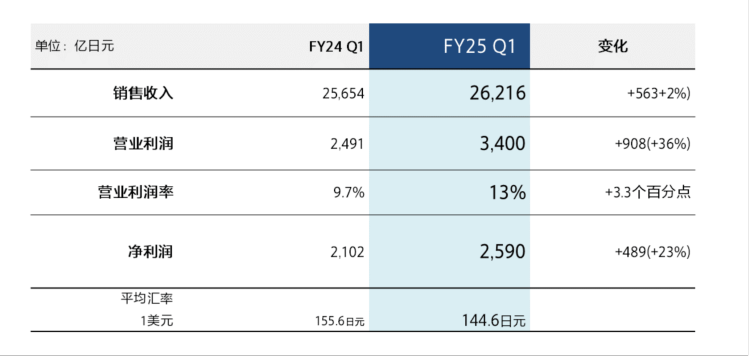
Core Insights - Sony Group reported a strong performance for Q1 of the fiscal year 2025, with sales revenue of 26,216 billion yen, a year-on-year increase of 2% [1] - Operating profit was raised to 3,400 billion yen, reflecting a significant year-on-year growth of 36% [1] - Net profit reached 2,590 billion yen, up 23% compared to the previous year [1] - The operating profit margin improved to 13%, an increase of 3.3 percentage points year-on-year [1] Business Segment Performance - **Gaming and Network Services**: Sales revenue grew by 8% to 9,365 billion yen, with operating profit soaring by 127% to 1,480 billion yen, driven by non-first-party game software and network service sales [1] - **Music**: Sales revenue increased by 5% to 4,653 billion yen, and operating profit rose by 8% to 928 billion yen, supported by growth in music streaming services and mobile game applications [1] - **Film and Television**: Sales revenue decreased to 3,271 billion yen, but operating profit surged by 65% to 187 billion yen, aided by increased production and delivery of TV shows and revenue from film libraries [1] - **Entertainment, Technology, and Services**: Sales revenue was 5,343 billion yen, with operating profit at 431 billion yen, as cost control mitigated the impact of declining product sales and negative currency effects [1] - **Imaging and Sensing Solutions**: Sales revenue rose by 15% to 4,082 billion yen, with operating profit increasing by 48% to 543 billion yen, driven by higher sales of image sensors for mobile products [1] Strategic Developments - Sony's business structure is evolving, with a greater emphasis on entertainment in its Chinese operations, aligning with its global business strategy [1] - In July, Sony held a comprehensive brand event, Sony Expo 2025, in China, themed "Dimensional Roaming," showcasing its diverse business segments [1]
索尼4-6月净利润同比增长23%,游戏业务仍是主要拉动力
Di Yi Cai Jing· 2025-08-07 12:29
Core Insights - Sony has raised its operating profit forecast for the fiscal year 2025 to 1.4 trillion yen [3] - The entertainment business plays a more significant role in Sony's operations in China [4] Financial Performance - For Q1 of fiscal year 2025 (April-June), Sony reported sales revenue of 26,216 billion yen, a year-on-year increase of 2% [3] - Operating profit for the same period was 3,400 billion yen, reflecting a 36% year-on-year growth [3] - Net profit reached 2,590 billion yen, up 23% year-on-year [3] - The operating profit margin improved to 13%, an increase of 3.3 percentage points year-on-year [3] Business Segment Performance - The gaming and network services segment saw sales revenue grow by 8% to 9,365 billion yen, with operating profit soaring by 127% to 1,480 billion yen, driven by growth in non-first-party game software sales and network services [3] - The music segment's sales revenue increased by 5% to 4,653 billion yen, with operating profit rising by 8% to 928 billion yen, benefiting from streaming service revenue and mobile game application income [3] - The film segment's sales revenue decreased to 3,271 billion yen, but operating profit increased by 65% to 187 billion yen, supported by higher delivery volumes of TV productions and film library income [3] Other Business Insights - The entertainment, technology, and services segment reported sales revenue of 5,343 billion yen and operating profit of 431 billion yen, with cost control mitigating the impact of declining sales in display products and negative currency effects [4] - The imaging and sensing solutions segment experienced a 15% year-on-year sales revenue increase to 4,082 billion yen, with operating profit rising by 48% to 543 billion yen, primarily due to increased revenue from mobile product image sensors [4] - Sony's entertainment business is becoming increasingly important in China, aligning with the global business structure changes [4]


索尼集团发布2025财年第一季度业绩
Sou Hu Cai Jing· 2025-08-07 11:13
Core Insights - Sony Group reported its Q1 FY2025 financial results, showing overall growth in sales and profits across various business segments [1][2]. Financial Performance - Sales revenue for Q1 FY2025 reached 26,216 billion yen, a 2% increase from 25,654 billion yen in Q1 FY2024 [2]. - Operating profit rose to 3,400 billion yen, marking a 36% increase from 2,491 billion yen year-over-year [2]. - Net profit for the quarter was 2,590 billion yen, up 23% from 2,102 billion yen in the same period last year [2]. - Operating profit margin improved to 13%, an increase of 3.3 percentage points compared to the previous year [2]. Business Segment Performance - Game & Network Services (G&NS) saw sales increase by 8% to 936.5 billion yen, with operating income soaring 127% to 148 billion yen, driven by growth in non-first-party game software sales and network services [5]. - Music segment sales grew by 5% to 465.3 billion yen, with operating income increasing by 8% to 92.8 billion yen, supported by streaming service revenue and mobile game income [6]. - Pictures segment sales slightly decreased to 327.1 billion yen, but operating income increased by 65% to 18.7 billion yen, aided by higher delivery volumes of TV shows and film library revenues [6]. - Entertainment, Technology & Services (ET&S) reported sales of 534.3 billion yen and operating income of 43.1 billion yen, with cost control mitigating the impact of declining sales in some display products [6]. - Imaging & Sensing Solutions (I&SS) achieved a 15% sales increase to 408.2 billion yen, with operating income rising 48% to 54.3 billion yen, driven by sales of image sensors for mobile products and digital cameras [6]. Future Outlook - Sony Group has raised its operating profit forecast for FY2025 to 1,400 billion yen, reflecting confidence in continued business performance [2].
神话为什么值得重读?
3 6 Ke· 2025-08-07 07:16
Core Insights - The article discusses the significance of myths, particularly focusing on Greek, Norse, and Celtic myths, in shaping human thought and culture [4][5][20] - It emphasizes the role of myths as cultural frameworks that provide insights into human nature, ethics, and the human experience [10][11][21] Group 1: Greek Mythology - Greek mythology is highlighted as a foundational aspect of Western culture, influencing literature, philosophy, and the arts through works like Homer's epics [5][10] - The concept of "hero's journey" derived from Greek myths has been widely applied in modern storytelling, showcasing its enduring relevance [4][6][12] - Myths serve as a reflection of human emotions and moral dilemmas, with characters embodying both virtues and flaws, thus resonating with contemporary audiences [21][22] Group 2: Norse Mythology - Norse mythology is presented as a source of raw energy and existential themes, contrasting with the rationality of Greek myths [20][31] - The interconnectedness of worlds represented by Yggdrasil, the World Tree, symbolizes the balance of existence and the cyclical nature of life and death [14][20] - Norse myths have significantly influenced modern fantasy literature, particularly through the works of J.R.R. Tolkien, who integrated these elements into his narratives [19][43] Group 3: Celtic Mythology - Celtic mythology is characterized by its mystical elements and connection to nature, offering a different perspective on existence and the human experience [31][32] - The revival of Celtic myths in the 18th and 19th centuries has contributed to a renewed cultural identity and appreciation for these ancient stories [35][36] - Themes of adventure and exploration in Celtic myths continue to inspire contemporary storytelling and cultural expressions [36][37]

游戏+音乐双引擎驱动! 索尼(SONY.US)上调利润预期 股价创四个月最强涨幅
智通财经网· 2025-08-07 07:13
Core Viewpoint - Sony Group Corp. has raised its profit forecast due to accelerated growth in its entertainment division, alleviating investor concerns about potential tariffs on chip products from the U.S. government, leading to a significant increase in its stock price [1][4]. Financial Performance - Sony's operating profit for the first fiscal quarter surged by 36.5% to 340 billion yen, exceeding Wall Street's average estimate of approximately 288 billion yen [3][4]. - The company has raised its overall operating profit forecast for the fiscal year ending in March to 1.33 trillion yen (approximately 9 billion USD), a 4% increase from previous estimates [4]. Business Segments - The entertainment business, primarily driven by gaming and network services, music, and film, is a core pillar of Sony's "emotionally moving the world" strategy [3]. - The gaming segment saw a doubling of quarterly operating profit to 148 billion yen, supported by strong sales of the PlayStation 5 and increased active users [3][4]. Market Impact - Following the announcement of the profit forecast increase, Sony's stock price rose by 7.6% in the Japanese market, reversing earlier declines [4]. - The recent U.S.-Japan trade agreement, which set tariffs on Japanese goods at 15%, has positively impacted Sony's outlook, reducing the estimated tariff impact from 1 trillion yen to 700 billion yen [1][4]. Future Prospects - The growth in subscription users for PlayStation Plus and the success of popular anime and mobile games are expected to bolster the entertainment business further [5]. - Upcoming game releases, including the sequel to "Ghost of Tsushima" and the highly anticipated "GTA 6," are projected to significantly boost sales for Sony's gaming division [8].

关注能源、黑色上游价格波动
Hua Tai Qi Huo· 2025-08-07 05:17
Report Summary 1. Industry Investment Rating No industry investment rating is provided in the report. 2. Core Viewpoints - The report focuses on price fluctuations in the energy and black upstream sectors, as well as policy implementation in high - tech and transportation infrastructure industries [1][2]. - It also provides an overview of the current situation in the upstream, mid - stream, and downstream of different industries, including price changes,开工率, and sales volume [3]. 3. Summary by Related Catalogs 3.1. Mid - level Event Overview - **Production Industry**: High - temperature and high - humidity weather has led to a continuous increase in the national power consumption level. From August 4th to 6th, the power load in the operating area of the State Grid Corporation reached a record high of 1.233 billion kilowatts, an increase of 53 million kilowatts compared to last year's peak of 1.18 billion kilowatts. Shanghai has issued a development plan for the embodied intelligence industry, aiming to achieve more than 20 core algorithm and technology breakthroughs by 2027, with the core industry scale exceeding 50 billion yuan [1]. - **Service Industry**: Three departments including the Ministry of Transport have issued a plan for the new round of rural road improvement, aiming to complete 300,000 kilometers of new and reconstructed rural roads by 2027 [2]. 3.2. Industry Overview - **Upstream**: International oil prices have dropped significantly recently. Egg prices and glass prices have also declined [3]. - **Mid - stream**: The operating rate of PTA has decreased, while that of pig products has increased slightly [3]. - **Downstream**: The sales of commercial housing in first - and second - tier cities have seasonally declined and are at a three - year low. Domestic film box office has increased during the summer vacation [3]. 3.3. Industry Credit Spread Tracking - The report provides credit spread data for various industries as of August 7th, showing different trends in each industry's credit spreads compared to the previous year, the first quarter, one month ago, and last week [46]. 3.4. Key Industry Price Index Tracking - The report presents price data for multiple industries as of August 6th, including agriculture, non - ferrous metals, black metals, non - metals, energy, chemicals, and real estate. Most prices have shown a downward trend, with some exceptions such as coal prices [47].