芯片

Search documents
美股新财报季平淡中开启 科技股走势和美联储政策如何影响后市
Di Yi Cai Jing· 2026-01-18 02:55
随着美股去年四季度财报季拉开帷幕,三大股指最终均录得周线下跌,美国总统特朗普对美联储、金融 业和格陵兰岛等密集言论成为打击风险偏好的主要原因。 未来一周,备受投资者关注的科技股财报将开始陆续披露,与此同时,美联储政策预期和地缘政治因素 将继续扰动市场神经,三大股指或将在震荡中等待方向确认。 美联储降息预期继续降温 施瓦茨向第一财经记者表示,他预计联邦公开市场委员会(FOMC)将在9月前把政策利率区间下调至 3.00%~3.25%,这一利率水平或将成为本轮降息周期的终点利率。"不过,若新任美联储主席的政策立 场更为鸽派,这一不确定性因素可能会影响联邦公开市场委员会委员的决策倾向,进而推动利率进一步 走低。"他分析道。 市场波动或升级 过去一周,影响市场的议题十分广泛,既包括对美联储独立性受威胁的担忧,也涉及伊朗和格陵兰岛地 区地缘政治风险的升级。 随着财报季正式启动,伦敦证券交易所集团(LSEG)的数据显示,市场预计美国大中型市值公司上季 度利润将增长10.8%,其中科技板块领跑,盈利增幅预计达到19.32%。 板块方面,率先打响头炮的美国大型银行公布的业绩大体稳健。但受特朗普提议对信用卡利率设置为期 一年、上 ...
美股点金丨美股新财报季平淡中开启,科技股走势和美联储政策如何影响后市
Di Yi Cai Jing· 2026-01-18 02:50
关注美债收益率和波动性走向。 随着美股去年四季度财报季拉开帷幕,三大股指最终均录得周线下跌,美国总统特朗普对美联储、金融 业和格陵兰岛等密集言论成为打击风险偏好的主要原因。 未来一周,备受投资者关注的科技股财报将开始陆续披露,与此同时,美联储政策预期和地缘政治因素 将继续扰动市场神经,三大股指或将在震荡中等待方向确认。 美联储降息预期继续降温 上周市场消化了大量经济数据,其中月度通胀数据与零售销售数据尤为引人关注。 施瓦茨向第一财经记者表示,他预计联邦公开市场委员会(FOMC)将在9月前把政策利率区间下调至 3.00%~3.25%,这一利率水平或将成为本轮降息周期的终点利率。"不过,若新任美联储主席的政策立 场更为鸽派,这一不确定性因素可能会影响联邦公开市场委员会委员的决策倾向,进而推动利率进一步 走低。"他分析道。 市场波动或升级 过去一周,影响市场的议题十分广泛,既包括对美联储独立性受威胁的担忧,也涉及伊朗和格陵兰岛地 区地缘政治风险的升级。 随着财报季正式启动,伦敦证券交易所集团(LSEG)的数据显示,市场预计美国大中型市值公司上季 度利润将增长10.8%,其中科技板块领跑,盈利增幅预计达到19.32% ...


新华财经早报:1月18日
Zhong Guo Jin Rong Xin Xi Wang· 2026-01-18 00:50
Group 1 - China Aviation Engine Group's "Taihang Three Brothers" has completed evaluation and acceptance, marking a significant breakthrough in gas turbine R&D and technology, which will strongly promote the industrialization and commercialization of the gas turbine industry in China [1][1][1] - The People's Bank of China and the National Financial Regulatory Administration announced that the minimum down payment ratio for commercial housing loans will be adjusted to no less than 30%, aiming to support a new model for real estate development [1][1] - The Ministry of Industry and Information Technology has revised the management measures for high-quality small and medium-sized enterprises, including technology-based SMEs in the cultivation scope, which will be implemented from April 1, 2026 [1][1] Group 2 - The National Energy Administration announced that by 2025, China's total electricity consumption will exceed 10 trillion kilowatt-hours, reaching 10.4 trillion kilowatt-hours, a year-on-year increase of 5%, which is unprecedented for a single country [1][1][1] - In 2025, the foreign trade import and export volume of Yiwu, Zhejiang, is expected to exceed 800 billion yuan, reaching 836.5 billion yuan, with imports hitting 105.8 billion yuan, a year-on-year increase of 32.3% [1][1] - In 2025, Shanxi's renewable energy generation is projected to reach 118 billion kilowatt-hours, a year-on-year increase of 26%, equivalent to the annual electricity consumption of approximately 35 million households [1][1]

这家武汉“独角兽”突破西方垄断 为50万辆电车装上驱动芯片
Xin Lang Cai Jing· 2026-01-18 00:32
Core Insights - In 2025, the company plans to equip 500,000 electric vehicles with self-developed automotive-grade high-side driver chips, achieving explosive growth and securing the top position in its niche market [1] - The high-side driver chip, which has been widely applied, is a key execution component in vehicle domain control architecture, managing the intelligent switching and protection of loads such as lights, motors, and pumps [1] - Another core product line, the high-power intelligent servo driver chip (gate driver chip), serves as the "power nerve" for smart terminals and has made significant breakthroughs in fields like robotic joints and drone electric drives [1] - Historically, these critical driver chip sectors have been dominated by European and American companies, which has restricted the autonomous safety of China's new energy vehicles and high-end equipment industry [1]
戴瑾:芯片产业合作中国做不好,为啥?咱们有个词叫“内卷”
Xin Lang Cai Jing· 2026-01-18 00:22
戴瑾:芯片产业合作中国做不好,为啥?咱们有个词叫"内卷" 戴瑾:芯片产业合作中国做不好,为 啥?咱们有个词叫"内卷" 戴瑾:芯片产业合作中国做不好,为啥?咱们有个词叫"内卷" #内卷影响企业间的合作# #2026答案秀# 特别声明:以上文章内容仅代表作者本人观点,不代表新浪网观点或立场。如有关于作品内容、版权或其它问 题请于作品发表后的30日内与新浪网联系。 ...

中国U23男足,挺进亚洲杯四强,刷新历史!
券商中国· 2026-01-17 15:40
Group 1 - The core viewpoint of the article is that the Chinese U23 football team has advanced to the semifinals of the U23 Asian Cup after defeating Uzbekistan in a penalty shootout following a goalless draw in regular and extra time [1][2]. Group 2 - The Chinese team finished the group stage with 1 win and 2 draws, accumulating 5 points, and advanced to the knockout stage as the second place in Group D, marking the first time in history for the team to reach this stage [2]. - The upcoming match for the Chinese team will be against Vietnam in the semifinals [1].

美国要慌了?2025年中国出口芯片3500亿个,1.44万亿元,量价齐升
Sou Hu Cai Jing· 2026-01-17 12:28
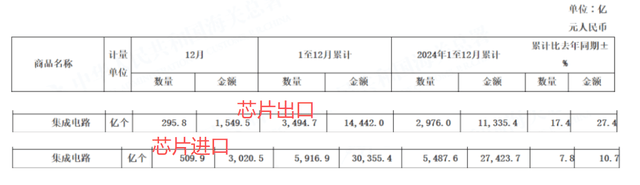
Core Insights - China's chip export volume is projected to reach 349.5 billion units in 2025, marking a year-on-year increase of 17.4%, while the export value is expected to be 1.4442 trillion yuan, up 27.4% [1] - The daily export figures translate to approximately 960 million chips and 3.96 billion yuan in value, both setting historical records [1] - In contrast, China's chip imports are forecasted at 591.7 billion units, a 7.8% increase, with an import value of 3.0355 trillion yuan, reflecting a 10.7% growth [3] Export vs. Import Analysis - The growth rates for both export quantity and value significantly outpace those of imports, indicating a robust expansion of China's chip industry [3] - The increase in export value suggests a notable rise in the average price of exported chips, indicating a shift from low-end to high-end chip production [5] Industry Implications - The rapid development of China's chip industry and its increasing self-sufficiency pose a challenge to the U.S., which has historically dominated the global chip market [7] - As China enhances its production capacity and exports more high-value chips, the competitive landscape may shift, potentially undermining the U.S.'s market position [9] - The combination of lower operational costs, high efficiency, and a well-established supply chain gives China a competitive edge in the global chip market [9]
消费与科技不是“谁主谁次”,而是“共生共荣”|宏观经济
清华金融评论· 2026-01-17 10:35
Core Viewpoint - Consumption and technology are interdependent and should not be viewed as mutually exclusive; without consumer demand, technological innovation lacks sustainability and market value [2][4]. Group 1: Economic Growth and Innovation - Many people instinctively emphasize "technological innovation" as the core driver of economic growth, influenced by narratives around breakthroughs in chips, AI, and new energy [4]. - In 2024, China's total R&D expenditure is expected to exceed 4 trillion yuan, accounting for 2.8% of GDP, with the number of patents in fields like new energy vehicles and AI ranking first globally [4]. - However, technology that is detached from consumer demand often fails to achieve market success, as seen in cases where companies invested heavily in R&D but faced low order volumes due to weak consumer demand [4][5]. Group 2: Consumer Demand and R&D Investment - Over 70% of R&D investment in China comes from enterprises, which directly depends on their revenue situation; in 2024, the growth rate of retail sales of consumer goods is projected to be only 3.5% [5][7]. - The decline in consumer spending has led to a reduction in R&D budgets for many companies, with some cutting their innovation budgets by half due to lower sales [7]. - Consumer demand is crucial as it serves as both the endpoint of economic circulation and the source of funding for technological innovation [7]. Group 3: Policy Implications - Current policies tend to favor technological innovation over consumer stimulation, leading to an imbalance; while tax incentives for tech firms are increasing, consumer stimulus measures remain superficial [8]. - In 2024, the technology conversion rate in China is only about 30%, significantly lower than the 60%-70% seen in developed countries, indicating a gap in market acceptance of innovations [8]. Group 4: The Symbiotic Relationship Between Consumption and Technology - The relationship between consumption and technology is cyclical, akin to the "chicken and egg" scenario; successful technological advancements often depend on a robust consumer market [9][10]. - For China, while exports of "new three items" (likely referring to new energy vehicles, electronics, etc.) are growing, a weak domestic consumer market could lead to wasted production capacity and increased operational pressures on companies [10]. - To address these challenges, a dual approach is necessary: supporting technological innovation while also expanding domestic demand through job stability and income growth [10][11].
黄金已失去吸引力 中国股市上涨具备可持续性
Sou Hu Cai Jing· 2026-01-17 10:29
对许多投资者而言,黄金前景依旧向好,因为推动金价去年上涨的大多数因素仍然完好。 周五,国际金价有所回落。COMEX黄金期货跌0.49%,报4601美元/盎司。投资者在近期金价创下历史 新高后获利了结,地缘政治紧张局势缓和的迹象也削弱了黄金的避险吸引力。此外,美联储降息预期降 温也令金价进一步承压。 据央视新闻报道,美国总统特朗普当地时间1月16日在白宫表示,他"说服了自己"暂缓对伊朗采取军事 行动。 素有"新兴市场教父"之称的美国资深投资者麦朴思(Mark Mobius)日前表示,在经历历史性的上涨之 后,黄金已不再具有吸引力。他警告称,在市场多数参与者仍坚定看涨黄金的当下,美元潜在的反弹可 能会削弱贵金属的表现。 麦朴思是莫比乌斯资本合伙公司(MobiusCapitalPartners)的联合创始人,也是麦朴思新兴机会基金 (MobiusEmergingOpportunitiesFund)的主席。此前他曾在大型投资机构富兰克林邓普顿投资公司工作 30余年,期间他在新兴市场的投资业绩为其赢得了诸多全球性的赞誉。 "在目前这个价位,我肯定不会买入,这是肯定的。"麦朴思周五接受采访时表示,并称,若金价较当前 水平 ...
特朗普暴露真面目,对华再加25%关税,丹麦通知全球,中方抛售美债
Sou Hu Cai Jing· 2026-01-17 09:51
Group 1 - The article discusses the U.S. government's imposition of a 25% tariff on certain high-end AI chips, including the NVIDIA H200 model, aimed at increasing profits from sales to China [1][3] - The U.S. has seen a significant increase in tariff revenue, reaching $264 billion in the fiscal year 2025, which is $185 billion more than the previous year, indicating a substantial rise in government income from tariffs [1] - The U.S. Treasury data shows that China has reduced its holdings of U.S. Treasury bonds for nine consecutive months, dropping from the largest holder to the third position, with a reduction of $6.1 billion in November, bringing its total holdings to $682.6 billion [1] Group 2 - The U.S. government, under the Trump administration, is actively seeking to reduce reliance on Chinese rare earth resources, with the G7 countries agreeing to accelerate the reduction of imports from China [1][3] - Denmark has issued a final ultimatum prohibiting Chinese investments in Greenland, highlighting the geopolitical tensions and the U.S. influence in the region, despite Greenland's need for foreign investment [3][5] - The strategic interest in Greenland is not only due to its geographical location but also its significant rare earth resources, which are crucial for global supply chains [5][6]