稀土

Search documents
上交所出手,A股热门股,突发
Zheng Quan Shi Bao· 2025-10-13 12:44
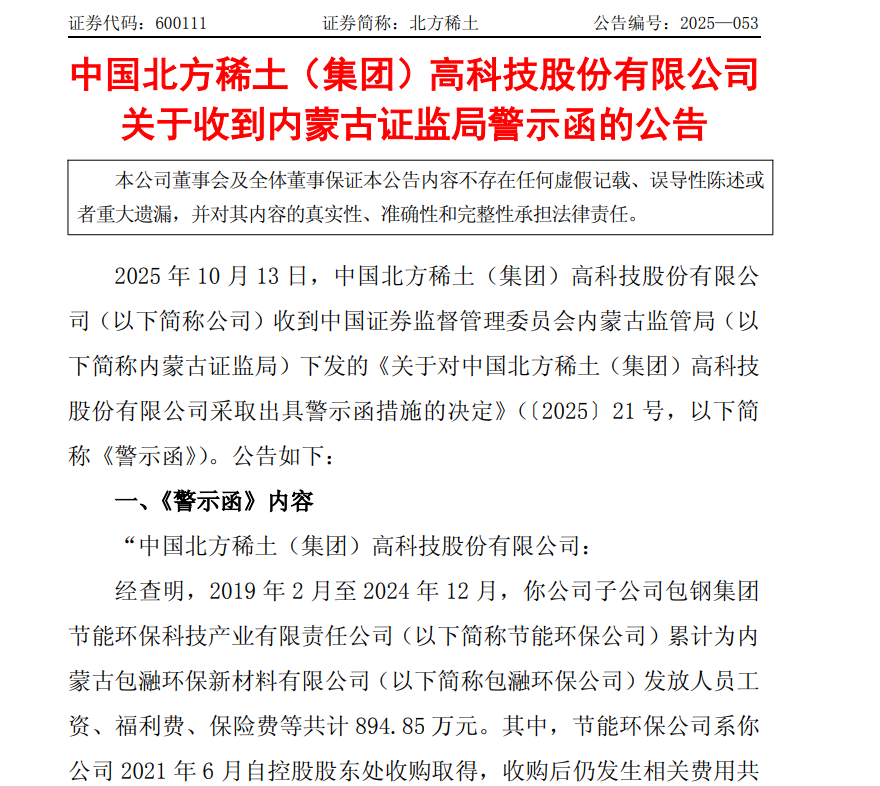
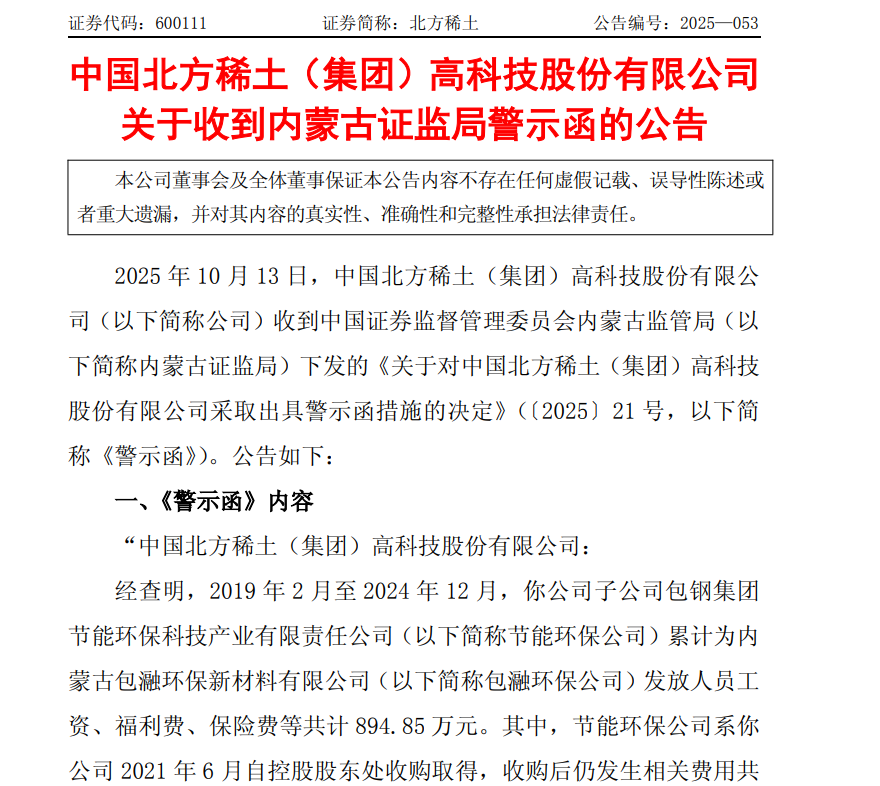
Core Viewpoint - Northern Rare Earth (600111) received a warning letter from the Inner Mongolia Securities Regulatory Bureau regarding the misuse of funds by related parties and failure to disclose information as required [1][5]. Group 1: Regulatory Actions - The warning letter indicates that from February 2019 to December 2024, a subsidiary of Northern Rare Earth, Baotou Steel Group Energy Conservation and Environmental Protection Technology Co., Ltd., paid a total of 8.9485 million yuan in wages, benefits, and insurance for the controlling shareholder's subsidiary, Inner Mongolia Baolan Environmental Protection New Materials Co., Ltd. [5] - The warning letter identifies this behavior as non-operating fund occupation by related parties, and Northern Rare Earth did not fulfill its information disclosure obligations regarding this matter [5]. - On October 10, the Shanghai Stock Exchange had already issued a regulatory warning to Northern Rare Earth and its related party, requiring them to take effective measures to rectify the violations and improve compliance [5][6]. Group 2: Company Response and Market Impact - Northern Rare Earth stated that it takes the issues raised in the warning letter seriously and will strengthen its internal management and improve information disclosure quality to prevent similar incidents in the future [9]. - On October 13, amidst a surge in the rare earth sector, Northern Rare Earth’s stock price hit the daily limit, with a trading volume of approximately 21.5 billion yuan, making it the top stock by trading volume on that day [9].


上交所出手!A股热门股,突发!
Zheng Quan Shi Bao· 2025-10-13 12:31
Core Viewpoint - Northern Rare Earth received a warning letter from the Inner Mongolia Securities Regulatory Bureau due to the occupation of funds by related parties and failure to fulfill information disclosure obligations [1][4]. Group 1: Regulatory Actions - From February 2019 to December 2024, a subsidiary of Northern Rare Earth, Baotou Steel Group Energy Conservation and Environmental Protection Technology Co., Ltd., paid a total of 8.9485 million yuan in wages, benefits, and insurance for the controlling shareholder's subsidiary, Inner Mongolia Baolan Environmental Protection New Materials Co., Ltd. [4] - The warning letter identified this as a non-operating fund occupation by related parties, and Northern Rare Earth did not disclose this matter as required [4]. - On October 10, the Shanghai Stock Exchange had already issued a regulatory warning to Northern Rare Earth and its related party, requiring them to take effective measures to rectify the violations [4][5]. Group 2: Company Response - Northern Rare Earth stated that it takes the issues raised in the warning letter seriously and will strengthen internal management and improve information disclosure quality to prevent similar incidents in the future [8]. - The company emphasized that the administrative regulatory measures will not affect its normal business operations [8]. Group 3: Market Reaction - On October 13, amidst a surge in the rare earth sector, Northern Rare Earth's stock hit the daily limit, with a trading volume of approximately 21.5 billion yuan, making it the top stock by trading volume on that day [8].
稀土产业指数大幅上涨6%,概念基金投资机会分析
Xin Lang Cai Jing· 2025-10-13 12:28
Core Insights - The importance of rare earths as a strategic resource is highlighted, with China's dominance in this area compared to oil-rich Middle Eastern countries [1] - Recent external news has positively impacted the rare earth sector, with the industry index rising over 6% on October 13, indicating a recovery in industry sentiment and solid long-term investment logic [1] Industry Drivers - Strong policy support and optimization of industry order are key drivers of the current recovery in the rare earth industry, with stricter management of supply-side controls following the release of new mining and separation quotas [1] - The explosive growth in downstream demand, particularly in sectors like electric vehicles and renewable energy, is providing significant growth momentum for the rare earth industry [1] Price Stabilization - The stabilization and recovery of rare earth prices have created upward potential for leading companies' performance, with prices returning to a relatively reasonable range after previous adjustments [2] - The dual effect of supply control and demand recovery is leading to a gradual stabilization and upward trend in mainstream rare earth product prices, improving revenue and profit expectations for resource-rich leading enterprises [2] Investment Products - The market offers two main types of rare earth-themed funds: index funds and actively managed funds, with six funds specifically tracking rare earth industry indices, including four ETFs and two ETF-linked funds [2] - The index funds provide transparency and lower management fees, while actively managed funds have a broader investment scope, potentially including new energy metals and materials, but with higher uncertainty [3] Fund Performance - The Qianhai Kaiyuan Hong Kong-Shenzhen Core Resource A fund is noted for its deep involvement in the rare earth industry, with approximately 60% of its assets allocated to this sector [3] - The rare earth industry is experiencing a new wave of development opportunities driven by favorable policies, demand, and prices, making rare earth-themed funds a time-efficient investment choice for interested investors [3]
未按规定履行信披义务,北方稀土收警示函
Zheng Quan Shi Bao Wang· 2025-10-13 12:27
Core Viewpoint - Northern Rare Earth (600111) received a warning letter from the Inner Mongolia Securities Regulatory Bureau due to non-compliance with information disclosure regulations regarding non-operating fund occupation by a subsidiary [1][2] Group 1: Regulatory Actions - The Inner Mongolia Securities Regulatory Bureau issued a warning letter to Northern Rare Earth, which will be recorded in the securities and futures market integrity archive [2] - The company acknowledged the issues raised in the warning letter and committed to improving internal management and information disclosure quality to prevent future occurrences [2] Group 2: Financial Performance - Northern Rare Earth expects a net profit attributable to shareholders of the parent company between 1.51 billion yuan and 1.57 billion yuan for the first three quarters of 2025, representing a year-on-year increase of 272.54% to 287.34% [3] - The company anticipates a net profit of 1.33 billion yuan to 1.39 billion yuan after deducting non-recurring gains and losses, reflecting a year-on-year increase of 399.90% to 422.46% [3] Group 3: Market Response - On October 13, Northern Rare Earth experienced a limit-up trading session, closing at 57.73 yuan, an increase of 5.25 yuan, or 10% [4]
智通港股解盘 | 祭出“王炸”特朗普态度软化 反制概念走势坚挺
Zhi Tong Cai Jing· 2025-10-13 12:18
Market Overview - China's recent rare earth policy has led to a significant drop in the US stock market, with the Nasdaq falling by 3.56% and the S&P 500 by 2.72%, indicating a strong impact on technology stocks and a spike in the VIX fear index above 31% [1] - The new policy effectively closes loopholes in rare earth exports, which are crucial for semiconductor manufacturing, particularly for companies like TSMC, which relies heavily on rare earth materials from China [1] - The US's dependency on Chinese rare earths for chip production raises concerns for major tech companies like Nvidia and Apple, potentially crippling their operations if strict enforcement occurs [1] Trade Relations - Despite the US's threats to impose 100% tariffs on Chinese goods, China's exports have shown resilience, with a reported 8.3% year-on-year increase in September, leading to a trade surplus of $90.5 billion [2] - The US administration's stance appears to soften, with indications that both countries prefer to avoid economic recession and are open to dialogue [3] Industry Impact - The recent tensions have prompted a shift in attitudes from other countries, such as Canada, which is reconsidering its tariffs on Chinese electric vehicles due to the negative impact on bilateral trade [4] - The market's reaction to the geopolitical situation has led to a rise in gold prices, with spot gold reaching a historical high of over $4060 [4] Semiconductor Sector - The semiconductor industry is witnessing advancements, with upcoming events like the Bay Area Semiconductor Industry Expo expected to showcase significant developments [5] - Companies involved in semiconductor manufacturing, such as Huahong Semiconductor and SMIC, have seen stock price increases, reflecting market optimism [5] Software and Domestic Alternatives - The cessation of support for Windows 10 by Microsoft is expected to boost the market share of domestic operating systems, with projections indicating a 15% share in the PC market by mid-2025 [6] - Companies like Kingsoft are benefiting from this trend, with significant stock price increases following the announcement of domestic software alternatives [6] Cobalt Market Dynamics - New export quotas for cobalt from the Democratic Republic of Congo have led to supply tightening and increased costs, benefiting companies like Luoyang Molybdenum and China Molybdenum [7] - The concentration of export rights among a few large companies enhances their bargaining power within the supply chain [7] Company Performance - Shanghai Fudan reported a revenue of 1.839 billion yuan for the first half of 2025, a year-on-year increase of 2.49%, although net profit saw a decline of 44.38% [8] - The company is positioned as a leading FPGA supplier, with a focus on advanced chip development and a positive outlook for revenue growth in various product lines [9]
花旗:中国稀土深度报告,配额紧&需求爆(双语)
Sou Hu Cai Jing· 2025-10-13 12:11
Core Viewpoint - The rare earth industry is in an early to mid-cycle uptrend, supported by China's strict supply management, favorable policy momentum, and the strategic role of rare earths in energy transition and advanced manufacturing [3][5][9]. Industry Overview - The rare earth market is experiencing a recovery phase, driven by strong demand from electric vehicles and renewable energy sectors, despite some fluctuations in light rare earth prices [5][9]. - Heavy rare earth prices remain robust due to supply constraints, with geopolitical risks contributing to price stability in the short term [6][9]. Price Outlook - Short-term prices are expected to remain firm with an upward trend due to supply tightness and geopolitical risks, while mid-term prices are projected to stabilize at a higher range as new capacities come online [6][43]. - Light rare earth elements may see moderate price fluctuations, while heavy rare earth elements could experience more significant volatility due to limited supply and difficulty in substitution [6][43]. Valuation Insights - The valuations for NRE and CRE are above their historical averages, reflecting the industry's strategic importance and policy support [6][9]. - NRE is assigned a target price of RMB 72, based on a 9.5x P/B ratio for 2026, while CRE is given a neutral rating with a target price of RMB 61.6, reflecting its smaller scale and limited integration [7][49]. Company Analysis - Northern Rare Earth (NRE) is the largest light rare earth producer in China, benefiting from a vertically integrated value chain and exclusive access to Bayan Obo resources, which supports stable profit margins [7][45]. - China Rare Earth Resources and Technology (CRE) focuses on heavy rare earths and is strategically important in the supply chain, but its valuation appears high relative to its earnings potential [49][52]. Supply Chain Dynamics - China dominates the global rare earth supply chain, accounting for approximately 70% of production and over 85% of refining capacity, which solidifies its control over pricing and supply [22][25]. - The U.S. and other countries are working to diversify their supply chains, but significant structural bottlenecks remain, particularly in refining and separation capabilities [30][36]. Global Trade and Supply Vulnerabilities - China plays a central role in global rare earth trade, exporting significant quantities while also importing raw materials to support domestic processing [25][28]. - The geopolitical landscape, particularly risks from Myanmar, poses challenges to supply stability, prompting countries to seek alternative sources [28][30].


中国升级稀土管制,为何欧盟感到深深寒意?
Sou Hu Cai Jing· 2025-10-13 12:11
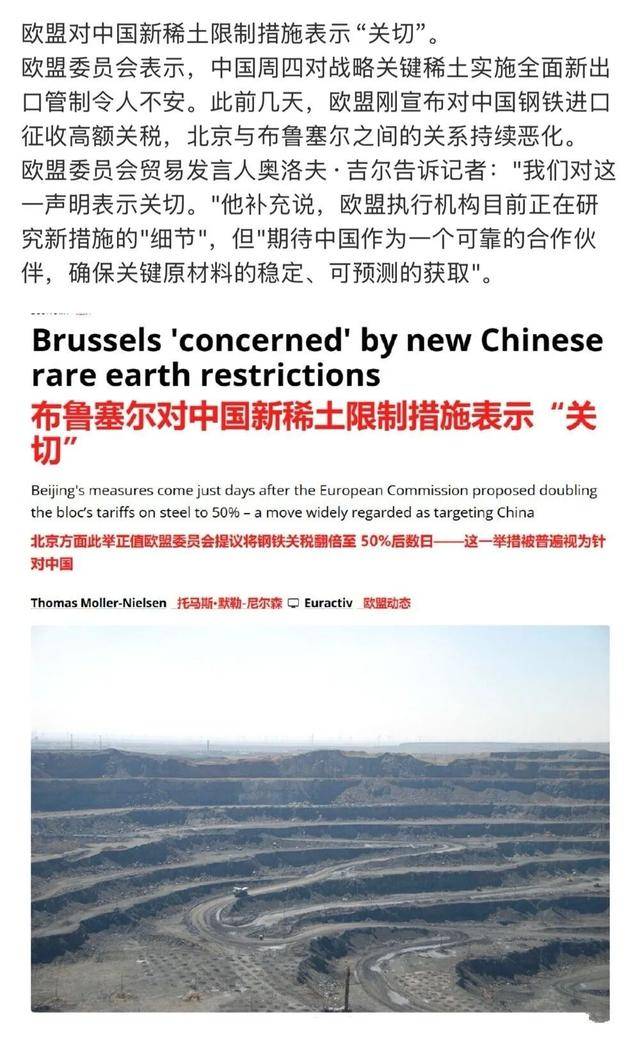
Core Viewpoint - The European Union (EU) expresses deep concern over China's recent rare earth export control measures, indicating anxiety about the impact on European industries [1][4]. Group 1: EU's Response and Position - The EU's trade spokesperson emphasizes the expectation for China to act as a reliable partner, revealing a sense of helplessness in their response [4]. - The EU had recently imposed a 50% tariff on Chinese steel and reduced quotas by 45%, indicating a confrontational stance towards China, which was countered by China's rare earth export controls [4][10]. - The EU's attempt to impose price controls on Chinese rare earths was preempted by China's actions, showcasing a strategic advantage for China in this trade conflict [4][6]. Group 2: China's Strategy and Implications - China's export control policy signals a clear message: compliance with demand reporting will be rewarded, while attempts to resell to the U.S. will result in supply cuts [6]. - The EU is heavily reliant on China for rare earths, with over 90% of its supply coming from China, making it difficult for Europe to find alternatives in the short term [6][7]. - China's control over the entire rare earth supply chain positions it as a "global distributor," complicating the EU's ability to negotiate effectively [14]. Group 3: Future Dynamics and Industry Impact - The competition over rare earths is expected to escalate, with potential for increased geopolitical tensions and conflicts among EU member states over access to these resources [9][16]. - The EU's dual approach of seeking to reduce dependency on China while simultaneously relying on Chinese supplies reflects a contradiction in its policy [10][12]. - In the long term, China's strategic use of rare earths could lead to significant shifts in global supply chains, impacting industries reliant on these materials, such as defense and technology [16][18].
北方稀土,收到警示函
中国基金报· 2025-10-13 12:11
【导读】10月13日,北方稀土收到内蒙古证监局下发的《警示函》 中国基金报记者 卢鸰 编辑:赵新亮 校对:王玥 制作:鹿米 审核:木鱼 注:本文封面图由AI生成 北方稀土10月13日晚公告,公司当日收到内蒙古证监局下发的《关于对中国北方稀土(集 团)高科技股份有限公司采取出具警示函措施的决定》(以下简称《警示函》)。 据《警示函》披露,2019年2月至2024年12月,北方稀土子公司包钢集团节能环保科技产业 有限责任公司(以下简称节能环保公司)累计为内蒙古包瀜环保新材料有限公司(以下简称 包瀜环保公司)发放人员工资、福利费、保险费等共计894.85万元。其中,节能环保公司系 北方稀土2021年6月自控股股东处收购取得,收购后仍发生相关费用共计587.61万元。截至 2024年12月31日,包瀜环保公司已全部归还上述代发款项共计894.85万元。 上述行为构成关联方非经营性资金占用,北方稀土未就该事项按相关规定履行信息披露义 务,不符合《关于规范上市公司与关联方资金往来及上市公司对外担保若干问题的通知 (2017年修改)》第一条第(二)项要求,违反了相关法规规定,内蒙古证监局决定对北方 稀土采取出具警示函的监管 ...

涨幅超100%!这类ETF火了
Zhong Guo Zheng Quan Bao· 2025-10-13 12:04
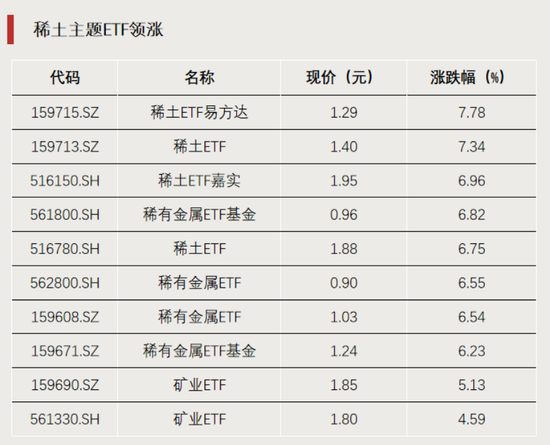
Group 1: ETF Performance - Multiple sectors including rare earth, gold, non-ferrous metals, and technology chips saw significant ETF performance, with two rare earth ETFs rising over 7% in a single day [1][4] - As of October 13, three ETFs have more than doubled in value this year, specifically focusing on the gold industry [2] - On October 13, gold ETFs and non-ferrous metal ETFs increased by over 4%, while several technology chip ETFs rose by over 3% [6][7] Group 2: Capital Inflows - The technology sector experienced substantial capital inflows, with over 30 billion yuan net inflow into the Jiashi Shanghai Stock Exchange Technology Chip ETF from October 9 to 10 [3][8] - Other notable inflows included 27.66 billion yuan into the Huaxia Shanghai Stock Exchange Technology 50 ETF and 11.45 billion yuan into the E-Fund Shanghai Stock Exchange Technology 50 ETF during the same period [9] Group 3: Market Trends and Analysis - The Ministry of Commerce's announcement on October 9 regarding rare earth export controls has led to a supply-demand resonance in the rare earth sector, positioning it as a core resource for high-end manufacturing and strategic emerging industries [4] - Factors supporting gold price increases include rising risk aversion and a decline in global credit currency credibility, with expectations for gold prices being adjusted upward by overseas institutions [10]
突发!3天2板稀土龙头因关联方非经营性资金占用未披露被出具警示函|盘后公告集锦
Xin Lang Cai Jing· 2025-10-13 12:04
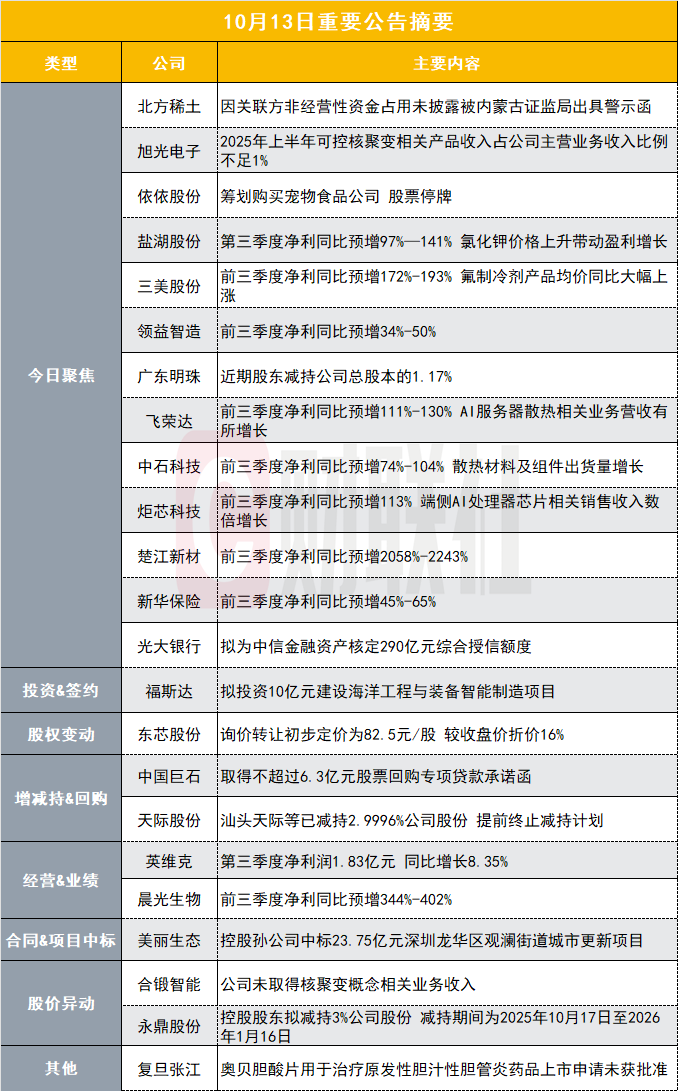
Company Announcements - Northern Rare Earth received a warning letter from the Inner Mongolia Securities Regulatory Bureau due to undisclosed non-operating fund occupation by related parties, amounting to 8.9485 million yuan, which has been fully repaid [2] - Aosheng Electronics reported that revenue from controllable nuclear fusion-related products will account for less than 1% of its main business revenue in the first half of 2025 [2] - Yiyi Co. is planning to acquire a pet food company, leading to a stock suspension [3] - Sanmei Co. expects a net profit increase of 172%-193% year-on-year for the first three quarters, driven by a significant rise in the average price of fluorinated refrigerants [4] - Feirongda anticipates a net profit increase of 111%-130% year-on-year for the first three quarters, with growth in AI server cooling-related business revenue [4] - Zhongshi Technology expects a net profit increase of 74%-104% year-on-year for the first three quarters, benefiting from increased shipments of thermal materials and components [4] - Juxin Technology forecasts a net profit increase of 113% year-on-year for the first three quarters, with sales revenue from edge AI processor chips increasing significantly [4] - Chuangjiang New Materials expects a staggering net profit increase of 2058%-2243% year-on-year for the first three quarters [4] - New China Life Insurance anticipates a net profit increase of 45%-65% year-on-year for the first three quarters [4] Investment & Contracts - Fostda plans to invest 1 billion yuan in the construction of an intelligent manufacturing project for marine engineering and equipment [11] Shareholding Changes - Dongxin Co. has set an initial transfer price of 82.5 yuan per share for its inquiry transfer, which is a 16% discount from the closing price [11] - China Jushi has obtained a commitment letter for a stock repurchase loan of up to 630 million yuan [12] - Tianji Co. has reduced its holdings by 2.9996% of the company's shares and has terminated its reduction plan early [3] Performance & Operations - Yingweike reported a net profit of 183 million yuan for the third quarter, an increase of 8.35% year-on-year [13] - Chenguang Biological expects a net profit increase of 344%-402% year-on-year for the first three quarters [14] - Meili Ecology's subsidiary won a bid for a 2.375 billion yuan urban renewal project in Shenzhen [18] Stock Price Movements - Hezhu Intelligent has not generated any revenue related to nuclear fusion concepts [19] - Jinli Yongci confirmed that its recent stock price fluctuations are not due to undisclosed significant matters [20] Other Developments - Heng Rui Medicine's subsidiary received approval for clinical trials of SHR-1905 injection [24] - Renfu Medicine received a drug registration certificate for Dapoxetine Hydrochloride Tablets, which are expected to generate approximately 1.1 billion yuan in sales in 2024 [26]