
科技研发

Search documents
2025服贸会|海淀透露数字贸易“攻坚路线图”
Bei Jing Shang Bao· 2025-09-12 14:04
Core Insights - The global economy is entering a new phase characterized by digital productivity, with digital trade emerging as a new engine for growth [1][3] - Digital trade is a core component of the digital economy, driven by advanced technologies such as artificial intelligence and blockchain, facilitating innovation and integration across various sectors [3] - China's digital trade market is projected to exceed 4.5 trillion yuan by 2025 and reach 8.2 trillion yuan by 2030, with a compound annual growth rate of over 12% [3] Industry Developments - Beijing is leading the nation in digital trade, with a projected growth of 7.7% in digital economy value in 2024, and core industries expected to grow over 10% [3][4] - Haidian District in Beijing is a key player in digital economy and trade, with its core industries contributing 53.1% to the district's GDP in 2024 [4] - The rapid development of digital trade is closely linked to supportive policies from both national and local governments, including recent initiatives to promote cross-border data flow and establish digital trade pilot zones [4] Future Directions - Haidian District aims to enhance global competitiveness by focusing on four key areas: optimizing the innovation ecosystem, accelerating the development of new digital infrastructure, exploring institutional innovations in the digital economy, and establishing a high-standard open environment for international trade [5] - The district plans to build a comprehensive digital free trade brand by focusing on the release of digital factors, cultivating digital trade growth, and exploring rules in the digital domain [5]


海南自贸港与香港合作再深化,前景更广阔
Hai Nan Ri Bao· 2025-09-12 01:58
Core Viewpoint - The cooperation between Hainan Free Trade Port and Hong Kong is deepening, presenting broader prospects for mutual development and economic integration [2][3][6]. Group 1: Events and Initiatives - A promotional event titled "Hainan-Hong Kong Cooperation, Mutual Benefit and Win-Win" was held in Hong Kong, showcasing Hainan's achievements and policies in its Free Trade Port development [2][4]. - Twelve projects were signed during the event, covering various sectors such as culture, tourism, technology, and food processing [2]. - Hainan's offshore RMB local government bond roadshow attracted participation from 46 financial institutions across seven countries and regions [2][6]. Group 2: Economic Significance - Hainan is recognized as the only Chinese-style Free Trade Port, aiming to become a significant gateway for China's new era of opening up [3][6]. - Hong Kong serves as a major source of foreign investment for Hainan, accounting for over 70% of the actual foreign capital used in Hainan [6]. - From January to July this year, Hong Kong established 382 new enterprises in Hainan, marking a 7.3% increase year-on-year, with actual utilized Hong Kong capital reaching 11.872 billion yuan, a 99.3% increase [6]. Group 3: Policy and Future Outlook - Hainan's policies, such as zero tariffs and simplified tax systems, are seen as attractive to businesses, encouraging further investment and collaboration [4][5]. - The establishment of the Hainan-Hong Kong Economic Cooperation Development Advisory Committee aims to enhance collaboration in various fields, including trade, finance, and tourism [6]. - The upcoming full island closure operation of Hainan Free Trade Port on December 18 is expected to mark a significant milestone in its development and attract more international investment [7][8].
国务院这项批复纳入大湾区内地9市,实施方案重点明确
Di Yi Cai Jing· 2025-09-11 13:57
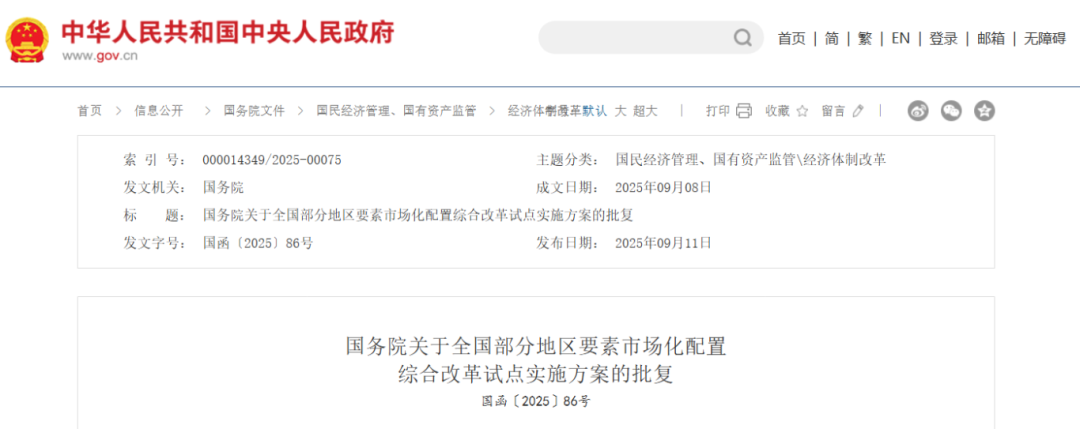
Group 1 - The State Council has approved a pilot program for market-oriented allocation of factors in ten urban areas, including the Guangdong-Hong Kong-Macao Greater Bay Area and several key cities in southern China, to enhance resource utilization efficiency [1][2] - The pilot areas are chosen based on their significant economic contributions and existing industrial clusters, aiming to provide differentiated exploration experiences for the construction of a unified national market [1][2] - The implementation plan covers seven major areas and 22 specific measures, focusing on technology, land, talent, data, and capital, with a key emphasis on improving land allocation efficiency [2][3] Group 2 - The plan proposes to revitalize idle land through market-oriented methods, including establishing standards for identifying low-efficiency urban land and encouraging measures such as negotiation for recovery and agreement exchanges [3] - It aims to create a unified construction land market across urban and rural areas, exploring diverse ways to utilize idle rural housing and promoting the entry of collective rural operating construction land into the market [3] - To facilitate the transformation of technological achievements, the plan suggests enhancing the property rights system for scientific and technological achievements and increasing financial services to support the development of multi-level capital markets [3]
首开股份(600376.SH):盈信公司间接持有的宇树科技股权比例约为0.3%,持股比例很低
Ge Long Hui A P P· 2025-09-11 11:30
Core Viewpoint - The company, Shoukai Co., Ltd. (600376.SH), has addressed media reports regarding its subsidiary, Beijing Shoukai Yingxin Investment Management Co., Ltd. ("Yingxin"), which indirectly holds equity in Hangzhou Yushu Technology Co., Ltd. ("Yushu Technology") [1] Group 1 - Yingxin is a subsidiary of the company with a holding ratio of 62.74% [1] - As of July 2025, Yingxin has committed to invest 300 million yuan in the Jinshi Growth Equity Investment (Hangzhou) Partnership (Limited Partnership) ("Fund"), with an actual investment of 180 million yuan [1] - As of August 25, the Fund's total committed capital is approximately 460.96 million yuan, leading to Yingxin's shareholding in the Fund being about 6.51% [1] Group 2 - The Fund holds a 4.7683% equity stake in Yushu Technology, which translates to Yingxin's indirect ownership of approximately 0.3% in Yushu Technology [1] - Yingxin's investment in the Fund is classified as a financial investment, indicating no control or influence over the Fund's decision-making and operations [1]

利好来了!国务院,重磅印发
Zheng Quan Shi Bao· 2025-09-11 08:53
Core Points - The State Council of China has approved a comprehensive reform pilot plan for market-oriented allocation of factors in ten regions, including Beijing's urban sub-center and the Guangdong-Hong Kong-Macao Greater Bay Area, to enhance the efficiency of resource allocation and promote a high-level socialist market economy [1][2]. Group 1: Technology Factor Allocation - The plan emphasizes the need to break down barriers in the technology transfer chain and promote the transformation of scientific and technological achievements into productive forces [4]. - It encourages the integration of technology and capital, supporting financial institutions to provide more financial products for technology transfer and transformation [4]. Group 2: Land Factor Allocation - The reform aims to explore land management system reforms, including optimizing land use and promoting mixed-use land development [5][6]. - It encourages the revitalization of idle and inefficient land through market-oriented approaches and supports the establishment of a unified urban-rural construction land market [6]. Group 3: Human Resource Allocation - The plan seeks to facilitate the social mobility of labor and talent by broadening the recognition of foreign professional qualifications and enhancing the recruitment of high-level professionals [7][8]. - It aims to stimulate innovation and entrepreneurship among talents by allowing flexible compensation structures and improving cross-border financial services [8]. Group 4: Data Factor Allocation - The initiative includes establishing rules for data circulation, enhancing public data sharing mechanisms, and promoting the development of new data-driven industries [9][10]. - It supports the creation of standardized contracts for data transactions and the implementation of a "ten-hundred-thousand project" to advance data application scenarios [10]. Group 5: Capital Factor Allocation - The plan emphasizes increasing effective financial service supply to support the real economy, including the establishment of merger funds and promoting direct and indirect financing [12][13]. - It encourages higher levels of financial openness and cooperation, facilitating cross-border financial services and supporting the development of a global wealth management center [13]. Group 6: Environmental Resource Allocation - The reform aims to construct a green factor trading mechanism and explore the realization of ecological product value [13][14]. - It emphasizes the importance of integrating environmental goals with resource allocation to promote sustainable development [14]. Group 7: Overall Efficiency Improvement - The plan focuses on enhancing the collaborative allocation efficiency of various factors, particularly in emerging industries such as artificial intelligence and life sciences [25][26]. - It aims to optimize resource allocation efficiency and effectiveness through market mechanisms and prevent undue government intervention in price formation [25].
探索“再贷款+”融资新机制 中国人民银行云浮市分行精准赋能县域产业振兴
Jin Rong Shi Bao· 2025-09-11 06:34
Group 1 - The core viewpoint emphasizes the innovative financial support mechanisms introduced by the People's Bank of China in Yunfu, aimed at fostering local economic development through targeted loans and subsidies [1][3][5] - As of July 2025, the balance of agricultural and small business re-loans in Yunfu reached 1.724 billion yuan, with a utilization rate of 97%, significantly supporting high-quality regional economic growth [1] - The "re-loan + provincial loan interest subsidy" model has been successfully implemented, allowing technology companies to benefit from lower loan rates and additional financial support [2][3] Group 2 - The financial institution has identified 24 strategic emerging industry enterprises eligible for credit, facilitating loans totaling 158 million yuan, which is expected to generate 1.6594 million yuan in provincial subsidies [3] - The introduction of innovative financing products such as "company + base + family farm" models has enabled local agricultural cooperatives to secure loans, enhancing their operational capabilities [4][5] - The "re-loan + modern agricultural industry chain" service model has led to the issuance of 560 million yuan in preferential loans to new agricultural operators, promoting local specialties [5] Group 3 - The collaboration between the People's Bank of China and local market regulation departments has resulted in the issuance of 113 million yuan in credit to "special, excellent, and new" individual businesses, benefiting 71 merchants [8] - The "Yue Quality Loan - Yun Quality Loan" model has been established to create a quality evaluation system for enterprises, facilitating access to financing for over 300 companies [8] - The ongoing efforts aim to deepen the "re-loan +" model, leveraging monetary, fiscal, and industrial policy synergies to drive sustainable economic development in key areas [8]
中国人民银行云浮市分行精准赋能县域产业振兴
Jin Rong Shi Bao· 2025-09-11 06:13
Core Viewpoint - The People's Bank of China (PBOC) in Yunfu is actively promoting financial support for local industries, focusing on technology innovation, rural revitalization, and small and micro enterprises through various financial models and policies [1][3][6]. Group 1: Financial Support Mechanisms - The PBOC Yunfu branch has introduced a "re-loan + provincial loan interest subsidy" model to support technology innovation enterprises, significantly reducing financing costs for eligible companies [2][3]. - As of July 2025, the balance of re-loans for agricultural and small enterprises in Yunfu reached 1.724 billion yuan, with a utilization rate of 97%, providing strong support for regional economic development [1][3]. Group 2: Support for Agricultural Development - The PBOC Yunfu branch has implemented a "re-loan + modern agricultural industry chain" service model, prioritizing financial support for modern agricultural parks and various operating entities within the industry chain [5]. - A total of 3.02 billion yuan in loans has been issued to support local agricultural projects, benefiting over eight towns and promoting local employment [5]. Group 3: Support for Small and Micro Enterprises - The PBOC Yunfu branch has collaborated with local market regulation departments to create a financial service document specifically for "special, excellent, and new" individual businesses, linking loan terms to business performance [6][7]. - Since March 2025, banks in Yunfu have granted 113 million yuan in credit to "special, excellent, and new" individual businesses, with 41.09 million yuan in loans issued, benefiting 71 merchants [7]. Group 4: Future Directions - The PBOC Yunfu branch plans to continue innovating the "re-loan +" model, enhancing the synergy between monetary, fiscal, and industrial policies to drive financial resources into key economic development areas [7].
坚持整体布局、共建共享、联动对接—— 粤港澳教育合作成色十足
Ren Min Ri Bao· 2025-09-07 23:49
Group 1: Education Initiatives in the Greater Bay Area - The Greater Bay Area is witnessing a surge in educational activities, including the launch of the Hong Kong Youth Internship Program in Guangzhou, which has over 100 Hong Kong youth participating in internships across emerging industries like fintech and biomedicine [1] - The establishment of the Greater Bay Area University has been approved, aiming to enhance educational resources and innovation in the region, with a focus on research and collaboration with leading tech companies [2][3] - Various universities in the region, such as Southern University of Science and Technology and Shenzhen University, are innovating their educational models to cultivate high-level talents and promote interdisciplinary studies [4] Group 2: Collaborative Research and Development - A joint laboratory for pollution exposure and health research has been established, integrating efforts from universities across Guangdong, Hong Kong, and Macau to address environmental and health issues [6][7] - The "1+1+1" collaborative funding initiative aims to enhance research capabilities by combining resources and expertise from different institutions, fostering a more integrated approach to scientific research [7] - The establishment of the International Medical Device Testing Research Institute in Hong Kong represents a new model of collaboration between universities and industries, focusing on life sciences and smart healthcare [7] Group 3: Vocational Education and Talent Development - The Greater Bay Area is developing vocational education parks that emphasize innovation and practical skills, with programs allowing students to earn dual diplomas from institutions in both Hong Kong and Shenzhen [8][9] - The entrepreneurial incubators within vocational education institutions are providing support for student-led startups, fostering a culture of innovation and practical application of skills [9][10] - The region's educational strategy includes partnerships with leading companies to ensure that curricula align with industry needs, thereby enhancing the employability of graduates [10][11]
我省举行天府峨眉专家人才前沿科技成果对接会 推动科技成果加速落地转化
Si Chuan Ri Bao· 2025-09-07 01:20
Group 1 - The "Innovation Tianfu · Linking the Future" event in Chengdu showcased the latest technological achievements, including electric vertical takeoff and landing aircraft, intelligent service robots, RF chip testing equipment, and low-altitude AI radar [1] - The event emphasized the collaboration between experts and financial institutions to enhance the transformation of technological achievements into practical applications [1] - A strategic cooperation agreement was signed between the Sichuan Tianfu Emei Plan Expert Association and four cities to deepen collaboration in technology and industry integration [1] Group 2 - The Tianfu Emei Plan is a talent introduction initiative aimed at implementing an innovation-driven development strategy, focusing on breakthroughs in key technologies, emerging industries, and rural revitalization [2] - The plan has successfully attracted over 2,000 high-end talents and more than 140 innovative entrepreneurial teams to date [2]
研发投入增长超三成,民生保障“挑大梁”!深圳市属国资国企2024社会责任报告发布
Sou Hu Cai Jing· 2025-09-05 14:54
Core Insights - The report highlights Shenzhen's state-owned enterprises' commitment to social responsibility and innovation, with a focus on national strategies and urban vision [1][4] - In 2024, Shenzhen's state-owned enterprises are projected to invest over 1,200 billion yuan in 182 major projects, accounting for nearly 40% of the city's total investment [2] Group 1: Innovation and R&D - Shenzhen's state-owned enterprises will invest 19.79 billion yuan in R&D in 2024, representing a year-on-year increase of over 30% [1] - The total assets of strategic emerging industries have surpassed 460 billion yuan, with operating income exceeding 180 billion yuan, reflecting growth rates of 14% and 13% respectively [1] - The number of national high-tech enterprises increased from 149 to 178, marking a nearly 20% rise [1] Group 2: Infrastructure and Public Services - State-owned enterprises are responsible for 80% of the city's fruit and vegetable transactions, 62% of grain reserves, and 100% of edible oil reserves [2] - They also provide 99% of the city's water supply and 82% of public transportation services [2] - The total investment for the year is projected to reach 263.9 billion yuan, with a focus on solid investment in Shenzhen [2] Group 3: Regional and Global Integration - Shenzhen's state-owned enterprises are actively integrating into the Guangdong-Hong Kong-Macao Greater Bay Area, with total import and export volume reaching 143.08 billion yuan, a year-on-year increase of 32.9% [3] - The Shenzhen-Europe freight train operated 195 trips, generating a revenue of 490 million yuan [3] - The report emphasizes the role of state-owned enterprises in supporting the city's "dual carbon" goals and promoting green transformation [3] Group 4: Social Responsibility and Recognition - This marks the eighth consecutive year that Shenzhen has comprehensively disclosed the performance and effectiveness of its state-owned enterprises in fulfilling social responsibilities [4] - The report received a "five-star" rating from the China Corporate Social Responsibility Report Rating Expert Committee, indicating leading practices in social responsibility management and sustainable development [4] - Innovations in the report include a public resource service map and a guide for innovation industry space, enhancing public service accessibility [4]