云计算

Search documents
金山云(03896)第三季度经调整净利润首度实现盈利 达到2870万元
智通财经网· 2025-11-19 11:16
Core Insights - The company reported a total revenue of RMB 2.478 billion for Q3 2025, representing a year-on-year increase of 31.4% and a quarter-on-quarter increase of 5.5% [1] - Gross profit reached approximately RMB 381 million, up 25.6% year-on-year [1] - The net loss narrowed significantly to RMB 7.847 million, a 99.26% improvement year-on-year, while non-GAAP net profit turned positive at RMB 28.7 million [1] Revenue Growth - Revenue growth was primarily driven by the increasing demand from AI-related clients as the company upgraded its AI infrastructure and products [1] - Public cloud service revenue surged by 49.1% year-on-year to RMB 1.7523 billion [1] - AI business billing revenue reached RMB 782.4 million, reflecting a growth rate of approximately 120% [1] Profitability Improvement - Adjusted gross profit was RMB 392.6 million, showing a year-on-year increase of 27.6% and a quarter-on-quarter increase of 12.0% [1] - Adjusted EBITDA profit soared to RMB 826.6 million, a year-on-year increase of 345.9%, with an adjusted EBITDA margin of 33.4%, up 23.6 percentage points year-on-year [1] - The company achieved adjusted operating profit of RMB 15.4 million, compared to a loss of RMB 140 million in the same quarter last year and a loss of RMB 166.4 million in the previous quarter [1] Strategic Partnerships - The strategic partnership with Xiaomi-Kingsoft ecosystem contributed significantly, with revenue from this ecosystem increasing by 83.8% year-on-year to RMB 691 million [1] - The integration of AI and cloud services is seen as a major market opportunity for the company, with optimism about rapid AI adoption across various verticals [1]
泸州老窖×华为云,让千年浓香焕发新生
Huan Qiu Wang· 2025-11-19 11:01
Core Insights - The traditional liquor industry, represented by Luzhou Laojiao, is actively embracing digital transformation to integrate with modern technology, aiming to redefine its growth model through a strategy termed "Digital Luzhou Laojiao" [1][3] Group 1: Digital Transformation Strategy - Luzhou Laojiao has been implementing a clear and gradual digital transformation strategy since 2015, evolving through stages of informatization, digitalization, and intelligence, covering marketing, supply chain, production, and management [3][4] - The company has partnered with Huawei Cloud to innovate in various fields, focusing on architecture optimization, data governance, and store management [3][4] Group 2: Architecture Optimization - To address challenges like service interruptions during peak traffic, Huawei Cloud designed a high-elasticity, high-availability architecture optimization plan for Luzhou Laojiao, enhancing system stability and laying a solid foundation for future upgrades [4] Group 3: Data Governance - Luzhou Laojiao and Huawei Cloud have established a marketing data asset portal to tackle issues of data dispersion and governance, creating a comprehensive data governance system that allows for efficient management and sharing of marketing data assets [6] Group 4: Store Management - A joint solution involving "applications + cloud" was implemented for managing over 400 national flagship stores, utilizing cloud-native technology and microservices to enhance flexibility and improve consumer service experiences [7] Group 5: Achievements in Digital Transformation - After nearly a decade of development, Luzhou Laojiao has achieved significant results in its digital transformation, including full-chain digital traceability from organic sorghum planting to multi-channel sales [8] - The company has built a private traffic pool of nearly 30 million high-end consumers, enabling precise outreach and deep engagement [8] - Luzhou Laojiao has established highly automated brewing and packaging factories, optimizing production processes through digital simulation and real-time data feedback, laying the groundwork for further AI applications [8] Group 6: Future Directions - Luzhou Laojiao plans to focus on artificial intelligence as a key direction in its 14th Five-Year Plan, aiming to build AI platform capabilities and explore more AI application scenarios in operational efficiency, precise marketing, and product innovation [9]



阿里云:做能源产业下一代智能核心的构建者
Zhong Guo Dian Li Bao· 2025-11-19 10:44
Core Viewpoint - The energy industry is undergoing a significant transformation towards low-carbon, clean, and efficient practices, with smart technology seen as a key solution to address challenges in traditional energy sectors and the integration of renewable energy sources [1][12]. Group 1: Smart Technology Integration - Alibaba Cloud has established partnerships with all major state-owned energy enterprises, with 70% already utilizing its AI technology to build a robust digital foundation for the energy sector [3][4]. - The digital transformation in the energy sector is exemplified by the State Grid's "State Grid Cloud," which supports the growing demand for intelligent applications, with Alibaba Cloud providing the necessary technological support [4][6]. Group 2: AI-Driven Innovations - The integration of AI into energy operations is reshaping traditional practices, as seen in the collaboration between the State Grid and Alibaba Cloud, which has led to the development of a multi-modal industry model that enhances operational efficiency and decision-making processes [6][7]. - The "Qingyuan" power generation model developed by the National Energy Group utilizes AI to optimize decision-making across various operational aspects, significantly improving efficiency in safety evaluations [7][9]. Group 3: Talent Development and Training - Alibaba Cloud is focusing on cultivating talent in the energy sector through specialized training programs that combine theoretical knowledge with practical applications, aimed at enhancing AI capabilities among industry professionals [10][11]. - The "Spark" digital talent training initiative launched by Shandong Energy Group in collaboration with Alibaba Cloud emphasizes the importance of skilled personnel in driving digital transformation within the energy industry [10][11]. Group 4: Future Outlook - The future of energy will see AI playing a central role in creating a new energy system that integrates various components, facilitating seamless energy and data flows across different sectors [13]. - Alibaba Cloud aims to be a key partner in the energy industry's transition to a smart, efficient, and clean future, supporting both domestic and global energy enterprises in their digital and AI-driven transformations [12][13].
AI狂潮下的债务杠杆——下一场金融风暴的“完美配方”?
Hua Er Jie Jian Wen· 2025-11-19 10:44
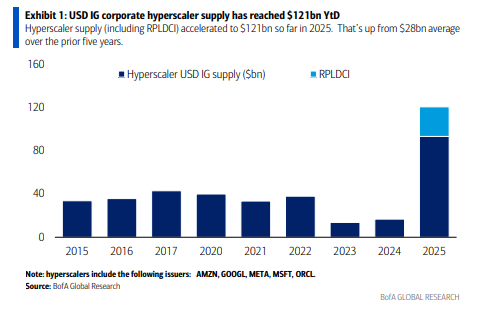
Group 1 - The core viewpoint of the articles highlights the significant capital demands for AI infrastructure, leading to a deep binding of the debt market with the global financial system, reminiscent of the pre-2008 financial crisis dynamics [1][2][6] - Major tech companies, such as Amazon, are experiencing a surge in capital expenditures, with Amazon's spending increasing by 75% year-over-year, approaching the level of its operating cash flow [1][3] - The bond market has seen a strong response, with Amazon's recent $15 billion bond issuance attracting $80 billion in subscriptions, indicating a high demand for yield among institutional investors [1][3] Group 2 - The current financing model raises concerns about risk transmission across the financial system, similar to the mortgage market before the 2008 crisis, where high leverage and concentrated bets could lead to widespread repercussions [2][5][6] - The total bond issuance by the five major U.S. cloud computing giants has reached an astonishing $121 billion this year, significantly higher than the average of $28 billion over the past five years [3][4] - The projected need for private credit funding for AI infrastructure projects is estimated to be around $800 billion from 2025 to 2028, which is one-third of the expected total investment in the sector during that period [4]

亚马逊:谷歌式暴涨即将来临?
美股研究社· 2025-11-19 10:08
Core Viewpoint - Amazon (AMZN) recently reported one of its best quarterly performances, with revenue and profit significantly exceeding expectations, despite a nearly 10% stock price drop following the earnings report [1][9]. Group 1: Performance and Market Reaction - Amazon's stock price reached a historical high after the earnings report but has since declined nearly 10% due to weak investor sentiment influenced by the crowded AI sector [1]. - Analysts believe that Amazon is poised for a price surge similar to Google's (GOOG) recent performance, as the company's fundamentals are improving [2][9]. - The recent sell-off in the market is viewed as a reaction to overheated AI sector speculation, rather than a reflection of Amazon's strong quarterly results [8][19]. Group 2: AWS and Business Segments - Amazon Web Services (AWS) has shown accelerated growth, addressing market concerns about its position in the AI space, with a record backlog of $200 billion, nearly doubling since the launch of ChatGPT [13]. - Other high-margin business lines, such as third-party seller services (11% growth), advertising (22% growth), and subscription services (10% growth), continue to perform strongly [9]. - Analysts expect AWS to maintain continuous quarterly growth and improved profit margins, which could lead to a significant increase in Amazon's stock price [9]. Group 3: Investment Cycle and Valuation - The current investment cycle in AI is one of the largest ever, with major tech companies expected to invest hundreds of billions of dollars [12]. - Concerns about excessive capital expenditure and overbuilding are noted, but analysts argue these do not apply to Amazon due to its strong return on investment and historical recovery of free cash flow after previous investment cycles [14][13]. - Amazon's stock is currently priced at $225 per share, with a projected P/E ratio of 29 for 2026, which analysts consider low compared to historical levels, suggesting a target price of $305 per share for a potential 35% upside in the next 12 months [16].

优刻得跌2.69% 2020年上市两募资共26.44亿元
Zhong Guo Jing Ji Wang· 2025-11-19 09:01
Core Viewpoint - UCloud's stock is currently trading at 23.14 yuan, reflecting a decline of 2.69% and is in a state of post-IPO loss [1] Group 1: IPO Details - UCloud was listed on the Shanghai Stock Exchange's Sci-Tech Innovation Board on January 20, 2020, with an initial offering price of 33.23 yuan per share [1] - The total number of shares issued during the IPO was 58.5 million, raising a total of 1.944 billion yuan, with a net amount of 1.840 billion yuan after deducting issuance costs [1] - The total issuance costs amounted to 104 million yuan, including underwriting and sponsorship fees of 88.31 million yuan [1] Group 2: Follow-on Offering - On February 16, 2022, UCloud announced the results of a specific stock issuance, priced at 23.11 yuan per share, with 30,289,917 shares issued to 8 specific investors [2] - The total funds raised from this issuance were approximately 699.999 million yuan, with a net amount of about 691.286 million yuan after deducting issuance costs [2] - The capital increase included an increase in share capital of 30,289,917 yuan and an increase in capital reserves of approximately 660.996 million yuan [2] Group 3: Total Fundraising - UCloud has raised a total of 2.644 billion yuan from both its IPO and follow-on offerings combined [3]

海马云与腾讯云签署战略合作协议,共建AIGC内容创作平台新生态
Sou Hu Cai Jing· 2025-11-19 08:55
Core Insights - Anhui Haima Cloud Technology Co., Ltd. has signed a strategic cooperation agreement with Tencent Cloud to collaborate on AIGC content creation, 3D generation technology, and cloud computing infrastructure [1] - Haima Cloud's RunningHub platform will fully integrate with Tencent's Mixyuan 3D model, enhancing the content creation experience and production capabilities for users [2][3] Group 1: Company Overview - Haima Cloud is a GPUaaS real-time cloud rendering platform provider, focusing on building a robust platform for real-time cloud rendering and AI inference, offering full-stack services such as cloud gaming, cloud XR, and cloud mobile [3] - The core product, RunningHub, is a leading AIGC graphics and audio-video workflow development and API service platform, gathering over 100,000 developers from more than 140 countries [3] Group 2: Partnership Details - The integration of Mixyuan 3D into the RunningHub platform significantly improves the efficiency and quality of 3D asset generation, allowing users to quickly create high-precision, ready-to-use 3D models for various applications such as game characters and VR scenes [4] - The collaboration combines Mixyuan 3D's intelligent completion capabilities with RunningHub's ComfyUI workflow, enabling an automated production process from concept to finished product [4] Group 3: Technological Advancements - Tencent recently launched the Mixyuan 3D 3.0 model, which enhances modeling precision by three times compared to the previous version, significantly improving the generation of character shapes and complex details [6] - The new Mixyuan 3D Studio tool addresses traditional 3D development challenges, improving production efficiency and supporting higher quality creation in industries such as game development, animation, and industrial design [6] Group 4: Market Impact - Tencent Cloud's AI products have served over 1,000 leading internet enterprises, providing an integrated "cloud + AI" full-stack product capability that supports AIGC, content creation, and recommendation optimization [6] - This partnership aims to accelerate AI application implementation and contribute to a more efficient and sustainable AI application ecosystem in the internet industry [6]


AI狂潮下的债务杠杆——下一场金融风暴导火索?
Hua Er Jie Jian Wen· 2025-11-19 08:33
Group 1 - The core trend driving the demand for debt in AI infrastructure is the significant increase in capital expenditures by tech giants, exemplified by Amazon's capital spending surging 75% year-over-year, nearing the company's operating cash flow levels [1] - Traditional equity financing is becoming insufficient to meet the capital needs, leading companies to turn to the bond market and private credit for support, as evidenced by Amazon's recent $15 billion bond issuance attracting $80 billion in subscriptions [1][2] - The strong demand for AI-related debt instruments is being fueled by institutional investors such as pension funds and insurance companies, which are seeking higher yields in a low-interest-rate environment [3] Group 2 - The total bond issuance by the five major U.S. cloud computing companies has reached an astonishing $121 billion this year, significantly higher than the average of $28 billion over the past five years, indicating a substantial impact on the market [2] - It is projected that AI infrastructure projects will require approximately $800 billion in private credit funding between 2025 and 2028, representing one-third of the expected total infrastructure investment in the sector during that period [3] - The financing structure poses a systemic risk due to its broad distribution across the financial system, as debts are held by various institutional investors, which could lead to widespread repercussions if the AI sector underperforms or experiences defaults [4][5]
长沙跨境出海产业服务联盟成立 助力湖南企业全球化
Zhong Guo Xin Wen Wang· 2025-11-19 08:26
中新网长沙11月19日电长沙亚马逊云科技出海赋能中心"乘云出海湘链全球 AI智启未来"项目签约暨跨 境出海峰会18日在长沙经开区举行。 "亚马逊云科技与颐高集团联合,将汇聚双方优势,构建集产业赋能、资源对接与创新孵化于一体的跨 境电商与数字贸易发展平台。" 颐高集团有限公司总裁黄涛介绍,长沙亚马逊云科技将提供先进的技术 支持,为本地企业提供云计算、人工智能、大数据、物联网等领域的前沿技术和解决方案,同时促进产 业集聚,联合产业链上下游企业,推动传统产业数字化转型与创新,构建以数字技术为核心的出海贸易 合作网络。 长沙经开区党工委副书记、管委会主任蒋红波表示,此次亚马逊云科技出海赋能中心与能科、西门子、 普华永道等企业签约,将进一步优化中部跨境出海产业生态,真正将出海赋能中心打造成集技术支撑、 资源对接、生态聚合于一体的高能级开放平台,期待出海赋能中心发挥平台优势,链接全球资源,创新 贸易形态,助力园区打造内陆地区开放高地。长沙经开区将持续打造市场化、法治化、国际化一流营商 环境,助力企业深耕全球市场、共拓产业蓝海。 湖南省商务厅党组成员、副厅长邓卫平说,希望出海赋能中心以此次签约为新起点,依托亚马逊云科技 领 ...
天量发债!美国云大厂今年发债量是过去5年平均的4倍,债券利差大幅扩大
Hua Er Jie Jian Wen· 2025-11-19 02:57
Core Insights - The report from Bank of America highlights an unprecedented surge in bond issuance by major U.S. tech giants, particularly the five leading cloud computing companies, which have collectively issued $121 billion in bonds this year, significantly surpassing the average annual issuance of $28 billion over the past five years [1][2][4] Group 1: Bond Issuance and Market Impact - The total bond issuance from the five major cloud computing companies (Amazon, Google, Meta, Microsoft, Oracle) has reached $121 billion in 2023, with $81 billion issued since September alone [2][4] - This surge in supply has led to a significant widening of bond spreads for these companies, with Oracle's spread increasing by 48 basis points, while Meta and Google saw increases of 15 and 10 basis points respectively, underperforming the overall investment-grade bond index which only rose by 3% [4][6] Group 2: Future Outlook and Investment Opportunities - Looking ahead, the bond issuance trend is expected to continue, with a projected issuance of around $100 billion in 2026, driven by varying capital expenditure needs among the cloud giants [6] - Despite the high issuance levels, the current widening of spreads may present attractive investment opportunities, as these companies are expected to cover most of their capital expenditures with operating cash flow [6]