
债券利差

Search documents
明年固收+与纯债基金增减如何影响债市需求?
Western Securities· 2025-12-28 10:12
Group 1: Report's Industry Investment Rating - Not provided in the given content Group 2: Report's Core Viewpoints - In the neutral scenario, the increase in bond demand from the growth of fixed - income + fund scale may not offset the decrease in bond demand caused by the shrinkage of pure - bond fund scale. Credit bond and convertible bond demand will increase, while interest - rate bond, especially policy - financial bond, demand will significantly decline [1] - In the short term, the bond market has entered a volatile stage after the previous rebound. The core strategy is carry trade, with a focus on allocating safe assets such as 4 - 5 - year credit bonds, 5 - year treasury bonds, and 5 - 7 - year CDB bonds. In January, interest rates may still face upward pressure due to factors like the front - loaded issuance of government bonds and high CD renewal pressure in the first quarter [1][2][33] Group 3: Summary by Relevant Catalogs 1. How much bond demand does the growth of fixed - income + fund scale bring? - **1.1 Fixed - income + fund scale and bond - holding structure**: The growth of the equity market has driven up the profitability and scale of fixed - income + funds. From Q4 2024 to Q3 2025, the scale increased from 1.69 trillion yuan to 2.44 trillion yuan. The bond - holding scale of fixed - income + funds has generally risen, reaching 3.3 trillion yuan in Q3 2025 with a 16% QoQ increase. In contrast, the bond - holding scale of pure - bond funds declined to 7.9 trillion yuan in Q3 2025. Both types of funds mainly hold credit bonds, but fixed - income + funds have a higher convertible bond position and a lower policy - financial bond position [10][12] - **1.2 Estimation of the incremental bond demand brought by the growth of bond fund scale in 2026** - **1.2.1 Changes in bond demand due to the growth of fixed - income + fund scale**: Under pessimistic, neutral, and optimistic scenarios, the bond demand scales of fixed - income + funds in 2026 are 3 trillion yuan, 3.40 trillion yuan, and 3.95 trillion yuan respectively, with incremental demands of 2723 billion yuan, 6807 billion yuan, and 12253 billion yuan. The demand for credit bonds may increase significantly. In the neutral scenario, compared with Q4 2025, the increments of general credit bonds and financial bonds are 2740 billion yuan and 1751 billion yuan respectively [18] - **1.2.2 Changes in bond demand due to the shrinkage of pure - bond fund scale**: Under pessimistic, neutral, and optimistic scenarios, the bond demand scales of pure - bond funds in 2026 are 6.58 trillion yuan, 6.97 trillion yuan, and 7.35 trillion yuan respectively, with demand decreases of 11608 billion yuan, 7739 billion yuan, and 3869 billion yuan. The demand for general credit bonds and policy - financial bonds will decrease relatively more. In the neutral scenario, compared with Q4 2025, the changes in general credit bonds and policy - financial bonds are - 2268 billion yuan and - 3043 billion yuan respectively [24] - **1.2.3 Total incremental bond demand brought by fixed - income + funds and pure - bond funds**: In the neutral scenario, overall bond demand decreases. The increase in bond demand from fixed - income + funds may not offset the decrease from pure - bond funds. Credit bond and convertible bond demand increase, while interest - rate bond, especially policy - financial bond, demand decreases significantly. The total demand for credit bonds and interest - rate bonds decreases by 1455 billion yuan [30] - **1.3 Bond market outlook**: In the short term, the bond market is in a volatile stage, and the strategy focuses on carry trade and safe - asset allocation. In January, interest rates may face upward pressure, but it may also present a good allocation window [33] 2. Overview of credit bond yields - From December 22 - 26, 2025, credit bond yields showed mixed trends. General credit bonds like urban investment bonds and industrial bonds performed better than financial bonds, and medium - and high - rated bonds performed better than low - rated ones. Urban investment bonds and industrial bonds mainly saw yield declines, while the yields of other financial bonds showed mixed trends. Insurance sub - bonds had all - around yield declines [34][35] 3. Primary market - **3.1 Issuance volume**: The issuance volume of credit bonds decreased MoM but increased YoY this week. The net financing volume increased both MoM and YoY. The net financing volume of financial bonds increased MoM, while that of urban investment bonds and industrial bonds decreased [42] - **3.2 Issuance cost**: The average issuance interest rate of credit bonds increased. The average issuance interest rate of industrial bonds decreased MoM, while those of urban investment bonds and financial bonds increased. The significant increase in financial bond issuance rates was due to the issuance of some high - interest - rate bonds [51] - **3.3 Issuance term**: The average issuance term of credit bonds decreased MoM. The issuance terms of urban investment bonds and industrial bonds decreased, while that of financial bonds increased [55] - **3.4 Cancellation of issuance**: The number and scale of cancelled credit bond issuances decreased MoM. From December 22 - 26, 8 bonds were cancelled, 2 less than the previous week, and the cancelled issuance scale decreased by 27.54 billion yuan [59] 4. Secondary market - **4.1 Trading volume**: Except for insurance sub - bonds, the trading volumes of other credit bonds rebounded. The trading terms of urban investment bonds and industrial bonds lengthened, while those of bank secondary capital bonds and insurance sub - bonds shortened. The trading terms of bank perpetual bonds and securities firm sub - bonds shifted from the middle to both ends [64] - **4.2 Trading liquidity**: The turnover rates of credit bonds increased. For urban investment bonds, except for the 3 - year - and - below term, the turnover rates of other terms increased, with the 7 - 10 - year term having the largest increase. For industrial bonds, except for the 3 - year - and - below term and the 3 - 5 - year term, the turnover rates of other terms increased, with the 7 - 10 - year term having the largest increase. For financial bonds, except for the 7 - 10 - year term and the 3 - 5 - year term, the turnover rates of other terms increased, with the 10 - year - and - above term having the largest increase [67] - **4.3 Spread tracking**: This week, the spreads of 1 - year and 7 - year urban investment bonds mostly widened, while those of other terms mostly narrowed. The spreads of AAA - rated industrial bonds mostly narrowed, while those of AA - rated industrial bonds mostly widened. The spreads of bank secondary and perpetual bonds mostly widened, with short - term spreads widening more. The spreads of securities firm sub - bonds and insurance sub - bonds mostly narrowed [74][77][79] 5. Weekly hot bonds overview - The report selects the top 20 urban investment bonds, industrial bonds, and financial bonds in terms of liquidity scores for investors' reference [83] 6. Review of credit rating adjustments - According to domestic rating agencies, 3 bonds had their credit ratings upgraded this week, and no bonds had their ratings downgraded [89]
成交额超11亿元,国债ETF5至10年(511020)近10个交易日净流入3.18亿元
Sou Hu Cai Jing· 2025-12-18 01:44
Group 1 - The core viewpoint emphasizes the focus on specific active bonds and hedging strategies for 5-year government bonds, particularly bonds 250208 and 250203, as well as the 5-year government bond-TF strategy [1] - For 30-year government bonds, the current yield spread between new and old bonds remains high, with non-active bonds showing good holding value, particularly bonds 250002 and 25T2 [1] - The 10-year government bond yield spread is around 7 basis points for bonds 250220-250215 and 1 basis point for bonds 250016-250022, indicating reasonable spreads [1] Group 2 - The liquidity of the 5-10 year government bond ETF is active, with a turnover rate of 58.28% and a transaction volume of 1.134 billion yuan [2] - The latest scale of the 5-10 year government bond ETF is 1.947 billion yuan, with a net inflow of 318 million yuan over the last 10 trading days [3] - The management fee rate for the 5-10 year government bond ETF is 0.15%, and the custody fee rate is 0.05% [4] Group 3 - The tracking error for the 5-10 year government bond ETF over the last three months is 0.024%, closely tracking the index of active bonds [5]
债券研究周报:30年国债切券的来龙去脉-20251123
Guohai Securities· 2025-11-23 11:01
Report Summary 1. Report Industry Investment Rating No industry investment rating was provided in the report. 2. Core View of the Report The bond market was volatile this week. In a sideways environment, the spread changes of individual bonds are more worthy of attention. The liquidity of the 25 Attached Interest 02 bond in the 30Y Treasury bonds increased significantly this week, once exceeding that of the 25 Special 02 bond. The report focuses on three questions: why the liquidity of the Attached Interest 02 bond improved significantly, which bond might become the active bond in the future, and what the current operation suggestions are [5][11]. 3. Summary According to the Table of Contents 3.1 This Week's Bond Market Review - The bond market was volatile this week. The liquidity of the 25 Attached Interest 02 bond in the 30Y Treasury bonds increased significantly, once exceeding that of the 25 Special 02 bond [5][11]. - The reasons for the significant improvement in the liquidity of the Attached Interest 02 bond may be twofold. Firstly, there is speculation that the next issuance scale will exceed expectations. According to the Ministry of Finance's issuance plan, the ordinary Treasury bonds will be re - issued on December 5, and the issuance scale will be known about one week in advance. The previous issuance scale of the Attached Interest 02 bond was 27 billion yuan, and the market is speculating that the issuance scale of the last issue of the Attached Interest 02 bond this year may exceed expectations, so the liquidity will improve. Historically, the issuance scale of the last issue of the 230023 bond was about twice that of the previous issue. Secondly, the market is speculating that the year - end issuance plan includes the Attached Interest 02 bond. Historically, special Treasury bonds have never been issued across years, but ordinary Treasury bonds have. As the end of the year is the final time point, as long as the expectation remains, the price may fluctuate repeatedly [5][11]. - Regarding which bond may become the active bond in the future, without considering other market sentiment disturbances, there are two time points worthy of attention: the disclosure time of the issuance scale of the Attached Interest 02 bond (around the end of November) and the year - end issuance plan of the Ministry of Finance. For the upcoming second re - issuance, if the issuance scale of the Attached Interest 02 bond exceeds expectations, its status as an active bond will be consolidated; if it is still small or fails to meet expectations, the Special 06 bond will continue to be the active bond, but the Attached Interest 02 bond may have an "active bond expectation" again by the end of the year. For the year - end issuance plan, if it is a re - issuance of the Attached Interest 02 bond, it may strengthen; if it is a new code, the pattern of active and sub - active bonds may not change significantly after the end of the year [5][12]. - For current operations, if choosing band trading, avoid 30 - year varieties; if choosing to allocate 30 - year varieties, both the Attached Interest 02 and Special 06 bonds can be held to hedge against possible spread fluctuations; if only adding a single bond in the short term, pay attention to the disturbances caused by the subsequent re - issuance scale of the Attached Interest 02 bond and trade in a timely manner [6][13][14]. 3.2 Bond Yield Curve Tracking - **Key Maturity Interest Rates and Spread Changes**: As of November 21, compared with November 17, the 1Y Treasury bond yield decreased by 0.56bp to 1.40%; the 10Y Treasury bond yield increased by 0.57bp to 1.82%; the 30Y Treasury bond yield increased by 1.85bp to 2.16%. The spread between the 30Y and 10Y Treasury bonds increased by 1.28bp to 34.10bp, and the spread between the 10Y CDB bond and 10Y Treasury bond increased by 0.28bp to 12.49bp [15]. - **Treasury Bond Maturity Spread Changes**: As of November 21, compared with November 17, the 3Y - 1Y Treasury bond spread increased by 0.23bp to 3.40bp, the 5Y - 3Y Treasury bond spread increased by 0.94bp to 15.59bp, the 7Y - 5Y Treasury bond spread decreased by 0.85bp to 11.46bp, the 10Y - 7Y Treasury bond spread increased by 0.81bp to 11.13bp, the 20Y - 10Y Treasury bond spread increased by 2.09bp to 34.09bp, and the 30Y - 20Y Treasury bond spread decreased by 0.81bp to 0.01bp [16]. 3.3 Bond Market Leverage and Funding Situation - **Balance of Inter - bank Pledged Repurchase**: As of November 21, compared with November 17, the balance of inter - bank pledged repurchase increased by 0.44 trillion yuan to 11.50 trillion yuan [19]. - **Change in Inter - bank Bond Market Leverage Ratio**: As of November 21, compared with November 17, the inter - bank bond market leverage ratio increased by 0.27pct to 106.89% [22]. - **Pledged Repurchase Turnover**: From November 17 to November 21, the average daily turnover of pledged repurchase was 7.29 trillion yuan, and the average overnight turnover was about 6.48 trillion yuan, with an average overnight turnover ratio of 88.86% [23][24]. - **Inter - bank Funding Operation Situation**: From November 17 to November 21, bank funds for lending continued to rise. As of November 21, the net lending of large state - owned banks and policy banks was 4.09 trillion yuan, the net borrowing of joint - stock banks and urban and rural commercial banks was 0.22 trillion yuan, and the net lending of the banking system was 3.88 trillion yuan. The daily lending amount of banks first decreased and then increased. As of November 21, the daily lending amount of large state - owned banks and policy banks was 3.66 trillion yuan, and that of small and medium - sized banks was 0.32 trillion yuan. In terms of funding rates, as of November 21, DR001 was 1.3209%, DR007 was 1.4408%, R001 was 1.3877%, and R007 was 1.4952% [27]. 3.4 Duration of Medium - and Long - Term Bond Funds - **Median Duration of Bond Funds**: As of November 21, the median duration of medium - and long - term bond funds (de - leveraged) was 2.76 years, an increase of 0.02 years compared with November 17; the median duration (including leverage) was 3.00 years, an increase of 0.06 years compared with November 17 [36]. - **Median Duration of Interest - Rate Bond Funds**: As of November 21, the median duration of interest - rate bond funds (including leverage) was 3.89 years, an increase of 0.01 years compared with November 17; the median duration of credit bond funds (including leverage) was 2.76 years, an increase of 0.06 years compared with November 17. The median duration of interest - rate bond funds (de - leveraged) was 3.36 years, unchanged from November 17, and the median duration of credit bond funds (including leverage) was 2.57 years, an increase of 0.03 years compared with November 17 [39][41]. 3.5 Change in Bond Lending Balance As of November 20, compared with November 17, the borrowing volume of 10Y CDB bonds showed volatility [43].

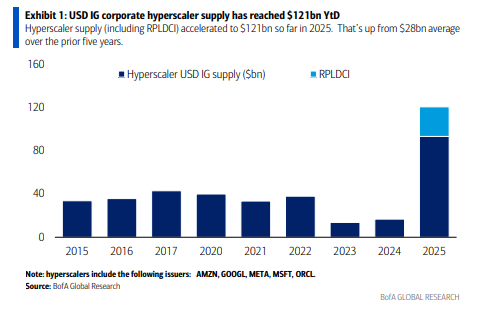
天量发债!美国云大厂今年发债量是过去5年平均的4倍,债券利差大幅扩大
Hua Er Jie Jian Wen· 2025-11-19 02:57
Core Insights - The report from Bank of America highlights an unprecedented surge in bond issuance by major U.S. tech giants, particularly the five leading cloud computing companies, which have collectively issued $121 billion in bonds this year, significantly surpassing the average annual issuance of $28 billion over the past five years [1][2][4] Group 1: Bond Issuance and Market Impact - The total bond issuance from the five major cloud computing companies (Amazon, Google, Meta, Microsoft, Oracle) has reached $121 billion in 2023, with $81 billion issued since September alone [2][4] - This surge in supply has led to a significant widening of bond spreads for these companies, with Oracle's spread increasing by 48 basis points, while Meta and Google saw increases of 15 and 10 basis points respectively, underperforming the overall investment-grade bond index which only rose by 3% [4][6] Group 2: Future Outlook and Investment Opportunities - Looking ahead, the bond issuance trend is expected to continue, with a projected issuance of around $100 billion in 2026, driven by varying capital expenditure needs among the cloud giants [6] - Despite the high issuance levels, the current widening of spreads may present attractive investment opportunities, as these companies are expected to cover most of their capital expenditures with operating cash flow [6]






票息资产热度图谱:中短债再临1.9%低位
SINOLINK SECURITIES· 2025-11-04 14:54
Group 1: Overall Investment Rating - No investment rating information provided in the report. Group 2: Core Viewpoints - As of November 3, 2025, private - owned real estate bonds and industrial bonds in the outstanding credit bonds have higher overall valuation yields and spreads compared to other varieties. Yields of non - financial and non - real estate industrial bonds and real estate bonds have generally declined, and financial bond yields have also decreased [8]. Group 3: Summary by Directory 3.1 General Information on Outstanding Credit Bonds - The weighted average valuation yields of public urban investment bonds in Jiangsu and Zhejiang are below 2.55%, while those with yields over 4.5% are from district - level in Guizhou. Private urban investment bonds in coastal provinces like Shanghai, Zhejiang, Guangdong, and Fujian have weighted average valuation yields below 2.9%, and higher - yield varieties are in Guizhou, Yunnan, and Gansu [2]. - Compared with last week, yields of public urban investment bonds have generally declined, with the 3 - 5 - year varieties having an average decline of 9.7BP. Yields of private urban investment bonds have also generally declined, with the 3 - 5 - year varieties having an average decline of 10BP [2]. - Non - financial and non - real estate industrial bonds (state - owned enterprises): 3 - 5 - year private non - perpetual and perpetual bonds have declined by 10.2BP and 9.8BP respectively, and the decline of varieties within 1 year is mostly within 5BP. Real estate bonds: yields have all declined, with significant differentiation between within 1 year and over 1 year, and non - perpetual bonds such as 2 - 3 - year state - owned public, 3 - 5 - year state - owned private, and private - owned public have a decline of over 9BP [3][8]. - In financial bonds, urban and rural commercial bank capital replenishment tools and leasing company bonds have relatively high valuation yields and spreads. Yields of financial bonds have declined. For example, in leasing bonds, the 2 - 3 - year private perpetual bonds have a yield decline of 9.5BP [4][8]. 3.2 Public Urban Investment Bonds - The weighted average valuation yields of public urban investment bonds in Jiangsu and Zhejiang are low, and those in Guizhou district - level are high. Yields have generally declined compared with last week, and the curve has flattened, with the 3 - 5 - year varieties having a large average decline [2][15]. - Specific varieties with large yield declines include 1 - 2 - year non - perpetual bonds of Zhejiang provincial level, 2 - 3 - year non - perpetual bonds of Henan district - level, etc. [2][15]. 3.3 Private Urban Investment Bonds - The weighted average valuation yields of private urban investment bonds in coastal provinces are low, and those in Guizhou, Yunnan, and Gansu are high. Yields have generally declined compared with last week, with the 3 - 5 - year varieties having an average decline of 10BP [2][23]. - Specific varieties with large yield declines include 3 - 5 - year perpetual bonds of Fujian district - level, 1 - 2 - year non - perpetual bonds of Guizhou prefecture - level, etc. [23].
美联储降息引发抢购潮,美国公司债利差被压至27年最低
Zhi Tong Cai Jing· 2025-09-19 02:44
Group 1 - A key valuation metric for U.S. corporate bonds has reached its highest level in nearly three decades, following the Federal Reserve's first interest rate cut since 2024, prompting investors to lock in still high yields [1] - The risk premium for U.S. investment-grade corporate bonds has narrowed to just 72 basis points, marking a new low not seen in decades, with the spread previously touching 73 basis points in August, the lowest since 1998 [1] - High-grade bond average yields are currently at 4.76%, significantly above the average level of approximately 3.6% since 2010 [1] Group 2 - For most of the past three years, average yields have remained above 5% due to the Federal Reserve's rate hikes aimed at curbing post-pandemic inflation, which has driven demand from investors like pension plans that need to fund long-term liabilities [2] - The Federal Reserve's updated economic forecasts indicate two more 25 basis point rate cuts this year, which could further lower yields and heighten urgency among some investors [2] - The current environment of tight spreads is considered ideal, with solid fundamentals, strong demand, and no excessive supply pressure [2]
荷兰国际:欧元区GDP数据可能导致债券息差扩大
news flash· 2025-07-30 08:29
Core Viewpoint - The report suggests that weaker-than-expected Eurozone GDP data could lead to an expansion of government bond yield spreads in the Eurozone [1] Group 1: Economic Indicators - If the preliminary Eurozone GDP data, set to be released at 17:00 Beijing time, is below expectations, it may catalyze an increase in government bond yield spreads [1] - Currently, the yield spread has narrowed as investors view European assets as a safe haven amid trade tensions [1] Group 2: Market Dynamics - With the recent trade agreement between Europe and the U.S., the attractiveness of Eurozone government bonds may diminish [1] - The latest data from Tradeweb indicates that the yield difference between Italian and German 10-year government bonds stands at 84 basis points [1]

固收专题:信用债发行额和净融资有所回暖,成交热度提升
KAIYUAN SECURITIES· 2025-07-28 03:34
Report Overview - Report Date: July 28, 2025 [1] - Research Team: Fixed Income Research Team [2] - Analysts: Chen Xi, Liu Rui [3] Investment Rating - The report does not mention the industry investment rating. Core Views - Credit bond issuance and net financing have recovered, and trading activity has increased [1][4] - The science and technology innovation bond market is in the second half, with room for spread compression [4] - Credit strategy focuses on balancing coupon and risk, increasing allocation to short - term high - coupon city investment bonds and 3Y/AAA - secondary capital bonds [6] Summary by Directory Policy and Market Trends - On July 18, 2025, the Shenzhen Stock Exchange issued a notice on pilot corporate bond re - issuance and asset - backed securities expansion business, aiming to enhance market depth and optimize financing efficiency [4] - The science and technology innovation bond market is in the second half. Driven by the expansion of underlying assets and policy guidance in the second half of the year, there is still room for spread compression [4] Primary Issuance - From July 21 - 25, the issuance amount of general credit bonds was 351 billion yuan, a week - on - week increase of 70.9 billion yuan; net financing was 128 billion yuan, a week - on - week increase of 83 billion yuan [4] - Among them, the issuance amount of urban investment bonds was 107.7 billion yuan, a week - on - week increase of 10.9 billion yuan; net financing was 29.8 billion yuan, a week - on - week increase of 27.5 billion yuan [4] - The issuance amount of industrial bonds was 243.2 billion yuan, a week - on - week increase of 60.1 billion yuan; net financing was 98.2 billion yuan, a week - on - week increase of 55.8 billion yuan [4] - The weighted issuance term of general credit bonds was 4.21 years, a week - on - week increase of 0.88 years; the weighted issuance interest rate was 1.75%, a week - on - week decrease of 0.09 pct [4] Secondary Trading - The turnover rates of general credit bonds with maturities of less than 1 year and 1 - 3 years increased, while those of other maturities decreased [5] - The turnover rate of bank Tier 2 and perpetual bonds increased overall, with a significant increase in the AAA - level, and a decrease in the AA+ and AA levels [5] Spread Tracking - As of July 25, the average yields of medium - and short - term notes, urban investment bonds, secondary capital bonds, and perpetual bonds with AAA ratings at various maturities were at historically low levels [5] - For urban investment bonds, most spreads widened, except for some 3 - year and 5 - year varieties [5] - For bank Tier 2 and perpetual bonds, the spreads of 3Y and 5Y levels widened, while the 1Y spread narrowed [5] - Regionally, most provincial urban investment bond spreads widened, with Heilongjiang having the largest widening amplitude of 11BP [5] - In the industrial bond sector, most industry spreads narrowed or remained flat, except for the AA - level chemical and AA - level building materials industries [6] Credit Strategy - Balance coupon and risk, and give priority to short - term high - rating varieties. Pay attention to liquidity premium opportunities at the ultra - long end and beware of policy and credit event disturbances [6] - Increase allocation to short - term high - coupon urban investment bonds and industrial bonds with a duration of less than 3 years [6] - Enter the ultra - long - term credit bond market after interest rate adjustments, and focus on the liquidity premium of insurance sub - debt and science and technology innovation bond ETF component bonds [6] - For bank Tier 2 and perpetual bonds, pay attention to changes in the capital market and the overall sentiment of the credit bond allocation end when considering sector games [6]
亚洲高等级美元债券利差至少扩大2个基点,亚洲信用违约掉期至少扩大2个基点。
news flash· 2025-06-23 01:19
Group 1 - The spread of high-grade dollar bonds in Asia has widened by at least 2 basis points [1] - The credit default swaps in Asia have also increased by at least 2 basis points [1]
债市机构行为周报(6月第4周):还有哪些债券可以挖掘?-20250622
Huaan Securities· 2025-06-22 09:13
1. Report Industry Investment Rating No relevant content provided. 2. Core Views of the Report - The 20Y Treasury bond market may not be over yet, with potential for the 20Y - 30Y spread to compress further, and the 20Y Treasury bond may be more cost - effective than the 50Y Treasury bond [2][3][12] - Investors can look for opportunities in some old bonds with certain liquidity and spread compression potential, but the follow - up odds of 230023 may be insufficient [3][13] - In the current bond market environment of extending duration and increasing leverage, there is no need to overly worry about reversal risks before the end of the month, and attention should be paid to the right - side response after sudden event shocks [4][6] 3. Summary by Directory 3.1 This Week's Institutional Behavior Review: Which Bonds Can Be Explored? - **Yield Curve**: Both Treasury and China Development Bank bond yields generally declined. For Treasury bonds, the 1Y yield dropped 4bp, 3Y dropped 3bp, 5Y dropped 4bp, 7Y dropped about 2bp, 10Y changed less than 1bp, 15Y dropped 3bp, and 30Y dropped 1bp. For China Development Bank bonds, the 1Y yield dropped about 1bp, 3Y dropped 2bp, 5Y dropped 3bp, 7Y and 10Y dropped about 2bp, 15Y dropped 5bp, and 30Y remained flat [15] - **Term Spread**: Treasury bond spreads showed deeper inversion and short - end spreads widened, while China Development Bank bond spreads had a differentiated trend with long - end spreads widening [18][19] 3.2 Bond Market Leverage and Funding Conditions - **Leverage Ratio**: The leverage ratio rose to 107.85%. As of June 20, it was about 107.85%, up 0.38pct from last Friday and 0.35pct from this Monday [21] - **Average Daily Repo Turnover**: The average daily turnover of pledged repos was 8.3 trillion yuan, with an average overnight share of 89.71%. The average daily turnover increased compared to last week [28] - **Funding Conditions**: Bank funding supply fluctuated upward. DR007 first rose and then fell, R007 first fell and then rose. 1YFR007 and 5YFR007 both declined [33][34] 3.3 Duration of Medium - and Long - Term Bond Funds - **Median Duration**: The median duration of medium - and long - term bond funds rose to 2.82 years (de - leveraged) and 3.07 years (including leverage). On June 20, the median duration (de - leveraged) was 2.82 years, up 0.04 years from last Friday; the median duration (including leverage) was 3.07 years, up 0.11 years from last Friday [44] - **Duration of Bond Fund Types**: The median duration of interest - rate bond funds (including leverage) remained at 3.69 years, up 0.02 years from last Friday; the median duration of credit bond funds (including leverage) rose to 2.88 years, up 0.15 years from last Friday [47] 3.4 Comparison of Generic Strategies - **Sino - US Yield Spread**: The overall Sino - US yield spread widened. The 1Y spread narrowed by about 2bp, while the 2Y, 3Y, 5Y, 7Y, and 10Y spreads widened [51] - **Implied Tax Rate**: The short - end implied tax rate widened, while the medium - and long - end narrowed [52] 3.5 Changes in Bond Lending Balances On June 20, the lending concentration trends of the active 10Y and 30Y Treasury bonds rose, while those of the second - active 10Y Treasury bond, the active 10Y China Development Bank bond, and the second - active 10Y China Development Bank bond declined [57]