
资产管理

Search documents
比美联储更强大?它执掌十万亿资本,贝莱德如何悄然影响世界
Sou Hu Cai Jing· 2025-09-24 11:48
Core Viewpoint - BlackRock, a major asset management company, influences global capital flows and decision-making without being a government entity, managing assets comparable to the GDP of major economies like China and the U.S. [1][3] Group 1: Influence and Operations - BlackRock manages over $10 trillion in assets, making it a significant player in global finance, comparable to the GDP of several countries [25] - The company has established itself as a key advisor to various governments and institutions, managing assets for royal families and pension funds [5][17] - BlackRock's investment strategies often involve indirect influence over major corporations, such as Apple and Nvidia, through its substantial shareholdings [7][9] Group 2: Leadership and Strategy - Larry Fink, the CEO of BlackRock, transitioned from a political aspiration to a financial career, recognizing the central role of capital in power dynamics [9][11] - Fink's innovation in financial products, such as Mortgage-Backed Securities (MBS), played a crucial role in the company's growth during the 2008 financial crisis [13][15] - The development of the Aladdin system, a sophisticated risk management and investment tool, has positioned BlackRock as a critical decision-maker for many large institutions [19][21] Group 3: Recent Developments - BlackRock has engaged in strategic investments following crises, such as acquiring real estate companies in Hawaii before a major disaster [25][27] - The company has signed agreements with countries like Ukraine, leveraging strategic resources as collateral for loans [25][27] - BlackRock's partnerships with other financial giants have resulted in a significant concentration of capital, controlling over $20 trillion in assets across developed economies [29][30]



赵欣舸答21:期待机构投资者推动中国资管行业发展
2 1 Shi Ji Jing Ji Bao Dao· 2025-09-24 11:33
Core Insights - The asset management industry in China is experiencing significant growth driven by the country's economic expansion and structural transformation [1][2] - Shanghai has risen to the fifth position globally in the asset management center ranking, showcasing improvements in asset management technology, underlying assets, and growth rates [1] - The shift in investment preferences from traditional savings and real estate to diversified asset management products is expected to fuel industry growth [1][2] Group 1: Industry Growth Drivers - The Chinese stock market's strong performance has positively impacted the asset management sector, leading to a diversification of investment products [2] - The increasing wealth demand in China, with investable assets reaching approximately 300 trillion yuan, is anticipated to drive growth in the asset management industry [1] - The competition among global asset management centers is evolving, focusing on technology-driven solutions and the emergence of new financial assets [2] Group 2: Future Trends and Opportunities - The competition in the asset management sector will center around three new areas: asset management technology, new supply and pricing of underlying assets, and institutional long-term capital [2] - China has the potential to leverage its complete industrial system and focus on green finance, transforming its renewable energy advantages into competitive strengths in green asset management [3] - The ongoing technological revolution positions China as a leader, with opportunities to convert technological advancements into asset management innovations [3]
东亚联丰:亚洲高收益债券配置价值或进一步凸显
Zheng Quan Ri Bao Wang· 2025-09-24 11:11
Core Viewpoint - The trend of declining deposit rates in China is driving residents' asset allocation behavior towards "yield chasing," with increasing investment willingness in high-yield risk assets [1] Group 1: Investment Trends - Asian high-yield bonds are gaining attention due to their leading global yields and relatively controllable default risks [1] - East Asia United Investment Management Company aims to capture the growth potential of high-yield bonds by flexibly adjusting the allocation between high-yield and investment-grade bonds [1] Group 2: Risk and Return Analysis - Asian high-yield bonds offer significantly higher yields compared to global counterparts, with shorter durations and lower volatility [1] - The credit quality of Asian high-yield bonds is relatively stable, with an overall low default rate, making them a viable option for risk diversification [1] Group 3: Macroeconomic Outlook - The current positive economic growth in Asia is expected to support the operational capabilities of issuing companies, enhancing their ability to repay principal and interest [1] - The outlook suggests that many central banks may maintain accommodative monetary policies, further highlighting the allocation value of Asian high-yield bonds [1]
资产证券化系列报告二:从“证券化”到“通证化”,RWA重构资产投资逻辑
Bank of China Securities· 2025-09-24 08:27
Investment Rating - The report suggests a positive outlook on the RWA (Real World Assets) sector, indicating significant potential for growth and investment opportunities in the tokenization of real estate and other assets [5][12]. Core Insights - RWA represents an upgrade of asset securitization through blockchain technology, allowing for the tokenization of both tangible and intangible assets, thus enhancing liquidity and providing new financing channels [12][13]. - The global on-chain RWA market reached approximately $26.65 billion as of August 26, 2025, with private credit and U.S. Treasury bonds being the primary assets tokenized [5][10]. - The report emphasizes that the real estate sector is poised to become a key application area for RWA, driven by its inherent asset value retention and expected cash flow [5][12]. Summary by Sections 1. Definition and Advantages of RWA - RWA allows for the tokenization of real-world assets, breaking down investment barriers and enhancing liquidity [12][17]. - The advantages of RWA include increased asset liquidity, lower investment thresholds, and enhanced transaction transparency [17][19]. 2. Development History and Market Scale - RWA has evolved from concept to market realization since 2017, entering a rapid expansion phase since 2023 [5][10]. - The total scale of global on-chain RWA has surpassed $26.65 billion, with significant growth in issuance volumes [10][12]. 3. Issuance Process and Regulatory Environment - The RWA issuance process involves asset selection, on-chain integration, issuance and trading, and ongoing management [5][18]. - Regulatory frameworks vary globally, with strict regulations in Europe and the U.S., while regions like Hong Kong adopt more flexible approaches [5][18]. 4. Tokenization of Real Estate - The report highlights the potential of RWA in real estate, suggesting it could reshape investment logic and open new financing avenues [5][12]. - Case studies, such as the tokenization of a commercial property in Hong Kong, illustrate the practical applications and benefits of RWA in real estate [5][12]. 5. Investment Recommendations - The report recommends focusing on companies with substantial real estate holdings that can leverage RWA projects to enhance liquidity and asset valuation [5][12]. - Companies with regulatory advantages are also highlighted as potential leaders in the RWA space [5][12].



践行“投资·向善”,共议ESG与高校基金会资产管理新路径——2025复旦管院·兴动ESG大讲堂成功举办
Zheng Quan Shi Bao Wang· 2025-09-24 03:24
Core Insights - The forum "Investment for Good" focused on ESG investment, asset management for university foundations, and asset allocation strategies, highlighting the importance of collaboration between asset management institutions and university foundations [1][2][3] Group 1: ESG Investment - ESG investment is recognized as a crucial force for promoting economic, environmental, and social development, representing both an innovative investment philosophy and a deep exploration of future development models [2] - The establishment of a comprehensive ESG product system in fixed income and the creation of multi-asset strategies reflect the growing emphasis on ESG products in the asset management industry [2] Group 2: University Foundations - University foundations are characterized by long-term investment horizons, public attributes, and liquidity requirements, necessitating a strategic approach to asset management [2][3] - The shift towards "asset allocation + entrusted management" signifies a professionalization journey for university foundations, emphasizing the need for strategic support and a fault-tolerant mechanism [2] Group 3: Investment Strategies - The discussion highlighted the need for university foundations to transition from direct investments to enhanced external cooperation and resource sharing, as well as from single asset investments to diversified allocations [4] - The importance of systematic decision-making over experiential judgment in investment strategies was emphasized, aiming to improve professional management capabilities [4] Group 4: Market Insights - Multi-asset allocation is viewed as an effective strategy to navigate high-volatility markets, with a focus on controlling portfolio volatility and optimizing risk-return profiles [4][5] - The current equity market environment is driven by declining risk-free rates, enhancing the attractiveness of equity assets compared to bonds, despite some concerns about localized bubbles in certain sectors [5]
景顺:目前环境支持多元化投资策略 迎接明年全球潜在增长复苏
Zhi Tong Cai Jing· 2025-09-24 02:41
Group 1: Market Outlook - The overall macro environment remains robust despite a slowdown in U.S. economic momentum, with limited risk of a significant recession [1] - The Federal Reserve's recent interest rate cut is expected to lead to three additional cuts this year, with short-term inflation pressures anticipated to be temporary [1] - The current environment supports diversified investment strategies while allowing for moderate market risk to prepare for potential global growth recovery next year [1] Group 2: Fixed Income Preferences - The yield curve is likely to steepen due to the Fed's rate cuts, with short-term rates declining while long-term rates may remain volatile due to concerns over the U.S. budget deficit [2] - Investment-grade corporate bonds are preferred due to their risk-return characteristics being similar to government bonds, with a focus on the UK and emerging markets for their attractive yields [2] - High-yield bond spreads are narrowing, necessitating a selective investment strategy despite strong fundamentals and corporate earnings [2] Group 3: Equity Market Insights - U.S. stock valuations are high, but the technology sector continues to show steady earnings growth, with cyclical sectors expected to outperform due to rate cut expectations [3] - European stocks have outperformed U.S. stocks this year, driven by valuation multiple re-evaluations, but may require a rebound in corporate earnings to sustain upward momentum [3] - The UK stock market presents attractive valuations, combining defensive sectors with cyclical sectors sensitive to economic changes [3] Group 4: Chinese Market Dynamics - The Chinese mainland and Hong Kong stock markets have shown strong recent performance, driven by a low interest rate environment encouraging local investors to shift towards equities [4] - Valuations in the Chinese mainland and Hong Kong markets remain attractive compared to global peers, with "anti-involution" policies expected to support corporate profit margins and earnings growth [4]
华金资本涨2.06%,成交额4210.63万元,主力资金净流出226.07万元
Xin Lang Cai Jing· 2025-09-24 02:37
Core Viewpoint - Huajin Capital's stock price has shown a year-to-date increase of 13.01%, despite recent declines in the short term, indicating potential volatility in the market [2]. Group 1: Stock Performance - As of September 24, Huajin Capital's stock price rose by 2.06% to 14.85 CNY per share, with a total market capitalization of 5.119 billion CNY [1]. - The stock has experienced a decline of 2.75% over the last five trading days and a 6.95% drop over the last 20 days, while showing a slight increase of 0.13% over the last 60 days [2]. Group 2: Financial Performance - For the first half of 2025, Huajin Capital reported a revenue of 234 million CNY, reflecting a year-on-year growth of 18.89%, and a net profit attributable to shareholders of 36.29 million CNY, which is a 21.00% increase compared to the previous year [3]. - Cumulative cash dividends since the company's A-share listing amount to 365 million CNY, with 63.77 million CNY distributed over the last three years [4]. Group 3: Shareholder and Ownership Structure - As of June 30, 2025, the number of shareholders decreased by 9.11% to 45,400, while the average circulating shares per person increased by 10.02% to 7,570 shares [3]. - Hong Kong Central Clearing Limited is the fourth largest circulating shareholder, holding 2.6616 million shares as a new shareholder [4]. Group 4: Business Overview - Huajin Capital, established on October 28, 1992, and listed on January 3, 1994, operates in various sectors including investment and management, electronic device manufacturing, water purification, and medical equipment [2]. - The company's main revenue sources are electronic device sales (41.99%), investment and management (33.88%), wastewater treatment (18.11%), and leasing of park carriers (4.14%) [2].

2025全球资管中心评价指数发布 上海首次进入全球前五
Zhong Guo Jin Rong Xin Xi Wang· 2025-09-24 02:30
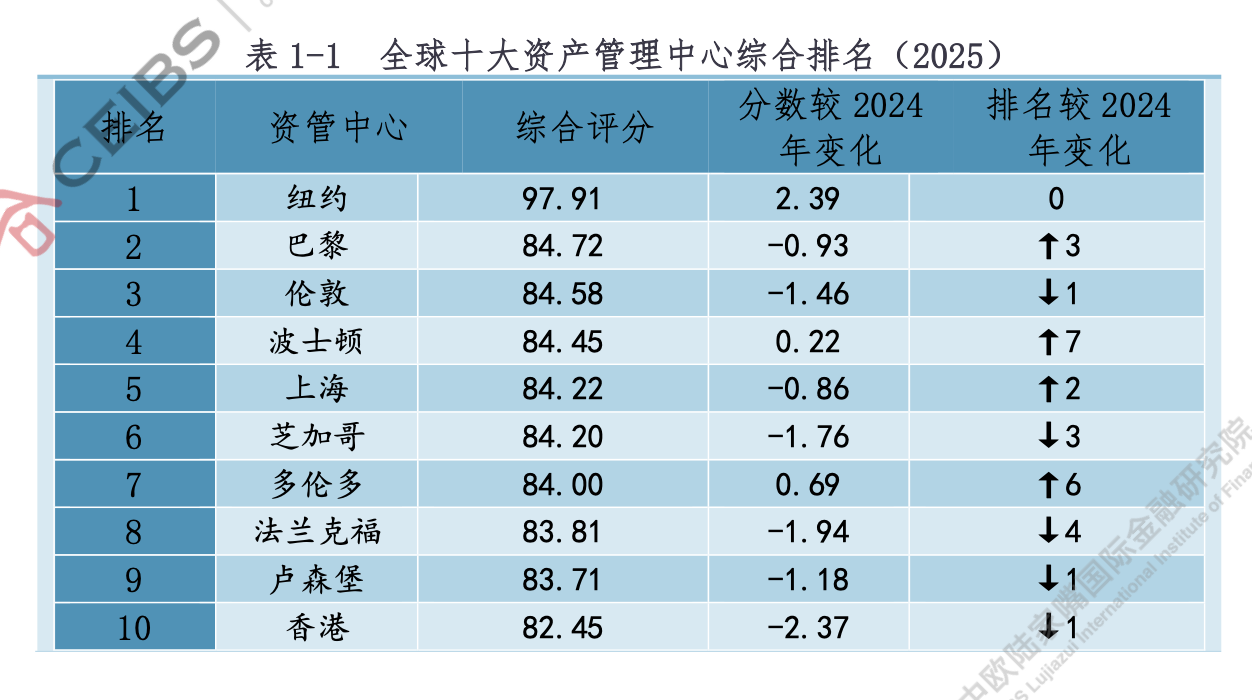
Core Insights - The "2025 Global Asset Management Center Evaluation Index" was officially released, with New York, Paris, and London ranking as the top three centers, while Shanghai rose to fifth place [1][2]. Group 1: Rankings and Scores - New York maintained its top position with a comprehensive score of 97.91, an increase of 2.39 points from 2024, leading in multiple dimensions such as funding sources and asset management technology [1][3]. - Paris climbed to second place despite a slight decrease in score to 84.72, ranking first in ESG and alternative assets, which boosted its overall performance [1][3]. - London fell to third place with a score of 84.58, widening the gap from New York by 1.46 points, showing strengths in asset management technology but weaknesses in tax incentives and talent attraction [1][3]. - Shanghai's score reached 84.22, a decrease of 0.86 points, ranking third in underlying assets and growth rate, and sixth in funding sources and asset management technology [2][3]. Group 2: Technological Advancements - The introduction of the asset management technology indicator aims to reflect the evolving landscape of global asset management centers, emphasizing the importance of technology as a key driver of economic growth [4][6]. - Asset management technology is transforming decision-making and risk management systems through data intelligence, enhancing the ability to monitor market behaviors and risks in real-time [6][4]. - The new evaluation framework for asset management technology includes four dimensions: foundational, market, innovation, and application layers, providing a comprehensive view of development levels in this field [4][6].
上海排名第五 全球资管中心“一超多强”格局凸显
Zheng Quan Shi Bao Wang· 2025-09-23 15:59
Core Insights - The "2025 Global Asset Management Center Evaluation Index" report indicates that New York remains the top asset management center, followed by Paris and London, while Shanghai has risen to fifth place from seventh last year [1] - The report introduces a new asset management technology index to reflect the evolving role of technology in the asset management industry, highlighting the differentiated advantages of various asset management centers in this field [1] Group 1: Asset Management Center Rankings - New York retains the first position, Paris moves up to second, and London drops to third, with Shanghai entering the top five for the first time [1] - Shanghai ranks third in both underlying assets and growth rate metrics, and sixth in funding sources and asset management technology [1] Group 2: Role of Asset Management Technology - Asset management technology is driving data intelligence transformation in decision-making and risk management systems, enabling personalized service models [2] - The technology enhances data processing capabilities, real-time monitoring of market behaviors, and predictive risk management through AI and big data [2] - It facilitates a shift from standardized services to personalized offerings, breaking down barriers between asset management institutions and investors [2] Group 3: Shanghai's Competitive Advantages - Shanghai's rich quality of Chinese assets, strong financial market, and rapidly growing asset management institutions position it favorably for global competitiveness [3] - The city’s market pricing mechanism and industry chain advantages allow efficient access to quality assets, with potential improvements in capital flow efficiency through policy trials [3] - Technological investments are strengthening the global leadership of large asset management institutions while providing opportunities for smaller firms [3] Group 4: Future Development and Challenges - Despite having a GDP per capita and labor productivity at about one-fourth of New York's, Shanghai has the potential for continued development as an international financial center through technological innovation [4] - The Lingang New Area is highlighted for its complete industry chain and strong AI capabilities, providing effective tools and real-world applications for asset management technology [4] - The integration of digitalization, compliance, and internationalization is crucial for Shanghai to enhance its position in the global asset management landscape [4]
每日机构分析:9月23日
Xin Hua Cai Jing· 2025-09-23 14:18
Group 1 - Eurozone inflation is on a downward trend, increasing the likelihood of the European Central Bank (ECB) cutting interest rates again in 2025, with core inflation expected to fall below 2% due to slowing wage growth and declining commodity prices [1] - Bridgewater Associates warns of high government debt in the US and UK, leading to economic strain and social polarization, with UK productivity stagnating since the mid-2000s [1] - Deutsche Bank strategists predict a continued weak dollar, as investors shift away from US assets amid a new easing cycle from the Federal Reserve and concerns over its independence [2] Group 2 - German manufacturing is facing challenges, with a decline in manufacturing PMI to 48.5 indicating increased contraction, despite a rise in services PMI to 52.5 [2] - Malaysia's fiscal deficit target for 2025 is expected to remain at 3.8%, benefiting from lower Brent crude prices and a stronger ringgit, with inflation expectations adjusted down to 1.5% [2] - The H-1B visa reform in the US may reduce the outflow of Indian talent, benefiting India's economy, but could also lead to decreased remittances from the US, putting downward pressure on the Indian rupee [3]

