饮料

Search documents
专访宗馥莉:做一个“追赶者”,不急于证明自己
Hu Xiu· 2025-08-29 05:09
Core Viewpoint - The new leadership under Zong Fuli at Wahaha has faced significant challenges, including family disputes and the need for product innovation, while achieving a revenue rebound to 70 billion yuan in 2024, but recognizes this growth may not be sustainable [4][16]. Group 1: Leadership Transition and Challenges - Zong Fuli's self-assessment of her performance is "not satisfied," reflecting the difficulties faced during her transition, including her father's passing and family conflicts [2][17]. - The company is undergoing a period of "new and old transition," requiring both leadership and product innovation to maintain competitiveness [5][6]. - Zong Fuli acknowledges the need for Wahaha to adapt to changing market conditions and consumer preferences, emphasizing the importance of innovation and market insight [7][15]. Group 2: Product Innovation and Market Strategy - The flagship product, AD Calcium Milk, remains a strong performer, but there is a pressing need for new product development, as the last major innovation was in 2005 [6][20]. - The launch of the upgraded ice tea product aims to capture market share from established competitors like Master Kong, with a focus on larger packaging and improved ingredients [7][21]. - Zong Fuli emphasizes that true innovation in the beverage industry requires deep consumer insights and technological advancements, rather than superficial changes [22][28]. Group 3: Sales and Distribution Strategy - Wahaha is optimizing its distribution network, moving away from the traditional "joint sales system" to a more modern and efficient approach, while still leveraging its existing strengths in lower-tier markets [9][24]. - The company has significantly increased its investment in offline ice cream cabinets, with plans for 100,000 units to enhance product visibility and availability [10][11]. - Zong Fuli's management strategy includes a focus on enhancing team execution and operational efficiency, aiming for a more professional and market-oriented organization [17][20]. Group 4: Organizational Changes and Employee Relations - Recent organizational changes, including a board restructuring and employee contract adjustments, have led to some unrest among staff, prompting the formation of a "rights protection committee" [14][25]. - Zong Fuli addresses these concerns by stating that adjustments are necessary to align with evolving market conditions and consumer demands, and emphasizes the importance of maintaining a stable and effective management structure [15][26]. - The company aims to create a high-performing executive team that embodies professionalism and leadership, fostering a culture of collaboration and shared responsibility [27][28].
大行评级|里昂:上调农夫山泉目标价至55港元 毛利率扩张应在下半年持续
Ge Long Hui· 2025-08-29 02:38
Core Viewpoint - The report from Credit Lyonnais anticipates that Nongfu Spring's revenue growth in the second half of the year will accelerate compared to the first half, driven by low base effects across all product categories, with market share in the beverage sector expected to further recover [1] Group 1 - The gross margin expansion is expected to continue in the second half, supported by lower raw material prices and reduced logistics costs [1] - Nongfu Spring's strong product quality is believed to support its expansion into new products and channels [1] - The target price for Nongfu Spring has been raised from HKD 45 to HKD 55, with a reaffirmation of a highly confident "outperform" rating [1] Group 2 - Net profit forecasts for 2025 to 2027 have been increased by 7% to 12% [1]

大行评级|花旗:上调农夫山泉目标价至52港元 续列为饮料行业首选股
Ge Long Hui· 2025-08-29 02:33
Core Viewpoint - Citigroup's research report indicates that Nongfu Spring's mid-year performance exceeded expectations, with high visibility for growth in the second half of the year [1] Financial Performance - In the first half of the year, sales and net profit increased by 16% and 22% year-on-year, reaching the upper limit of market expectations [1] - Core operating profit grew by 31% year-on-year, surpassing expectations due to a faster-than-expected recovery in gross margin and effective control of selling and administrative expenses [1] Growth Outlook - The strong growth in bottled water sales is expected to continue in the second half of the year, supported by an improved product mix that reduces price volatility and healthy channel inventory levels [1] - Nongfu Spring is anticipated to solidify its leadership position in the sugar-free tea market through promotions and the introduction of new flavor products, while also exploring additional growth opportunities [1] Analyst Recommendations - Bank of America Securities has raised its earnings per share forecast for Nongfu Spring for the next two years by 2%, increasing the target price from HKD 50 to HKD 52, and continues to list Nongfu Spring as a preferred stock in the beverage industry, reaffirming a "Buy" rating [1]
宗馥莉:农夫山泉非常值得尊敬
Xin Lang Cai Jing· 2025-08-29 02:10
Core Viewpoint - The new leadership under Zong Fuli at Wahaha has faced significant challenges, including family disputes and the need for product innovation, while achieving a revenue rebound to 70 billion yuan in 2024, although this growth is seen as unsustainable in the long term [4][12]. Company Performance - Wahaha's revenue has returned to the peak of 70 billion yuan in 2024, attributed partly to emotional factors following the founder's passing [4]. - The company has not launched a new major product since 2005, relying heavily on existing products like AD Calcium Milk for sales [5][12]. Product Innovation - Zong Fuli emphasizes the need for product innovation, viewing it as essential for understanding consumer insights and market demands [5][12]. - The upcoming launch of the upgraded ice tea product is seen as a test of the company's innovation capabilities, with a focus on capturing consumer preferences for natural ingredients [6][12]. Distribution and Sales Strategy - Wahaha is optimizing its distribution channels, moving away from the traditional "joint sales system" to a more modern and diversified approach, including partnerships with convenience stores and online platforms [7][16]. - The company has significantly increased its investment in offline ice cream freezers, with plans to deploy 100,000 units by 2025, indicating a focus on enhancing product availability [7][12]. Management Changes - A board restructuring has introduced younger executives, reflecting a shift towards a more professional and market-oriented management style [8][12]. - Recent changes in labor contracts and factory operations have led to employee dissatisfaction, prompting the formation of a "rights protection committee" [8][12]. Market Positioning - Zong Fuli positions Wahaha as a "follower" in the competitive beverage market, acknowledging the need to learn from successful peers like Nongfu Spring and Master Kong [12][14]. - The company aims to maintain a balance between traditional values and modern market demands, focusing on quality and consumer trust [12][14].


农夫山泉的护城河:透明工厂背后的绿水青山
Jing Ji Guan Cha Wang· 2025-08-29 01:28
Core Viewpoint - The company, Nongfu Spring, has demonstrated strong financial performance with a revenue of 25.622 billion yuan and a net profit of 7.622 billion yuan for the first half of 2025, reflecting a year-on-year growth of 15.6% and 22.1% respectively, indicating its resilience in a competitive market [2][4]. Financial Performance - The half-year report shows impressive growth in both revenue and profit, with profit growth outpacing revenue growth, highlighting the company's structural advantages [4][5]. - The addition of three new spring water sources in Hunan, Sichuan, and Tibet has increased the total number of major water sources to 15, emphasizing the company's long-term growth strategy [5][6]. Competitive Advantages - Nongfu Spring's competitive edge lies in its "water source factory" model, which has seen the establishment of 10 new water source factories since 2020 and the laying of over 240 kilometers of water pipelines, creating significant physical barriers to entry for competitors [6][7]. - The company's commitment to transparency is evident through its open factories, allowing consumers to witness the entire process from water sourcing to bottling, thereby building trust [6][7]. Strategic Approach - The company adopts a "slow and steady" approach in an industry that often prioritizes speed, focusing on securing water sources, establishing pipelines, and building factories [8][9]. - The scarcity of quality water sources gives Nongfu Spring a unique advantage, as competitors will find it challenging to replicate its resources once established [9][10]. - The company's investments in water source facilities and transparent operations provide stability against external market fluctuations, ensuring consistent product quality [10]. Consumer Trust - By normalizing the concept of "transparent factories," Nongfu Spring fosters consumer trust, which is crucial in a market where products are increasingly similar [10]. - The brand's commitment to transparency and sustainability not only appeals to consumers but also positions the company favorably for future growth [10].
【光大研究每日速递】20250829
光大证券研究· 2025-08-28 23:05
Group 1 - New Steel Co. (600782.SH) reported a revenue of 17.51 billion yuan in H1 2025, a year-on-year decrease of 18.33%, but achieved a net profit attributable to shareholders of 111 million yuan, marking a turnaround from losses [5] - Keda Manufacturing (600499.SH) achieved a revenue of 8.19 billion yuan in H1 2025, with a year-on-year growth of 49.0%, and a net profit of 750 million yuan, up 63.9% [5] - Sungrow Power Supply (300274.SZ) reported a revenue of 43.53 billion yuan in H1 2025, a year-on-year increase of 40.34%, with a net profit of 7.735 billion yuan, up 55.97% [6] Group 2 - Yizumi Precision Machinery (300415.SZ) achieved a revenue of 2.75 billion yuan in H1 2025, a year-on-year increase of 15.9%, with a net profit of 340 million yuan, up 15.2% [7] - Anta Sports (2020.HK) reported a revenue of 38.54 billion yuan in H1 2025, a year-on-year increase of 14.3%, with a net profit of 7.03 billion yuan, up 14.5% [7] - Jiu Gui Jiu (000799.SZ) reported a total revenue of 561 million yuan in H1 2025, a year-on-year decline of 43.54%, with a net profit of 8.955 million yuan, down 92.6% [8] Group 3 - Rongchang Biopharmaceutical (688331.SH, 9995.HK) reported a revenue of 1.098 billion yuan in H1 2025, a year-on-year increase of 48.02%, but incurred a net loss of 450 million yuan [9]





上海乐哈哈饮料有限公司成立 注册资本0.1万人民币
Sou Hu Cai Jing· 2025-08-28 21:20
天眼查App显示,近日,上海乐哈哈饮料有限公司成立,法定代表人为王静静,注册资本0.1万人民币, 经营范围为一般项目:食品销售(仅销售预包装食品);食用农产品批发;食用农产品零售;企业管 理;外卖递送服务;居民日常生活服务;组织文化艺术交流活动;项目策划与公关服务;个人商务服 务;礼仪服务;文艺创作;技术服务、技术开发、技术咨询、技术交流、技术转让、技术推广;互联网 数据服务;软件开发;人工智能基础软件开发;广告设计、代理;广告发布;广告制作;会议及展览服 务;市场营销策划;企业形象策划;动漫游戏开发;国际货物运输代理;互联网销售(除销售需要许可 的商品);厨具卫具及日用杂品批发;个人卫生用品销售;茶具销售;服装服饰批发;鞋帽批发;化妆 品批发;礼品花卉销售;机械设备销售;机械电气设备销售;办公用品销售;日用品销售;电子产品销 售。(除依法须经批准的项目外,凭营业执照依法自主开展经营活动)许可项目:食品销售。(依法须 经批准的项目,经相关部门批准后方可开展经营活动,具体经营项目以相关部门批准文件或许可证件为 准)。 ...
中亚股份:拟向激励对象134人授予限制性股票609.75万股
Mei Ri Jing Ji Xin Wen· 2025-08-28 18:47
Company Incentive Plan - The company announced an incentive plan granting a total of 134 individuals, with a total of 6.0975 million restricted stocks, accounting for approximately 1.5% of the company's total share capital of about 408 million shares [1] - The grant price for the restricted stocks is set at 4.26 yuan per share, allowing recipients to purchase the stocks at this price upon meeting the grant conditions, with a maximum validity period of 48 months [1] Revenue Composition - For the year 2024, the company's revenue composition is as follows: dairy industry accounts for 55.4%, beverage industry for 34.61%, other industries for 9.72%, and other business activities for 0.28% [1]

红棉股份上半年扣非净利润增长15.94% 完善发展布局寻求外延突破
Zheng Quan Shi Bao Wang· 2025-08-28 14:45
Group 1 - The core viewpoint of the articles highlights the financial performance and strategic developments of Hongmian Co., which reported a revenue of 999.7 million yuan and a non-net profit of 50.2034 million yuan, reflecting a year-on-year growth of 15.94% in the first half of 2025 despite market fluctuations [1] - The beverage segment has achieved revenue and gross margin growth through e-commerce expansion and market development outside the province, contributing positively to the overall profitability of the company [1] - The company has adjusted its acquisition strategy, opting to acquire a 39.9996% stake in Asia Foods instead of 100% of Eagle Money, allowing it to become the controlling shareholder of Asia Foods and integrate it into its consolidated financial statements [2] Group 2 - Hongmian Co. has established an investment fund to seek external growth opportunities, with a project related to its food and beverage segment approved for an investment of 15 million yuan [2] - The subsidiary, Xinshicheng, has successfully launched the T.I.T Innovation Park project, marking a significant expansion into external business and focusing on biomedicine and innovative manufacturing [3] - The T.I.T Innovation Park has established a collaboration mechanism with the Guangzhou Disabled Persons' Federation, promoting employment and entrepreneurship for disabled individuals, and has attracted over 30 quality enterprises, including high-tech and specialized companies [3]

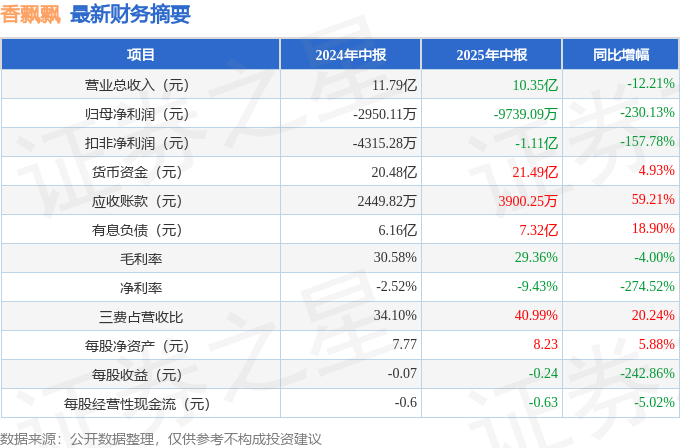
香飘飘(603711)2025年中报简析:净利润同比下降230.13%
Zheng Quan Zhi Xing· 2025-08-28 14:19
Core Viewpoint - The financial performance of Xiangpiaopiao (603711) in the 2025 mid-year report shows significant declines in both revenue and net profit, indicating challenges in the company's operations and market conditions [1]. Financial Performance Summary - Total operating revenue for 2025 is 1.035 billion yuan, a decrease of 12.21% compared to 2024 [1]. - The net profit attributable to shareholders is -97.39 million yuan, reflecting a year-on-year decline of 230.13% [1]. - The gross profit margin is 29.36%, down 4.0% year-on-year, while the net profit margin is -9.43%, a decrease of 274.52% [1]. - Total expenses (selling, administrative, and financial) amount to 424 million yuan, accounting for 40.99% of revenue, an increase of 20.24% year-on-year [1]. - Earnings per share are -0.24 yuan, a decline of 242.86% compared to the previous year [1]. Key Financial Metrics Changes - Significant changes in financial items include: - Trading financial assets increased by 54.89% due to increased purchases of financial products [3]. - Prepayments rose by 45.7% due to increased brand promotion and consulting fees [3]. - Other receivables decreased by 64.93% due to the recovery of land sale payments [3]. - Inventory decreased by 35.25% due to reduced stocking [3]. - Cash flow from operating activities decreased by 5.57% due to reduced operating inflows [5]. Market and Operational Insights - The company is currently experiencing a sales off-season in its milk tea business, with channel inventory showing a significant year-on-year decrease, indicating a healthy inventory management [4]. - The company's return on invested capital (ROIC) was 4.57% last year, indicating weak capital returns, with a historical median ROIC of 14.14% since its listing [5]. - The company relies heavily on marketing-driven performance, necessitating a thorough examination of the underlying factors driving this performance [5].