
金融科技

Search documents
(经济观察)中国企业出海:从“输出产品”到“组建生态”
Zhong Guo Xin Wen Wang· 2025-09-13 12:24
Core Insights - Chinese enterprises are transitioning from simple product exports to a complex model of "technology co-construction, standard output, and ecological cooperation" in their global expansion efforts [1][2] - The shift in strategy is characterized by three main changes: moving from "product output" to "solution output," evolving from "solo ventures" to "ecological group expansion," and changing the focus from "scale pursuit" to "root establishment" [1][2] Group 1: Evolution of Chinese Enterprises Going Global - The current phase of Chinese enterprises going global emphasizes the role of "global corporate citizenship," which involves sustainable development and a broader global perspective [2] - The transition from the 1.0 era, which relied on low-cost manufacturing and export scale, to the 3.0 era highlights the need for Chinese companies to establish a global mindset and diversify their cooperation models, including joint ventures and minority equity investments [2] Group 2: Role of Technology in Global Expansion - AI technology is becoming a crucial support for Chinese enterprises in their global endeavors, enhancing capabilities across various sectors such as energy, manufacturing, and research [2] - Antom, a subsidiary of Ant Group, is integrating AI technology to assist Chinese enterprises in mitigating foreign exchange risks and improving payment success rates, thereby facilitating refined operations for companies venturing abroad [3]
(经济观察)中国企业出海:从“输出产品”到“组建生态”
Zhong Guo Xin Wen Wang· 2025-09-13 11:55
Core Insights - The conference highlighted the transformation of Chinese tech companies' overseas expansion into a model characterized by "global corporate citizenship," focusing on technology co-construction, standard output, and ecological cooperation [1][2] Group 1: Transformation of Overseas Expansion - Chinese tech companies are shifting from simple product exports to providing comprehensive technology solutions and business models validated in China [1][2] - The previous model of "going it alone" is evolving into an "ecological fleet model," where leading companies guide the industry chain's collaboration, significantly reducing risks and enhancing survival capabilities [2] Group 2: Stages of Globalization - The globalization process of Chinese enterprises is categorized into three stages: 1. Stage 1.0 relied on low-cost manufacturing and export scale 2. Stage 2.0 was driven by overseas mergers and acquisitions to enhance capabilities 3. Stage 3.0 emphasizes sustainable development through a global corporate citizen identity [2] Group 3: Role of AI in Overseas Expansion - AI technology is becoming a crucial support for Chinese companies' overseas ventures, enhancing various sectors such as energy, manufacturing, and research [2] - Antom, a subsidiary of Ant Group, integrates AI technology to help Chinese companies mitigate foreign exchange risks and improve payment success rates, thereby supporting refined operations for overseas enterprises [3]
对话蚂蚁数科余滨:绝不认可“AI泡沫”论,我一定要证明AI有价值
Xin Lang Ke Ji· 2025-09-13 04:06
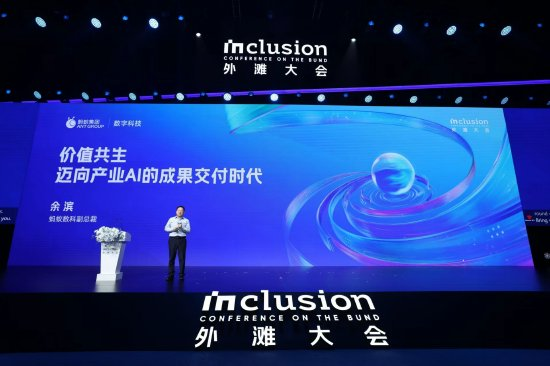
Core Viewpoint - Ant Group's Vice President Yu Bin emphasizes that AI is not a bubble and will bring long-term sustainable value to the industry [1][3] Group 1: AI Strategy and Focus - Ant Group's AI action plan is focused on professional industries, ease of implementation, and value creation [3] - The company aims to develop applications on top of existing platforms rather than creating a universal platform that fits all industries [3] - Ant Group's expertise lies in financial technology, internet, and life services, allowing it to innovate effectively at the application and industry levels [3] Group 2: New Business Model - Ant Group introduced a new business model for large model applications based on "pay for performance," allowing clients to pay based on actual results like business growth or cost savings [4] - This model significantly lowers the barriers and risks for enterprises to adopt large model applications, especially benefiting small and medium-sized enterprises [4] - The full-stack enterprise-level AI service solution enables companies to access AI capabilities without incurring high infrastructure costs [4]

9点1氪丨西贝门店厨师长称部分菜品是隔夜菜;海底捞小便事件涉案者父母判赔220万;iPhone Air在华发售延期
3 6 Ke· 2025-09-13 00:51
Group 1 - Xibei's founder, Jia Guolong, announced plans to sue Luo Yonghao over allegations of using pre-made dishes, while Luo offered a reward for evidence supporting his claims [2][3] - Xibei confirmed that some dishes may be prepared in advance, with the chef stating that lamb chops can be served up to three meals after cooking [2][3] Group 2 - A court ruled that the parents of two teenagers involved in a public urination incident at a Haidilao restaurant must pay a total of 2.2 million yuan in damages [3][4] - The compensation includes 130,000 yuan for cleaning and damages, and 2 million yuan for business losses and reputation damage [3][4] Group 3 - Apple delayed the launch of the iPhone Air in China due to regulatory issues related to its eSIM technology, with all models pending approval [4][5] - Major Chinese telecom operators will support the iPhone Air with eSIM services once regulatory approval is obtained [4][5] Group 4 - Nio's M9 interior design was leaked by a man who was later ordered to pay 250,000 yuan in damages for infringing on trade secrets [5][6] - The court found that the man's actions diminished consumer interest and disrupted marketing strategies for the new vehicle [5][6] Group 5 - Ant Group introduced a new "pay for performance" model for its enterprise AI services, allowing clients to pay based on the actual results achieved [6] - This model aims to reduce upfront costs for businesses, particularly benefiting small and medium enterprises [6] Group 6 - China Resources Land denied rumors of an intention to acquire Evergrande Property, stating that such information is untrue [7] - Evergrande Property had previously announced a trading suspension pending the release of insider information [7] Group 7 - Shanghai Disneyland responded to complaints about the high price of sanitary products, reducing the price of a pack of five sanitary pads from 150 yuan to 70 yuan [7][8] Group 8 - Wumart Supermarket announced plans to open 20 newly renovated stores by the end of September, as part of its strategy to enhance customer experience [8] Group 9 - Tencent refuted claims regarding a former OpenAI researcher's salary exceeding 100 million yuan upon joining the company [9] Group 10 - Gold prices reached a new record high of $3,674.27 per ounce, surpassing the inflation-adjusted peak from 1980 [10] - The price increase reflects a nearly 40% rise this year, highlighting gold's status as a safe-haven asset amid macroeconomic uncertainties [10] Group 11 - The China Securities Regulatory Commission announced penalties against Beijing Dongtong Technology for serious financial fraud, proposing fines totaling 229 million yuan [10] - The company faces potential delisting due to significant violations of securities laws [10] Group 12 - Dazhonghua's operations remain unaffected despite the investigation of a senior executive for alleged misconduct [11] - The company emphasized its commitment to legal compliance and maintaining operational efficiency [11] Group 13 - Xiamen Hengkang New Materials Technology received approval for its initial public offering on the Sci-Tech Innovation Board [12] - Figure Technology became the first platform focused on real-world assets to list on NASDAQ [12] Group 14 - Albania appointed an AI named "Diera" as a government minister, marking a global first for AI in a governmental role [13] - The AI will oversee public procurement processes to ensure transparency and reduce corruption [13] Group 15 - The U.S. Federal Trade Commission initiated an investigation into AI chatbots from seven companies, including Meta and OpenAI, to assess their impact on children [14] Group 16 - Chasing Car completed its first round of financing and is planning to establish a factory near Tesla's German facility [15]

外滩大会首届全球主题日召开 三大共识引领金融科技发展
Guo Ji Jin Rong Bao· 2025-09-12 20:21
Core Insights - The 2025 Inclusion Bund Conference held in Shanghai highlighted the future of fintech in Asia and globally, emphasizing the integration of technology and industry, regulatory compliance, and regional collaboration as key drivers for high-quality fintech development [1] Group 1: Technology Empowering Industries - The focus of discussions at the conference was on the deep integration of emerging technologies with real industries, moving beyond conceptual understanding to practical applications that create real value [2] - In the field of artificial intelligence, the emphasis has shifted from potential to application efficiency, with numerous case studies shared on AI's role in enhancing financial service efficiency, risk control, and business decision optimization [2] - Blockchain technology is recognized as a key component in building the next generation of financial infrastructure, particularly in cross-border payments and asset tokenization [2] Group 2: Compliance Supporting Innovation - A robust regulatory environment is essential for the steady development of fintech, with discussions centered on balancing innovation incentives with risk prevention [3] - The Hong Kong Securities and Futures Commission highlighted the development trends and regulatory frameworks for tokenized products, stressing that a comprehensive compliance and security system is foundational for digital asset growth [3] - European representatives shared insights on how favorable regulatory measures enhance fintech competitiveness, with consumer protection, digital security, and fair competition being top priorities [3] Group 3: Deepening Regional Cooperation - Strengthening regional cooperation is seen as a vital pathway for Asian economies to achieve common development, with Asia being a dynamic corridor for global trade growth [4] - The Global Finance & Technology Network organized discussions on cross-border financial innovation, showcasing successful cases of payment system connectivity through bilateral cooperation among Southeast Asian banks and payment institutions [4] - Emphasis was placed on understanding local cultures and markets, rigorous compliance practices, and nurturing local talent to foster sustainable innovation and growth [5]
外滩大会首届全球主题日召开,三大共识引领金融科技发展
Guo Ji Jin Rong Bao· 2025-09-12 15:44
Core Insights - The 2025 Inclusion Bund Conference held in Shanghai focused on the future of fintech in Asia and globally, emphasizing the integration of technology and industry, compliance-driven innovation, and regional collaboration as key drivers for high-quality fintech development [1][3]. Group 1: Technology and Industry Integration - The conference highlighted the importance of deep integration between emerging technologies and traditional industries, with a shift from conceptual discussions to practical applications that create real value [5]. - In the field of artificial intelligence, discussions centered on the application benefits, showcasing AI's role in enhancing financial service efficiency, risk control, and optimizing business decisions [5]. - Blockchain technology was identified as a crucial component for building a new generation of financial infrastructure, particularly in cross-border payments and asset tokenization [5]. Group 2: Regulatory Environment - A robust regulatory environment is essential for the sustainable development of fintech, with a focus on balancing innovation incentives and risk prevention [6]. - The Hong Kong Securities and Futures Commission discussed the development trends and regulatory frameworks for tokenized products, emphasizing the need for a comprehensive compliance and security system in the Web3 era [6]. - European representatives shared insights on how favorable regulatory measures enhance fintech competitiveness, highlighting consumer protection, digital security, and fair competition as key regulatory priorities [6]. Group 3: Regional Cooperation - Strengthening regional cooperation is seen as a vital pathway for Asian economies to achieve common development, with Asia being a significant driver of global trade growth [8]. - The Global Finance & Technology Network organized discussions on cross-border financial innovation, showcasing successful cases of payment system connectivity through bilateral cooperation among Southeast Asian banks and payment institutions [8]. - The CEO of GFTN summarized four characteristics of Asia's emerging markets: a large and fast-paced market culture open to new technologies, youth-driven innovation, traditional industry leaders seeking digital transformation, and a regulatory focus on inclusivity and consumer protection [9].

边卓群外滩大会谈RWA:以技术释放低增长时代实体资产新潜能
Sou Hu Cai Jing· 2025-09-12 15:07
Core Insights - Digitalization is emerging as a significant growth opportunity amid a global economy characterized by "low growth norms" [1] - The tokenization of real-world assets (RWA) is identified as a key pathway to unlock the value of the real economy [1] - Ant Group has developed a leading technology foundation and a one-stop solution for RWA over the past decade [1] Group 1 - Ant Group's subsidiary, Ant Digital Technology, has launched the DT Tokenization Suite, a comprehensive digital service for global institutions, aimed at standardizing and scaling RWA [3] - The DT Tokenization Suite has been validated in various asset scenarios, including green energy assets like charging piles and photovoltaic systems, demonstrating its universality and commercial value [3] - Ant Digital Technology is redefining the standardization, circulation, and valuation system for new energy assets, achieving large-scale on-chain issuance [5] Group 2 - The integration of self-developed energy service agents with vertical models is driving intelligent asset operation and risk control, creating the world's largest new energy "asset chain" [5] - Ant Digital Technology is committed to leveraging real assets to unlock the potential of the real economy, emphasizing the importance of regulatory compliance and support from asset and capital providers [5]
AI迈向落地金融场景 如何释放关键价值?
Zhong Guo Jing Ying Bao· 2025-09-12 13:54
Core Insights - The integration of AI into the financial sector is crucial for achieving sustainable development and requires a systematic approach [1][3] Group 1: AI's Role in Finance - AI is reshaping the foundational logic of the financial industry, enhancing service efficiency and contributing to a more resilient and inclusive global economy [2] - The financial sector is identified as a key area for AI technology to unlock value and achieve breakthrough applications [1] Group 2: Key Areas for Development - Five critical areas need attention for the sustainable development of AI in finance: assessing the current state of AI in finance, understanding the basic attributes of finance that influence AI requirements, analyzing the profound impacts of AI on the financial system, conducting forward-looking research on AI trends, and building a robust ecosystem for AI in finance [3] - Collaboration across disciplines and industries is essential for the successful integration of AI into finance, with a focus on creating a "technology-finance-industry" ecosystem [2][3] Group 3: Quantum Computing and AI - The combination of AI and quantum computing is seen as a potential paradigm shift in addressing real-world challenges in financial technology [4] - Quantum computing is expected to play a significant role in areas such as financial modeling, derivative pricing, and data analysis, particularly concerning information security [4] Group 4: Future Directions - The next phase of AI development in finance will focus on leveraging industry-specific knowledge to solve problems rather than merely applying external scenarios [4][5] - The importance of partnerships and collaborative efforts in the AI era is emphasized, with a focus on the need for hybrid talent that bridges technology and business insights [5]
中科驭数聚焦自研DPU核心技术 构建低时延网络方案与产业生态
Zheng Quan Ri Bao Wang· 2025-09-12 13:26
Core Insights - The evolution of securities trading technology focuses on enhancing trading efficiency and speed, transitioning from manual trading to electronic, and now to AI and big data-driven smart trading, supported by robust network infrastructure [1] - The Chinese government is emphasizing the need for self-controllable core systems in the financial industry, with a mandate for domestic production of key financial infrastructure by 2027 [1] Group 1: Company Developments - Zhongke Yushu Technology Co., Ltd. has launched the SWIFT series of low-latency network DPU products, marking a significant achievement in China's financial infrastructure innovation [1][2] - The SWIFT-2200N DPU card has demonstrated a latency of only 0.98 microseconds in testing, which is a 20% improvement over the Solarflare X2522 [2] - The SWIFT series products are compatible with various domestic CPUs and operating systems, showcasing their comprehensive self-controllable capabilities and open ecosystem collaboration [2] Group 2: Market Applications - The SWIFT series products are already deployed in core trading systems of multiple domestic securities firms and exchanges, supporting hundreds of billions in daily trading volume [2] - A case study with Everbright Securities demonstrated that the SWIFT-2200N Pro outperformed the Intel + X2522 solution in terms of latency and stability, leading to zero faults during long-term operation [3] Group 3: Future Prospects - The company plans to produce the K3 chip by 2026, which will support 200 Gbps processing and nanosecond-level latency, aiming to cover over 80% of core trading scenarios in China [3] - Zhongke Yushu is actively participating in industry standard-setting and has contributed to over 50 standards, positioning itself as a key player in the financial IT market [4] - The market potential for the SWIFT series products is significant, with plans to expand into other sectors requiring low-latency networks, such as IoT, 5G/6G, and defense [5]
AI服务“按效付费” 蚂蚁数科创新大模型时代AI to B商业模式
Shang Hai Zheng Quan Bao· 2025-09-12 11:59
Core Insights - The introduction of a new "pay-for-performance" business model by Ant Group's Ant Financial, allowing enterprise clients to pay based on the actual results achieved from AI applications, rather than traditional project-based or subscription models [1] - The shift from AI as a standalone technology to an accelerator of business outcomes, emphasizing the need for enterprise-level AI services to focus on measurable results [1] - The "pay-for-performance" model aims to lower the barriers and risks associated with AI adoption for enterprises, particularly benefiting small and medium-sized enterprises by reducing upfront costs and infrastructure investments [1] Summary by Sections Business Model Transformation - Ant Financial announced a new business model that supports clients in paying based on the actual effects of AI applications, such as business growth or cost savings [1] - This model represents a significant shift in how enterprise AI services are measured, moving from paying for technology to paying for results [1] Challenges in AI Adoption - High initial costs, uncertain return on investment, and lack of implementation pathways are major challenges for enterprises in scaling AI applications [1] - The new model is designed to significantly reduce these challenges, making it easier for businesses to access AI capabilities [1] Implementation Methodology - Ant Financial has developed a three-step methodology called "ACE" (Align-Construct-Evaluate) for implementing large models in industries [2] - The first step involves value positioning with clients to identify measurable and valuable business goals [2] - The second step focuses on constructing a comprehensive solution and implementation path based on the identified business goals [2] - The third step ensures the achievement of business outcomes through continuous joint operations [2]