
保险业

Search documents
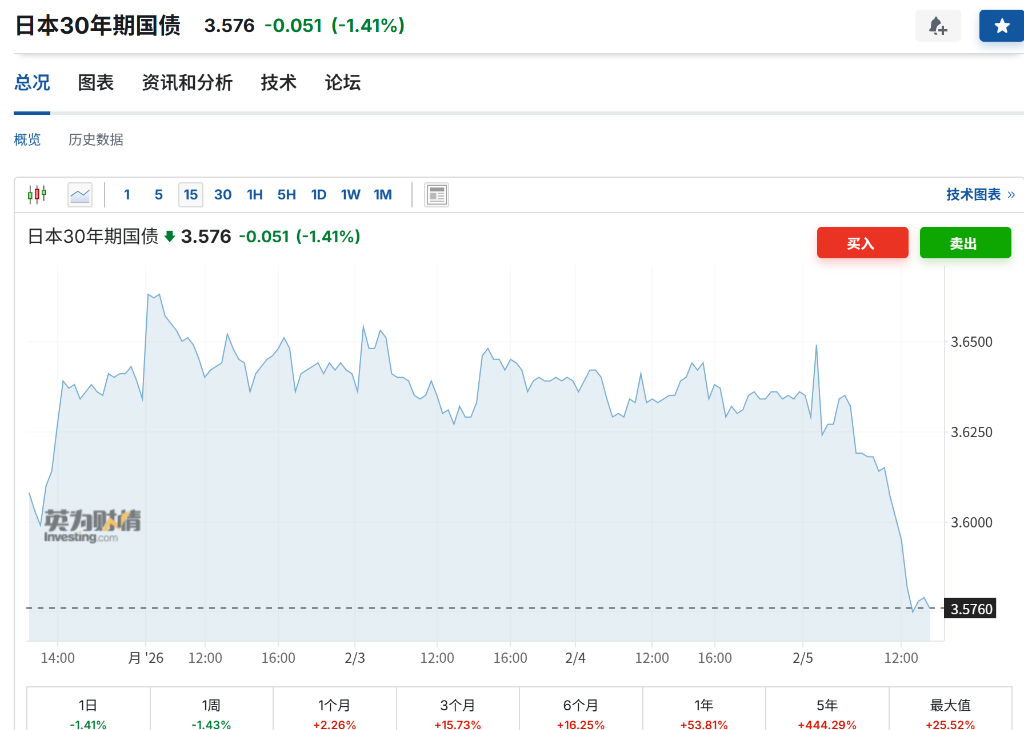
选举不确定性下,日本30年期国债拍卖“稳住市场”
Hua Er Jie Jian Wen· 2026-02-05 06:07
Core Viewpoint - The strong demand for Japan's 30-year government bonds in the recent auction alleviated short-term concerns about long-term debt, leading to a decline in yields ahead of the upcoming elections [1][3]. Group 1: Auction Results - The bid-to-cover ratio for the 30-year bonds reached 3.64, significantly higher than the previous auction's 3.14 and above the 12-month average of 3.35, indicating increased investor interest [4]. - The yield on the 30-year bonds fell by 5 basis points to 3.585%, while the 10-year bond yield decreased by 1.5 basis points to 2.23%, reflecting a positive market sentiment [1][4]. - Over 23% of the bonds were purchased by two large domestic companies, which is expected to support stable trading in the secondary market [4]. Group 2: Market Sentiment and Political Context - Despite concerns over rising fiscal spending, the auction results suggest that higher yield levels are attracting buyers, indicating a potential increase in demand as political uncertainties diminish [3][4]. - The upcoming House of Representatives election on February 8 will determine future fiscal spending, adding complexity to the current market environment [5]. Group 3: Currency and Monetary Policy Considerations - The depreciation of the yen has become a focal point, with hedge funds resuming short positions ahead of the elections, indicating concerns over currency volatility [6]. - Investors are closely monitoring how the election results may influence the Bank of Japan's interest rate path, as Prime Minister Kishi Sanae is known for advocating monetary easing [7].

临汾监管分局同意撤销中国人寿襄汾县支公司永固乡营销服务部
Jin Tou Wang· 2026-02-05 03:42
Group 1 - The National Financial Supervision Administration of Linfen approved the request from China Life Insurance Company to revoke the Yonggu Township Marketing Service Department of the Xiangfen County Branch [1] - Following the approval, the Yonggu Township Marketing Service Department must immediately cease all business activities and return its license to the Linfen Financial Supervision Bureau within 15 working days [1]

固定收益|点评报告:信用情绪降温了吗?
Changjiang Securities· 2026-02-04 23:30
1. Report Industry Investment Rating No relevant content provided. 2. Core Viewpoints of the Report - From January 26th to January 30th, the performance of general credit bonds was stronger than that of secondary capital bonds, possibly due to some institutions taking phased profit - taking after the yields of secondary capital bonds declined for two consecutive weeks. Large banks increased their allocation of interest - rate bonds due to abundant liabilities, small and medium - sized banks became more cautious, wealth management products increased their allocation of low - volatility amortized cost - based bond funds under the net - value constraint, and insurance preferred local government bonds. In the next few weeks, the concentrated opening of amortized bond funds will benefit specific - term credit bonds, and the market of secondary capital bonds is driven by the buying power of funds and insurance, with different yield performances for each term. In terms of future allocation, it is recommended to focus on 5 - year AA+ and AAA urban investment bonds with more attractive interest - rate differentials, and for secondary capital bonds, focus on the allocation opportunities of medium - and long - term varieties after phased profit - taking and the warming of market sentiment [3]. - The overall credit bond market recently followed the fluctuations of interest - rate bonds but showed relative resilience. Urban investment bonds generally outperformed secondary and perpetual bonds. The short - end interest rates of interest - rate bonds rose due to the temporary tightening of the capital market, while the long - end and ultra - long - end interest rates fluctuated under the alternating influence of stock market sentiment and policy expectations. The weakening participation of trading - type funds in ultra - long - term interest - rate bonds led to a shift of funds to credit bonds, which is a key reason for the relatively better performance of credit bonds [7]. - The behaviors of major investment institutions have significantly diverged, affecting the supply - demand pattern of credit bonds. Large banks increased their net purchases of interest - rate bonds due to asset shortages and abundant liabilities, which created conditions for the narrowing of credit spreads. At the end of 2025, wealth management products slightly increased their holdings of credit bonds but significantly increased their holdings of public funds, cash, and deposits. This reflects the demand for stable asset net values under the net - value transformation [8]. - In the future, asset supply and specific product cycles will directly affect the credit bond market. Although the supply of government bonds in January was large, the market interest rates remained stable due to the active participation of insurance and other allocation funds, providing a good allocation window for credit bonds. The upcoming opening peak of amortized cost - based bond funds in the next 16 weeks will bring re - allocation demand for corresponding - term credit bonds, and the deepening of the net - value transformation of wealth management products may increase the demand for medium - and long - term amortized bond funds, benefiting medium - and long - term credit bonds [9]. - The recent strong market of secondary capital bonds is driven by the implementation of the new public - fund fee regulations, the structural change of bond - type funds, and the hot sales of dividend - insurance products. Currently, the market has shown signs of differentiation. The yields of 1 - 3 - year varieties have fallen back to near the previous lows, with a narrowing spread protection space, while the 5 - year, 7 - year, and 10 - year varieties still have a certain spread protection margin and relatively high allocation cost - effectiveness. The market rhythm is expected to slow down, and medium - and long - term secondary capital bonds still have certain allocation value. In terms of the allocation strategy, it is recommended to focus on 5 - year AA+ and AAA urban investment bonds and medium - and long - term secondary capital bonds with relatively sufficient spread protection [10]. 3. Summary According to Relevant Catalogs 10Y Treasury Bonds: Large Banks Net Buy, Small and Medium - Sized Banks Net Sell - Since January 7, 2026, as the yield of 10 - year treasury bonds gradually declined, the net purchase volume of 7 - 10 - year treasury bonds by large banks showed a fluctuating upward trend, with a single - day peak of 14.105 billion yuan. The increase in large - bank purchases of 10 - year treasury bonds has created conditions for the narrowing of credit spreads. On the demand side, bank deposits have shown super - seasonal growth, increasing the scale of on - balance - sheet funds and reducing the pressure on the liability side. On the supply side, the slow issuance of government bonds, especially local government bonds, has created an asset gap, forcing large banks to increase their net purchases [19]. - In contrast, small and medium - sized banks have a more obvious left - hand trading characteristic in bond investment. Since January 7, 2026, as the yield of 10 - year treasury bonds declined, their willingness to allocate medium - and long - term treasury bonds decreased. Their conservative trading strategy is a passive choice due to the weakening of the traditional profit model. The narrowing of the interest - rate spread of 3 - year large - denomination certificates of deposit between representative city commercial banks and large banks has limited their bond - allocation funds, and the increasing difficulty and risk of obtaining capital gains through trading in the volatile bond market have made them more cautious, focusing on stable coupon income [24]. Bank Wealth Management: Slightly Increase Holdings of Credit Bonds, Focus on Low - Volatility and High - Liquidity Assets - At the end of 2025, bank wealth management slightly increased its holdings of credit bonds, focused on increasing the allocation of public funds, cash, and bank deposits, and reduced its holdings of equity - type assets and inter - bank certificates of deposit. The proportion of bond investment was at a low level in recent years. The increase in public - fund investment may be related to the increase in the allocation of amortized cost - based bond funds and bond ETFs, and the increase in cash and bank - deposit investment may be due to the temporary increase in the supply of inter - bank deposits at the end of the year and the relatively attractive interest rates. The decrease in the scale of equity - type assets and inter - bank certificates of deposit may be due to the contraction of the net supply of inter - bank certificates of deposit [30]. New Trends in the Long - Term Bond Market: Slower Brokerage Trading, Insurance Allocation Shift - At the beginning of the year, the concentrated short - selling behavior of brokerage self - operation in 30 - year treasury bonds, combined with the weak承接 power of insurance and other allocation funds, suppressed the trading sentiment of interest - rate bonds. Trading - type investors, represented by funds, reduced their participation in 30 - year treasury bonds and shifted some funds to credit bonds, which is an important reason for the relatively better performance of credit bonds. The selling amount and borrowing balance of 20 - 30Y treasury bonds by brokerage self - operation have declined recently, but they are still at a relatively high level. Insurance institutions prefer local government bonds over 30 - year treasury bonds, mainly for the relatively higher coupon and continuous tax advantages [33]. Is the Supply of Government Bonds in January in Line with Expectations? - Although the supply of government bonds in January was large, the active participation of allocation funds, mainly insurance, in local government bonds effectively alleviated the supply pressure, and the market interest rates remained stable, providing a good allocation window for credit bonds. The actual issuance volume of government bonds in January 2026 was higher than the planned volume, and the issuance scale was basically the same as that of the same period in 2025. After adjusting for seasonal factors, the issuance scale was actually similar to that of the previous year [40]. Future 16 Weeks: Peak Opening of Amortized Bond Funds, Benefiting Corresponding - Term Credit Bonds - The next 16 weeks will be the peak opening period of amortized bond funds, with those with a fixed - opening period of less than 1 year and more than 5 years being the main types, which will have a positive impact on corresponding - term credit bonds. The demand of wealth management products for stable net values may benefit medium - and long - term credit bonds. The opening scale in February is small, but there will be a peak in March. The term structure shows that in February, bonds with a term of more than 5 years are the main type, and in March, bonds with a term of less than 1 year are the main type, which may increase the demand for corresponding - term credit bonds [48]. Adjustment of Cash - Bond Trading Data Caliber: Institutional Classification and Callable Bond Terms - The adjustment of the institutional net - purchase data caliber implemented in 2026 includes two dimensions. One is the simplification of the classification of all - market institutions, and the other is the adjustment of the calculation rule of callable bond terms from being based on the maturity date to being based on the exercise date. After the adjustment, the configuration behavior of wealth - management funds needs to be tracked through the "other" category, and the previous method of judging institutional allocation behavior of secondary capital bonds based on the net - purchase data of 5 - 10Y "other" - type bonds is no longer applicable [52]. How Long Will the Secondary Capital Bond Market Last? - The recent strong market of secondary capital bonds is driven by the improvement of policy expectations, the structural adjustment of bond funds, and the allocation demand of dividend - insurance products. Currently, insurance mainly undertakes long - term secondary capital bonds such as 10Y, while funds have become the main buyers of medium - and short - term secondary capital bonds since December 2025. However, due to the influence of the spread level of secondary capital bonds of different terms, the daily net - purchase growth rate of funds has slowed down. The yields of 1 - 3Y secondary capital bonds have fallen back to near the lows after the release of the draft new public - fund fee regulations in September 2025, with a narrowing spread protection space, while medium - and long - term secondary capital bonds still have a certain spread protection margin and relatively high investment cost - effectiveness [59]. Bond Allocation Strategy: Slightly Cooled Market Sentiment, Focus on Credit Bond Catch - Up - In the past four weeks, the market has shifted from the dominance of secondary capital bonds in mid - January to the recent leadership of general credit bonds. Based on the current interest - rate differential quantile, valuation level, and rotation rhythm, the next - week allocation priority is adjusted as follows: urban investment bonds (AA+, 5Y) > urban investment bonds (AAA, 5Y) > secondary capital bonds (AAA -, 5Y). The 5Y AA+ urban investment bonds have coupon advantages and certain credit - sinking space, and have clear valuation - repair potential; the 5Y AAA urban investment bonds have low credit risk and good liquidity; the 5Y AAA - secondary capital bonds have a relatively reasonable valuation in their sector. For previously strong varieties, such as 5Y AA and AA(2) urban investment bonds and 10Y local government bonds, caution is recommended in allocation [65].
开展风险减量服务是保险行业大势所趋
Nan Fang Du Shi Bao· 2026-02-04 23:12
Core Viewpoint - The insurance industry is transitioning from being a "risk bearer" to a "risk reduction manager," which is a necessary choice to adapt to the economic and social development needs in the new era. New technologies like artificial intelligence are playing a positive role in reshaping the insurance value chain [3][4][5]. Group 1: Industry Trends and Challenges - The insurance industry is tasked with serving the "new quality productivity" and the important mission of financial "five articles." China Taiping aims to redefine its role in this new era by focusing on risk reduction management [3][4]. - Key challenges and opportunities identified include the need for a shift in development concepts, strengthening operational foundations, and deepening cross-sector collaboration to enhance risk reduction services [5][6]. - The industry is experiencing a profound transformation, with a focus on enhancing service quality and adapting to diverse customer needs, particularly in the life insurance sector [6][7]. Group 2: Life Insurance Transformation - The life insurance sector is undergoing a significant transformation, with China Taiping achieving notable success in the transition of dividend insurance products, leading to substantial growth in new business value [6][7]. - Core drivers for sustainable growth in life insurance include strong policy support, enhanced ecological services, financial technology empowerment, and channel transformation [6][7]. Group 3: Technological Integration - The application of AI and other advanced technologies is positively reshaping the insurance value chain, making previously uninsurable risks insurable and allowing for more flexible and precise product designs [8][9]. - In underwriting, big data enables differentiated assessments based on individual behaviors and risk statuses, leading to more reasonable pricing for customers [8][9]. - The use of AI and big data in claims processing enhances fraud detection and reduces operational costs, significantly improving efficiency and customer experience [9][10]. Group 4: Ecosystem Development - China Taiping is focused on building a modern customer service ecosystem that integrates insurance, investment, and ecological industry collaboration, aiming to enhance its support for core business development [11]. - Future initiatives include enriching health management services, accelerating the application of financial technology in insurance, and expanding the ecological "friend circle" to improve resource sharing and professional capabilities [11].


湾财晚报|黑暗且诡异!爱泼斯坦豪宅曝光;大润发母公司CEO失联
Nan Fang Du Shi Bao· 2026-02-04 13:42
Group 1 - The U.S. Department of Justice has released remaining documents related to the late financier Jeffrey Epstein, reigniting discussions about his controversial past and the circumstances surrounding his death [2] - Epstein was convicted in 2008 for soliciting minors for prostitution and was arrested again in July 2019 on charges of sex crimes, dying in prison in August 2019, officially ruled as a suicide [2] Group 2 - The People's Bank of China held a meeting on January 30 to summarize the 2025 credit market performance and outline key tasks for 2026, emphasizing the need for financial support in major strategic areas and weak links [4] - The meeting highlighted the importance of adapting to changes in the economic and financial landscape during the 14th Five-Year Plan period [4] Group 3 - CITIC Prudential Life Insurance reported a record net profit of 5 billion yuan for Q4 2025, reversing two years of losses, with insurance business revenue reaching 33.7 billion yuan, a 12% year-on-year increase [6] - Despite the impressive turnaround, rising surrender rates and compliance issues raise concerns about the sustainability of this growth [6] Group 4 - Guangzhou Rural Commercial Bank announced the resignation of independent non-executive director Zheng Guojian, reducing the number of independent directors to four, below the required threshold [7] - The bank has faced delays in appointing a new independent director, with the candidate's qualifications still pending regulatory approval [7] Group 5 - The Credit Card Center of Bank of Communications is undergoing a significant personnel change, with He Bo, the deputy head of the Zhejiang branch, expected to take over as general manager, pending regulatory approval [10] Group 6 - Jiangxi Huaheng Pet Food Co., Ltd. was penalized for producing pet food that did not meet quality standards, as reported by the Jiujiang Agricultural and Rural Bureau [11]

上海金融监管局:2025年辖内保险公司原保费收入累计2979.26亿元
Jin Rong Jie· 2026-02-04 11:38
Core Insights - The Shanghai Financial Regulatory Bureau reported the main regulatory indicators for the banking and insurance sectors in Shanghai for the year 2025, highlighting significant figures in premium income and claims payouts [1] Group 1: Insurance Premium Income - In 2025, the total original premium income for insurance companies in Shanghai reached CNY 297.93 billion, with cross-border reinsurance premium income amounting to CNY 0.0847 billion, resulting in a combined total of CNY 298.77 billion [1] - The breakdown of original premium income shows that property insurance companies contributed CNY 79.69 billion, while life insurance companies accounted for CNY 218.24 billion [1] Group 2: Insurance Claims Payouts - The total original insurance claims payouts by insurance companies in Shanghai for 2025 amounted to CNY 107.41 billion, with property insurance claims at CNY 44.95 billion and life insurance claims at CNY 62.46 billion [1]
保险代理人转型:从“人海战术”走向“人才红利”
Jin Rong Shi Bao· 2026-02-04 05:32
Core Insights - The insurance industry is experiencing a transformation driven by the influx of high-end talent from various sectors, responding to changing customer demands for comprehensive solutions rather than simple insurance policies [1][2][4] - Companies are implementing specialized training programs and recruitment initiatives to attract and retain professional talent, enhancing their service offerings and operational capabilities [2][3] Group 1: Talent Transformation - Chen Jitao, a former private banking executive, transitioned to a role at Ping An Life, seeking a platform that allows for greater personal agency and long-term commitment [1] - High-end professionals from diverse backgrounds, including finance, law, and healthcare, are increasingly entering the insurance sector, bringing valuable resources and expertise [1][2] - Ping An Life's "High Talent Manager Training Program" and similar initiatives from other leading insurers aim to provide structured training and resources to enhance the capabilities of new recruits [2] Group 2: Industry Dynamics - The competition among insurance companies has intensified, leading to a focus on professional development and the establishment of new management systems to support agents [3][4] - The entry of skilled professionals is reshaping the client relationship dynamics, with agents now expected to provide comprehensive financial planning and solutions [4] - Despite the positive momentum, challenges remain, including the integration of new talent with the existing large pool of agents and the pressure to balance long-term strategies with short-term performance metrics [5][6] Group 3: Market Challenges - The insurance industry faces a significant challenge in bridging the gap between newly recruited professional agents and the existing large number of traditional agents [5] - There is a tension between the need for long-term value creation and the pressure for immediate business performance, which complicates strategic decision-making [6] - Changing societal perceptions of insurance sales remains a hurdle, as many still hold outdated views of the profession [6]

助推“冷资源”释放“热效应” 保险业全链条护航冰雪经济
Jin Rong Shi Bao· 2026-02-04 05:32
Core Insights - The Chinese government emphasizes the development of the ice and snow economy as a new growth point, focusing on the entire industry chain including sports, culture, equipment, and tourism [1] - The ice and snow tourism sector is experiencing sustained growth, with a projected 3.6 billion visitors and revenue of 450 billion yuan during the 2025-2026 winter season [2] - Insurance companies are actively integrating into the ice and snow economy, providing tailored risk management services to support the development of ice and snow cultural tourism projects [1][2] Industry Growth - The ice and snow industry in China has grown from 364.7 billion yuan in 2016 to 980 billion yuan in 2024, with an average annual growth rate of 21.09%, and is expected to exceed 1 trillion yuan by 2025 [6] - The government aims for the ice and snow economy to reach 1.2 trillion yuan by 2027 and 1.5 trillion yuan by 2030 [6] Insurance Sector Involvement - Insurance companies are developing specialized insurance products for winter sports, addressing the unique risks associated with activities like skiing [4][5] - Customized insurance solutions are being offered for various aspects of the ice and snow industry, including event coverage, equipment manufacturing, and youth sports initiatives [6][7] - Major insurance firms have provided substantial coverage for significant events, such as the Beijing Winter Olympics, with total coverage exceeding 500 billion yuan [6] Consumer Engagement - The popularity of ice and snow activities has led to increased demand for specialized insurance, with many consumers seeking tailored coverage for skiing and other winter sports [4][5] - Insurance services are evolving towards more personalized and scenario-based offerings, enhancing consumer confidence in participating in ice and snow activities [2][3]
赔付近5.1亿港元!香港宏福苑火灾超八成理赔个案处理完毕
Guo Ji Jin Rong Bao· 2026-02-04 05:23
Core Viewpoint - The Hong Kong Insurance Authority is actively coordinating with insurance companies to support individuals affected by the fire at Hongfu Garden, with a significant number of claims already processed [1] Group 1: Claims Processing - A total of 1,032 claims have been processed, representing 85% of the cases, with a total amount of nearly HKD 510 million involved [1] - Among general insurance claims, 1,030 cases were reported, with 863 cases (84%) processed, amounting to approximately HKD 450 million [1] - In the life insurance sector, there were 188 claims, with 169 cases (90%) processed, totaling around HKD 60 million [1] Group 2: Insurance Policies - Residents of Hongfu Garden hold approximately 10,660 life insurance policies underwritten by 36 insurance companies, primarily covering whole life, annuity/savings, and medical/critical illness insurance, with 17 companies involved in claims [1] - In terms of property insurance, residents possess about 1,800 policies underwritten by 35 insurance companies, mainly covering home, medical, and personal accident insurance, with 34 companies involved in claims [1] Group 3: Authority's Statement - The Chief Executive of the Insurance Authority, Zhang Yunzhen, stated that most claims have been resolved fairly, while remaining cases require on-site inspections and damage assessments [1]
除了12315,还有哪些正规靠谱的投诉渠道?
Xin Lang Cai Jing· 2026-02-04 04:47
Core Viewpoint - The article emphasizes the importance of various complaint channels available for consumers to address service quality issues and consumer disputes, highlighting the evolution of these channels in the digital age. Group 1: Official Complaint Channels - In addition to the 12315 hotline, many industries have established their own complaint platforms through regulatory bodies or industry associations, which are reliable and authoritative [1][11]. - These official channels are backed by administrative regulatory power, making them effective for issues related to industry standards, qualification reviews, and administrative penalties [2][14]. Group 2: Industry-Specific Complaint Platforms - Certain industries have specialized complaint platforms that are more adept at handling specific issues due to their in-depth understanding of industry characteristics [3][15]. - These platforms are familiar with industry rules and common disputes, allowing for smoother processing of complaints that require professional knowledge [4][16]. Group 3: Social Complaint Platforms - With the rise of mobile internet, social complaint platforms have gained popularity, characterized by their convenience and public exposure, which can leverage public opinion to resolve issues [5][16]. - An example is the "Black Cat Complaint" platform, which allows consumers to quickly log complaints through various digital means, significantly reducing the time and effort required compared to traditional methods [5][17]. - The platform features a real-time tracking system for complaints, alleviating anxiety about the complaint process by providing visibility into progress and notifications at key stages [5][17]. Group 4: Choosing the Right Complaint Channel - Consumers are advised to select complaint channels based on the nature of the issue, urgency, and personal preferences [18][19]. - For issues involving safety, qualifications, or administrative penalties, official channels like 12315, the Ministry of Industry and Information Technology, and the China Banking and Insurance Regulatory Commission should be prioritized [19]. - For industry-specific issues requiring professional judgment, such as tourism or telecommunications, corresponding industry complaint platforms are recommended [19]. - For those seeking convenience and quick responses, social platforms like Black Cat Complaint are suitable, especially for common disputes in e-commerce and service sectors [19][20]. - Utilizing multiple platforms simultaneously can enhance the likelihood of resolution by combining regulatory oversight with public attention [20].