
制造

Search documents
企业家人工智能应用报告|三分之二受访企业已设或规划AI岗位
Xin Jing Bao· 2025-07-29 13:21
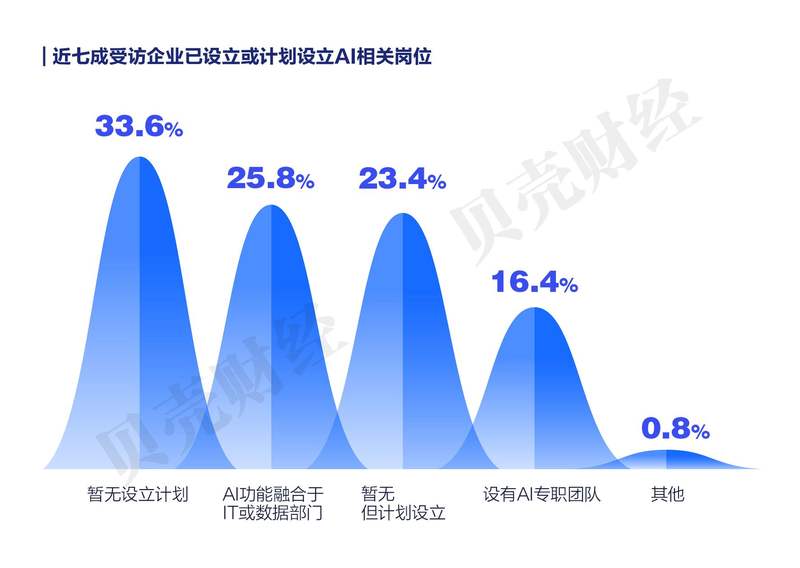
Core Insights - The integration of artificial intelligence (AI) into business operations is accelerating, transforming from a mere tool to a new "productivity system" in the context of China's economic resilience and global trade restructuring [1] - The "2025 New Beijing News Beike Finance Annual Conference" highlighted the growing importance of AI in corporate strategy, with a significant number of companies planning or already implementing AI-related roles and training [1] Group 1: AI Organizational Structure - Approximately 65.63% of surveyed companies have established or planned AI-related organizational structures, indicating a shift from mere technology deployment to organizational integration [2] - 25.78% of companies have integrated AI functions into IT or data departments, reflecting a trend of embedding AI as an "enhanced capability" within existing business frameworks [5] - 16.41% of companies have set up independent AI teams, showcasing a strategic approach to AI as a standalone capability [5][6] Group 2: AI Employee Training - Over 30% of companies have initiated AI training programs, with a trend towards institutionalizing these efforts [7] - 28.91% of companies have launched pilot AI training initiatives, focusing on key departments and roles [10] - 52.35% of companies are either implementing or planning to implement AI training systems, indicating a growing recognition of the link between employee capabilities and AI applications [10][11] Group 3: AI Strategic Integration - 42.97% of companies have incorporated AI into their three-year development plans, reflecting a long-term strategic vision [13] - Nearly 30% of companies view AI as a short-term exploration, indicating a proactive approach to pilot projects and business validation [15] - Only 8.59% of companies reported no urgent need for AI, suggesting a widespread acknowledgment of AI's strategic importance [15] Group 4: AI Governance - Over 58% of companies are either advancing or planning to establish AI governance frameworks, indicating a growing awareness of the need for internal regulations [16] - 11.72% of companies have formally established AI governance systems, providing early models for industry practices [19] - 28.91% of companies have not yet established governance but have included it in their plans, showing a shift towards proactive governance strategies [20]

企业家人工智能应用报告|近九成受访企业已将AI嵌入经营环节
Xin Jing Bao· 2025-07-29 11:39
Core Insights - The integration of artificial intelligence (AI) into business operations is accelerating, transitioning from an optional tool to a systemic variable that enhances efficiency and drives organizational change [1][12] - A survey conducted by Beijing News and Shell Finance revealed ten key trends in AI application among Chinese enterprises, indicating a significant shift towards practical implementation and strategic planning [2][10] Group 1: AI Application Trends - Trend 1: Nearly 90% of enterprises have implemented AI in various business functions, marking a shift from vision to practical application [2] - Trend 2: AI applications are concentrated in decision-making, research and development, and customer service, with 57.03%, 49.22%, and 46.09% of enterprises deploying AI in these areas respectively [3][15] - Trend 3: Enterprises are adopting a tiered approach to AI service integration, with 41.41% preferring public APIs, 34.38% opting for customized models, and 30.47% utilizing embedded tools [4][16] Group 2: AI Capability Development - Trend 4: 65.63% of enterprises have established or plan to establish AI-related positions, indicating a shift towards organizational integration of AI [4] - Trend 5: 42.97% of enterprises have included AI in their strategic planning for three years or more, while 22.66% are in short-term testing phases [5] - Trend 6: Although only 11.72% have established AI governance frameworks, 51.57% have partial regulations or plans, reflecting a growing trend of "use while governing" [6] Group 3: Challenges and Expectations - Trend 7: Talent shortages and strategic gaps are significant barriers, with 47.66% of enterprises lacking composite talent and 43.75% lacking AI expertise [7] - Trend 8: 68.75% of enterprises recognize AI's potential to reduce costs and increase efficiency, highlighting its perceived value [8] - Trend 9: 78.13% of enterprises expect AI to optimize or reshape industry dynamics within three years, indicating a positive outlook on AI's impact [9] Group 4: Policy and Support Expectations - Trend 10: Enterprises are calling for support in three main areas: talent training (62.5%), subsidies for small and medium-sized enterprise transformations (60.16%), and data compliance (51.56%) [9]
跨部门不扯皮,从“看懂一张图纸”开始
3 6 Ke· 2025-07-29 00:49
Core Viewpoint - The article emphasizes the critical role of technical drawings in the manufacturing process, highlighting that understanding these drawings is essential for all personnel involved in product development and production [2][10]. Group 1: Importance of Technical Drawings - Technical drawings serve as a universal language in manufacturing, facilitating clear communication among various departments [9][19]. - The ability to read and interpret drawings is not limited to designers; it is a fundamental skill required by quality assurance, production, and procurement personnel [19][23]. - Drawings help prevent misunderstandings and errors that can lead to production issues, quality problems, and customer complaints [2][24]. Group 2: Manufacturing Process Steps - The manufacturing process consists of three main steps: conceptualization, production, and sales [4][8]. - Each step requires collaboration among different departments to ensure that everyone understands their roles and responsibilities [5][8]. - The process of creating a technical drawing involves multiple stages, including planning, conceptualization, design, and review [11][13]. Group 3: Drawing Creation Process - The creation of technical drawings begins with defining product requirements based on market needs, followed by sketching and formalizing the design [13][15]. - Drawings undergo a rigorous review process to ensure accuracy and completeness before production begins [16][29]. - The final drawings must meet standardized criteria to ensure they convey all necessary information clearly and consistently [25][27]. Group 4: Standardization and Quality Control - The ISO GPS standard provides a unified framework for technical drawings, ensuring that all stakeholders interpret them consistently [24][25]. - Standardization is crucial for maintaining quality across various manufacturing processes, as it minimizes the risk of miscommunication [27][30]. - Quality checks are performed on drawings to identify any potential issues before they are used in production [30].
中山90家重点企业携近1500个岗位进商圈
Nan Fang Ri Bao Wang Luo Ban· 2025-07-28 08:42
Group 1 - The "Million Talents Gathering in South Guangdong" job fair in Zhongshan released nearly 1,500 job openings from 90 key local enterprises, covering industries such as new energy, intelligent manufacturing, biomedicine, electronic information, modern services, and cultural education [1] - The job fair's innovative approach of being held in shopping malls, food streets, and night markets aims to make job-seeking more accessible [1] - A significant highlight of the job fair is that 43.3% of the job openings do not require specific educational qualifications or work experience, while 50.2% of positions with an average monthly salary above 8,000 yuan are for technical and skilled talent [1] Group 2 - Zhongshan has provided 500 short-term free housing units for job seekers, along with over 4,300 rental talent housing units to facilitate their job search [2] - The local human resources and social security bureau will continue to promote employment services for 2025 college graduates and youth, including the sixth "Hundred Days of Millions of Recruitment Special Action" to ensure high-quality employment opportunities [2]
法国今年减排速度将明显放缓
Zhong Guo Chan Ye Jing Ji Xin Xi Wang· 2025-07-24 22:18
Group 1 - The French industry is expected to experience a significant slowdown in greenhouse gas emission reduction this year, with a 0.2% increase in emissions in the first quarter compared to the previous year, reaching 104.2 million tons of CO2 equivalent [1][2] - The construction sector is identified as the main driver of the increase in emissions, with a 5.2% rise, equivalent to an additional 1 million tons of CO2 equivalent [1] - The energy sector also saw a slight increase in emissions of 0.5%, primarily due to increased consumption related to urban heating [1] Group 2 - Despite the increase in emissions in the first quarter, the total emissions for the year are projected to decrease by approximately 0.8% compared to 2024, reaching 366 million tons of CO2 equivalent [2] - The French government’s low-carbon strategy requires an average annual reduction of 5% in greenhouse gas emissions from 2024 to 2030 to achieve a 50% reduction from 1990 levels by 2030 [2] - The Minister for Ecological Transition has called for a "collective re-mobilization" to intensify emission reduction efforts in sectors such as construction and transportation [2]
Textron (TXT) Q2 Earnings: Taking a Look at Key Metrics Versus Estimates
ZACKS· 2025-07-24 18:30
Core Insights - Textron (TXT) reported revenue of $3.72 billion for the quarter ended June 2025, reflecting a 5.4% increase year-over-year and surpassing the Zacks Consensus Estimate of $3.63 billion by 2.37% [1] - The company's EPS was $1.55, slightly up from $1.54 in the same quarter last year, with an EPS surprise of 6.9% compared to the consensus estimate of $1.45 [1] Revenue Performance - Textron eAviation revenues were $8 million, below the average estimate of $9.25 million, marking an 11.1% decline year-over-year [4] - Bell Manufacturing revenues reached $1.02 billion, exceeding the estimated $936.78 million, representing a 28% increase compared to the previous year [4] - Textron Systems revenues were $321 million, slightly above the average estimate of $286.25 million, with a minor decline of 0.6% year-over-year [4] - Textron Aviation revenues totaled $1.52 billion, slightly below the estimated $1.56 billion, but showing a 2.9% increase from the year-ago quarter [4] - Finance revenues were $15 million, surpassing the average estimate of $11.74 million, reflecting a 25% increase year-over-year [4] - Overall Manufacturing revenues were $3.7 billion, exceeding the estimated $3.62 billion, with a 5.3% increase compared to the previous year [4] - Industrial Manufacturing revenues were $839 million, above the average estimate of $821.73 million, but showing an 8.2% decline year-over-year [4] Segment Profit Analysis - Textron Aviation segment profit was $180 million, below the average estimate of $189.92 million [4] - Bell segment profit was $80 million, compared to the average estimate of $89.44 million [4] - Textron Systems segment profit was $40 million, slightly above the average estimate of $39.12 million [4] - Industrial segment profit was $54 million, exceeding the average estimate of $35.55 million [4] - Overall Manufacturing segment profit was $338 million, in line with the average estimate of $336.93 million [4] Stock Performance - Textron shares have returned +10% over the past month, outperforming the Zacks S&P 500 composite's +5.7% change [3] - The stock currently holds a Zacks Rank 3 (Hold), indicating expected performance in line with the broader market in the near term [3]

公募基金2025年二季报解读点评
2025-07-23 14:35
Summary of Key Points from the Conference Call Industry Overview - The report focuses on the public fund industry in China, specifically analyzing the performance and trends of various fund types in the second quarter of 2025. Core Insights and Arguments Public Fund Performance - In Q2 2025, the number and scale of newly launched active equity funds significantly increased, with an average fundraising scale of 520 million yuan, focusing on dividend value and technology growth [1][2] - Despite a market rebound, the overall share of active equity funds decreased by 2.2% due to redemptions of older products, maintaining a scale of 3.33 trillion yuan [1][2] - Fixed income plus products surpassed the levels of the second half of 2023, reaching 2.16 trillion yuan, with a notable expansion in mixed bond FOFs [1][2] Fund Categories - Active equity funds showed strong performance, with a 3.1% increase in the equity fund index, outperforming broad-based indices [1][5] - The new issuance of FOF products continued at a high level, with a total new scale of 18.6 billion yuan, leading to a 10% increase in the overall market scale of FOFs to 166.2 billion yuan [1][4] Investment Trends - Active equity funds increased their stock positions slightly, with a notable rise in holdings of Hong Kong stocks, which now account for 17% of their portfolios [3][26] - The communication and financial sectors received increased allocations, while consumer and manufacturing sectors saw reductions [27] Performance Metrics - The median returns for active equity funds in Q2 were strong, with ordinary stock, mixed equity, and flexible allocation products achieving median returns of 2.0%, 2.1%, and 1.8% respectively, all outperforming major indices [19][20] - Fixed income plus funds achieved positive returns across all subcategories, with convertible bond funds leading in performance [22][23] Additional Important Insights - The competitive landscape for FOF products shows a slight decrease in the market share of the top ten managers, which now account for 60.8% of the market [4][8] - The concentration of holdings in active equity funds has decreased, indicating a more diversified investment approach, with the CR10 and CR20 ratios at 17.5% and 25.8% respectively [28] - Notable stock holdings include Ningde Times, which remains the most favored stock among funds, despite a slight reduction in holdings [29] Market Dynamics - The passive index product market reached a total scale of 5.79 trillion yuan by the end of Q2, with a 12.6% quarter-on-quarter growth [11] - The issuance of passive stock products hit a historical high, with 109 new products launched in Q2 2025 [9][10] Sector-Specific Performance - The innovative pharmaceutical sector led the market in Q2, with corresponding theme funds achieving a median return of 10.1% [21] - The report highlights the strong performance of small-cap growth and value products, with median returns of 3.4% and 3.2% respectively [20] This summary encapsulates the key findings and insights from the conference call regarding the public fund industry, highlighting performance metrics, investment trends, and sector-specific dynamics.
欧洲央行调查:多数企业受到贸易紧张情势影响,其中制造商及对美出口业受到影响最大。
news flash· 2025-07-21 08:05
Group 1 - The core viewpoint of the article highlights that the majority of companies are affected by trade tensions, with manufacturers and exporters to the U.S. being the most impacted [1] Group 2 - The European Central Bank's survey indicates that trade tensions have a significant negative impact on business operations [1] - The manufacturing sector is particularly vulnerable to these trade tensions, facing the greatest challenges [1] - Exporters to the U.S. are experiencing heightened difficulties due to the ongoing trade disputes [1]
文科大批裁撤后,理科的消亡也开始了
吴晓波频道· 2025-07-19 00:04
Core Viewpoint - The article discusses the historical evolution of job roles, emphasizing the shift from repetitive tasks to creative and empathetic roles, and from single skills to interdisciplinary thinking [1][47]. Group 1: Popular Majors and Employment Crisis - In 2023, the top 20 popular undergraduate majors are predominantly in STEM fields, with electrical engineering and automation leading with a heat score of 82,000 [2][3]. - Despite the popularity of these majors, an unexpected employment crisis is emerging, particularly in the U.S. where computer science, once considered a top field, now has a high unemployment rate of 6.1% [5][6]. - The article highlights that the perception of job security in popular fields does not correlate with actual employment stability in the AI era [22]. Group 2: Impact of AI on Employment - By 2030, it is predicted that over 12 million jobs in the U.S. will disappear, affecting not only low-skilled labor but also white-collar jobs previously considered secure [8]. - A study predicts that up to 70% of roles in professions like medicine, law, and education may be replaced by AI by 2028 [9]. - The article notes that the demand for computer science graduates is not necessarily increasing due to oversupply and the need for more skilled candidates [18][20]. Group 3: Shifts in Educational Focus - Major universities are reducing humanities courses while expanding STEM programs, with over 100 new AI-related majors added in the last six years in China [12][13]. - The article cites that the number of STEM graduates in China is eight times that of the U.S., indicating a significant shift in educational focus towards technical fields [16]. Group 4: Job Market Transformation - The retail and manufacturing sectors are expected to see significant job losses, with 2.8 million and 2.1 million jobs respectively needing to be reallocated by 2030 [28]. - In manufacturing, the demand for basic skill jobs is declining, while the need for engineers and high-level management is increasing [30]. - The financial sector is also undergoing transformation, with an estimated 600,000 jobs affected, particularly in roles like cashiers and data entry [31][32]. Group 5: Future Skills Demand - The article emphasizes the importance of both technical and social-emotional skills in the future job market, with predictions of a 29% increase in technical skills demand in the U.S. by 2030 [43]. - It highlights that the integration of technical and social-emotional skills will be crucial, as both STEM and humanities graduates will need to adapt to the evolving job landscape [45][47].

浙江国企首批26个“人工智能+”开放场景发布
Zhong Guo Xin Wen Wang· 2025-07-18 07:49
Core Viewpoint - Zhejiang State-owned Assets Supervision and Administration Commission has released the first batch of 26 "Artificial Intelligence +" scenario lists, covering eight key areas including transportation, manufacturing, services, energy, construction, finance, new materials, and environmental protection, aimed at promoting high-quality development of artificial intelligence in the region [1][2]. Group 1 - The "Artificial Intelligence +" initiative is a special action implemented by the Zhejiang State-owned Assets Supervision and Administration Commission to leverage the advantages of state-owned enterprises in terms of large demand, comprehensive industrial support, and diverse application scenarios [1]. - The released scenarios focus on high-value applications that have strong strategic significance, high economic returns, and close ties to people's livelihoods, aiming to accelerate the application of cutting-edge artificial intelligence technologies [1][2]. - Four cooperation models have been established for scenario collaboration: procurement of applications, joint innovation, solution provision, and scenario verification [1][2]. Group 2 - To ensure effective connection with social innovation forces, three open paths and docking methods have been set up: online platform publication and regular collection, offline matching events, and the establishment of a cooperation ecosystem library [2]. - The Zhejiang Transportation Group has chosen the scenario verification cooperation model, focusing on the "Smart Traffic Testing and Verification Platform" to address issues in the highway sector [2]. - The release of these open scenarios aims to create an efficient cooperation platform for private enterprises and research institutions to collaborate with state-owned enterprises, thereby stimulating innovation in artificial intelligence technology [2].