
服务器

Search documents
IDC:2025上半年中国加速服务器市场规模达160亿美元 同比增长超一倍
Zhi Tong Cai Jing· 2025-10-09 05:49
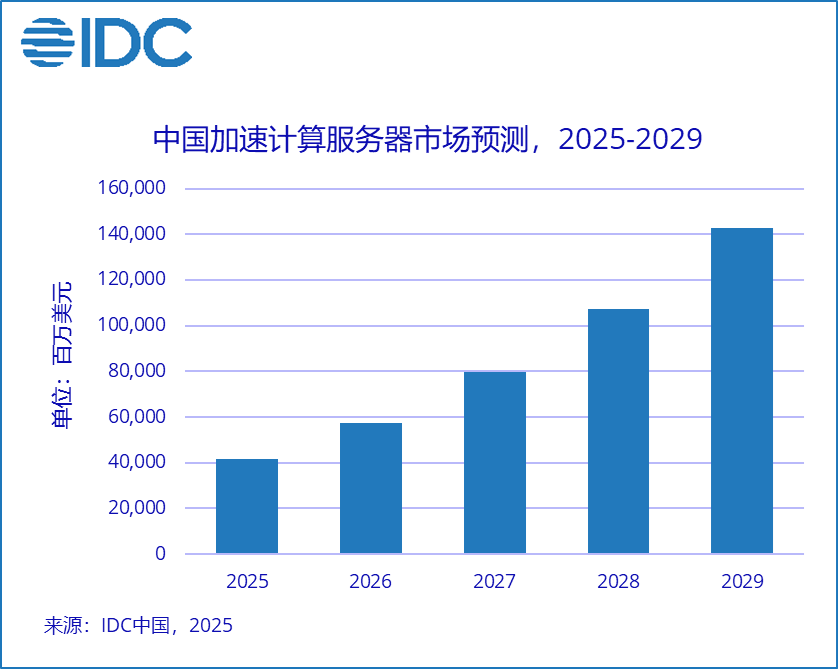
Core Insights - The Chinese accelerated server market is projected to reach $16 billion in the first half of 2025, more than doubling from the first half of 2024, with expectations to exceed $140 billion by 2029 [1][3] Market Overview - The top three vendors by sales revenue in the first half of 2025 are Inspur, H3C, and Lenovo, collectively holding nearly 50% of the market share [3] - In terms of server shipments, Inspur, H3C, and Ningchang lead the market with approximately 43% share [3] - The internet sector remains the largest purchaser, accounting for nearly 69% of the overall accelerated server market, with significant growth observed in finance, education, telecommunications, and healthcare sectors [3] Policy and Industry Dynamics - The computing power voucher policy has significantly lowered the entry barriers for domestic AI computing power through substantial funding and multi-level support systems [3] - This initiative has facilitated a strategic shift for domestic manufacturers from single product replacements to comprehensive ecosystem innovation [3] - The market is transitioning from a phase of demand driven by large-scale commercial deployment in 2024 to a focus on product competitiveness in the first half of 2025 [3] Application and Technology Trends - In the industrial sector, AI servers are enhancing real-time process optimization, predictive maintenance, and digital twin simulations, improving manufacturing precision [3] - In finance, applications include high-frequency trading risk control and intelligent investment research, capable of processing high-dimensional real-time data [3] - In smart healthcare, technologies such as genomic analysis and surgical robot control are emerging, emphasizing ultra-low latency and high reliability [3] - Traditional industries like retail, energy, and agriculture are leveraging edge computing for real-time analysis and localized decision-making [3] Accelerated Chip Market - The market for accelerated chips in China is expected to exceed 1.9 million units in the first half of 2025 [5] - Demand for non-GPU cards is growing rapidly, supported by policies, capturing 30% of the market share, while domestic chip brands account for approximately 35% of the overall market [5] Competitive Landscape - The Chinese AI accelerated server market is currently in a phase of scale expansion and domestic substitution, with a need for breakthroughs in high-end computing efficiency and ecosystem maturity [7] - Future competition will shift focus from single-chip performance to system efficiency, open ecosystem collaboration, and green computing cost control [7] - The industry is encouraged to avoid low-level redundant construction and enhance international competitiveness through technological collaboration and standard optimization [7]


AI高景气度延续,从三季报角度看国产算力与光模块
2025-10-09 02:00
Summary of Conference Call Notes Industry Overview - The AI industry outlook remains optimistic, with leading companies such as Zhongji Xuchuang, Xinyi Sheng, and Tianfu Communication benefiting from the demand growth driven by NVIDIA's B series chips, specifically a 1.6T demand increase [1][3] - The pricing for 1.6T optical modules is approximately $1,100, while silicon optical modules range from $900 to $1,000, which have been incorporated into profit models [1][2][5] - Despite minor annual declines in pricing, these changes are considered normal and will not significantly impact overall profit forecasts for companies like Zhongji Xuchuang and Xinyi Sheng, which are expected to achieve net profit margins around 30% [1][5] Key Companies and Their Performance - ODM server manufacturers, including Hon Hai Precision, Wistron, and Inventec, have shown strong shipment performance, with Hon Hai's September revenue reaching NT$837.6 billion, a 38% quarter-on-quarter increase and a 15% year-on-year increase [4] - Zhongji Xuchuang and Xinyi Sheng have announced minor share reductions of 0.49% and 1.14%, respectively, which are seen as normal after stock price increases and do not alter the industry's fundamentals [2] Technological Developments - The development of CPU technology is a significant trend, with Broadcom validating a 400G port CPU operation for 1 million hours, indicating the importance of CPU technology [6] - Companies like Zhongji Xuchuang and Huagong Technology are actively researching CPU technology, positioning themselves for competitive advantages in the future [6] Market Sentiment and Future Trends - Recent market fluctuations have been influenced by short-term news, but the long-term fundamentals of the communication sector remain unchanged. Companies with strong performance support are expected to continue benefiting [7] - The acceleration of CPU industrialization is not expected to negatively impact optical module manufacturers; instead, it may provide benefits, as indicated by Zhongji Xuchuang's involvement in the CPO track [8] AI Computing Demand and Infrastructure - AI computing demand remains high, as evidenced by OpenAI's collaborations with NVIDIA and AMD, which are driving infrastructure development [9] - Domestic companies like Huawei and Alibaba are actively deploying data center super nodes to support the development of domestic chips, with Huawei's Ascend 910 chip showing improved yield rates [9] Recommendations for Companies - The domestic AI inference edge application market shows significant potential, with C-end users driving the deployment of AIC chips [10] - Zhongji Xuchuang is recommended due to its strong technical capabilities and support for various super node layouts [10] - The optical module industry is expected to grow, with strong demand driven by NVIDIA's 1.6T B series chip, leading to positive performance forecasts for companies like Xinyi Sheng and Tianfu Communication [11] ZTE Corporation's Market Position - ZTE Corporation's performance is noteworthy, with revenue expected to double this year following a recovery in Q2. The company is anticipated to enhance its profitability as it scales up production of self-controlled chips [12] - ZTE has showcased several core technologies, including CPU and switching chips, indicating its strong technical control capabilities [12] Conclusion - The overall sentiment towards the AI and communication sectors remains positive, with key players positioned to benefit from ongoing technological advancements and market demand [13]



WTO上调2025年全球贸易增长预期:人工智能成核心引擎,南南贸易亮眼
Xin Lang Cai Jing· 2025-10-07 14:45
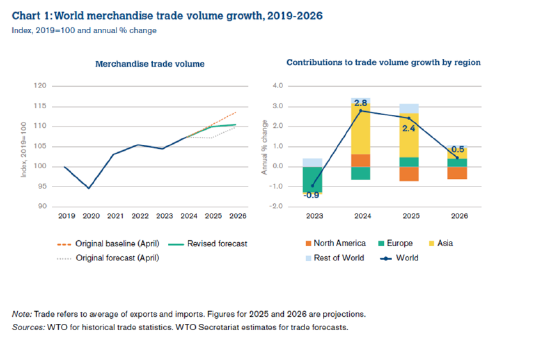
Core Insights - The World Trade Organization (WTO) has revised its global goods trade growth forecast for the first half of 2025 from 0.9% to 2.4%, driven by strong demand for AI-related products, early imports in North America to avoid tariffs, and active trade among emerging economies [1][3] Group 1: Global Trade Growth - The global goods trade volume is expected to grow by 4.9% year-on-year in the first half of 2025, with trade value in USD increasing by 6% [3] - AI-related products, including semiconductors, servers, and telecommunications equipment, are key drivers of this growth, contributing nearly half of the overall increase with a 20% year-on-year rise in trade value [3][4] Group 2: Emerging Economies and Regional Performance - Trade among emerging economies (South-South trade) grew by 8% in the first half of 2025, surpassing the global average growth rate of 6% [4] - Asia and Africa are projected to achieve the fastest export growth in 2025, while Europe may experience a slowdown and North America could see a decline in export trade [4] Group 3: Economic Outlook - Global GDP is expected to grow by 2.7% in 2025, slightly decreasing to 2.6% in 2026, with short-term trade growth supported by inventory accumulation and AI-related products [5] - The growth momentum for global services trade is anticipated to weaken, with commercial services export growth expected to drop from 6.8% in 2024 to 4.6% in 2025 [5]
平安证券(香港)港股晨报-20251006
Ping An Securities Hongkong· 2025-10-06 07:16
Market Overview - The Hong Kong stock market experienced a slight pullback, with the Hang Seng Index closing down 145 points or 0.61% at 23,831 points, while the Hang Seng China Enterprises Index fell 47 points or 0.49% to 9,656 points [1][5] - The market turnover decreased to 82.799 billion HKD, with net inflows of 484 million HKD recorded in the Hong Kong Stock Connect [1][5] - The major sectors that saw declines included local real estate, software, and 5G concepts, while gold stocks performed well [1] US Market Performance - The US market showed resilience, with the Dow Jones Industrial Average rising 529 points at one point, ultimately closing up 0.5% at 46,758 points [2] - The S&P 500 index remained nearly flat, while the Nasdaq Composite fell 0.3% to 22,780 points, influenced by declines in stocks like Nvidia and Tesla [2] Hong Kong Stock Index Trends - The Hang Seng Index saw significant gains this year, with a 30% increase year-to-date and an 11.56% rise in the third quarter [3] - The Hang Seng Technology Index surged 21.93% in the third quarter, reaching its highest level since October 2021 [3] Investment Recommendations - The report suggests focusing on sectors such as artificial intelligence, semiconductors, and industrial software, which are supported by new productivity initiatives [3] - It also highlights the value of state-owned enterprises with lower valuations and higher dividends, as well as upstream non-ferrous metals benefiting from anticipated interest rate cuts [3] Key Company Highlights - Shanghai Electric (2727 HK) saw a significant increase of over 14%, reaching a new closing high due to the successful launch of a photovoltaic project in Romania [1] - The military industrial leader AVIC (2357 HK) rose by 5.4% over the week, as recommended in previous reports [1] Market Sentiment and Future Outlook - The report indicates a continued positive sentiment towards Chinese assets, with substantial net inflows from southbound funds totaling 436.322 billion HKD in the third quarter [3] - The anticipated growth in domestic chip companies and AI applications is expected to drive further investment opportunities in the technology sector [9]
中国算力企业收到100亿大红包
Di Yi Cai Jing· 2025-10-04 14:05
Core Insights - Chinese computing power companies received significant contracts from China Unicom and Industrial and Commercial Bank of China (ICBC), totaling over 10 billion RMB, primarily for domestic chip-based servers [2][6] - The rapid growth of domestic chip manufacturers is attributed to technological advancements and favorable policies [2][11] Group 1: Contract Details - ICBC awarded a 30 billion RMB server project to Inspur Information, with stringent bidding conditions requiring bidders to have prior contracts with major banks or telecom companies [4][5] - China Unicom's centralized procurement project for general servers totaled 79.6 billion RMB, with significant portions allocated to domestic computing power server providers [5][6] - The total procurement amount from both ICBC and China Unicom approaches 110 billion RMB, with around 100 billion RMB going to domestic server suppliers [6] Group 2: Market Position and Trends - Inspur Information is currently the leading domestic server provider, holding a 30.8% market share in the x86 server market [8][9] - The x86 server market in China is projected to reach 39.3 billion USD in 2024, with major players including Inspur Information, Super Fusion, and H3C [9][10] - Domestic chip companies like Haiguang and Huawei are emerging as key players, with Haiguang's products compatible with x86 instruction sets [11][12] Group 3: Industry Growth and Future Outlook - The demand for domestic chips is increasing, particularly in the financial and internet sectors, with significant revenue growth observed in these areas [13][14] - The shift towards AI and the need for advanced computing power are driving the development of local AI computing companies [14][15] - The resilience of domestic chip manufacturers in overcoming high-end manufacturing and design tool limitations positions them for future growth [15]


中国本土算力企业收到工行、联通的100亿国庆“红包”
Di Yi Cai Jing· 2025-10-04 13:20
Core Insights - Chinese computing power companies received significant contracts during the National Day holiday, with China Unicom and Industrial and Commercial Bank of China (ICBC) announcing server procurement projects totaling over 10 billion RMB [1][5] - The projects primarily feature domestic chips, highlighting the rapid growth and market establishment of local chip manufacturers [1][8] Group 1: ICBC Server Procurement - Inspur Information won a 3 billion RMB server procurement project from ICBC, which set stringent conditions for bidders, including prior contracts with major banks and telecom companies [2][4] - The project involves air-cooled servers, despite a market shift towards liquid cooling, indicating a continued demand for traditional cooling methods [2][4] - The scale of this hardware tender is notable, as typically multiple companies would win such contracts, but this time only Inspur was selected as the primary bidder [2][5] Group 2: China Unicom Server Procurement - China Unicom's centralized procurement project for general servers totaled 7.96 billion RMB, with 11 manufacturers sharing the contracts [4][5] - The procurement was divided into two packages: one for Intel CPU servers and another for domestic computing servers, with significant portions allocated to domestic brands like Haiguang and Kunpeng [4][5] - Domestic server providers secured the majority of the contracts, reflecting a strong preference for local technology [5] Group 3: Market Position and Growth - Inspur Information is currently the leading domestic server provider, holding a 30.8% market share in the x86 server market, followed by other companies like Super Fusion and H3C [7][6] - The x86 server market in China is projected to reach 39.3 billion USD in 2024, indicating robust growth potential for domestic manufacturers [7] - Local chip companies, such as Haiguang and Huawei, have emerged as key players, with Haiguang's products compatible with mainstream operating systems and instruction sets [8][9] Group 4: Industry Trends and Future Outlook - The increasing adoption of domestic chips is supported by favorable policies and technological advancements, with significant growth observed in sectors like finance and internet [10][9] - The market share of domestic chips is growing, with Haiguang holding approximately 30% and Huawei's Kunpeng dominating around 70% [10] - The shift towards AI and the need for enhanced computing power are driving the development of local AI computing companies, creating new opportunities in the market [10]
中国本土算力企业收到工行、联通的100亿国庆“红包” | 海斌访谈
Di Yi Cai Jing Zi Xun· 2025-10-04 13:12
Core Insights - Chinese computing power companies received significant contracts during the National Day holiday, with China Unicom and Industrial and Commercial Bank of China (ICBC) announcing server procurement projects totaling over 10 billion RMB [1][5] - The projects primarily feature domestic chips, highlighting the rapid growth and market acceptance of local chip manufacturers [1][9] Group 1: ICBC Server Procurement - ICBC awarded a 3 billion RMB server project to Inspur Information, which was the sole winner of the bid [3] - The bidding conditions were stringent, requiring bidders to have prior contracts with major banks or telecom companies totaling at least 20 million RMB [3] - The project involves air-cooled servers, despite a market shift towards liquid cooling solutions [3][5] Group 2: China Unicom Server Procurement - China Unicom's centralized procurement project totaled 7.96 billion RMB, divided into two packages: one for Intel CPU servers and another for domestic computing servers [4][5] - The domestic computing server package included budgets of 2.782 billion RMB for Haiguang servers and 4.285 billion RMB for Kunpeng servers [4] - Domestic suppliers secured the majority of the contracts, indicating a strong preference for local technology [5] Group 3: Market Dynamics and Trends - Inspur Information leads the domestic server market with a 30.8% share, followed by other local companies like Super Fusion and H3C [7] - The x86 server market in China is projected to reach 39.3 billion USD in 2024, with local companies increasingly relying on both Intel and Haiguang chips [7][8] - The rise of domestic chip manufacturers like Haiguang and Huawei is reshaping the competitive landscape, with local chips gaining market share against established players like Intel and AMD [9][10]


AI服务器液冷渗透率将超50%,系统化服务能力成竞争焦点
Sou Hu Wang· 2025-10-04 02:33
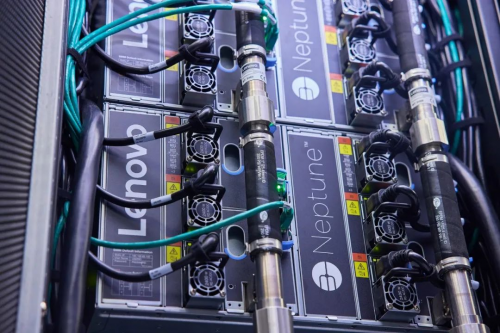
Group 1: Market Overview - The rapid development of AI technology is driving unprecedented cooling demands in data centers, with liquid cooling emerging as a more efficient and cost-effective solution [1] - According to Guosen Securities, the global liquid cooling market for data centers is expected to reach $10 billion by 2026, driven by major tech companies like Google, Amazon, Meta, and NVIDIA [1][6] - The penetration rate of liquid cooling in domestic data centers is projected to accelerate, with an expected penetration rate of over 50% for AI servers by 2026 [6] Group 2: Technological Advancements - Liquid cooling systems outperform traditional air cooling in terms of heat transfer capabilities and overall energy efficiency, leading to lower Power Usage Effectiveness (PUE) and reduced energy consumption [3] - Lenovo's "Hades" warm water cooling system, designed for AI training and high-performance computing, has achieved a PUE value below 1.1, allowing for the operation of servers exceeding 100 kW without dedicated air conditioning [5][8] - Innovations such as Lenovo's "Flying Fish" bionic cooling design and "Dual-Cycle" phase-change immersion cooling system have significantly enhanced cooling performance, with PUE values as low as 1.035 [8] Group 3: Competitive Landscape - Domestic manufacturers are gaining ground in the liquid cooling market, leveraging cost advantages and technological innovations to compete with established foreign players [9][14] - Vertiv, a leading overseas temperature control company, holds a 23.5% share of the global data center cooling market, benefiting from partnerships with NVIDIA [9] - Lenovo's collaboration with major chip manufacturers like Intel, NVIDIA, and AMD enhances its competitive edge in the liquid cooling sector, allowing for seamless integration of server performance [13][14] Group 4: Future Projections - The liquid cooling market in China is expected to grow significantly, with projections indicating a market size of approximately 130 billion yuan by 2029 [6] - The demand for liquid cooling solutions is expected to be driven by the increasing energy consumption of data centers, which currently accounts for 1.5% to 2% of global electricity usage, projected to rise to 4% by 2030 [2] - Companies like Lenovo are well-positioned to capitalize on the growing liquid cooling market due to their technological advancements and strong service capabilities [14]
Altman密访鸿海、台积电:探讨星际之门合作细节、自研ASIC芯片项目
Hua Er Jie Jian Wen· 2025-10-01 08:14
Group 1 - OpenAI CEO Sam Altman visited Taiwan to discuss key projects with Foxconn and TSMC, focusing on the "Star Gate" initiative and the production details of its self-developed AI chips (ASIC) [1][2][3] - The "Star Gate" project aims to build five new data centers in the U.S., representing one of the largest investments in computing power in the country, with Foxconn being the largest AI server supplier for this initiative [2] - OpenAI is developing custom AI chips to reduce reliance on external suppliers like NVIDIA, with plans to have TSMC manufacture these chips, targeting mass production by 2026 [3] Group 2 - The collaboration with Foxconn is crucial for ensuring the production and delivery capabilities of AI servers needed for the "Star Gate" project's infrastructure [2] - OpenAI's initial chip versions are expected to focus on inference rather than training, marking a significant test for the viability of self-developed chips in the tech industry [3]

三大股指集体上涨,人工智能相关ETF全线走高,5G通信ETF(515050)上涨2.34%
Mei Ri Jing Ji Xin Wen· 2025-09-29 08:33
Market Performance - The three major indices collectively rose on September 29, with the Shanghai Composite Index up by 0.9%, the Shenzhen Component Index up by 2.05%, and the ChiNext Index up by 2.74% [1] - The total trading volume in the Shanghai and Shenzhen markets reached 21,781 billion yuan, an increase of 120 billion yuan compared to the previous day [1] - Over 3,500 stocks in the market experienced gains, with sectors such as securities, batteries, non-ferrous metals, and steel leading the gains, while education, pork, coal, and chemical pharmaceuticals saw declines [1] ETF Performance - Major broad-based ETFs saw significant afternoon gains, with the A500 ETF (512050) rising by 1.39% [1] - AI-related ETFs performed well, with the Chip ETF (159995) and AI ETF (515070) both increasing by 1.14% [1] - The 5G Communication ETF (515050) rose by 2.34%, and the ChiNext AI ETF (159381) increased by 1.33%, indicating strong performance in the AI computing hardware supply chain [1] Sector Focus - Recent domestic policies and structural industry trends have garnered attention, with market funds gradually shifting from the computing power sector to other low-valuation growth sectors [1] - The market is expected to maintain a slow bull trend in the medium term, with structural growth sectors becoming key investment opportunities [1] - Key sectors to watch include new energy, humanoid robots, innovative pharmaceuticals, and non-ferrous metals, which are expected to have concentrated catalytic events [1] Earnings Expectations - According to Industrial Securities, industries with upward revisions in profit expectations since September are primarily concentrated in technology, advanced manufacturing, cyclical, consumption, and finance [2] - The third quarter reports will serve as an important window to validate the economic cycle for strong sectors represented by technology and advanced manufacturing [2] - In the technology growth narrative, sectors such as AI, innovative pharmaceuticals, and new energy have seen trading congestion return to reasonable levels, suggesting a potential focus on growth trends [2]