航空业

Search documents
12条航线取消航班,短期中国赴日人数骤降
3 6 Ke· 2025-11-26 01:58
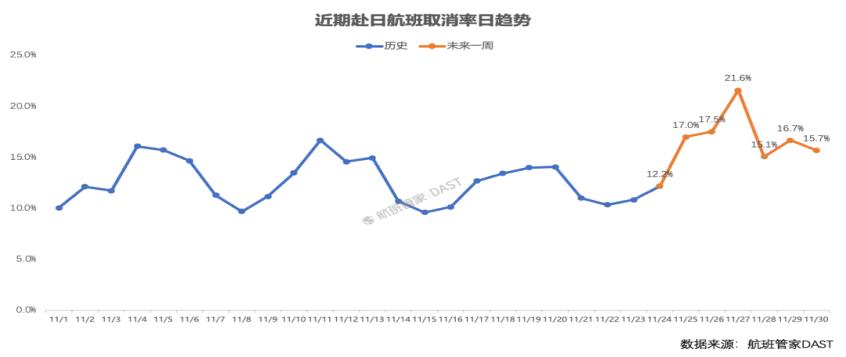
Core Viewpoint - The number of Chinese tourists traveling to Japan has sharply decreased, with a significant rise in flight cancellations and a potential economic impact on Japan's tourism industry [1][6]. Flight Cancellations - The flight cancellation rate from China to Japan is projected to peak at 21.6% on November 27, marking the highest rate in nearly a month [1]. - Out of 103 regular routes, 12 have canceled all flights, including routes from Hangzhou to Nagoya and Nanjing to Fukuoka [2]. - The Shanghai Pudong to Osaka Kansai route, which previously had 30 flights daily, has seen a cancellation rate of 30.1%, with 72 out of 239 flights canceled [2]. - Approximately 500,000 tickets are estimated to have been canceled, with a 12.3 percentage point drop in seat occupancy and a 10.8% decrease in passenger volume compared to the previous week [2]. Impact on Cruise Industry - A Chinese cruise ship has canceled its planned stop in Japan, affecting local tourism, although this is not yet a widespread trend [3]. - The cruise "Aida Mediterranean" canceled its stop in Okinawa, impacting local businesses that rely on tourist influx [3]. - The cruise line has adjusted its itinerary, replacing a stop in Japan with a visit to Vietnam [3]. Economic Impact on Japan - The decline in Chinese tourists is expected to significantly impact Japan's tourism sector, which constitutes about 7% of the country's GDP [4]. - Chinese tourists account for 25% of all foreign visitors to Japan, with a year-on-year increase of 42.7% in the first three quarters of 2025 [4]. - The average spending of Chinese tourists is 27.7 million yen (approximately 125,000 RMB), surpassing the average of 22.7 million yen (about 103,000 RMB) for all foreign visitors [4]. - The loss in tourism alone could reduce Japan's GDP by 0.36%, with potential economic losses estimated at 2.2 trillion yen (approximately 101.16 billion RMB) if the travel warnings persist for a year [6].

未来组织:麦肯锡12要素运营法则
麦肯锡· 2025-11-25 09:23
Core Insights - The article emphasizes that having the right strategy is not enough; companies need an effective operational model to achieve key outcomes such as clear resource accountability, agile decision-making, specialized talent capabilities, and efficient organizational collaboration [2][3][4] - A significant number of companies have attempted to restructure their operational models, with nearly two-thirds having done so in the past two years and half planning to initiate changes again within the next two years [2][3] - McKinsey's research indicates that even high-performing companies can experience a gap of up to 30% between strategic potential and execution, often due to limitations in their operational models [2][3] Operational Model Design - The article introduces a new methodology for operational model design, termed the "Value-Oriented Organization" system, which consists of 12 core elements that can be flexibly configured based on the company's environment and development goals [3][4] - The updated framework builds upon the classic 7S model, which identified seven interrelated elements that influence organizational change capability [4][5][6] - The new system aims to help managers respond to rapidly changing business environments, technological trends, and social dynamics [5][6][7] Key Elements of the New Framework - The 12 elements include: corporate mission, value proposition, organizational structure, ecosystem, leadership capabilities, governance mechanisms, process systems, technology empowerment, behavioral norms, incentive mechanisms, overall layout, and talent strategy [19][21][22] - Each element is interconnected, and the effectiveness of the operational model relies on the alignment and mutual reinforcement of these components [22][23] Trends and Challenges - The article highlights that many leaders still focus on organizational structure when redesigning operational models, which may not be sufficient in today's complex environment [8][18] - High-level executives view technology, particularly AI and automation, as significant opportunities, while geopolitical complexities and workforce demographic shifts pose challenges [8][12][15] Paths for Transformation - Companies are exploring two main paths for operational model transformation: improving traditional structures or adopting new agile frameworks that emphasize speed and technology [12][15] - Research shows that organizations using emerging structures tend to exhibit greater adaptability and proactivity in innovation and technology strategies [15][18] Implementation and Performance - Successful operational model redesign requires a systematic approach that considers all 12 elements, allowing leaders to identify their unique operational model "fingerprint" [22][23] - Companies that effectively implement these changes can achieve measurable improvements in customer satisfaction, operational efficiency, decision-making speed, and employee engagement [34][35]

释放关系回暖信号,印加重启关键贸易协定谈判
Huan Qiu Shi Bao· 2025-11-24 22:57
Core Points - India and Canada have agreed to resume trade agreement negotiations, marking a thaw in bilateral relations after a diplomatic dispute [1][2] - The goal is to double bilateral trade to $50 billion by 2030, with both leaders emphasizing the potential economic opportunities [1][2] - The negotiations will cover various sectors including goods, services, investment, agriculture, digital trade, labor mobility, and sustainable development [2][3] Group 1: Trade Agreement Resumption - The trade agreement negotiations had been stalled for nearly 15 years due to a diplomatic crisis following the assassination of a Sikh leader [1][2] - Canadian Prime Minister Carney highlighted that India is a reliable trade partner, despite some existing friction points [1][2] - The resumption of talks is seen as a way to rebuild trust and inject confidence into investors and businesses from both countries [2][3] Group 2: Economic Context - The bilateral trade volume is projected to reach approximately CAD 31 billion in 2024, with India currently being Canada's seventh-largest trading partner [3] - The Canadian government is actively seeking to diversify its trade relationships in response to U.S. protectionist policies [4][5] - The shift in Canada’s trade strategy is partly influenced by the trade war initiated by former U.S. President Trump, prompting Canada to strengthen ties with countries like India [4][5]
一句话,重创日本经济!
Jin Tou Wang· 2025-11-24 10:35
Economic Impact - Japan's economy is facing significant challenges, with the Nikkei 225 index dropping over 4,000 points since November, a decline of more than 7% [1] - The tourism sector, a crucial pillar of Japan's economy, has been severely impacted, with 500,000 travel tickets canceled following travel warnings issued to Chinese tourists [2] - The reliance on Chinese tourists is highlighted, as they accounted for 30% of inbound visitors pre-pandemic, with a consumption share of 36.8% in 2019 [2][3] Financial Market Reactions - The Japanese yen has reached a 10-month low against the US dollar, trading at over 156 yen per dollar [2] - The bond market is experiencing turmoil reminiscent of the 2008 financial crisis, with 10-year government bond yields surpassing 1.8%, the highest since 2007 [1] Dependency on China - Over 1,400 products in Japan have more than half of their supply sourced from China, indicating a dependency level twice that of the US and six times that of Germany [4] - Despite government efforts to subsidize companies to reduce risk, there has been a lack of response, as alternatives like Vietnam do not match China's efficiency and quality [4] Education Sector Challenges - Chinese students represent a significant portion of Japan's international student population, with 123,000 expected in 2024, making up 36.7% of total international students [5] - The potential decline in Chinese students poses a survival threat to Japanese language schools and universities, as they struggle to find alternative sources of students [5] Seafood Export Issues - Japan's seafood exports to China have been halted, leading to a significant loss of revenue, with exports to China amounting to approximately 4 billion yuan in the first half of the year [5] Economic Policy Concerns - The Japanese government has introduced a massive economic stimulus plan worth 21.3 trillion yen, raising concerns about the reliance on debt to fund this initiative [6] - Japan's debt-to-GDP ratio exceeds 260%, the highest among major economies, causing investor anxiety and contributing to capital flight from Japan [6] Public Sentiment and Protests - Public dissatisfaction is growing, with a recent poll showing nearly equal support for and against Prime Minister Kishi's controversial statements regarding Taiwan [7] - Protests have emerged, with citizens demanding the retraction of statements that could harm Japan-China relations and calling for adherence to peace principles [7]
12条中日航线取消全部航班
证券时报· 2025-11-24 07:56
Core Viewpoint - The article highlights the significant cancellation of flights from China to Japan, with a focus on the implications for tourism and the economy due to recent travel warnings and rising cancellation rates [1][6]. Flight Cancellations - As of November 24, 2023, 12 routes from China to Japan have canceled all flights, with a 100% cancellation rate for several routes including Hangzhou to Central International Airport and Nanjing to Fukuoka Airport [1][2]. - The cancellation rate for planned flights to Japan is expected to reach 21.6% by November 27, marking the highest rate in a month, with specific routes like Tianjin to Kansai International seeing a 65% cancellation rate [3]. Travel Warnings - Multiple Chinese government departments, including the Ministry of Foreign Affairs and the Ministry of Culture and Tourism, have issued warnings advising citizens to avoid travel to Japan [6]. - The Hong Kong government has also updated travel information, urging residents to exercise caution when traveling to Japan [6]. Economic Impact - Data from Japan's National Tourism Organization indicates that in the first three quarters of 2025, Japan welcomed 31.65 million foreign tourists, with 7.4872 million from mainland China, a 42.7% increase year-on-year [6]. - A significant reduction in Chinese tourists could lead to a 0.36% decrease in Japan's GDP, with estimated economic losses reaching 2.2 trillion yen, approximately 101.16 billion yuan [6].

商务部答每经记者问:中英经贸关系正值“黄金时代” 中企在英累计直接投资近200亿美元
Mei Ri Jing Ji Xin Wen· 2025-11-24 04:09
Group 1 - The UK government has introduced a white paper titled "National Security and Investment," which significantly lowers the threshold for foreign investment scrutiny from £70 million to £1 million, allowing for increased government intervention in potential national security risks [1] - The new regulations will require all foreign competitors, including Chinese companies, to report any mergers, acquisitions, or transactions that may pose a risk to UK national security, regardless of the transaction size [1] - The UK has recently approved a Chinese acquisition of a UK company, marking the first merger since the modification of the Companies Act, indicating a potential willingness to engage with foreign investments despite new scrutiny measures [2] Group 2 - The Chinese government has expressed its respect for the UK's right to conduct national security reviews on foreign investments, while also urging the UK to maintain non-discriminatory practices and transparency in its review processes [2] - As of now, Chinese companies have invested nearly $20 billion in the UK, establishing over 500 enterprises, which have contributed significantly to local employment and tax revenue [2] - The Chinese government emphasizes the importance of fair treatment for foreign investors to maintain confidence and avoid creating new uncertainties for foreign investments in the UK [2]
美国政府停摆阴霾散去,美国航空业乐观备战感恩节创纪录客流
Zhi Tong Cai Jing· 2025-11-24 01:48
Core Viewpoint - The upcoming Thanksgiving holiday is expected to see record travel volumes, with optimism in the airline industry following the end of the recent government shutdown [1] Group 1: Passenger Volume Predictions - Airlines are projected to transport over 31 million passengers from November 21 to December 1, with the busiest travel day expected to be the Sunday after Thanksgiving, accommodating approximately 3.4 million travelers [1] - United Airlines anticipates carrying 6.6 million passengers between November 20 and December 2, representing an increase of over 4% compared to the previous year [3] Group 2: Impact of Government Shutdown - The recent government shutdown disrupted travel plans for about 6 million people due to delays and cancellations caused by air traffic controllers working without pay [1] - Major airlines may face operational revenue losses estimated between $150 million to $200 million, while smaller airlines could incur losses of around $100 million [2] Group 3: Booking Trends - There has been a 16% increase in bookings for United Airlines from November 15 to November 16 compared to the previous week, indicating travelers waited until the end of the shutdown to make reservations [2] - International travel bookings during the holiday period have reached a new high, increasing by 10% compared to last year, with popular destinations including Cancun, London, and Frankfurt [2] Group 4: Capacity Adjustments - Major airlines are increasing international capacity by approximately 5% and domestic capacity by about 2% compared to the previous year [3] - American Airlines plans to operate 80,759 flights during the holiday period, the highest among all airlines [3] - Spirit Airlines is significantly reducing its capacity by nearly 40% year-over-year due to financial struggles, including laying off hundreds of pilots [3]
2025年12月宏观及大类资产月报:中美达成阶段性协议,经济数据波动加大-20251123
Chengtong Securities· 2025-11-23 06:14
Group 1: Macro and Asset Performance - In November, the Shanghai Composite Index fell by 3.0%, the CSI 300 dropped by 4.0%, the ChiNext Index decreased by 8.4%, and the STAR 50 Index declined by 9.2% [1][11] - The bond market experienced a slight decline, with an overall drop of 0.1%, and government bond yields increased, with 1-year, 5-year, and 10-year yields rising by 1.8bp, 2.5bp, and 2.1bp respectively [1][21] - The Hang Seng Index fell by 2.7%, and major US stock indices also saw declines, with the Dow Jones Industrial Average, Nasdaq, and S&P 500 dropping by 2.8%, 6.1%, and 3.5% respectively [1][21] Group 2: A-Share Market Outlook - The central economic work conference in December is crucial for setting the tone for 2026 economic policies, which could lead to an independent market trend if macro and industrial policies exceed expectations [1][22] - The market is currently in a phase of consolidation without a clear main line, with recommendations to focus on the aviation sector, new consumption, and undervalued banking stocks [2][23] - The aviation sector is expected to benefit from supply-side constraints and policy guidance, leading to improved profitability alongside low oil prices [2][23] Group 3: Bond Market Strategy - The overall outlook for government bond yields suggests a continued upward trend, influenced by domestic fundamentals and policy fluctuations [3][24] - The upcoming central economic work conference is anticipated to have a significant impact on interest rates, as yields typically price in next year's policies [3][26] - Despite a weak economic backdrop, the 10-year government bond yield is expected to maintain a strong position, rising from 1.79% to around 1.82% [3][29]
Portugal says only Europe's three largest airlines showed interest in TAP privatisation
Reuters· 2025-11-22 18:22
Core Points - The deadline for airlines to formally express interest has closed, indicating a significant step in the ongoing process [1] Group 1 - Airlines were required to submit their expressions of interest by the specified deadline, which has now passed [1]


这2件事还没摆平,特朗普吹嘘:中国不这样做,归功于美国太强大
Sou Hu Cai Jing· 2025-11-22 08:18
近期,美国总统特朗普在接受采访时再次展现了他一贯的强硬言辞。他将中美关系维持现状的原因归结 为美国拥有强大的军事实力,而这种实力的基础正是他引以为傲的关税政策和对军队的重建。这番话虽 然在表面上增强了美国的全球地位感,但实际上,美国国内正面临着两场愈加严峻的危机。第一场危机 是创下历史纪录的政府长期停摆,第二场则是对其关税政策合法性的最高法院审判。这两场悬而未决的 难题,如同阴云笼罩在白宫上空,不仅深刻影响着美国民众的生活和国家经济的稳定,也让特朗普关于 实力的言辞显得苍白无力。 当特朗普在镜头前谈论如何依靠强大实力维持国际秩序时,他所领导的政府正处于严重的内政危机中。 美国的政府停摆已经持续了四十多天,打破了历史纪录,形成了前所未有的政治僵局。虽然特朗普声称 会尽快达成让所有人都满意的协议,但进展远比他所言的复杂。国会参议院的谈判虽然有了些许进展, 两党已达成一个潜在的打包法案,试图通过短期拨款和部分机构全年拨款的方式,暂时为政府提供资 金。然而,这并不意味着危机就此解除。按照美国的立法流程,即便参议院通过了该法案,它还需要返 回众议院重新表决。考虑到两党在医保等重要问题上的巨大分歧,且民主党内部也有强烈反 ...