
纺织服装

Search documents
服饰年报|过半数公司净利率不足7% 美邦服饰、安奈儿、三夫户外净利率垫底
Xin Lang Zheng Quan· 2025-05-09 08:28
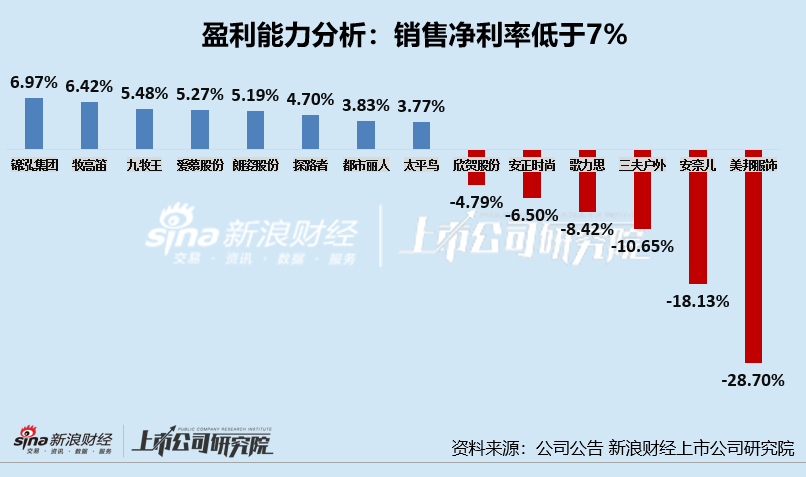
Core Insights - The apparel industry continues to exhibit high gross margins and low net margins, with over half of the selected 25 listed companies achieving gross margins above 50% and many exceeding 65%, while net margins are generally below 15% [1][6] Group 1: Gross Margin Analysis - Among the selected companies, the top three in terms of gross margin for 2024 are: - Bi Yi Le Fen at 77.01% - Di Su Shi Shang at 74.84% - Jin Hong Group at 68.63% [1] - Only two companies, Mu Gao Di and Mei Bang Fu Shi, reported gross margins below 40%, with figures of 28.48% and 27.44% respectively [1] Group 2: Net Margin Analysis - A significant number of companies have net margins below 7%, with 14 out of 25 companies falling into this category [2] - The net margins for specific companies are as follows: - Jin Hong Group at 6.97% - Mu Gao Di at 6.42% - Jiu Mu Wang at 5.48% - Ai Mu Shares at 5.27% - Lang Zi Shares at 5.19% - Tu Lu Zhe at 4.70% - Du Shi Li Ren at 3.83% - Tai Ping Niao at 3.77% - Xin He Shares at -4.79% - An Zheng Shi Shang at -6.50% - Ge Li Si at -8.42% - San Fu Outdoor at -10.65% - An Nai Er at -18.13% - Mei Bang Fu Shi at -28.70% [4][6] Group 3: Trends and Observations - In 2024, nine companies experienced simultaneous declines in both gross and net margins, including Mei Bang Fu Shi, An Zheng Shi Shang, Xin He Shares, An Nai Er, Bi Yi Le Fen, Ai Mu Shares, Zhong Guo Li Lang, Ge Li Si, and Sen Ma Fu Shi [2][6] - The disparity between gross and net margins is attributed to high selling expense ratios in the textile and apparel industry, which significantly erodes profits [6]






中国外贸企业:提升产品竞争力 拓展多元市场
Zhong Guo Xin Wen Wang· 2025-05-09 06:33
Group 1 - The core viewpoint is that while export orders to the US are under short-term pressure, companies are focusing on diversifying markets and enhancing product competitiveness to navigate challenges [1][2] - Companies like Jiangmen Haiji Technology Co., Ltd. are experiencing instability in orders due to US tariff policies but are actively expanding into European and South American markets while developing domestic markets [1] - The textile industry is accelerating its transformation towards high value-added, green, and intelligent production, with companies planning to open nearly 200 large stores in emerging markets over the next five years [1] Group 2 - The machinery and electrical products sector is a key category for China's exports to the US, with companies adjusting their order models from "inventory-based purchasing" to "emergency purchasing" due to tariffs [2] - Companies are increasing their domestic market share, with one company raising its domestic sales proportion from 40% to over 65% by localizing products for domestic needs [2] - The implementation of national policies to stabilize foreign trade is allowing companies to convert some tariff costs into domestic market promotion funds, highlighting the importance of "hard technology" and "quick response" as core competitive advantages [2]
这一板块,直线拉升!
天天基金网· 2025-05-09 05:33
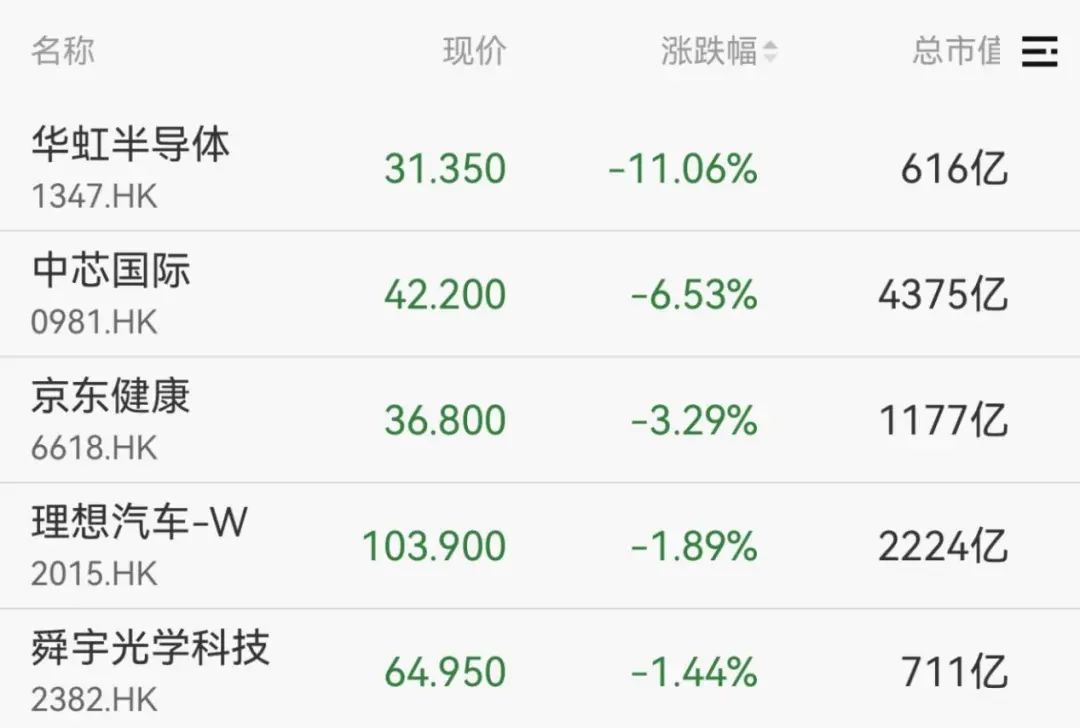
Market Overview - On May 9, A-shares experienced fluctuations with the Shanghai Composite Index down by 0.18%, Shenzhen Component Index down by 0.56%, and ChiNext Index down by 0.63% [1] - The banking sector showed resilience, with notable gains in banks such as China Construction Bank reaching a historical high, and Qingdao Bank, Chongqing Bank, and Industrial Bank rising over 2% [10][11] Sector Performance - The banking sector performed well against the market trend, while sectors like aerospace, robotics, and semiconductor chips faced declines [2][9] - The textile and apparel sector was active, with companies like Wanshili hitting the daily limit up and Huafang Co. achieving a four-day consecutive rise [7][8] Notable Stocks - Honghua Semiconductor saw a significant drop of over 11%, while SMIC fell by more than 6%, and JD Health decreased by over 3% [3][6] - In the textile sector, several stocks experienced substantial gains, including Lishili with a rise of 20.03% and Huafang Co. with a 10.06% increase [8] Regulatory Developments - The Ministry of Industry and Information Technology and the Ministry of Commerce announced a campaign to enhance the quality of textile and apparel supply, aiming to drive industry upgrades through improved product quality and brand creation [8] - Recent announcements from banks like China Merchants Bank and CITIC Bank indicated plans to establish financial asset investment companies with significant capital contributions [10][12] Market Sentiment - High-priced stocks faced significant declines, with Zhongyida hitting a daily limit down and other stocks like Jinlong Electric and Qide New Materials dropping over 9% and 7% respectively [13][14] - Zhongyida's stock price had surged by 226.55% since March 10, prompting concerns about market overheating and potential corrections due to a lack of fundamental changes [15]


这一板块,直线拉升!
Zhong Guo Ji Jin Bao· 2025-05-09 03:00
Market Overview - The banking sector showed resilience, rising against the market trend, while the textile and apparel sector saw multiple stocks hitting the daily limit up [1][7] - As of May 9, the A-share indices experienced fluctuations, with the Shanghai Composite Index down 0.18%, the Shenzhen Component down 0.56%, and the ChiNext Index down 0.63% [1] Banking Sector - The banking sector saw significant gains, with China Construction Bank reaching a new historical high, and banks like Qingdao Bank, Chongqing Bank, and Industrial Bank rising over 2% [7][8] - Recent announcements from major banks include plans to establish financial asset investment companies, with China Merchants Bank and CITIC Bank proposing investments of 150 billion yuan and 100 billion yuan respectively [9] Textile and Apparel Sector - The textile and apparel sector was notably active, with stocks like Wanshili hitting the daily limit up and Huafang Co. achieving a four-day consecutive rise [4][6] - The Ministry of Industry and Information Technology and the Ministry of Commerce recently issued a notice to promote high-quality supply in the textile and apparel industry, emphasizing the need for innovation and quality improvement [6] Stock Performance - Specific stocks in the textile sector showed remarkable performance, such as Lixueli with a 20.03% increase and DR Dahuixue with a 16.03% increase [5] - In the banking sector, Chongqing Bank rose by 2.88%, Qingdao Bank by 2.77%, and Industrial Bank by 2.00% [8]
主力资金监控:中航成飞净卖出超10亿
news flash· 2025-05-09 02:58
星矿数据显示,今日早盘主力资金净流入纺服行业、 银行、 小金属等板块,净流出 电子、 计算机、 机械设备等板块,其中电子板块净流出超69亿元。个股方面, 科蓝软件大涨,主力资金净买入5.00亿元 位居首位, 比亚迪、 万向钱潮、 润和软件获主力资金净流入居前; 中航成飞遭净卖出超10亿元, 中 芯国际、 中超控股、 常山北明主力资金净流出额居前。 ...
纺织服装板块盘初活跃 华纺股份4连板
news flash· 2025-05-09 01:38
智通财经5月9日电,华纺股份走出4连板,华茂股份涨停,戎美股份、太湖雪涨超10%,凤竹纺织、迎 丰股份、万事利等涨幅靠前。消息面上,工信部、商务部发布关于开展2024纺织服装优供给促升级活动 的通知。组织开展先进适用技术推广、数字化转型、科技创新、降本增效、绿色发展等方面活动,创新 纺织服装消费场景,发展直播电商等新业态新模式,实现线上线下联动等。 纺织服装板块盘初活跃 华纺股份4连板 ...


从“找布神器”出发 看人工智能如何助力传统纺织业
Yang Shi Xin Wen Ke Hu Duan· 2025-05-08 08:01
Core Viewpoint - The integration of AI technology in the textile industry is revolutionizing the fabric sourcing and garment design processes, significantly reducing time and improving efficiency in the fast fashion sector [1]. Group 1: AI in Fabric Sourcing - The Guangzhou fabric market features nearly 3,000 suppliers and around 1 million fabric products, making it a major hub for domestic and international buyers [2]. - The introduction of AI fabric-finding machines has transformed the sourcing process, reducing the time needed to find matching fabrics from an average of 2 days to just 2 minutes [3][4]. - Currently, 90% of fabrics in the domestic market are integrated into the AI fabric-finding system, enhancing business opportunities for suppliers [4]. Group 2: AI in Garment Design - AI technology enables designers to generate over 100 clothing styles in a single session, a significant increase from the previous maximum of 2-3 styles per day [6]. - The use of AI and big data allows for real-time monitoring of production across 700,000 weaving machines, facilitating a seamless connection between design and production [6][7]. - Future trends indicate that with AI and digitalization, custom clothing can be produced with a minimum order of one piece and delivered within 7 days, reducing design costs by over 90% compared to traditional methods [7]. Group 3: Challenges and Innovations in Textile Production - Traditional textile manufacturers face challenges in adapting to the fast fashion era, necessitating the development of innovative materials and production techniques [8]. - The establishment of a human factors engineering laboratory in Nanhai Xiqiao aims to support textile companies in developing new materials through comprehensive testing and optimization [8][9]. - Local government initiatives are promoting digital transformation in the textile industry by organizing numerous specialized matchmaking events to foster innovation and development [9].
“一块布”如何建设品牌?业界呼吁全产业链参与
Zhong Guo Xin Wen Wang· 2025-05-08 07:33
"当前,中国纺织业已经进入高质量发展阶段,实现了从跟跑到领跑的历史性跨越。推动形成更具价值 创造力、文化传播力、国际影响力的产业体系,品牌建设正当时。"近日,在浙江绍兴柯桥举行的2025 中国纺织品牌创新发展培训会暨品牌对接会上,中国纺织工业联合会会长孙瑞哲表示,纺织品牌建设, 需要全产业链参与。 中国纺织服装产业链完善,已是世界最大的服装生产国、出口国。当前全球经济和贸易形势复杂多变, 在全球纺织产业承压的背景下,加强品牌建设已成为业界的关注点。 在孙瑞哲看来,一个品牌,凝结了技术创新、文化创意,承载着价值理念、企业信誉,是国家形象、产 业实力的重要体现。尤其是当前外部不确定性因素较多,强大的品牌体系有助于提升企业价值能级、稳 定市场份额,增强抵御风险能力。 如何推动纺织品牌建设?孙瑞哲认为,纺织品牌的创新发展是一项系统工程,涉及趋势设计引领、纤维 面料创新、渠道平台赋能等,"只有全产业链同频共振,才能将中国的规模优势、体系优势真正转化为 产业品牌的价值高度、创新势能"。 纺织品牌建设,还离不开产业、市场的基础性支撑。会议所在地——柯桥坐拥"全球最大的纺织品集散 中心"中国轻纺城,培育了8000多家纺织企业 ...
光大证券晨会速递-20250508
EBSCN· 2025-05-08 01:03
Macro Insights - The recent financial policy package has been substantial and contains many unexpected details, shifting market focus towards the implementation of incremental fiscal policies [2] - A-shares are likely to enter a strong oscillation phase, while the bond yield curve is expected to steepen before flattening [2] Industry Strategy - In May, if market sentiment declines, the top-performing sectors according to the five-dimensional industry comparison framework will be utilities, banking, construction decoration, transportation, food and beverage, and coal [3] - Conversely, if market sentiment rises, the leading sectors will include media, national defense, computer, electronics, machinery, and automotive [3] Investment Strategy - The A-share market showed a rebound in April, with internal policies and medium to long-term funding providing resilience to the index [4] - Key investment themes include domestic consumption, domestic substitution, and industries with relatively high first-quarter performance, particularly utilities, banking, construction decoration, transportation, food and beverage, and coal [4] Bond Market - A comprehensive policy package has exceeded expectations, largely due to prior preparations by monetary authorities [5] - The recent 7D OMO rate cut of 10 basis points is expected to lead to a similar decline in the LPR, effectively guiding down actual loan rates and stimulating more financing demand [5] Internet Media - The internet sector's recent adjustments are more influenced by liquidity and sentiment rather than fundamentals, with concerns over decoupling risks between China and the US [6] - Post-adjustment, a divergence is expected, with Alibaba and Tencent showing resilience due to their lower exposure to cross-border e-commerce and tariffs, respectively [6] Retail Sector - During the Labor Day holiday, key retail and catering enterprises saw a 6.3% increase in sales compared to the previous year, while Hainan's duty-free shopping revenue decreased by 7.3% [8] - Notable segments to watch include national subsidy-related categories, gold and jewelry retail, and emotional consumption [8] Real Estate - In April, the top 100 real estate companies reported a 9.2% year-on-year decline in sales, indicating a need to consolidate the stability of the housing market [9] - The cumulative sales figures for the first four months show a decline of 7.8% year-on-year, with some high-energy cities beginning to stabilize [9] Coal Industry - The decline in coal prices has led to increased performance differentiation among companies, with expectations of limited further price drops in the current market [10] - Recommendations focus on companies with high long-term contract ratios and stable profits, such as China Shenhua and China Coal Energy [10] High-end Manufacturing - The company reported a 2.9% year-on-year increase in revenue for Q1 2025, with a significant 54% increase in net profit, driven by emerging businesses and overseas market expansion [15] - Future profit forecasts for 2025-2027 are set at 50.0, 62.2, and 73.5 billion yuan, respectively [15] Utilities Sector - The company reported a 4.67% year-on-year decline in revenue for 2024, but a 9.14% increase in Q1 2025 revenue, indicating a recovery trend [12] - The acquisition of Yili Technology is expected to accelerate industry optimization [12] Food and Beverage - Shanxi Fenjiu achieved a total revenue of 360.11 billion yuan in 2024, with a 12.79% year-on-year growth, and a 7.72% increase in Q1 2025 [22] - Predictions for EPS from 2025 to 2027 are 10.90, 12.14, and 13.53 yuan, respectively [22]
关税应对策略三部曲(二):柳暗花明
Changjiang Securities· 2025-05-07 12:11
Group 1 - The report highlights that after the tariff increases in 2019, domestic counter-cyclical policies and easing external pressures contributed to a bullish equity market. The "export chain" continues to show significant excess returns, indicating a potential "spring" for exports [4][6][8] - The report notes that the tariffs imposed during the Trump administration altered the export structure but did not significantly change export competitiveness. The share of Chinese exports in global exports showed resilience, recovering from 12.8% in 2017 to 14.2% in 2023 [6][30][18] - The report emphasizes that the market's risk appetite will continue to rise, contingent on policy changes, including potential liquidity releases by the Federal Reserve and significant shifts in domestic export data [4][9][6] Group 2 - The report identifies that the "golden pit" of tariff opportunities should be closely monitored, especially if there are signs of policy easing, such as phase exemptions or progress in bilateral negotiations [9][8][6] - The analysis indicates that during the tariff implementation periods, there were notable "export rush" phenomena, particularly in the periods surrounding the announcements and implementations of tariffs [7][8][64] - The report suggests that companies with high exposure to the U.S. market (over 30%) performed better during the "export rush" periods, particularly in industries like industrial machinery and semiconductors [8][7][6]