光伏

Search documents
工信部召开座谈会,强调以产能调控等手段破除光伏“内卷”
第一财经· 2026-01-29 12:42
Core Viewpoint - The article discusses the ongoing efforts by regulatory authorities to address the "involution" issues within the photovoltaic (PV) industry, emphasizing the need for a return to rational competition and sustainable development [2][5]. Group 1: Industry Overview - The Chinese photovoltaic industry has been a global leader in scale, industrial chain layout, technology, and application, with manufacturing output increasing from 750 billion yuan in 2021 to 1.75 trillion yuan in 2023, and expected to remain above 1 trillion yuan in 2024 [2]. - By 2025, the installed capacity of wind and solar power in China is projected to exceed 1.8 billion kilowatts, with solar power capacity reaching 1.2 billion kilowatts, marking a year-on-year growth of 35.4% [2]. Group 2: Challenges Faced - The rapid expansion of the domestic PV industry has led to significant supply-demand mismatches and chaotic low-price competition, resulting in severe "involution" issues [3]. - From 2022 to 2025, the price of domestic PV modules has dropped from 2 yuan per watt to around 0.6 yuan, while silicon material prices have plummeted from a peak of 300,000 yuan per ton to about 55,000 yuan, causing many companies to sell products below mainstream cash cost lines [4]. - As a result, the industry has faced widespread losses since the fourth quarter of 2023, with major companies like Longi Green Energy, JinkoSolar, and Tongwei expected to report losses ranging from 60 billion to 100 billion yuan in 2025 [4]. Group 3: Regulatory Actions - In response to the chaotic situation, regulatory authorities have initiated multiple measures to promote "anti-involution" governance in the PV industry, including capacity regulation, curbing low-price competition, and supporting industry self-discipline [5]. - The Ministry of Finance and the State Taxation Administration announced the cancellation of VAT export rebates for PV products starting April 1, which is seen as a move to end the "rebate subsidy era" and promote rational pricing in foreign markets, ultimately enhancing the industry's international competitiveness [5]. Group 4: Industry Recovery Signs - Benefiting from the ongoing "anti-involution" efforts, the PV industry is reportedly approaching a cyclical bottom, with profitability gradually improving in the main industry chain [6]. - In the first three quarters of 2025, 31 companies reported a total loss of 31.04 billion yuan, with the third quarter loss narrowing by approximately 46.7% to 6.42 billion yuan, and the gross margin for the main industry chain reaching 5.61%, up from 3.64% in the previous quarters [6]. - As of November 2025, the average prices of polysilicon, silicon wafers, battery cells, and modules have increased by 38.9%, 2.2%, 0.4%, and 2.3% respectively compared to the beginning of the year [6].



银浆价格突然暴涨光伏企业承压,高盛研判:行业短期成本压力陡增
Zhi Tong Cai Jing· 2026-01-29 12:28
Core Viewpoint - The silver price surge is significantly impacting the production costs of the photovoltaic (PV) industry, leading to a restructured cost structure and increased pressure on profitability, with a consensus emerging around the need for silver alternatives in the industry [1]. Group 1: Price Dynamics - The price of silver paste has become the largest variable, with significant increases in January, leading to a rise in the unit production cost of battery cells and modules by 0.03 yuan per watt [2]. - The cost of silver now accounts for 20% of the total production cost of modules, a substantial increase from 7% in Q3 2025 and 11% in Q4 2025, making it the core cost component [2]. Group 2: Impact of Silver Price Surge - The rise in silver prices has redefined the cost structure of the PV industry, with silver paste now constituting over 20% of component costs, compared to less than 10% previously, leading to severe profit compression for companies [3]. - Major companies are expected to report significant losses in 2025, with Tongwei Co. projected to lose 9-10 billion yuan and Trina Solar expected to lose 6.5-7.5 billion yuan, resulting in an overall industry gross margin drop from 15% in 2024 to below 5% [3]. Group 3: Challenges in Price Transmission - Companies are attempting to raise prices in response to cost pressures, but face limitations due to market conditions, with only short-term relief available through export tax rebates [4]. - The market for PV components is characterized by oversupply, limiting the ability of companies to pass on costs to downstream project developers, which may lead to loss of market share if prices are raised individually [6]. Group 4: Technological Evolution and Industry Outlook - The surge in silver prices is accelerating technological innovation in the PV industry, with a focus on reducing silver dependency, which is expected to lead to a market reshuffle [7]. - By 2026, the PV industry is anticipated to operate under increased antitrust regulations and efforts to combat internal competition, with pricing closely following the cost reduction progress of leading companies [7]. Group 5: Investment Strategies - Investment focus is shifting towards companies with high efficiency and low costs, emphasizing the importance of capacity utilization rates and cost reduction progress in improving profitability [7]. - Specific investment directions include short-term solutions like silver-coated copper paste, mid-term solutions such as copper plating, and long-term exploration of pure copper paste [9].
锚定金融强国 洞察产业价值:招商证券《投资中国——走进上市公司》赋能客户投资决策
Sou Hu Cai Jing· 2026-01-29 12:21
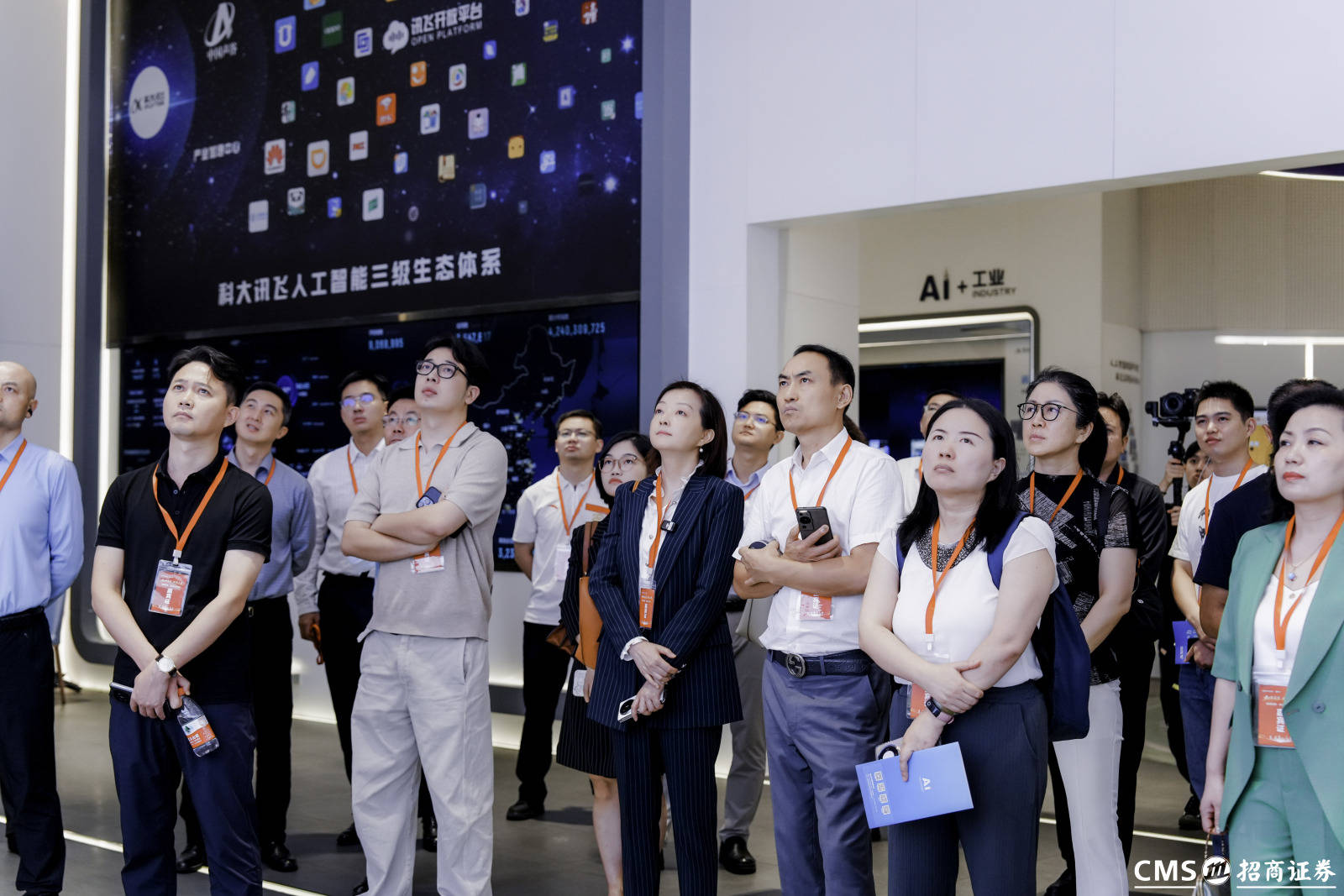
Core Insights - The Chinese capital market is transitioning from scale expansion to quality enhancement, with the "financial power" goal and new "National Nine Articles" providing direction for high-quality development in the industry [1] - Investor wealth management needs have evolved from traditional short-term returns to a focus on deep industry analysis and long-term value, emphasizing risk-controlled certainty and comprehensive service [1] - China Merchants Securities is launching the "Investing in China - Entering Listed Companies" service brand in 2025 to address information barriers through in-depth industry research, embodying the "buy-side advisory" concept and serving the real economy [1] Group 1 - The service brand will conduct nine in-depth industry research events to help investors understand the real pulse of Chinese industries based on data logic [1] - The focus areas include semiconductor sensors, pharmaceutical CDMO services, green energy in photovoltaics, AI, healthcare, optical communication, rare earth permanent magnets, and new materials [1] - The initiative aims to provide investors with insights into "Chinese manufacturing" and deliver investment guidance that combines depth and foresight [1] Group 2 - The series of activities features "on-site visits + industry decoding" to create a direct communication bridge between investors and quality listed companies [3] - Activities include senior analysts leading tours, in-depth dialogues with company executives, and on-site exploration of production operations, meeting clients' needs for industry insights [3] - This approach enhances the professional depth of client services and conveys the warmth of wealth management [3] Group 3 - The nine industry visits serve as an upgrade in investment understanding and an expansion of industry perspectives for investors [5] - Investors reported that engaging with production lines and management teams transformed their understanding from financial data to a comprehensive grasp of industry logic and application scenarios [5] - This experience strengthens their recognition of the value and structure of the industry chain, turning abstract trends into concrete frameworks [5] Group 4 - Each visit allows investors to combine data support with on-site insights, deepening their understanding of corporate long-term value and responsibility [9] - The initiative exemplifies the mission of connecting capital with real value and aligns with the brand's commitment to customer value and serving the real economy [9] - The "Investing in China - Entering Listed Companies" initiative will continue to develop in the coming year, enhancing wealth and high-net-worth client services while supporting the high-quality development of the real economy [9]

华为向宁德时代出售数字能源业务?双方均未正面回应
Nan Fang Du Shi Bao· 2026-01-29 12:13
Core Viewpoint - There are rumors regarding Huawei's digital energy business being sold, potentially to CATL and local state-owned enterprises, but no official confirmation has been provided [1][3][4] Group 1: Huawei's Digital Energy Business - Huawei's digital energy business is considered a key growth area, with projected revenue of 68.68 billion yuan in 2024, reflecting a 24.4% year-on-year increase [3] - The business has shown resilience against sanctions, maintaining a leading position in the global market for smart photovoltaic inverters for ten consecutive years [4] - Huawei has made significant investments in digital energy projects, including a 4 billion yuan investment in a headquarters for digital energy technology [4] Group 2: CATL's Strategic Needs - The rumors of CATL acquiring Huawei's digital energy business stem from its need to address competitive pressures in the energy storage industry and to fill gaps in its business model [7][9] - CATL holds a dominant position in the battery and energy cell market, with a 25% market share, but lacks a strong presence in the energy system integration sector [7] - The trend of "integrated solar and storage" is becoming crucial, and CATL risks falling behind if it does not enhance its system integration capabilities [8][9] Group 3: Market Dynamics - The energy storage market is experiencing rapid growth, with global energy storage cell shipments reaching 410.45 GWh in the first three quarters of 2025, a 98.5% increase [7] - Companies like Trina Solar and JinkoSolar are rapidly expanding their energy storage businesses, posing a challenge to current market leaders [8] - Huawei's digital energy business could provide CATL with the necessary technology and market access to enhance its competitive position in the integrated energy solutions market [9]

中来股份:总经理林建伟计划减持公司股份不超过约3269万股
Mei Ri Jing Ji Xin Wen· 2026-01-29 11:56
每经AI快讯,中来股份1月29日晚间发布公告称,持有苏州中来光伏新材股份有限公司股份约1.78亿股 (占公司总股本比例为16.36%)的股东、董事、总经理林建伟先生计划在本公告披露之日起15个交易 日后的3个月内,以集中竞价交易或大宗交易方式减持公司股份合计不超过约3269万股(占公司总股本 比例为3%)。 每经头条(nbdtoutiao)——水贝黄金平台"杰我睿"兑付危机调查:40倍杠杆对赌,金价越涨平台越 亏!老板自称"还在深圳",投资者:兑付方案本金打两折,无法接受 (记者 曾健辉) ...

中来股份:股东林建伟拟减持不超过3%
Xin Lang Cai Jing· 2026-01-29 11:56
中来股份公告,持股1.78亿股占16.36%的股东、董事兼总经理林建伟计划在公告披露之日起15个交易日 后的3个月内,通过集中竞价或大宗交易方式合计减持不超过3268.88万股,占3.00%。其中集中竞价减 持不超1089.63万股,占1.00%;大宗交易减持不超2179.25万股,占2.00%。减持所得资金将优先用于履 行其对公司私募基金投资本金差额补足承诺。 ...
上海首个乡村道路亮化光储充一体化项目开工 探索“道路+光伏”振兴新模式
Xin Hua Cai Jing· 2026-01-29 11:28
为助力地方发展,中农信投还将在当地成立供应链公司,助力乡村振兴,形成可持续的利益联结机制。 据介绍,乡村道路亮化光储充一体化项目的实施将带来多重效益:在财政层面,可节省乡镇路灯建设及 运营预算,为村集体增加稳定收入;在资源利用层面,通过对闲散土地资源的统一规划,实现乡村风貌 提升与环境品质改善;在技术层面,采用汇流后高压并网模式,有效解决区域容量不足问题,保障供电 稳定性;在生态层面,构建多能互补微电网系统,助力乡村"零碳"建设目标实现。 作为上海探索乡村能源转型与产业融合的重要实践,该项目通过资源活化、技术创新与模式创新的有机 结合,为乡村带来稳定收益的同时,构建了"生态得保护、集体得收益、村民得实惠"的共赢格局,为乡 村振兴提供可复制、可推广的实践样本。 新华财经上海1月29日电 记者从29日在上海浦东新区书院镇举行的"农村道路+光伏场景"现场观摩会上 获悉,上海市首个乡村道路亮化光储充一体化项目近日开工建设。该项目由中农信投(上海)供应链有 限公司主导投资,创新性地将乡村道路闲置资源与光伏能源开发相结合,通过"新能源+场景"融合模 式,为乡村振兴注入绿色动能,同步实现能源转型与民生改善双重目标。 据介绍 ...
漳州发展(000753.SZ):集中式光伏发电项目并网发电
Ge Long Hui A P P· 2026-01-29 11:25
格隆汇1月29日丨漳州发展(000753.SZ)公布,公司全资子公司福建漳发新能源投资有限公司投建的国昌 茂漳浦盐场100MW渔光互补光伏发电项目已于近日并网发电。该项目坐落于福建省漳州市漳浦县漳浦 盐场,类型为陆上渔光互补光伏电站。本项目的成功并网发电,进一步推动公司新能源产业发展战略落 地,有效积累集中式光伏项目建设与运营经验,持续夯实主业发展基础,助力公司加快新质生产力转型 升级步伐,不断增强核心竞争实力。 ...

海泰新能2025年净利预亏5.8亿—6.8亿元
Bei Jing Shang Bao· 2026-01-29 11:05
Core Viewpoint - The company, Haitai New Energy, is forecasting a significant loss for the year 2025, with expected net profit attributable to shareholders ranging from -680 million to -580 million yuan, compared to a profit of 182 million yuan in the previous year [1] Company Performance - The anticipated loss is attributed to ongoing supply-demand mismatches and intense low-price competition within the photovoltaic industry, leading to sustained low operating rates [1] - The company cites that despite a continued increase in global photovoltaic installations, the overall supply-demand imbalance has not significantly improved, resulting in low prices for photovoltaic components and subsequent operational losses during the reporting period [1] Industry Environment - The photovoltaic industry is facing a challenging operating environment due to deepening domestic electricity market reforms and increasing overseas trade barriers [1] - The competitive landscape remains severe, with companies struggling to maintain profitability amid these adverse conditions [1]
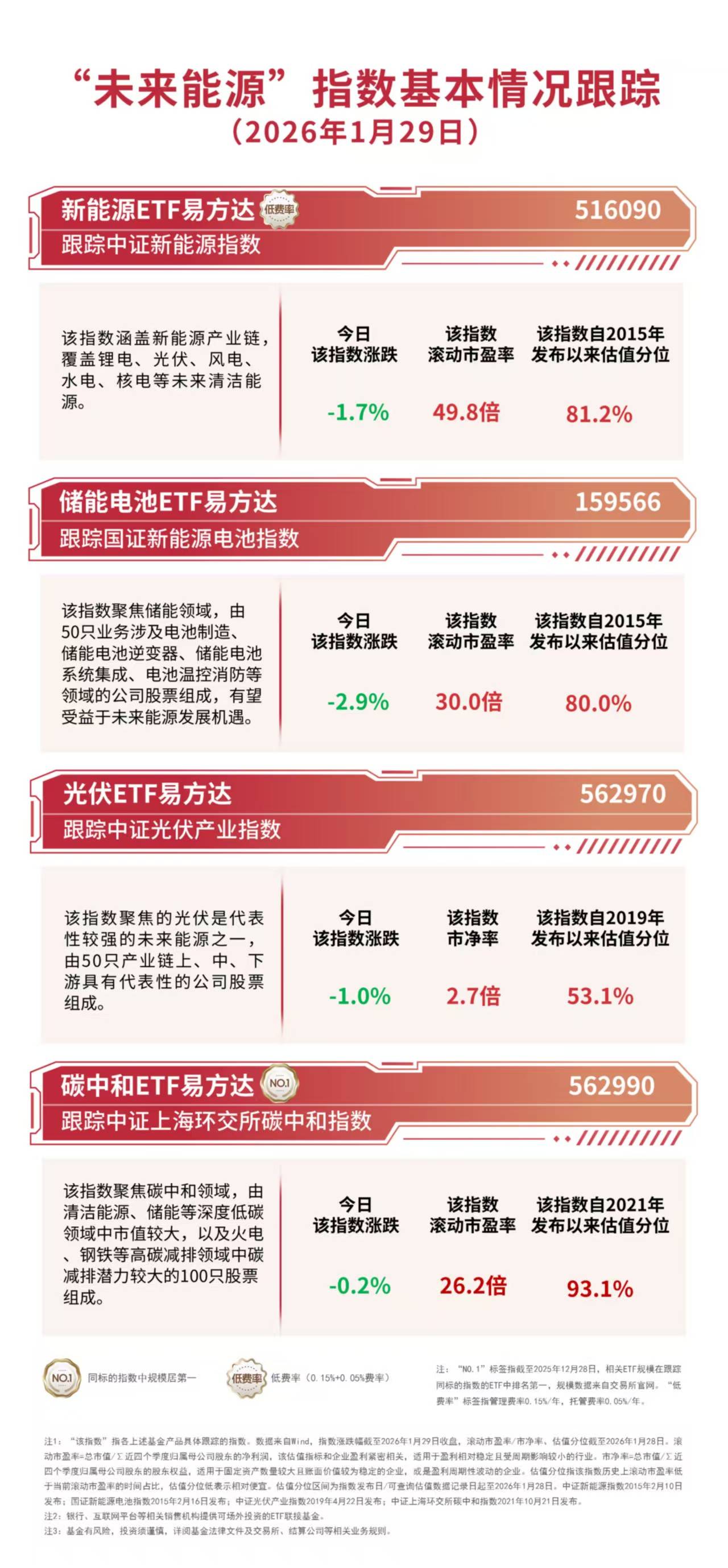
新能源板块集体回调,资金逆势加码,储能电池ETF易方达(159566)全天净申购近1亿份
Sou Hu Cai Jing· 2026-01-29 11:03
Group 1 - The core viewpoint of the article indicates a decline in various indices related to carbon neutrality and renewable energy, with the China Carbon Neutrality Index down by 0.2%, the China Photovoltaic Industry Index down by 1.0%, the China New Energy Index down by 1.7%, and the National New Energy Battery Index down by 2.9% [1] - Despite the decline in these indices, there is a notable increase in investment, as evidenced by the nearly 100 million net subscriptions to the E Fund Energy Storage Battery ETF (159566) throughout the day [1] - Huatai Securities emphasizes the importance of accelerating the construction of a new energy system during the 14th Five-Year Plan, focusing on the development of new energy storage and the construction of smart grids, which suggests a positive outlook for the renewable energy sector and the electrification rate [1] Group 2 - The article highlights that companies in the energy storage, wind power, and grid sectors are expected to continue benefiting from the ongoing developments in renewable energy [1]