半导体芯片

Search documents
美股半导体芯片股逆势拉涨
第一财经· 2025-11-14 15:06
编辑丨钉钉 11月14日,美股三大股指低开,半导体芯片股盘初逆势拉涨,截至发稿,闪迪涨4%,美光科技涨超 3%;英伟达股价一度转涨,此前跌超3%。 ...


半导体芯片股逆势拉涨,闪迪涨4%,英伟达接近转涨
Mei Ri Jing Ji Xin Wen· 2025-11-14 15:00
每经AI快讯,11月14日,半导体芯片股逆势拉涨,闪迪涨4%,美光科技涨超3%,英伟达接近转涨,此 前一度跌超3%。 (文章来源:每日经济新闻) ...


宏观策略周报:适度宽松的货币政策持续发力,十月份CPI同比由降转涨-20251114
Yuan Da Xin Xi· 2025-11-14 11:46
Investment Strategy Report Summary Core Insights - The report highlights the ongoing implementation of a moderately loose monetary policy, with October's CPI showing a year-on-year increase for the first time in several months, indicating a potential shift in inflation trends [1][2][11]. - The report emphasizes the importance of maintaining liquidity in the financial system, with significant increases in social financing and RMB loans, suggesting a supportive environment for economic growth [1][23][26]. News and Commentary - In October, the CPI rose by 0.2% month-on-month and 0.2% year-on-year, with core CPI increasing by 1.2%, marking the sixth consecutive month of growth [1][11]. - The PPI saw a month-on-month increase of 0.1%, the first rise this year, while the year-on-year decline narrowed to 2.1%, indicating improving supply-demand dynamics [1][15][16]. - The People's Bank of China (PBOC) reported a total social financing increase of 30.9 trillion yuan in the first ten months of 2025, which is 3.83 trillion yuan more than the same period last year [1][26][27]. - Real estate prices in major cities continued to decline, with new residential prices in first-tier cities dropping by 0.3% month-on-month and 0.8% year-on-year [1][31][32]. Market Overview - The domestic securities market showed mixed performance, with the Shanghai Composite Index experiencing a slight increase of 0.003%, while other indices like the ChiNext Index fell by 3.01% [2][36]. - Traditional industries are showing signs of recovery, while technology sectors are under pressure, reflecting a shift in market dynamics [2][34]. Investment Recommendations - **Technology Sector**: Companies focused on AI, semiconductor chips, robotics, and deep-sea technology are expected to benefit from the current policy direction aimed at fostering new productive forces [3][45]. - **Non-Banking Financials**: Brokerages may benefit from a slow bull market, while insurance companies could see improved returns on long-term assets [3][45]. - **Precious Metals**: Given the geopolitical tensions and economic uncertainties, demand for gold as a safe-haven asset is expected to grow [3][45]. - **Energy Storage**: The energy storage sector is projected to have significant growth potential driven by policy support [3][45]. - **Machinery**: With the recovery of manufacturing activities post-overseas interest rate cuts, sectors like construction machinery and heavy trucks are recommended for investment [3][46]. - **Domestic Demand**: There is a focus on boosting consumption to expand effective domestic demand, with expectations for increased consumer spending [3][47].
沪指创十年新高,短期预计仍有上冲空间,踏准板块轮动节奏
British Securities· 2025-11-14 01:43
Group 1 - The report indicates that the A-share market is currently stabilizing around the 4000-point mark, which is expected to build a solid foundation for future gains and potentially reach new highs within the year [1][4][8] - The Shanghai Composite Index successfully broke through the 4025-point level, marking a new high for both the year and the past decade, with significant gains observed in sectors such as energy metals, batteries, and power equipment [1][5][8] - The report highlights that the market is optimistic about upcoming economic policy meetings in December, which are anticipated to provide positive signals for growth, consumption, and technological innovation [1][9] Group 2 - The report notes that while the market is expected to continue its upward trend, there may be volatility and divergence between index highs and individual stock adjustments due to profit-taking and cautious sentiment from outside investors [2][9][10] - It emphasizes the importance of timing in sector rotation strategies, recommending a balanced allocation and opportunistic buying in sectors with strong performance indicators, including technology growth areas and cyclical industries [2][10] - The report identifies that the energy metals and new energy sectors are experiencing significant growth, driven by supportive policies and a shift in the business model of the storage industry towards self-sustainability [6][7]
港股收评:午后拉升!恒指涨0.56%站上27000点,阿里巴巴一度大涨6%
Ge Long Hui· 2025-11-13 08:21
受阿里消息助推,午后市场情绪被点燃!港股午后现快速拉升行情,三大指数均涨超1%,恒生科技指 数最高涨至1.5%,最终收涨0.8%,恒生指数、国企指数分别上涨0.56%及0.63%,恒指更是站上27000点 上方。 盘面上,大型科技股午后多数转涨,媒体报道已秘密启动"千问"项目,阿里巴巴一度冲高至6%,带领 一众科技股由跌转涨,网易、美团收盘小幅上涨;造纸行业涨价潮持续升温且力度加码,纸业股全天表 现强势;现货黄金突破4220美元,黄金股带领有色金属股走俏,存储涨价行情有望贯穿26年全年,半导 体芯片股午后多数转涨,龙头中芯国际涨超3%,生物医药股、航空股、汽车股、保险股多数表现活 跃。 另一方面,欧佩克警告全球原油市场转入结构性过剩,国际油价大跌,连续上涨的三桶油回调明显,煤 炭股、燃气股等能源板块走低。(格隆汇) ...

港股午评:恒指涨0.63%一度站上27000点大关,金融股活跃,工行农行再创新高
Ge Long Hui· 2025-11-12 04:04
Core Viewpoint - The Hong Kong stock market showed mixed performance in the morning session, with the Hang Seng Index rising by 0.63% and briefly surpassing the 27,000-point mark, driven by strong performances in financial stocks, particularly Agricultural Bank of China and Industrial and Commercial Bank of China reaching new historical highs [1] Group 1: Market Performance - The Hang Seng Index increased by 0.63% and reached above 27,000 points [1] - The Hang Seng Tech Index fell by 0.41%, indicating a decline in technology stocks [1] - The National Enterprises Index rose by 0.6%, with both indices previously rising by 1.2% during the session [1] Group 2: Sector Performance - Financial stocks, including major banks, contributed significantly to market strength, with Agricultural Bank of China and Industrial and Commercial Bank of China hitting new highs [1] - Other sectors such as oil, insurance, and state-owned enterprises also supported the market's resilience [1] - Conversely, solar energy and semiconductor stocks performed poorly, and spot gold prices fell below $4,120, leading to a decline in gold stocks [1]
港股恒指午间收涨0.61% 三桶油继续上涨 消费类股走势活跃
Ge Long Hui· 2025-11-10 04:11
Core Viewpoint - The Hong Kong stock market opened higher but experienced fluctuations, with the Hang Seng Technology Index initially dropping before closing slightly up by 0.12% [1]. Group 1: Market Indices - The Hang Seng Index and the Hang Seng China Enterprises Index rose by 0.61% and 0.84% respectively [1]. Group 2: Sector Performance - Large technology stocks showed mixed performance, with Tencent increasing by 1.66%, while Alibaba and Meituan saw slight gains; however, JD.com, Baidu, and Xiaomi declined [1]. - Domestic oil prices are expected to rise for the seventh time this year, leading to continued gains for the three major oil companies, with China Petroleum rising by 3% to reach a new high [1]. - Airline stocks performed strongly, and consumer stocks were active, with Pop Mart and Gu Ming both rising [1]. - Semiconductor stocks experienced significant declines, with leading company SMIC dropping over 3%, while Apple-related stocks, lithium battery stocks, and military stocks mostly remained sluggish [1].
必易微(688045):盈利能力持续修复 收购兴感强化产品布局
Xin Lang Cai Jing· 2025-11-09 12:38
Core Insights - The company reported a revenue of 461 million yuan for the first three quarters of 2025, a year-on-year decrease of 3.15%, while achieving a net profit attributable to shareholders of -3 million yuan, significantly reducing losses [1] - In Q3 2025, the company achieved a revenue of 179 million yuan, a year-on-year increase of 3.61% and a quarter-on-quarter increase of 12.13%, with a net profit attributable to shareholders of 6 million yuan, a year-on-year increase of 161.63% and a quarter-on-quarter increase of 39.46% [1] Revenue and Profitability - The most notable highlight of the quarter was the recovery in profitability, with a gross margin exceeding 30%, an increase of over 5 percentage points year-on-year, directly driving the net profit attributable to shareholders into positive territory and achieving profitability for two consecutive quarters [2] - Despite a decline in revenue year-on-year, the gross profit amount increased by over 15% in the first three quarters, supported by a simultaneous optimization of expenses, including a 12.83% year-on-year decrease in R&D expenses [2] Strategic Acquisition - The acquisition of Xinggan Semiconductor, a leading global supplier of high-performance sensor chips, aims to build a comprehensive system-level solution capability [3] - Xinggan Semiconductor possesses independent intellectual property and rich technical reserves in sensor devices, high-precision mixed-signal processing, and sensor packaging, serving downstream sectors such as new energy equipment, automotive terminals, and industrial automation [3] - Post-acquisition, the company will form a complete product system from current detection, motion sensing to power management, battery management, and motor drive, significantly enhancing product portfolio competitiveness [3] Investment Outlook - Revenue projections for 2025-2027 are estimated at 738 million, 909 million, and 1.121 billion yuan, respectively, with net profits attributable to shareholders of 15 million, 42 million, and 70 million yuan [4] - Corresponding EPS is projected at 0.22, 0.60, and 1.00, with PE ratios of 188.06, 68.81, and 40.92x, maintaining a "buy" rating [4]

资讯日报:港股市场做多情绪回稳-20251107
Guoxin Securities Hongkong· 2025-11-07 08:52
Market Overview - The Hong Kong stock market showed a recovery in bullish sentiment, with the Hang Seng Technology Index rising by 2.74% and the Hang Seng Index increasing by 2.12%[9] - Southbound capital net inflow into Hong Kong stocks reached HKD 5.479 billion[9] Sector Performance - Technology stocks collectively surged, with Alibaba up over 4% and JD.com up over 3%[9] - Financial heavyweight stocks, including insurance and Chinese banks, also contributed to the market's rise[9] - Aluminum sector stocks led gains in the non-ferrous metals sector, with China Aluminum rising over 11%[9] U.S. Market Performance - Major U.S. indices closed lower, with the Nasdaq down 1.9%, S&P 500 down 1.12%, and Dow Jones down 0.84%[9] - Large tech stocks experienced declines, with Nvidia and Tesla both dropping over 3%[9] Notable Stock Movements - New stock Wangshan Wangshui debuted with a 145.73% increase on its first trading day[9] - Semiconductor stocks remained strong, with SMIC rising over 7% amid expectations of continued price increases in the fourth quarter[9] Economic Indicators - U.S. employers announced 153,074 layoffs in October, marking a 175% increase compared to the previous year[13] - The Bank of England maintained interest rates at 4%, indicating potential for future rate cuts[13]
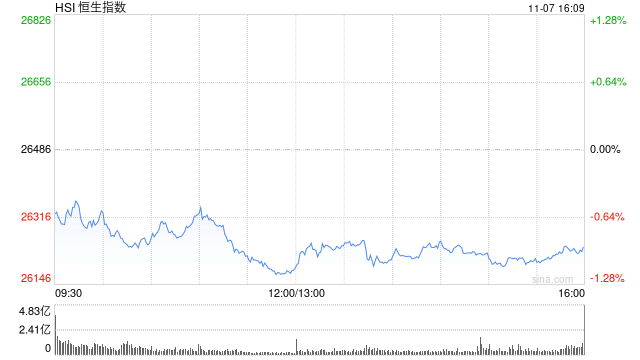
港股收评:指数全天低迷!恒指跌0.92%,科技半导体普跌,光伏股逆势大涨,福莱特玻璃涨9%,中芯国际跌2%,阿里巴巴、小米集团跌近3%
Ge Long Hui· 2025-11-07 08:37
Group 1 - Major technology stocks experienced a downturn, with Kuaishou dropping nearly 6%, Alibaba and Xiaomi down nearly 3%, and JD.com falling over 2% [2] - Semiconductor, Apple-related, biopharmaceutical, and automotive sectors also saw declines, with notable drops in stocks like SMIC (down about 2%) and Q Technology (down 5.6%) [2] - Various sectors including education, wind power, dairy, heavy machinery, Chinese brokerage firms, and domestic real estate stocks also faced declines [2] Group 2 - The polysilicon industry is showing signs of a turning point, with solar energy stocks like Longi Green Energy performing strongly, and Flat Glass rising nearly 9% [2] - UBS indicated that the fundamental demand remains strong, with expectations for prices to return to $4,200 within the year [2] - Gold stocks continue to lead the rise in the non-ferrous metal sector, while oil stocks remain active, with China National Offshore Oil Corporation hitting a new high [2] Group 3 - The Hong Kong stock market opened lower and maintained a weak performance throughout the day, with the Hang Seng Index closing down 0.92% at 26,241 points, the Hang Seng China Enterprises Index down 0.94% at 9,267 points, and the Hang Seng Tech Index down 1.8% at 5,837 points [3]