基建

Search documents
2026年上半年期A股投资策略报告:方兴未艾,逐光而行-20251126
Dongguan Securities· 2025-11-26 09:14
Group 1 - The A-share market experienced a strong upward trend in 2025, with the Shanghai Composite Index reaching 4000 points, driven by domestic policies and a rebound in the technology sector [6][15]. - The market is expected to continue its recovery in the first half of 2026, supported by improved economic fundamentals and favorable policies, despite potential short-term volatility [6][22]. - The report emphasizes the importance of strategic optimism and suggests investors focus on structural opportunities aligned with policy guidance and performance trends [6][6]. Group 2 - The report outlines three main investment themes for 2026: 1) High dividend assets with low valuations and stable earnings, particularly in sectors like finance, non-ferrous metals, public utilities, and transportation [6]. 2) Technology-driven sectors that align with the "14th Five-Year Plan," focusing on domestic substitution and innovation in areas such as semiconductors and AI [6]. 3) Domestic demand expansion, highlighting sectors like food and beverage, automotive, home appliances, and pharmaceuticals that benefit from strong domestic market strategies [6][6]. Group 3 - The report recommends overweighting sectors such as non-ferrous metals, TMT (Technology, Media, and Telecommunications), finance, power equipment, food and beverage, and machinery [6][6]. - It suggests a benchmark allocation for sectors like agriculture, automotive, transportation, public utilities, and defense [6][6].
宏观日报:中游开工分化-20251126
Hua Tai Qi Huo· 2025-11-26 03:09
1. Report Industry Investment Rating No relevant information provided. 2. Core View of the Report The report provides an overview of mid - and macro - level events and industry trends, including production and service industries, as well as upstream, mid - stream, and downstream sectors [1][2][3]. 3. Summary by Related Catalogs Mid - and Macro - Level Events - **Production Industry**: The National Space Administration issued an action plan for the high - quality and safe development of commercial space from 2025 - 2027, aiming to achieve significant development in the industry by 2027 [1]. - **Service Industry**: Seven双创Artificial Intelligence ETFs will be issued on November 28, focusing on AI leaders in the Sci - tech Innovation Board and ChiNext, bringing incremental funds to high - tech [1]. Upstream Industry - **Agriculture**: Palm oil prices dropped by nearly 5% [1]. - **Chemical Industry**: Urea prices rebounded [1]. - **Energy Industry**: International crude oil and liquefied natural gas prices fluctuated downward [1]. Mid - stream Industry - **Chemical Industry**: PX operating rate increased, while PTA operating rate declined [2]. - **Energy Industry**: Coal consumption in power plants increased [2]. - **Infrastructure Industry**: Asphalt production was in the off - season [2]. Downstream Industry - **Real Estate**: The sales of commercial housing in second - and third - tier cities declined seasonally [3]. - **Service Industry**: The number of domestic flights decreased slightly [3]. Key Industry Price Index Tracking - **Agriculture**: On November 25, the spot price of palm oil was 8392 yuan/ton, down 4.85% year - on - year; the spot price of corn was 2201.4 yuan/ton, up 0.72% [34]. - **Non - ferrous Metals**: On November 25, the spot price of copper was 86603.3 yuan/ton, up 0.68% year - on - year; the spot price of aluminum was 21373.3 yuan/ton, down 0.47% [34]. - **Black Metals**: On November 25, the spot price of iron ore was 808.2 yuan/ton, up 0.51% year - on - year; the spot price of wire rod was 3337.5 yuan/ton, up 0.53% [34]. - **Energy**: On November 25, the spot price of WTI crude oil was 58.8 dollars/barrel, down 1.79% year - on - year; the spot price of liquefied natural gas was 4108 yuan/ton, down 1.77% [34]. - **Chemical Industry**: On November 25, the spot price of PTA was 4651.7 yuan/ton, up 0.49% year - on - year; the spot price of urea was 1655 yuan/ton, up 1.53% [34]. - **Real Estate**: On November 25, the building materials composite index was 114.4 points, up 0.55% year - on - year; the national concrete price index was 90.5 points, down 0.33% [34].
建筑装饰行业周报(20251117-20251123):\高切低\,积极关注低位基建和地产链-20251125
Hua Yuan Zheng Quan· 2025-11-25 05:15
Investment Rating - The investment rating for the construction decoration industry is "Positive" (maintained) [2] Core Viewpoints - The overall market has weakened, with the Shanghai Composite Index down 3.9% and the ChiNext Index down 6.15%. This adjustment is likely influenced by multiple factors, including delayed expectations for US interest rate cuts, increased volatility in US stocks, and rising geopolitical uncertainties. As the year-end approaches, a "high-cut low" tendency may emerge in the market, where technology sectors may see profit-taking while the construction sector, with its counter-cyclical attributes and low valuations, becomes more attractive for allocation [3][10] - The report suggests focusing on construction companies with stable dividends and low valuations, regional construction firms with project advantages, and companies in the decoration sector that may benefit from policy improvements [4][11] Summary by Sections Market Performance - The Shanghai Composite Index fell 3.90%, the Shenzhen Component Index fell 5.13%, and the ChiNext Index fell 6.15%. The construction decoration index dropped 6.11%, with all sub-sectors declining. Among individual stocks, 8 stocks in the construction sector rose, with the top five performers being Zhengzhong Design (+14.14%), Shanghai Port (+11.83%), and others [5][16] Infrastructure Data Tracking - Special bonds issued this week amounted to 1176.39 billion, with a cumulative issuance of 72,311.75 billion, up 25.14% year-on-year. City investment bonds issued this week totaled 618.90 billion, with a net financing amount of 129.13 billion, resulting in a cumulative net financing amount of -5,407.40 billion [6][20][21] Company Dynamics - Notable new contracts signed by major companies include China Power Construction with new orders of 9579.79 billion, China Nuclear Engineering with new contracts of 1238.40 billion, and China Chemical with new orders of 3126.70 billion. Other companies also reported significant contract wins [14]
【11月25日 财经信息差 】行业机会与风险预警全解析
Sou Hu Cai Jing· 2025-11-25 02:19
Group 1 - The Ministry of Industry and Information Technology of China has initiated the creation of national emerging industry development demonstration bases, covering nine major fields including new generation information technology and new energy, with a target of establishing 100 park-type and 1,000 enterprise-type bases by 2035, which will receive policy and resource support [2] - The Federal Reserve officials have signaled a potential interest rate cut in December, with an 82.9% probability of a 25 basis point cut according to CME FedWatch, leading to a 2.69% increase in the Nasdaq and a broad rise in technology stocks [2] - Former President Trump signed an executive order for the AI "Genesis Plan," opening federal scientific data sets, while Amazon plans to invest $50 billion to expand AI and supercomputing infrastructure for the U.S. government, benefiting AI-related companies [2] Group 2 - The European Union has approved a budget of €192.8 billion for 2026, focusing on defense and high-end manufacturing, with €716 million reserved for emergency funds, which will create procurement opportunities for related industries [3] - The Bank of Israel has lowered the benchmark interest rate from 4.5% to 4.25%, allowing businesses in the Middle East to optimize their capital allocation [3] Group 3 - The Nasdaq Golden Dragon China Index rose by 2.82%, with Hesai Technology increasing by over 12%, indicating strong capital interest in Chinese tech companies like Baidu and Alibaba, which will benefit their supply chain partners [4] - Spot gold has surpassed $4,140 per ounce, and WTI crude oil has risen above $59 per barrel, providing profit opportunities for energy and precious metals companies [4] Group 4 - The European Central Bank has warned about the risks of stablecoins diverting retail deposits in the Eurozone, urging companies involved in crypto assets to manage compliance costs [5] - The U.S. pressured the EU to amend digital regulations in exchange for lowering steel and aluminum tariffs, which was rejected, creating tariff volatility risks for related import-export businesses [6] - Bitcoin has surpassed $89,000, and Thailand's Bitkub plans to raise $200 million through a Hong Kong IPO in 2026, highlighting opportunities in the Hong Kong digital asset hub [6]


钢材需求变化跟踪:产业供需双弱,驱动或来自宏观
Guo Tai Jun An Qi Huo· 2025-11-24 12:35
1. Report Industry Investment Rating - Not provided in the given content 2. Core Viewpoints of the Report - The steel industry is currently in a situation of weak supply and demand, and its driving force may come from the macro - level.权益表现偏好,短期政策刺激概率有限,中长期需要需求端发力以保证经济走出通缩螺旋 [1][3][7] 3. Summary by Related Catalogs 3.1总量矛盾 3.1.1 权益表现与政策刺激 - The equity performance is favorable, and the probability of short - term policy stimulus is limited [5] 3.1.2 资金供给 - In March 2025, the scale of ultra - long - term special sovereign bonds was 1.3 trillion yuan (300 billion yuan was for debt roll - over and 500 billion yuan was for supplementing bank capital). On May 20, 2025, the loan prime rate (LPR) was lowered for the first time this year, with the 1 - year LPR dropping from 3.1% to 3.0% and the over - 5 - year LPR dropping from 3.6% to 3.5%. On May 15, 2025, the deposit reserve ratio of financial institutions was lowered by 0.5 percentage points (excluding those already implementing a 5% deposit reserve ratio), and the deposit reserve ratio of auto finance companies and financial leasing companies was lowered by 5 percentage points [11] 3.1.3 资金需求 - Data on new social financing scale, new RMB loans, and other aspects are presented to show the situation of capital demand [13][14] 3.2 地产 3.2.1 销售 - The real estate market is not stable, housing prices are falling, and the decline in new home transactions is expanding. The growth rate of spot - home sales has slowed down, and the growth rate of unsold housing area has also slowed down [18][22][26] 3.2.2 新开工与土地成交 - The decline in new construction starts has expanded [27][28] 3.3 基建 3.3.1 投资增速 - The "anti - involution" policy restricts supply, and the growth rate of infrastructure investment has declined [29][30] 3.3.2 资金 - Traditional funds include public fiscal expenditure, government - funded expenditure, and special bonds. Emerging funds come from quasi - fiscal policies, such as the 1 - trillion - yuan ultra - long - term special treasury bonds in 2024 for "two - major" construction and the 1.3 - trillion - yuan ultra - long - term special sovereign bonds in March 2025 [31][33][36] 3.3.3 项目 - Data on the PMI of the construction industry and the investment amount of major project starts are presented [38][39] 3.4 制造业 3.4.1 投资与利润 - The "anti - involution" policy restricts supply, the growth rate of manufacturing investment has declined, and industrial profits have expanded [40] 3.4.2 相关指标 - Data on power generation, coal consumption, freight volume, and price differences are presented [43][44][45] 3.4.3 主要工业品产销 - Production and sales data of major industrial products such as automobiles, white goods, and excavators are presented [47][48] 3.4.4 生产企业订单和销售 - Data on the planned and actual production of home appliances and their domestic sales are presented [50] 3.4.5 家电产销数据 - The home appliance industry operates on a production - based - on - sales model. Structural factors include domestic sales and exports, and leading indicators include real estate completion and US housing sales [55] 3.4.6 汽车产销数据 - The automobile industry operates on a production - based - on - sales model. Structural factors include different types of vehicle production and sales, and leading indicators are enterprise orders from micro - level research [63] 3.4.7 机械产销数据 - The machinery industry operates on a production - based - on - sales model. The export proportion of sub - categories is increasing year by year, and leading indicators are enterprise orders from micro - level research [71] 3.4.8 船舶产销数据 - The shipbuilding industry is driven by economic growth, manufacturing capacity changes in the long - term, supply - demand pattern and renewal cycle in the medium - term, and transportation efficiency in the short - term. Currently, shipyards have abundant orders on hand and new orders are growing rapidly [76] 3.5 钢材直接出口 - Exports are price - driven, with production scheduling leading by about one month and port departure being synchronous. High - frequency data such as port departure volume and price differences are presented [77][81][83] 3.6 钢材需求 - Demand has entered the off - season, and the industrial chain has shifted to a pattern of weak supply and demand. Data on apparent consumption, spot transactions, and price difference structures are presented [86][95][97]
连板股追踪丨A股今日共79只个股涨停 中水渔业7连板
Di Yi Cai Jing· 2025-11-24 07:34
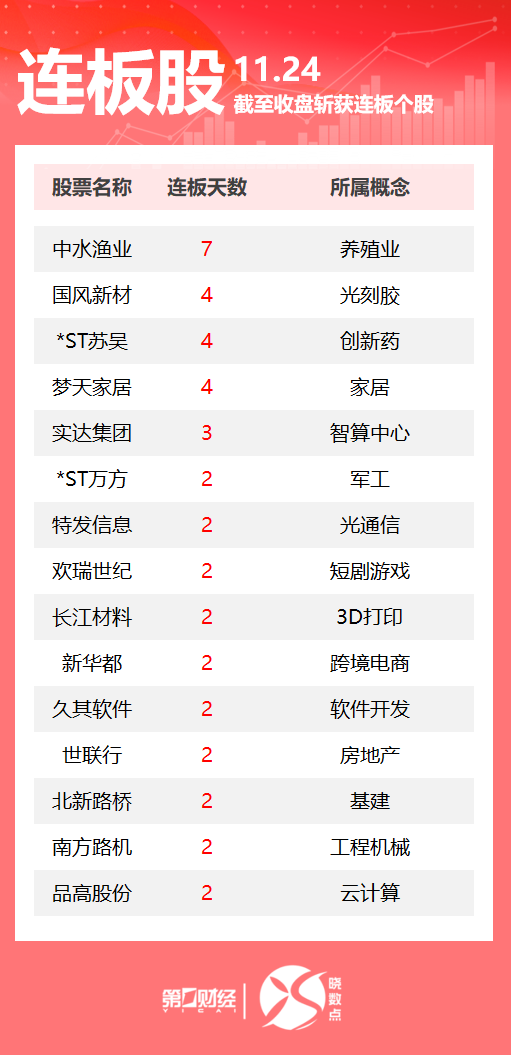
Core Insights - The A-share market saw a total of 79 stocks hitting the daily limit up on November 24, with notable performances in various sectors, particularly aquaculture, photolithography, and 3D printing [1][2]. Group 1: Stock Performance - Guofeng New Materials achieved a four-day consecutive limit up in the photolithography sector [1][2]. - Changjiang Materials, associated with 3D printing, recorded a two-day consecutive limit up [1][2]. - The aquaculture sector, specifically Shuiyu Industry, experienced a remarkable seven-day consecutive limit up [1][2]. Group 2: Conceptual Breakdown of Stocks - The following stocks have notable consecutive limit up days: - Sansi Mingchu: 7 days, related to aquaculture [2]. - Guofeng New Materials: 4 days, related to photolithography [2]. - *ST Suwu: 4 days, related to innovative pharmaceuticals [2]. - Meng Tian Home: 4 days, related to home furnishings [2]. - Shida Group: 3 days, related to intelligent computing centers [2]. - Other stocks with 2 days of consecutive limit up include *ST Wanfang (automotive), Te Fa Information (optical communication), and Changjiang Materials (3D printing) [2].

如何理解中观数据“温差”?
Sou Hu Cai Jing· 2025-11-24 00:35
Group 1 - Recent macroeconomic data has shown weakness, particularly in urban fixed asset investment growth, which dropped from 2.8% in the first half of the year to -6.5% in Q3 and -12.2% in October, while export growth also decelerated significantly to -1.1% in October [2][8] - Despite the decline in some macro indicators, mid-level data, especially industrial product shipment volumes and price indicators, have remained stable or improved, indicating that corporate capital expenditures have not significantly slowed down, and cash flow continues to improve [2][8] Group 2 - The weakness in macroeconomic data may be attributed to high base effects and changes in statistical methodologies, which have impacted the perception of overall demand stability [3][25] - The decline in fixed asset investment may also be influenced by changes in statistical reporting and project reporting cycles, which could exaggerate actual fluctuations [3][26] Group 3 - New policy financial tools have yet to fully demonstrate their impact on social financing and infrastructure investment, with 500 billion yuan allocated by the end of October, but social financing and infrastructure investment remain weak [4][31] - Overall, excluding special disturbances, investment and consumption trends outside the real estate sector are likely to remain stable, with price changes indicating a steady demand trend [5][39] Group 4 - The end-of-year fiscal spending is crucial for stabilizing growth in Q4 and potentially for a strong start in the following year, with expectations for real estate-related policy adjustments to support demand and expectations [5][41] - The impact of deleveraging in the real estate sector on credit cycles and corporate cash flow is marginally easing, with signs of stabilization in transaction volumes for second-hand housing [5][42]

开工率普遍回落——每周经济观察第46期
一瑜中的· 2025-11-23 15:56
Core Viewpoint - The article discusses the current economic trends in China, highlighting both upward and downward movements in various sectors, including real estate, consumer goods, and infrastructure, while also addressing the implications for investment opportunities and risks. Group 1: Economic Activity - The WEI index has shown a low recovery, reaching 5.43% as of November 16, 2025, up from 4.83% the previous week, indicating a slight improvement in economic activity [2][9] - Since the end of September 2025, the WEI index has generally declined, primarily driven by decreases in infrastructure, domestic demand, and industrial production [9][10] Group 2: Demand Trends - Retail sales of passenger cars have continued to decline, with a year-on-year decrease of 14% as of November 16, 2025, compared to a growth of 5.8% in October [3][15] - In the real estate sector, the decline in residential sales has narrowed, with a year-on-year decrease of 21% in the third week of November across 67 cities [3][13] Group 3: Production Insights - Infrastructure data shows a continued decline, with cement shipment rates at 33.4% in the second week of November, unchanged from the previous week but down from 36.4% year-on-year [3][17] - The operating rate of asphalt plants has also decreased to 25%, down 4.2 percentage points from the previous week and 7.7 percentage points from the same week last year [3][17] Group 4: Trade and Export - Container throughput at Chinese ports has marginally declined, with a week-on-week decrease of 5.4% as of November 16, 2025 [3][27] - The number of vessels departing from major ports has shown a slight rebound but remains lower year-on-year, indicating ongoing challenges in trade [3][28] Group 5: Price Movements - Domestic and international commodity prices have generally decreased, with the South China index down 1.8% and the RJ/CRB commodity price index down 2.2% [3][42] - Agricultural product prices have also fallen, with pork prices down 0.8% and vegetable prices down 0.7% [3][45] Group 6: Interest Rates and Debt - The issuance of new local government bonds has accelerated, with 224 billion yuan issued in the week of November 24, 2025, including 215.3 billion yuan in special bonds [3][49] - The yields on government bonds have remained stable, with the one-year, five-year, and ten-year yields reported at 1.4008%, 1.5907%, and 1.8166%, respectively [3][64]

宏观经济周报:增长换引擎,财富换赛道-20251123
Guoxin Securities· 2025-11-23 05:12
Economic Outlook - The goal for GDP per capita by 2035 is set at $29,000, necessitating a shift in China's economic logic from solely pursuing GDP growth to a new paradigm focusing on productivity enhancement, moderate inflation, and currency appreciation[1] - The new growth paradigm emphasizes the importance of nominal GDP growth and inflation levels, which directly impacts corporate profitability and capital returns[1] Market Dynamics - The equity market is positioned for a systematic revaluation, supported by three main factors: profit foundation, valuation environment, and relative returns[1] - The expectation of RMB appreciation is a significant driver for valuation improvements, enhancing the attractiveness of RMB assets and drawing global capital to Chinese assets[2] Asset Allocation Trends - There is a notable shift in asset preference from real estate and bonds to equities, driven by the changing yield characteristics of various asset classes in a moderate inflation environment[2] - Bonds, while still a stabilizing component, are expected to see diminishing capital gains potential, while real estate is facing downward pressure due to income and price expectations[2] Consumption and Production Insights - Recent data indicates a recovery in consumption, with metro passenger flow increasing by 5.9% year-on-year and logistics delivery volume rising by 5.8%[12] - Production shows structural improvement, particularly in real estate-related sectors, with a narrowing decline in rebar production and a continued decrease in inventory levels[14] Trade and External Factors - Port cargo throughput has decreased to 266 million tons, reflecting a structural adjustment in external demand, while the export container freight index has risen to 1094.03 points[25] - Geopolitical tensions, particularly with Japan, have introduced new uncertainties into the external trade environment, impacting market sentiment[25] Fiscal and Monetary Policy - The broad deficit for the week ending November 23 reached 204.3 billion, with a cumulative total of 11.2 trillion, indicating a slower pace compared to the previous year[35] - The monetary market remains in a loose state, with indicators suggesting continued low interest rates and a high willingness to leverage in the bond market[44]
沙特砸钱美国,马斯克抢滩,藏着对华算计
Sou Hu Cai Jing· 2025-11-21 23:50
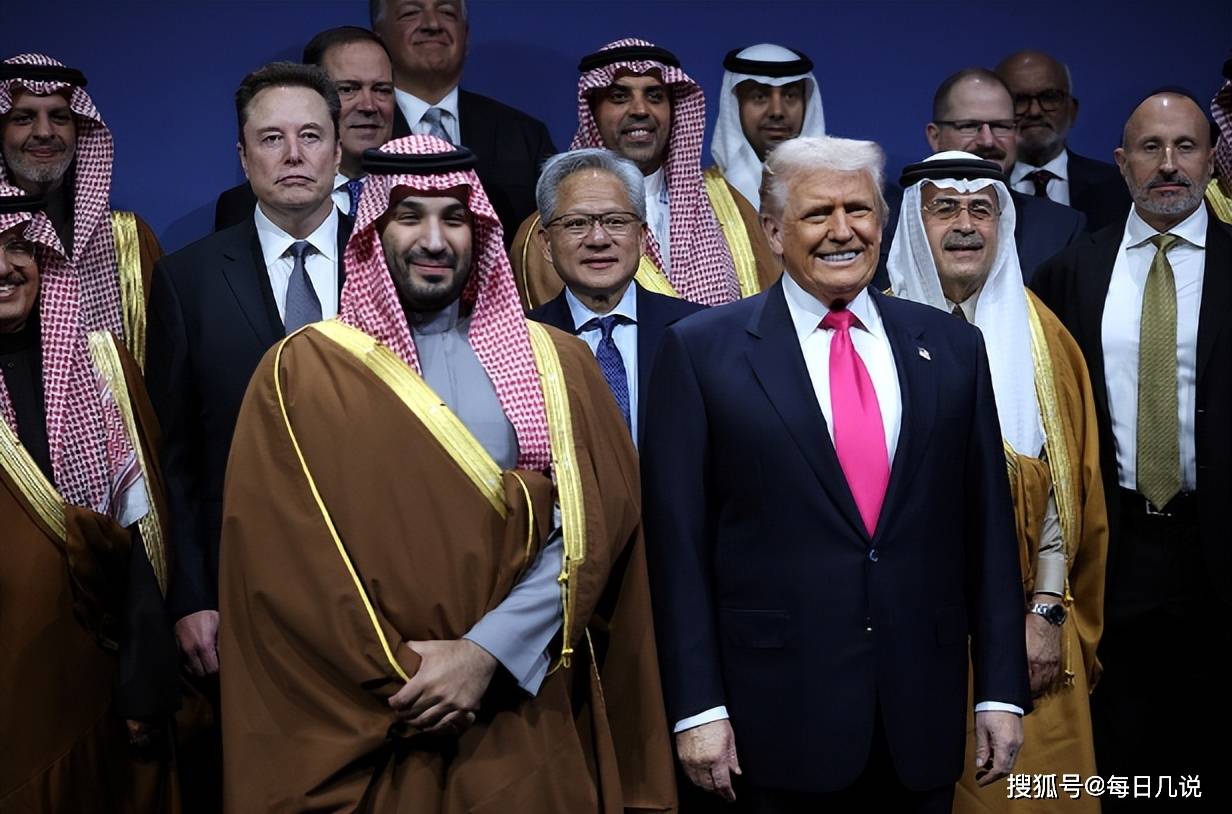
Core Insights - Saudi Arabia has announced a $1 trillion investment in the U.S., with significant involvement from tech giants like Tesla and Nvidia, indicating a strategic alignment with the U.S. while pursuing its own "Vision 2030" goals [1][3][7] Investment and Economic Cooperation - Of the $1 trillion investment, $300 billion is allocated for U.S. shale oil technology upgrades and $200 billion for military procurement, reflecting a continuation of the longstanding U.S.-Saudi alliance [3] - Saudi Arabia is China's largest crude oil supplier, with imports expected to reach 78.639 million tons in 2024, accounting for over 12% of China's total imports, and a bilateral trade exceeding $107.5 billion [3] Digital Economy and Technological Competition - The establishment of data centers by Tesla and AI computing bases by Nvidia in Saudi Arabia poses a competitive threat to Chinese firms like Huawei and Alibaba Cloud, which have already invested in 5G and smart city projects in the region [3][10] - China's digital infrastructure exports to Saudi Arabia are projected to exceed $8 billion in 2024, highlighting the competitive landscape in the Middle East's digital transformation [3] Strategic Maneuvering - Saudi Crown Prince Mohammed bin Salman is employing a dual strategy, engaging both the U.S. for military protection and China for infrastructure development, to enhance Saudi Arabia's industrial capabilities [7][10] - The recent signing of a currency swap agreement between the central banks of China and Saudi Arabia, increasing the amount to 50 billion yuan, indicates China's proactive approach to maintain economic ties [10] International Reactions - The U.S. is positioned as a beneficiary of Saudi investments, with President Biden referring to Saudi Arabia as a "strategic partner" and supporting its entry into BRICS, while also selling advanced military systems [11] - The EU is portrayed as an anxious observer, lacking the military support of the U.S. and the infrastructure capabilities of China, leading to a preference for collaboration with China on digital infrastructure standards [11] Challenges and Risks - Concerns arise from the potential impact of Saudi Arabia's technology partnerships on its energy exports and pricing strategies, particularly regarding the U.S. shale oil industry [11][12] - The operational feasibility of foreign tech projects in Saudi Arabia may face challenges due to reliance on Chinese technology for stable power supply and energy needs [12]