跨境支付

Search documents
A股跨境支付概念股午后走低,四方精创、中油资本跌超5%,宇信科技跌超4%,新国都、青岛金王、长亮科技跟跌。
news flash· 2025-07-21 05:08
A股跨境支付概念股午后走低,四方精创、中油资本跌超5%,宇信科技跌超4%,新国都、青岛金王、 长亮科技跟跌。 ...

帮主郑重:上午这波基建狂潮,藏着下半年最实在的赚钱机会
Sou Hu Cai Jing· 2025-07-21 04:48
Group 1 - The market showed a slight increase with the Shanghai Composite Index rising less than half a point, while the Shenzhen Component and ChiNext also saw minor gains, indicating a more active trading atmosphere compared to the previous week [1][3] - Infrastructure-related sectors, including cement, steel, and hydropower, experienced significant gains, with stocks like Tibet Tianlu and China Power Construction hitting the daily limit, driven by the announcement of key projects for the second half of the year [3] - The performance of these sectors is directly linked to project commencement, suggesting that companies in these areas are likely to report solid earnings in the upcoming mid-year reports [3] Group 2 - There was a noticeable shift in funds towards safer investments with tangible performance, moving away from speculative stocks that rely solely on concepts [4] - The banking sector showed weakness, with stocks like Qilu Bank and Xiamen Bank declining, likely due to the lack of a reduction in the Loan Prime Rate (LPR) [3] - For long-term investors, focusing on sectors with reasonable valuations and existing orders, such as regional cement leaders or infrastructure support equipment manufacturers, presents a better opportunity during market pullbacks [3][4]

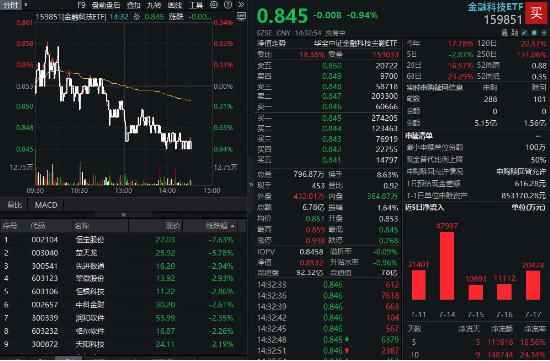
热门高标领跌超7%,金融科技ETF午后跌近1%,资金大手笔加仓!159851实时净申购超3.5亿份
Xin Lang Ji Jin· 2025-07-18 06:40
Group 1 - The core viewpoint of the news highlights the volatility in the fintech sector, particularly in stablecoins and cross-border payments, with significant declines in several stocks [1][3] - The financial technology ETF (159851) experienced a slight adjustment, with a near 1% drop in price, but saw substantial net subscriptions of 350 million shares, indicating strong investor interest [1][3] - Recent reports suggest that the technology innovation theme remains a growth focus, with an emphasis on fintech, particularly in the context of stablecoins and RWA (Real World Assets) [3] Group 2 - The stablecoin industry is expanding due to the legalization in Hong Kong, benefiting RWA issuers, consulting/technical service providers, and cross-border payment companies [3] - The financial technology ETF (159851) has a significant scale of over 7 billion yuan and an average daily trading volume exceeding 550 million yuan over the past six months, showcasing its liquidity advantage [3] - The market is increasingly focused on the Q2 performance of listed companies, particularly in the internet finance sector, which is expected to release performance potential in a bullish market [3]
政策破冰+万亿赛道启幕:稳定币概念的“长坡厚雪”才刚开始?
Sou Hu Cai Jing· 2025-07-17 14:09
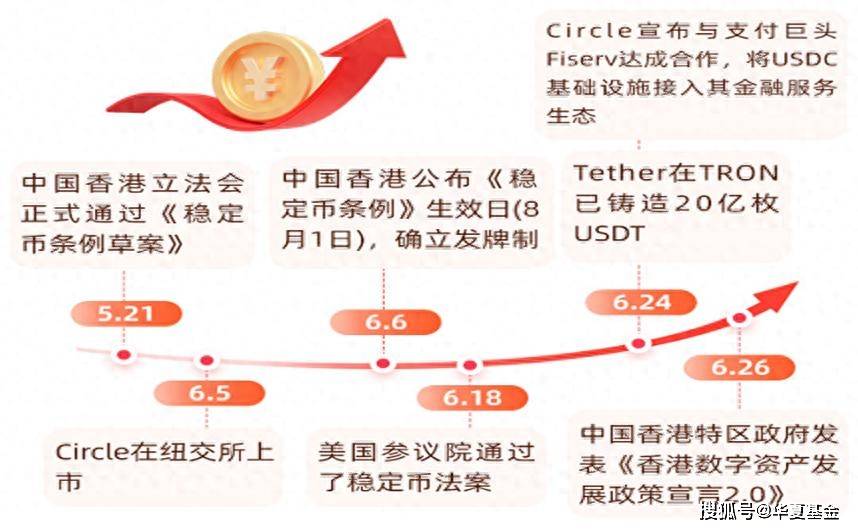
Core Insights - The global stablecoin market has surpassed $250 billion, with projections estimating it could reach $3.7 trillion by 2030, driven by regulatory support and increasing adoption in digital economies [1][9] - Stablecoins are distinct from cryptocurrencies like Bitcoin, serving primarily as payment tools rather than investment assets, and are pegged to real-world assets such as fiat currencies [1][3] Regulatory Developments - The passage of the U.S. GENIUS Act and Hong Kong's Stablecoin Regulation marks a significant milestone, providing regulatory clarity and legitimacy to stablecoins, which enhances market confidence [3][9] - These regulations are expected to facilitate the long-term development of stablecoins, allowing for innovation while establishing compliance frameworks [5][9] Market Dynamics - Stablecoins address traditional financial pain points by linking fiat currencies with virtual currencies, thus streamlining transactions and reducing costs [6][7] - The inherent characteristics of stablecoins, such as lower transaction costs and higher efficiency, make them suitable for cross-border payments, potentially transforming the cross-border settlement landscape [7][8] Future Outlook - The anticipated growth in stablecoin issuance is supported by optimistic forecasts from financial institutions, with Standard Chartered predicting a $2 trillion issuance by 2028 and Citibank suggesting a market cap of $3.7 trillion by 2030 [9] - Companies in fintech, cross-border payments, and blockchain technology are expected to benefit from the rise of stablecoins, as they align with the ongoing digital economy trends [9][10]
【明日主题前瞻】全球首个!我国提出的《电力储能用超级电容器》国际标准成功立项
Xin Lang Cai Jing· 2025-07-17 12:51
Group 1: Energy Storage and Capacitors - The international standard for supercapacitors in energy storage, proposed by China, has been successfully established with support from countries like Germany, Japan, and Finland, marking a significant milestone in the industry [1] - The global installed capacity of supercapacitors for energy storage has surpassed 1GW and is expected to reach between 5GW and 10GW by 2030, indicating a clear industry trend [1] - Dongyang Sunshine focuses on the innovation and development of electronic materials, including supercapacitors, with a production capacity of approximately 1.4 billion capacitors annually [2] Group 2: Automotive Industry and Tesla - Tesla has introduced a six-seat version of the Model Y, with analysts optimistic about the core Tier 1 suppliers in the supply chain despite competitive pressures in the domestic market [3] - Tesla aims to reduce production costs of the Model Y by at least 20% by 2026, while also planning a special six-seat version for the Chinese market [3] - Wuzhou Xinchun supplies high-end bearing components to leading manufacturers, including those in the electric vehicle sector, showcasing the interconnectedness of the automotive supply chain [4] Group 3: Pharmaceutical Industry - China National Pharmaceutical has agreed to acquire a 95.09% stake in Lixin Pharmaceutical for up to $950 million, enhancing its position in the innovative drug development sector [6] - The acquisition is expected to bolster the capabilities of China National Pharmaceutical, which is recognized for its efficient R&D team and valuable innovation pipeline [6] - The pharmaceutical sector is witnessing significant advancements in AI-driven drug development, which could accelerate growth and improve valuations for related companies [6] Group 4: Cross-Border Payment Systems - The cross-border payment system has expanded to 17 banks in Hong Kong, enhancing the connectivity between mainland China and Hong Kong for instant payment services [7] - The stablecoin market is experiencing rapid growth, with transaction volumes projected to exceed $27.6 trillion in 2024, surpassing traditional payment systems like Visa and Mastercard [7] - Companies like Kela Software and Yuxin Technology are actively involved in building cross-border payment systems for domestic and international clients, indicating a robust market for payment solutions [8] Group 5: Robotics and Automation - The world's first bipedal robot specialized for cultural and tourism applications has been launched, showcasing advancements in robotics technology [9] - The bipedal robot is set to perform at the 2025 Chengdu World Games, highlighting the growing interest and investment in humanoid robotics [9] - Companies like Xiasha Precision and Double Forest Co. are developing components for humanoid robots, indicating a burgeoning market for robotics applications [10] Group 6: Carbon Fiber Industry - The carbon fiber market in China is projected to reach approximately 17.14 billion yuan in 2024, with an 8.16% year-on-year growth in production [11] - The price of T300-grade carbon fiber has decreased by 70%, making it more accessible for various industries, including aerospace and automotive [11] - Companies like Zhongjian Technology and Jilin Chemical Fiber are enhancing their carbon fiber product offerings, capitalizing on the growing demand in high-end applications [12] Group 7: Solar Energy Industry - The photovoltaic industry is experiencing a recovery phase, driven by policies aimed at high-quality development and a shift away from previous "involution" challenges [13] - Companies like Tongwei Co. and China National Electric are expanding their solar project capacities, with significant orders and production capabilities in place [13] - The collaboration between industry players and government initiatives is expected to foster growth and innovation in the solar energy sector [13]

亚洲领先的稳定币支付及嵌入式金融服务平台鲲KUN 完成 A 轮融资,融资额超过5000万美元
3 6 Ke· 2025-07-17 03:22
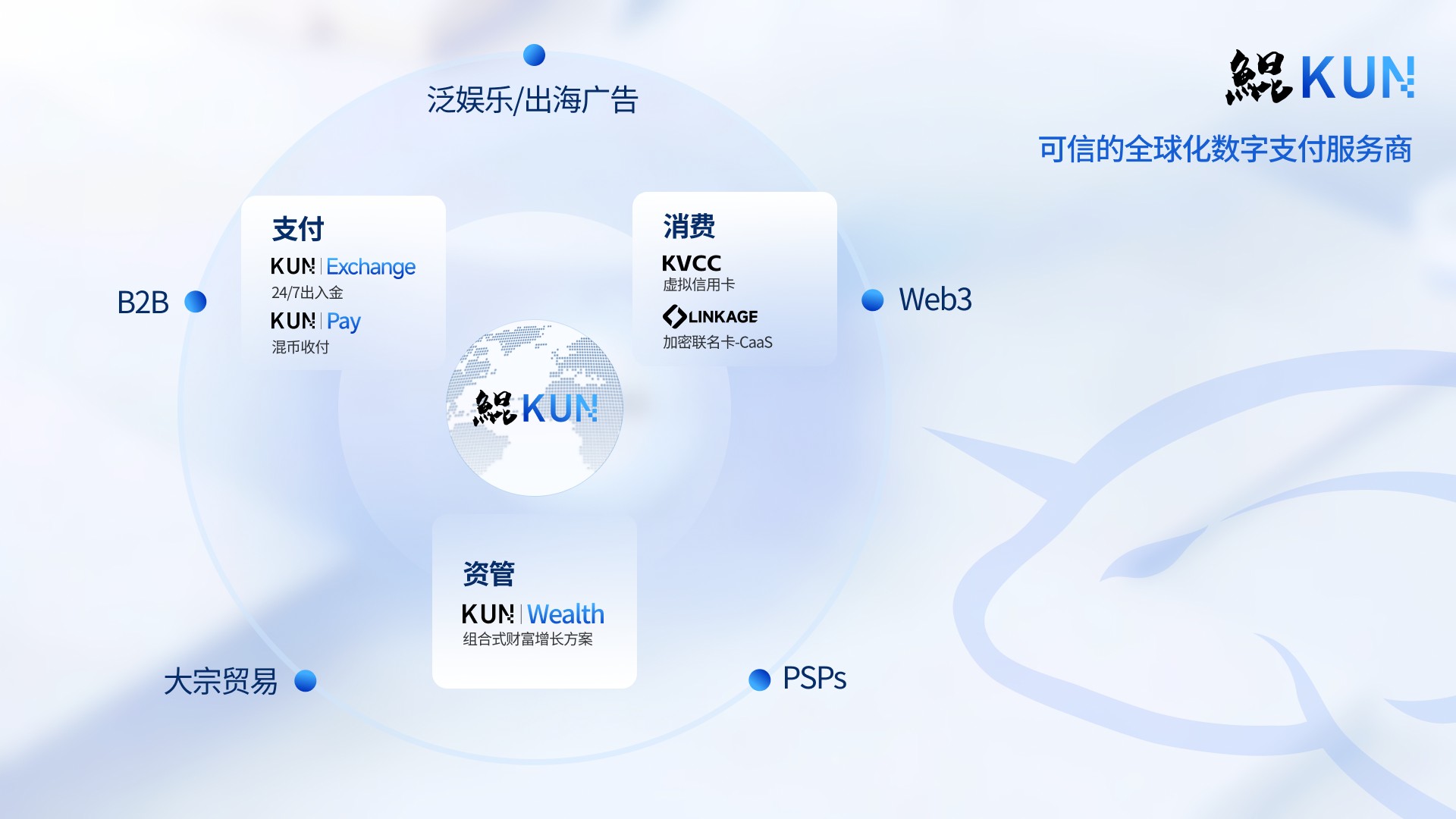
Core Insights - KUN, a leading global stablecoin payment and embedded financial services platform in Asia, announced the completion of its Series A funding round, significantly oversubscribed, with total funding exceeding $50 million since its inception 20 months ago [1][5] - The funding signifies KUN's ongoing breakthroughs in building a global stablecoin cross-border payment network and financial infrastructure, aiming to assist real enterprises in achieving efficient, secure, and compliant globalization [1][4] - KUN has experienced rapid growth, with an average monthly transaction growth rate exceeding 200% over the past 12 months, serving thousands of enterprise and institutional clients [1][4] Company Developments - KUN has established strategic partnerships, including a memorandum of understanding with TradeGo to develop a comprehensive trading service solution for bulk trade, focusing on blockchain electronic bill of lading technology and stablecoin settlement networks [1][3] - The company plans to leverage the recent funding to enhance technology development, particularly in cross-border transaction security, blockchain infrastructure, and compliance capabilities [4][5] - KUN aims to build a one-stop digital payment network that integrates Web2 and Web3 technologies, while expanding its global team and strengthening its core talent [4][5] Industry Trends - The collaboration with Eternium Global aims to create a diversified Web3 payment system, targeting high-growth markets in Latin America, the Middle East, and Africa [3] - There is a growing consensus on the potential of stablecoins to replace traditional systems like SWIFT in cross-border payments, with KUN positioned as a leader in this transition [3][4] - The integration of stablecoins in cross-border transactions is seen as a key infrastructure for the globalization of enterprises, particularly in emerging economies [4]
稳定币-全面重视B端跨境支付结算体系重构机会
2025-07-16 06:13
Summary of Conference Call Notes Industry Overview - The discussion revolves around the **cross-border payment industry** and the potential of **stablecoins** to reshape this sector, which is valued in the trillions [1][2][9]. Key Points and Arguments 1. **Opportunities in Cross-Border Payments**: The cross-border payment sector presents significant opportunities, especially for large enterprises and state-owned enterprises, as stablecoins are expected to play a crucial role in this transformation [1][2]. 2. **Stablecoins vs. Traditional Payment Systems**: Stablecoins are positioned to disrupt traditional payment systems, such as banks and SWIFT, by offering lower fees and faster transaction times [11][12]. 3. **Ecosystem Development**: The profitability in the stablecoin industry will likely concentrate among a few key players who can establish a robust ecosystem and achieve high transaction volumes [4][9]. 4. **Collaboration with Large Enterprises**: There is a strong interest in partnerships with large state-owned enterprises, although challenges exist in establishing direct communication and collaboration due to regulatory constraints [5][6]. 5. **Market Trends**: The stablecoin market is still in its early stages, with significant growth potential driven by the increasing demand for cross-border payment solutions [1][9]. 6. **Investment Recommendations**: Companies like **Pulin Software** and **Changliang Technology** are highlighted as key players in providing payment and treasury management systems for multinational corporations, which could benefit from the adoption of stablecoins [9][18]. 7. **Regulatory Environment**: The regulatory landscape in Hong Kong is seen as more favorable for stablecoin operations compared to mainland China, which could facilitate the growth of this market [6][17]. 8. **Diverse Application Scenarios**: The application scenarios for stablecoins are expected to expand, with participation from various players ranging from small businesses to large multinational corporations [19]. Additional Important Content - **Focus on Liquidity**: The success of stablecoins as a payment tool hinges on their liquidity and the ability to find suitable application scenarios [10]. - **Technological Infrastructure**: The development of payment interfaces and treasury management systems is crucial for integrating stablecoins into existing financial frameworks [14][15]. - **Cross-Border Trade Demand**: There is a growing demand for cross-border payment services among small and micro enterprises, which presents additional opportunities for service providers in this space [12][19]. This summary encapsulates the key insights and trends discussed in the conference call, emphasizing the transformative potential of stablecoins in the cross-border payment industry and the strategic positioning of certain companies within this evolving landscape.
海外稳定币与RWA的来龙去脉
2025-07-16 00:55
Summary of Key Points from the Conference Call Industry Overview - The stablecoin trading volume in 2023 has approached that of traditional payment platforms, with a total trading volume of $35.5 trillion over the past 12 months, and $7.4 trillion when excluding high-frequency trading, significantly surpassing PayPal's $1.68 trillion and nearing Mastercard's $9.8 trillion, indicating its substantial potential in payment settlements [1][3] Core Insights and Arguments - Global stablecoin regulation is diverging, with the U.S. favoring strict regulations to reinforce the dollar's dominance, requiring stablecoin reserves to be held at a 1:1 ratio in U.S. dollar deposits or short-term U.S. Treasury securities, while Hong Kong adopts a more open regulatory approach, allowing the issuance of stablecoins backed by HKD or other currencies [1][6] - Hong Kong is actively promoting the synergy between stablecoins and Real World Assets (RWA), particularly in cross-border payments, where stablecoins can significantly reduce costs to less than $1 per transaction, compared to the global average of 6% for cross-border remittances, thus providing an efficient and low-cost solution [1][7] - The total market size of RWA has exceeded $23 billion, with platforms like Propety facilitating over $4 billion in real estate transactions, and Center Fusion converting receivables into tradable tokens [1][10] - The rise of RWA is driven by the need to address trust and efficiency issues in traditional asset transactions, utilizing reliable data and computation to enable real-time asset status updates and automated execution of returns [2][9] Regulatory Developments - The global regulatory landscape for stablecoins is evolving, with the U.S. pushing for legislation that mandates a 1:1 reserve ratio for stablecoin issuance, while Hong Kong's new regulations, effective August 1, 2025, allow for the issuance of stablecoins backed by various currencies with high reserve standards [6][12] Opportunities and Applications - The development of stablecoins and RWA presents opportunities for issuers, virtual asset trading platforms, and infrastructure service providers. Companies like Circle Internet may see revenue growth through expanded business lines and compliance services, while platforms like Coinbase Global will benefit from increased market scale and profitability [4][16] - Stablecoins are primarily used for currency trading and decentralized finance but are also expanding into payments, transfers, and liquidity management [5] Hong Kong's Initiatives - Hong Kong has been proactive in the digital asset space, launching the "Digital Asset Development Policy Declaration 2.0" and implementing the "Stablecoin Ordinance" to attract institutional participation in HKD stablecoin projects [4][12] - The government is also exploring the issuance of tokenized government bonds and encouraging innovative applications, such as tokenizing traditional financial products and enhancing liquidity in the digital currency ecosystem [13][14] Recent Progress - As of April 2024, three fund companies have launched spot Bitcoin and Ethereum ETFs on the Hong Kong Stock Exchange, showcasing significant advancements in RWA development [15] Conclusion - The interplay between stablecoins and RWA is set to create substantial opportunities in the financial landscape, with potential benefits for various stakeholders involved in the ecosystem [11][16]
中企出海如何构建“能力矩阵”
经济观察报· 2025-07-15 10:29
Core Viewpoint - The article emphasizes that Chinese companies are entering a new wave of globalization, facing both opportunities and challenges. The key to success lies in capability building, long-term strategic focus, and leveraging existing advantages to achieve higher goals and global capabilities [2][37]. Existing Advantages - Chinese companies currently possess strong advantages in technological innovation, large-scale manufacturing, and supply chain organization, which are crucial for transforming these strengths into core competitiveness in international markets [4]. - In emerging fields like new energy and artificial intelligence, Chinese companies have reached a leading global position. For instance, BYD's blade battery technology and DJI's drone control systems are benchmarks in their respective markets [5]. - The speed of technological iteration is vital for maintaining competitive advantage. Companies like Huawei and CATL are heavily investing in R&D to ensure continuous innovation and market leadership [6][8]. High-Level Goals - Chinese companies need to invest in brand value, standard-setting, and industry influence to gradually move upstream in the value chain and lead the future direction of industries globally [10]. - The ultimate goal for Chinese companies should be to build globally recognized and reputable brands, moving from OEM reliance to establishing their own brand identities [11][12]. - Mastering technical standards is essential for controlling industry ecosystems and value chain distribution. The case of Chinese electric vehicles in Indonesia illustrates the importance of aligning with local standards to avoid competitive disadvantages [13][14]. Global Capabilities - Compliance capability, cross-cultural management, and understanding international dynamics are essential elements for Chinese companies throughout their globalization process [21]. - Initially, companies may struggle with compliance due to a lack of understanding of local laws and regulations. As they mature, they must develop a comprehensive compliance system to manage risks effectively [22][24]. - Cross-cultural management is crucial for building trust and integrating local practices. Companies should focus on cultural sensitivity and flexible management to navigate cultural differences [27][28]. - Understanding international dynamics is vital for risk management. Companies need to establish local information networks and resilient supply chains to mitigate geopolitical risks [29][30]. Conclusion - The essence of globalization for Chinese companies is a race between capability evolution and environmental complexity. Companies must maintain a long-term perspective and continuously enhance their global capabilities to thrive in the new era of globalization [35][37].

东吴证券晨会纪要-20250715
Soochow Securities· 2025-07-14 23:30
Macro Strategy - The "Great Beautiful Act" has been quickly implemented, but its distribution effects and the tightening fiscal impact from excluding extended and expanded tax cuts limit its growth stimulus for the US economy [1][24] - The act's characteristic of "increasing deficits first, reducing deficits later" implies a risk of a "fiscal cliff" around 2028 [1][24] - In the short term, concerns about the impact of US Treasury issuance on market liquidity and yield premiums are not excessive; however, the long-term path dependency of unsustainable US government debt makes it difficult for Treasury yield premiums to decrease [1][24] Fixed Income - The "stock-bond seesaw" effect is evident as the stock market stabilizes, influencing bond yields; the 10-year government bond yield rose from 1.641% to 1.666% during the week [3][5] - The bond market's reaction to Trump's threats of additional tariffs on BRICS countries was muted, indicating a limited impact on bond yields [3][5] - The bond yield's upward trend is expected to continue, influenced by stock market performance, but the extent of the increase is likely to be limited [5] Industry Insights - Wanda Film's diversified layout in esports and concert live streaming is expected to create new growth points, with net profit forecasts for 2025-2027 at 1.0 billion, 1.24 billion, and 1.44 billion yuan, respectively [8] - Lianlian Digital is projected to achieve a reasonable P/S valuation of 8.0x and 7.0x for 2025 and 2026, respectively, as it continues to expand its business [10] - Youyou Foods has revised its profit forecast upwards, expecting net profits of 232 million, 285 million, and 329 million yuan for 2025-2027, reflecting a growth rate of 47.2%, 23.2%, and 15.3% [11] - Siyi Electric's net profit for the first half of 2025 is expected to be 1.293 billion yuan, a year-on-year increase of 46%, driven by strong overseas orders [14][15] - The energy sector, represented by Furan Energy, anticipates stable growth in natural gas supply and a steady increase in new energy business, with net profit forecasts of 872 million, 922 million, and 976 million yuan for 2025-2027 [12] - The lithium battery sector, represented by Weilan Lithium Core, has revised its profit expectations upwards, forecasting net profits of 750 million, 1 billion, and 1.31 billion yuan for 2025-2027, reflecting significant growth [13] - The pharmaceutical sector, represented by Lianbang Pharmaceutical, is expected to see revenue growth driven by innovative drug development, with net profits projected at 3.11 billion, 3.10 billion, and 3.38 billion yuan for 2025-2027 [21]