
采矿业

Search documents
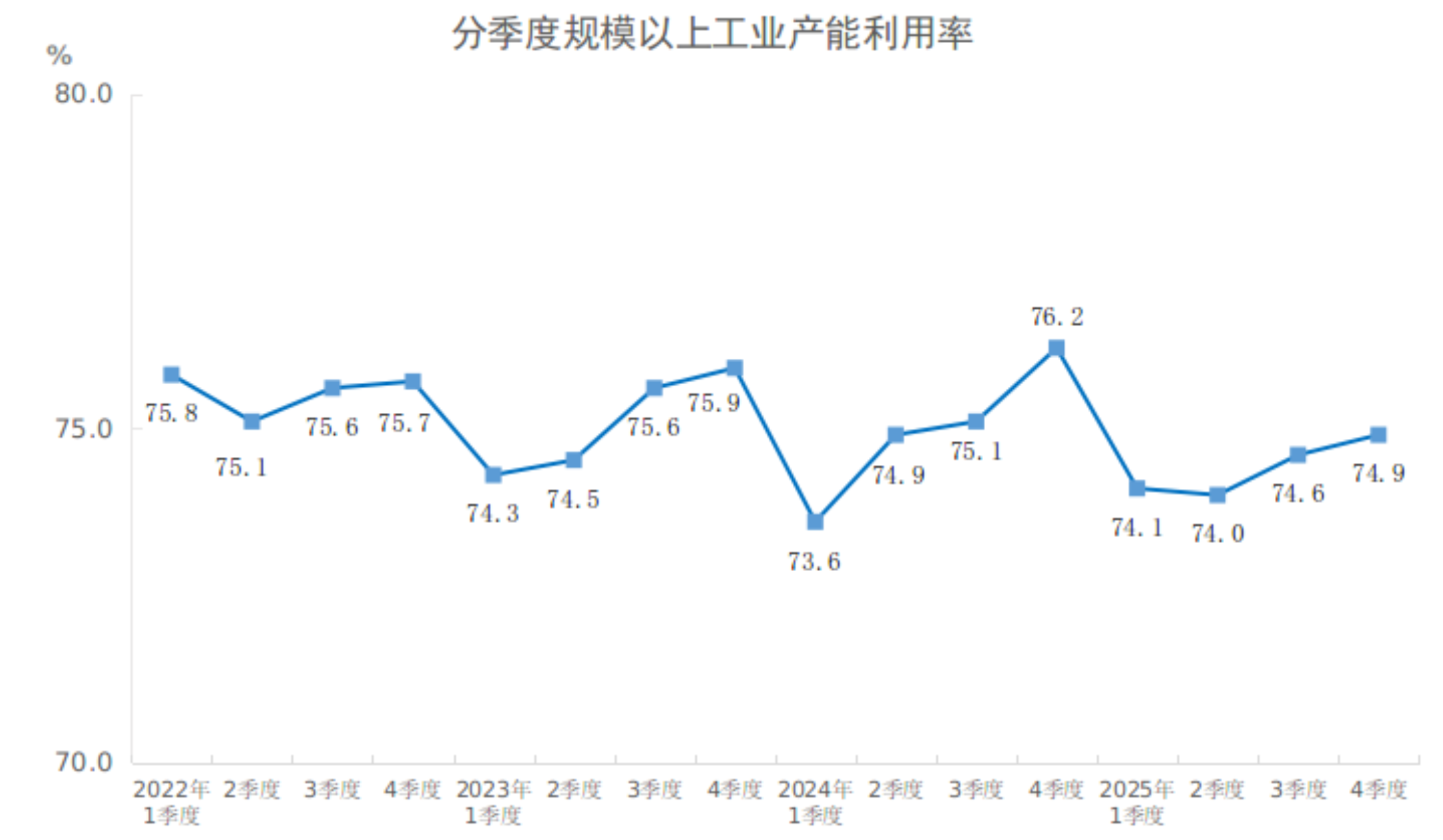
2025年四季度全国规模以上工业产能利用率为74.9%
Guo Jia Tong Ji Ju· 2026-01-19 02:01
Core Viewpoint - The national industrial capacity utilization rate for large-scale industries in Q4 2025 is reported at 74.9%, showing a 0.3 percentage point increase from Q3 but a 1.3 percentage point decrease compared to the same period last year [1][4]. Group 1: Overall Industrial Capacity Utilization - The overall industrial capacity utilization rate for the entire year of 2025 is 74.4%, which is a decrease of 0.6 percentage points from the previous year [6]. - The Q4 capacity utilization rate reflects a mixed performance across different sectors, with some industries experiencing significant declines [6]. Group 2: Sector-Specific Capacity Utilization - In Q4 2025, the mining industry has a capacity utilization rate of 71.7%, down by 3.9 percentage points year-on-year [6]. - The manufacturing sector's capacity utilization rate stands at 75.2%, a decrease of 1.2 percentage points from the previous year [6]. - The electricity, heat, gas, and water production and supply sector shows a capacity utilization rate of 74.0%, down by 0.8 percentage points year-on-year [6]. Group 3: Detailed Industry Breakdown - Coal mining and washing industry has a capacity utilization rate of 69.1%, down by 4.8 percentage points year-on-year [6]. - The food manufacturing industry reports a capacity utilization rate of 68.5%, a decrease of 2.2 percentage points from the previous year [6]. - The textile industry has a capacity utilization rate of 77.1%, down by 1.7 percentage points year-on-year [6]. - The chemical raw materials and products manufacturing industry shows a capacity utilization rate of 74.1%, down by 2.3 percentage points [6]. - The black metal smelting and rolling industry has a capacity utilization rate of 78.5%, with a slight increase of 0.4 percentage points year-on-year [6]. - The automotive manufacturing industry reports a capacity utilization rate of 76.0%, down by 1.2 percentage points from the previous year [6]. - The computer, communication, and other electronic equipment manufacturing industry has a capacity utilization rate of 79.7%, showing a slight increase of 0.3 percentage points year-on-year [6].

2025年全国固定资产投资基本情况
Guo Jia Tong Ji Ju· 2026-01-19 02:01
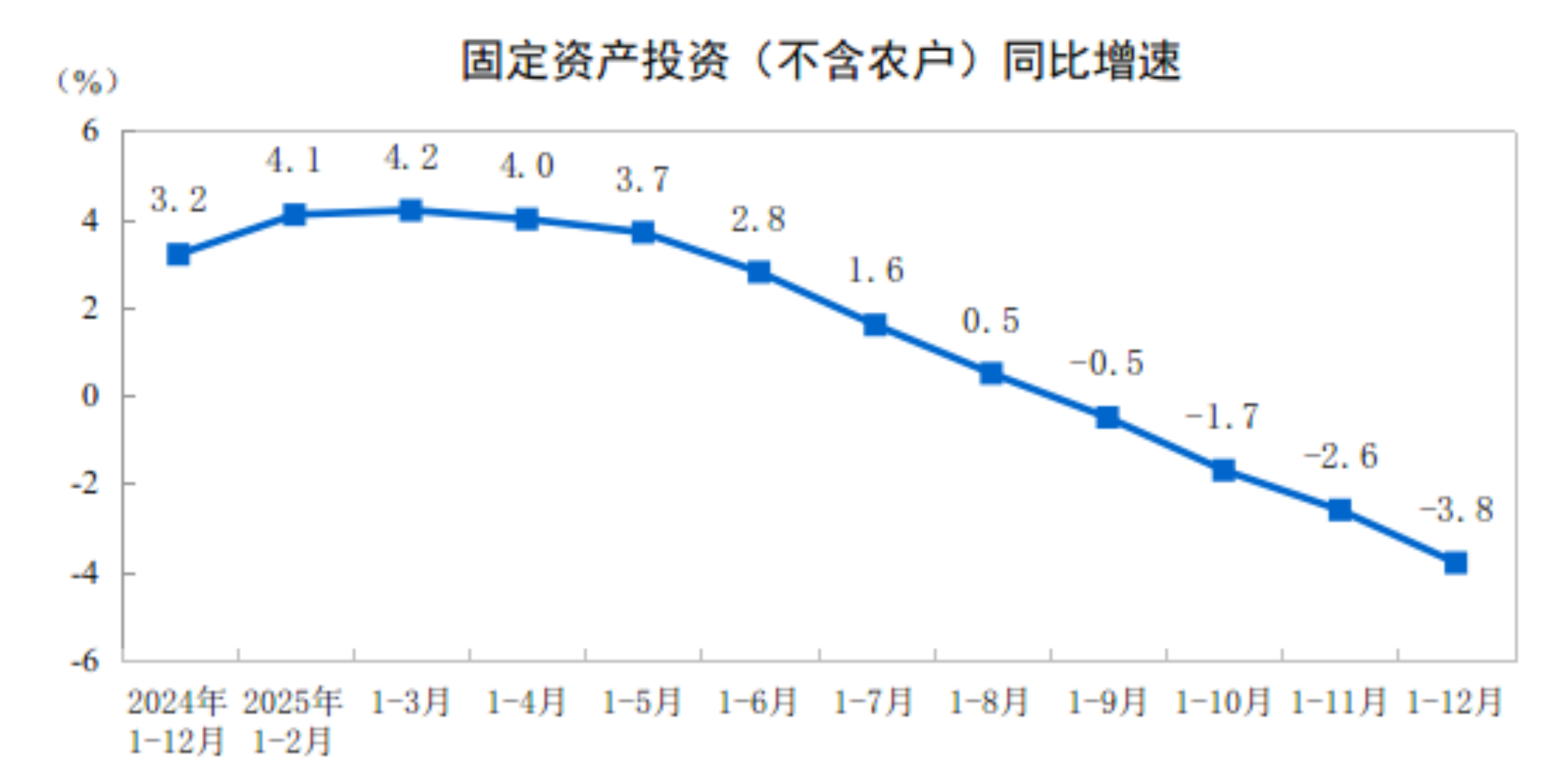
Core Insights - In 2025, China's fixed asset investment (excluding rural households) reached 48,518.6 billion yuan, a decrease of 3.8% compared to the previous year, with private fixed asset investment declining by 6.4% [1][6] Investment by Industry - Investment in the primary industry was 957 billion yuan, showing a growth of 2.3% year-on-year [3] - Investment in the secondary industry totaled 177,368 billion yuan, with a growth of 2.5% [3] - The tertiary industry saw a decline in investment, amounting to 298,248 billion yuan, down by 7.4% [3] Secondary Industry Breakdown - Within the secondary industry, industrial investment grew by 2.6% year-on-year [4] - Mining investment increased by 2.5%, while manufacturing investment grew by 0.6% [4] - Investment in the electricity, heat, gas, and water production and supply industry rose significantly by 9.1% [4] Infrastructure and Regional Investment - Infrastructure investment (excluding electricity, heat, gas, and water production and supply) decreased by 2.2% [4] - Investment in pipeline transportation surged by 36.0%, while multimodal transport and logistics saw a growth of 22.9% [4] - Investment trends varied by region, with the eastern region experiencing an 8.4% decline, the central region down by 2.7%, the western region down by 1.3%, and the northeastern region down by 15.5% [4] Investment by Registration Type - Domestic enterprises' fixed asset investment fell by 3.8%, while investment from Hong Kong, Macau, and Taiwan enterprises decreased by 2.2% [5] - Foreign enterprises saw a significant decline in fixed asset investment, down by 13.8% [5]
出口延续高增长,结构性降息政策出台
Hua Lian Qi Huo· 2026-01-18 13:32
1. Report's Investment Rating for the Industry - No investment rating for the industry is provided in the report. 2. Core Viewpoints of the Report - In December 2025, China's exports continued high - growth, imports rebounded significantly, and the trade surplus expanded. The Fed's January rate - cut probability decreased, and the RMB showed an appreciation trend. The central bank adjusted the structural monetary policy tool rate and commercial real - estate credit policies, aiming to improve capital activation and support the real economy [8][10]. 3. Summary According to Relevant Catalogs 3.1 National Economic Accounting - GDP quarterly data from 2023 to 2025 are presented, showing the performance of different industries, including agriculture, forestry, animal husbandry, fishery, industry, and services. The contribution rates and pulling effects of the three industries on GDP are also provided [13][18]. 3.2 Industry Analysis - **Industrial Sector**: The growth rate, added - value of major industries, and production of key products are analyzed. The profit situation of industrial enterprises shows mixed results, with some industries growing and some declining. The inventory of industrial enterprises is at a relatively high level, and enterprises still have the intention to reduce inventory [28][43][53]. - **Price Index**: In December 2025, the national consumer price index (CPI) increased year - on - year, and the industrial producer price index (PPI) decreased year - on - year but the decline narrowed. The prices of different categories in CPI and PPI showed different trends [60][68]. 3.3 Real Estate Market - In January - November 2025, real estate development investment, construction area, new - start area, completion area, sales area, and sales volume all declined year - on - year. The prices of new and second - hand residential properties in major cities also showed different degrees of decline [122][126][130]. 3.4 Foreign Trade and Investment - In December 2025, China's total import and export volume reached a record high. Exports to ASEAN and the EU increased, while exports to the US decreased. The export of key products and the import of key commodities are presented in detailed tables [93][100][101]. 3.5 Fixed - Asset Investment - From January - November 2025, national fixed - asset investment (excluding rural households) decreased year - on - year. Private fixed - asset investment also declined. Investment in different industries showed different trends, with the second - industry investment growing and the third - industry investment declining [114]. 3.6 Domestic Trade - The growth of service retail sales and social consumer goods retail sales is analyzed, and the year - on - year changes in retail sales of different industries above the quota are presented [158][165]. 3.7 Transportation - The transportation volume of goods and passengers by different means, the subway passenger flow in major cities, and the freight rates of shipping routes are analyzed [168][173][179]. 3.8 Banking and Currency - The new social financing scale, social financing scale stock, new RMB loans, and money liquidity are analyzed. The central bank emphasizes reasonable interest - rate control to promote the decline of the real - economy financing cost [183][194][200]. 3.9 Bond Market - The issuance of interest - bearing bonds and the yields of long - and short - term treasury bonds are analyzed [213][216]. 3.10 Foreign Exchange and Gold - The RMB exchange rate against the US dollar and the US dollar index are presented. China's gold reserves increased, and the foreign exchange reserves reached a new high [220][223]. 3.11 Fiscal and Employment - The central and local general public budget revenues and expenditures are analyzed, and the urban surveyed unemployment rate and new urban employment are presented [232][236][242]. 3.12 Business Climate Survey - The global and Chinese manufacturing and non - manufacturing PMI are analyzed. In December 2025, China's manufacturing PMI returned to the expansion range, and the non - manufacturing business activity index also rebounded [245][248][256]. 3.13 US Macroeconomy - The US real GDP growth rate, employment situation, treasury bond yields, retail sales, and the Fed's asset structure and federal funds rate are analyzed [263][266][274].
利空!英伟达,突曝大消息!
券商中国· 2026-01-16 09:57
Core Viewpoint - Nvidia significantly revised its data center copper demand estimates, reducing the copper busbar requirement per gigawatt from 500,000 tons to 200 tons, leading to a downward adjustment in market expectations for future copper demand [1][2][3]. Group 1: Nvidia's Revision Impact - Nvidia's correction indicates that previous market expectations regarding severe copper shortages due to data centers were overly aggressive [1][2]. - The adjustment suggests that the total copper demand for data centers, if global capacity reaches 219 gigawatts, would only require approximately 44,000 tons of copper, which is just 0.15% of annual copper production [3]. Group 2: Market Reactions - Following Nvidia's announcement, copper prices on the London Metal Exchange (LME) dropped significantly, with a decline of 2.84% on the day of the news [2]. - Analysts from Goldman Sachs warned that most of the copper price increases may have already occurred, and future price corrections are likely [1][3]. Group 3: Broader Industry Context - The copper market has seen a 40% increase over the past year due to rising demand from AI data centers and tightening global supply [5]. - Rio Tinto's agreement to supply copper to Amazon for its AI data centers highlights the competitive landscape for critical mineral resources, although the projected output from their new extraction technology may only meet a small fraction of Amazon's needs [5]. Group 4: Future Demand Projections - Standard & Poor's forecasts that copper demand will grow from 28 million tons annually in 2025 to 42 million tons by 2040, with AI and data centers contributing a relatively small portion of this demand [3].


“十四五”矿山生态修复目标超额完成
Zhong Guo Jing Ji Wang· 2026-01-16 06:40
专家表示,这些制度旨在建立源头防控、全程监管的约束机制,强调矿山企业要严格履行生态保护、资 源节约、地质环境治理与土地复垦等法定义务。 "十四五"期间,我国在长江、黄河等重要流域以及青藏高原、"三北"工程区等地实施了68个历史遗留矿 山生态修复示范工程,通过示范引领,有效推动各地历史遗留矿山生态修复构建。 据统计,通过实施示范工程,全国已修复废弃矿山超1.8万个,消除地质安全隐患点近7000处,治理边 坡与采坑面积超25万亩,新增耕地、园地面积约2.6万亩,新增林草湿地面积超15万亩,有效改善矿区 生态和人居环境,提升了采矿损毁废弃土地利用价值。 专家表示,当前我国矿山修复仍存在一些难题。有些地方矿山生态修复没有系统规划,对修复后土地的 用途、生态结构等规划不到位。同时,部门统筹协同不够,整合机制不健全。矿山生态修复涉及自然资 源、水务、园林多部门,规划设计、建设实施、运维管护层面的部门协调机制尚不完善。此外,矿山生 态环境修复是一个系统工程,需要大量的资金投入。目前矿山生态修复大部分以财政投入为主,社会资 金参与相对不足。 自然资源部近日称,"十四五"期间,全国共完成修复治理历史遗留矿山面积335万亩,超过 ...
Capstone Copper Announces Record 2025 Production Results and Provides Update on Mantoverde Labour Negotiations
Financialpost· 2026-01-15 22:09
Article contentIn certain cases, forward-looking statements can be identified by the use of words such as “anticipates”, “approximately”, “believes”, “budget”, “estimates”, expects”, “forecasts”, “guidance”, intends”, “plans”, “scheduled”, “target”, or variations of such words and phrases, or statements that certain actions, events or results “be achieved”, “could”, “may”, “might”, “occur”, “should”, “will be taken” or “would” or the negative of these terms or comparable terminology. In this document certai ...

2025年巴西贸易顺差达683亿美元
Shang Wu Bu Wang Zhan· 2026-01-15 17:00
Core Insights - Brazil's trade surplus is projected to reach $68.3 billion by 2025, driven by record high export and import figures [1] Group 1: Trade Data - Brazil's total exports are expected to amount to $348.7 billion, reflecting a growth of 3.5% [1] - Total imports are projected at $280.4 billion, showing an increase of 6.7% [1] - Both exports and imports are set to achieve historical highs [1] Group 2: Sector Performance - Manufacturing sector exports are forecasted to reach $188.7 billion, with a growth rate of 3.8% [1] - Mining sector exports are anticipated to be $80.4 billion, experiencing a slight decline of 0.7% [1] - Agricultural exports are expected to total $77.6 billion, marking a growth of 7.1% [1] Group 3: Trade by Country - Exports to China are projected at $100.02 billion, with a growth of 6.0% [1] - Exports to the European Union are expected to reach $49.81 billion, increasing by 3.2% [1] - Exports to the United States are forecasted at $37.72 billion, reflecting a decline of 6.6% [1] - Exports to Argentina are anticipated to be $18.11 billion, with a significant growth of 31.4% [1]
突发特讯!根本花不完!沙特通告全球:沙特矿业公司在沙特境内四个区域新发现242.6吨黄金资源量,矿体在深部仍然“开放”!引爆国际舆论
Sou Hu Cai Jing· 2026-01-15 09:31
Group 1 - The core narrative of Saudi Arabia's recent gold discoveries is part of its broader national transformation strategy, "Vision 2030," aimed at diversifying its economy away from oil dependency [3] - The discovery of approximately 242.6 tons of gold resources in four regions signifies a shift in Saudi Arabia's wealth narrative from oil to mining, establishing mining as the third pillar of its economy [3][5] - The strategic value of these gold discoveries extends beyond market value, signaling to investors that Saudi Arabia's underground wealth includes more than just hydrocarbons, enhancing the country's economic resilience [3][5] Group 2 - The international gold market's pricing logic has evolved, primarily driven by Federal Reserve monetary policy expectations and global geopolitical risk, rather than traditional supply and demand dynamics [5] - Gold possesses a "dual personality," serving both as a physical commodity and as a non-sovereign, ultimate currency anchor in the global financial system, which diminishes the impact of new gold discoveries on global prices [5][7] - The substantial increase in Saudi Arabia's gold reserves enhances its financial sovereignty and stability, crucial for its geopolitical strategy and potential future financial instruments linked to commodities [7][9] Group 3 - The geopolitical significance of Saudi Arabia's gold discoveries is substantial, as control over key mineral resources equates to strategic power in an era emphasizing resource security and supply chain autonomy [7] - The potential discovery of other critical minerals like copper and nickel could further elevate Saudi Arabia's status from an oil exporter to a comprehensive resource powerhouse, enhancing its leverage in global economic negotiations [7][9] - The ongoing "gold rush" reflects Saudi Arabia's ambition to redefine its future, transforming geological endowments into sustainable industrial capabilities and financial influence beyond the "petrodollar" system [9]

资源重估周期下,如何在资源板块里做结构性投资?
Xin Lang Cai Jing· 2026-01-15 07:53
Core Viewpoint - Resource commodities are emerging as a core investment direction due to macroeconomic changes and asset price revaluation, driven by U.S. fiscal expansion and a shift towards looser monetary policy, alongside domestic demand for key metals like copper, aluminum, and lithium [1][3][4] Global Macro Perspective - The combination of U.S. fiscal expansion and low interest rates is expected to drive global funds to reprice major assets, with a renewed focus on precious metals like gold due to increased demand from central banks and institutional investors [3] - The restructuring of global manufacturing, including the return of manufacturing to the U.S. and increased focus on energy security in Europe, is enhancing the underlying demand for resource commodities [3][4] Domestic Demand Dynamics - The new productive forces in China are creating a new demand structure for resource commodities, particularly in sectors like electric vehicles and energy storage, where lithium shows strong demand elasticity [4] - The inventory cycle is shifting from passive destocking to active restocking, indicating a structural change in demand for raw materials and midstream products [4] Investment Framework - The resource commodities are categorized into defensive assets like gold and certain energy resources, and offensive assets like industrial metals (copper, aluminum) and rare resources, emphasizing a balanced "attack and defense" strategy [5][6] - Gold is highlighted as a defensive asset, gaining strategic value amid global conflicts and serving as a hedge against uncertainty [5] - Energy companies with resource control and cost advantages are positioned to provide sustainable cash returns and risk mitigation [6] Rare Metals and Strategic Assets - Rare metals like tungsten and antimony are gaining attention due to their high demand in AI infrastructure, aerospace, and defense sectors, with their scarcity providing pricing power amid supply chain disruptions [7] - The investment logic for these rare resources aligns with a "strategic asset" approach, suggesting potential for price revaluation in the medium to long term [7] Investment Strategy and Performance - The investment strategy emphasizes a high equity position in resource-related companies, focusing on mining and manufacturing sectors, with a significant allocation to upstream resources [8] - The performance of the fund, achieving a total return of 83.05% within less than a year, demonstrates the effectiveness of a forward-looking investment approach [9] Research and Risk Management - The investment discipline emphasizes long-term performance and compliance, integrating macroeconomic analysis with industry trends and individual stock fundamentals [11][12] - A systematic research framework is employed to assess macroeconomic conditions, industry phases, and individual stock evaluations, enhancing the sustainability of investment strategies [11][12]
2025年1-11月采矿业企业有12866个,同比增长0.18%
Chan Ye Xin Xi Wang· 2026-01-15 03:49
2019-2025年1-11月采矿业企业数统计图 数据来源:国家统计局,智研咨询整理 上市公司:甘肃能化(000552),新大洲A(000571),冀中能源(000937),蓝焰控股(000968), 山西焦煤(000983),电投能源(002128),首华燃气(300483),郑州煤电(600121),兰花科创 (600123),兖矿能源(600188),晋控煤业(601001),中国神华(601088),昊华能源 (601101),陕西煤业(601225) 相关报告:智研咨询发布的《2026-2032年中国采矿业市场竞争态势及投资方向分析报告》 2025年1-11月,采矿业企业数(以下数据涉及的企业,均为规模以上工业企业,从2011年起,规模以上 工业企业起点标准由原来的年主营业务收入500万元提高到年主营业务收入2000万元)为12866个,和上 年同期相比,增加了23个,同比增长0.18%,占工业总企业的比重为2.45%。 知前沿,问智研。智研咨询是中国一流产业咨询机构,十数年持续深耕产业研究领域,提供深度产业研 究报告、商业计划书、可行性研究报告及定制服务等一站式产业咨询服务。专业的角度、品质化的服 ...
