
自动驾驶

Search documents
全球Robotaxi第一股文远知行获中国证监会港股上市备案
Sou Hu Cai Jing· 2025-10-15 04:48
Group 1 - WeRide Inc. has received approval from the China Securities Regulatory Commission to issue up to 102.4282 million shares for overseas listing on the Hong Kong Stock Exchange [2] - The company is recognized for its outstanding capabilities in autonomous driving research, testing, operations, technology, business, capital, and safety [2] Group 2 - WeRide operates in over 11 countries and more than 30 cities, holding autonomous driving licenses in seven countries, making it a unique player in the global market [3] - The company boasts one of the largest Level 4 (L4) autonomous vehicle fleets globally, with over 1,500 autonomous vehicles, including more than 700 robotaxis [3] - WeRide's technology development capabilities are strong, with the WeRide One platform supporting a full product matrix from Level 2+ to Level 4, and the WeRide GENESIS simulation engine significantly reducing testing costs and risks [3] - The business model is designed for rapid expansion, utilizing a light-asset approach for overseas robotaxi operations, forming strategic partnerships, and generating sustainable cash flow through hardware sales, software licensing, and profit sharing [3] - Since its public operations began in 2019, WeRide has maintained an excellent safety record without regulatory penalties due to autonomous driving system failures [3] - The company has strong backing from industry and capital, being the only Chinese autonomous driving company to secure investment commitments from Uber and Grab for its Hong Kong IPO, and has received strategic investments from leading global partners like Uber, Bosch, and Renault-Nissan [3]


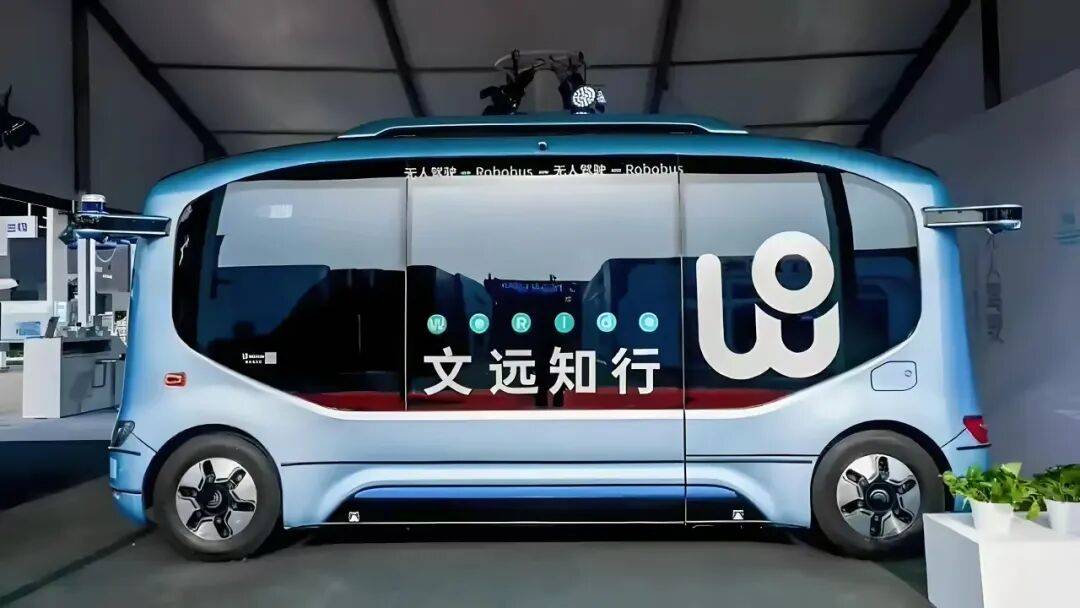
自动驾驶巨头从纳斯达克“归港”!1.02亿股叩关港股,藏着哪些野心?
Xin Lang Cai Jing· 2025-10-15 02:56
Core Viewpoint - Pony AI Inc. is advancing its plan for a dual listing in Hong Kong, driven by its significant revenue growth but increasing losses, reflecting the urgent capital needs of leading companies in the autonomous driving sector [3][10]. Group 1: Listing Progress - On October 14, the China Securities Regulatory Commission confirmed Pony AI's overseas listing registration, allowing it to issue up to 102,146,500 ordinary shares on the Hong Kong Stock Exchange [5][7]. - This move comes less than a year after Pony AI's successful NASDAQ listing as the "first global Robotaxi stock" on November 27, 2024 [7][8]. - If successful, Pony AI will be among the few companies in the autonomous driving field to achieve a dual listing in both the US and Hong Kong markets [8]. Group 2: Financial Performance - For Q2 2025, Pony AI reported a revenue of 154 million RMB, a year-on-year increase of 75.9%, with its core Robotaxi business seeing a revenue increase of 157.8% [12]. - Despite the revenue growth, the company faced a net loss of 38.2 million RMB, a year-on-year increase of 72.49%, highlighting the financial pressures inherent in the autonomous driving industry [12]. - As of the end of Q2, Pony AI had cash and cash equivalents of 5.356 billion RMB, but the company has set a goal to operate 1,000 Robotaxi vehicles by year-end, indicating a clear funding gap [12]. Group 3: Strategic Implications - The dual listing is not merely a financing opportunity but a strategic choice to meet both short-term and long-term development needs [14]. - The Hong Kong listing will provide closer access to capital markets that are more familiar with Chinese technology sectors, aligning with Pony AI's core operational markets in major Chinese cities [15]. - The capital raised will support the company's commercialization efforts and global expansion, which have been increasingly active since September 2025 [17].
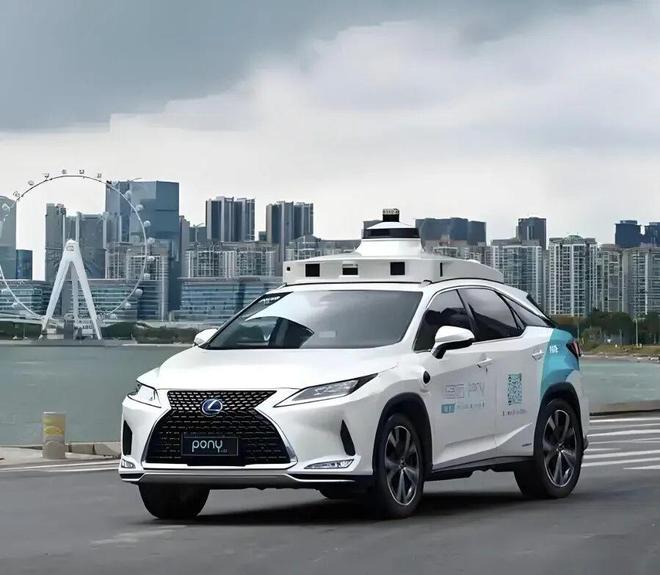
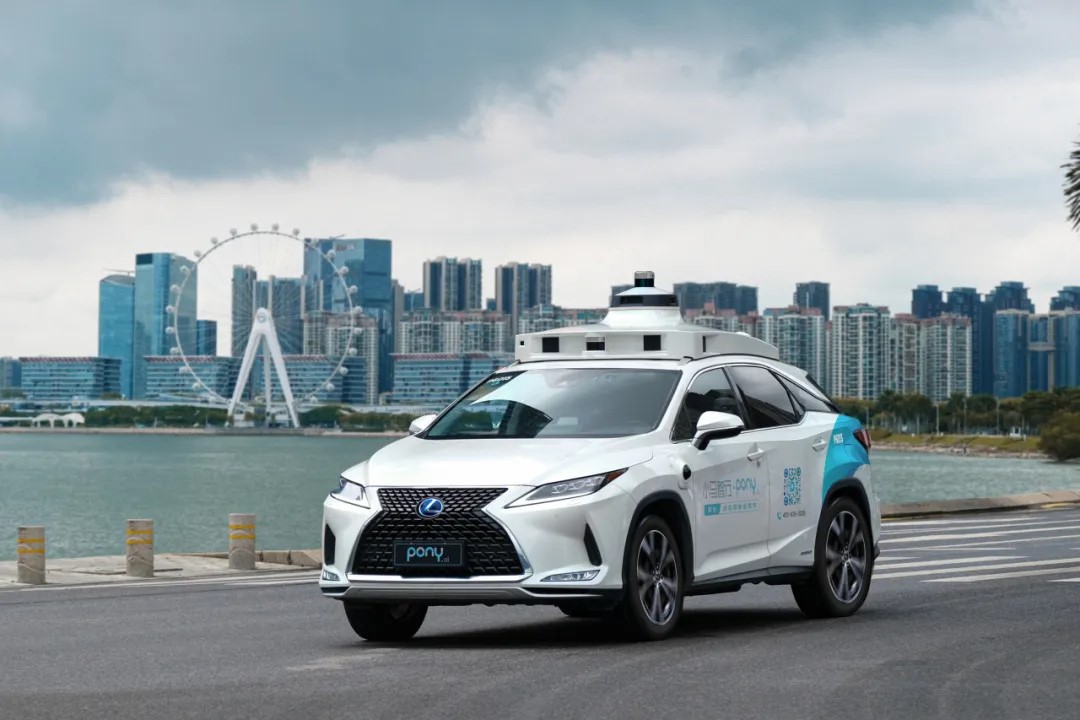
小马智行港交所IPO备案获批,股东包括广汽、丰田
Ju Chao Zi Xun· 2025-10-15 02:45
Core Viewpoint - Pony AI Inc. has received approval for its IPO registration in Hong Kong, intending to issue up to 102,146,500 ordinary shares [1][2]. Company Overview - Founded in December 2016, Pony AI focuses on providing safe, advanced, and reliable full-stack autonomous driving technology, aiming to revolutionize future transportation and achieve the vision of "Autonomous Mobility Everywhere" [5]. Development Milestones - The company established its Silicon Valley R&D center in December 2016 and has since expanded its operations globally, including significant partnerships and technological advancements in autonomous driving [5][7]. - Key achievements include obtaining various autonomous driving licenses in California and China, launching the first Robotaxi service in China, and forming strategic partnerships with major automotive companies like Toyota and GAC [7][8][12]. Recent Developments - In October 2023, Pony AI secured a $100 million investment from Saudi Arabia's New Future City and plans to establish a joint venture [16]. - The company has been actively expanding its testing and operational capabilities, including obtaining licenses for unmanned autonomous driving services in multiple cities [17].
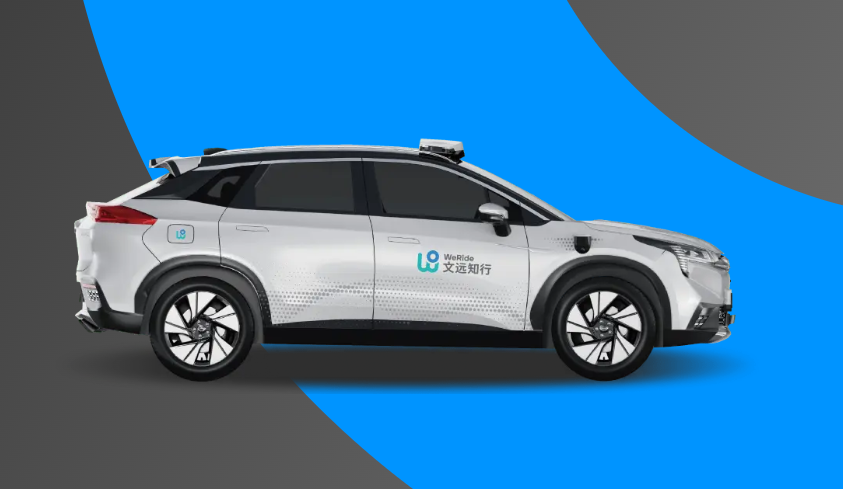
文远知行港股IPO备案获批,拟发行1.02亿股股份
Ju Chao Zi Xun· 2025-10-15 02:38
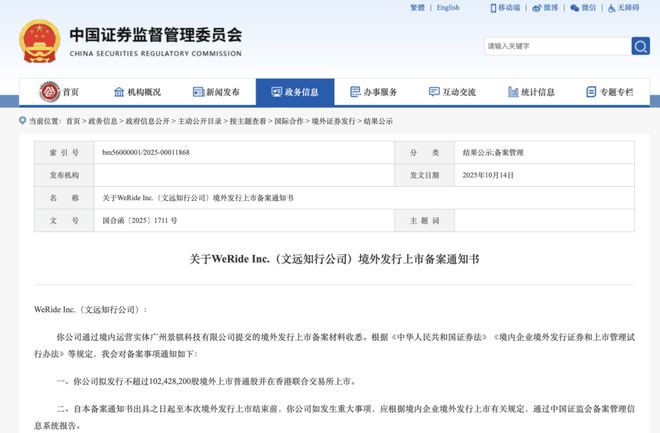
Core Insights - WeRide Inc. (文远知行) has received approval from the China Securities Regulatory Commission for its overseas listing in Hong Kong, indicating a significant step in its capital market strategy [2][3] - The company plans to issue up to 102,428,200 shares of ordinary stock for its listing on the Hong Kong Stock Exchange [2] Company Overview - Founded in 2017, WeRide Inc. focuses on transforming human mobility through autonomous driving technology, offering products and services ranging from Level 2 to Level 4 autonomous driving [5] - The company's product matrix includes Robotaxi, Robobus, Robovan, Robosweeper, and advanced intelligent driving solutions, which are widely applied in smart mobility, freight, and sanitation sectors [5] Financial Performance - In Q2 2025, WeRide reported revenue of 127 million yuan, marking a year-on-year increase of 60.8% [5] - The Robotaxi business generated revenue of 45.9 million yuan in Q2, a substantial year-on-year growth of 836.7%, setting a new record for the company [5] - The proportion of Robotaxi revenue in total revenue rose to 36.1% in Q2, the highest since 2021, while gross profit increased by 40.6% year-on-year [5] Market Position - WeRide became the first global publicly traded autonomous driving company upon its listing on NASDAQ on October 25, 2024, under the ticker symbol "WRD.US" [5] - The scale of the Robotaxi fleet in Abu Dhabi has tripled since 2024, demonstrating significant scaling effects [5] - The Robotaxi service has operated safely for over 2,200 days, establishing a new safety benchmark in the industry [5] IPO Context - The decision for WeRide to pursue a Hong Kong IPO is influenced by geopolitical factors, reflecting the company's strategic response to market conditions [6]
小马智行、文远知行获港股上市备案
Zhong Guo Jing Ying Bao· 2025-10-15 02:24
中经记者 陈靖斌 广州报道 不过,尽管资本市场的支持为行业注入"新活水",但Robotaxi距离大规模盈利仍有一段距离。在商业化 临界点尚未到来之前,如何维持高额研发支出与日常运营投入,成为摆在小马智行、文远知行等L4级 自动驾驶企业面前的共同课题。此次赴港上市,既是资本层面的战略延伸,也是企业谋求全球资本市场 认同、加速商业落地的关键一步。 同日,《中国经营报》记者获悉,另一家头部自动驾驶企业WeRide Inc.(文远知行)也获得了境外发行 上市备案通知书。文远知行拟发行不超过1.024亿股境外普通股,同样计划登陆港交所。公开资料显 示,文远知行早在2024年10月25日已完成在纳斯达克的上市,成为首批登陆美股市场的中国自动驾驶公 司之一。 德邦证券研报指出,Robotaxi的商业化路径高度依赖"技术、政策与资金"三大支撑。其中,技术创新是 核心驱动力,涵盖算法、芯片、传感器及整车集成等多个环节;政策开放与示范区建设则决定了商业化 落地速度。据太平洋证券预测,随着传感器成本下降与规模化运营推进,Robotaxi单公里成本预计将在 2026年降至2.1元,到2030年进一步降至1元。届时,中国Robotax ...
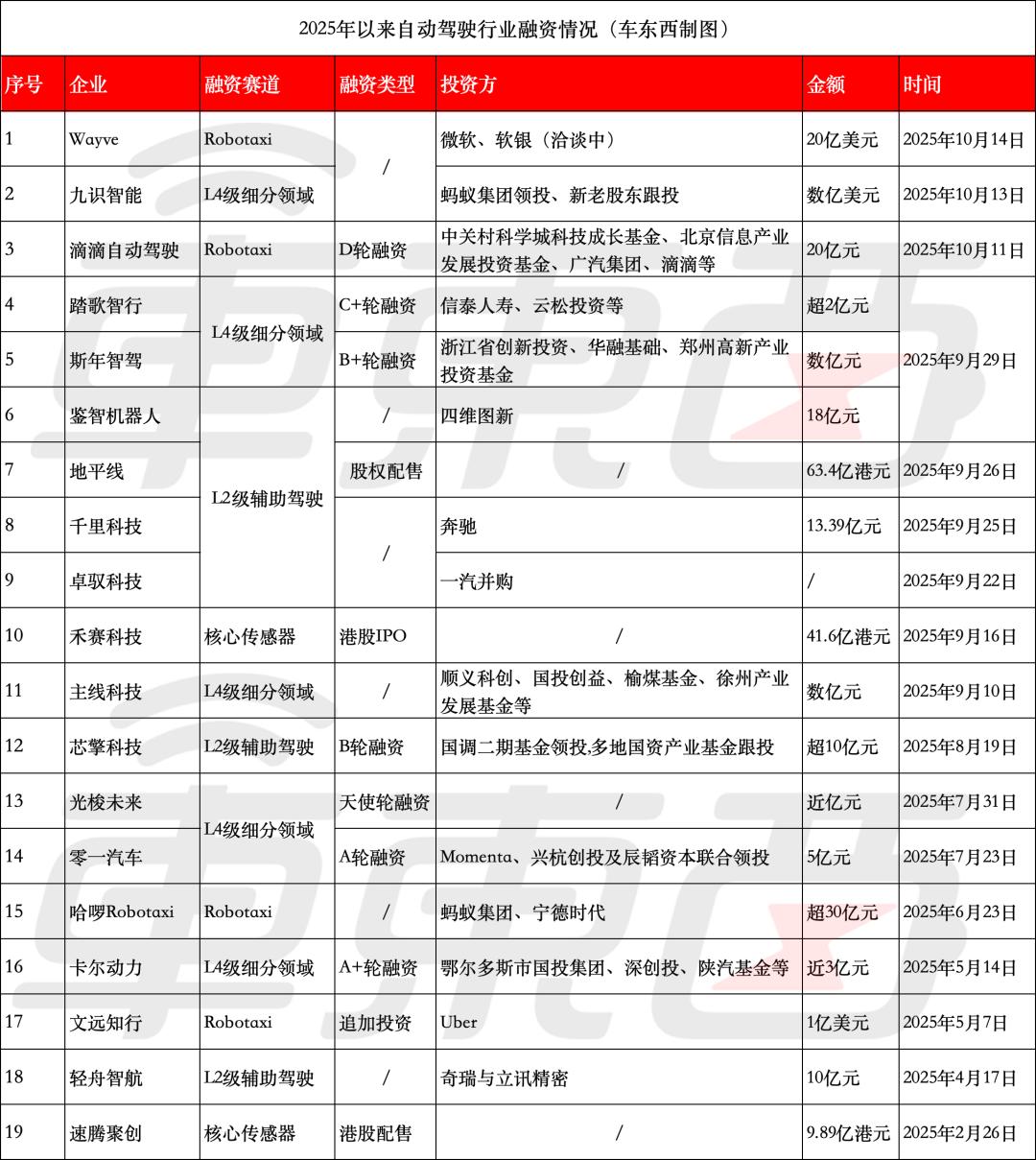
自动驾驶大爆发,19起融资吸金超300亿,四大赛道都很火热
3 6 Ke· 2025-10-15 00:35
Core Insights - The autonomous driving industry is experiencing a significant surge in financing, with 11 funding events in the past month totaling over 29.2 billion yuan, bringing the total for the year to 36.7 billion yuan across 19 events [1][2][22] - This marks a stark contrast to the previous three years of capital winter, indicating a renewed confidence in the commercialization prospects of autonomous driving by 2025 [1][22] Financing Overview - The financing landscape is dominated by four main areas: L2-level assisted driving, L4-level niche applications, Robotaxi, and core sensors [3][11] - L2-level assisted driving saw six financing events this year, with notable funding including Horizon Robotics raising approximately 6.34 billion HKD (around 5.81 billion yuan) to expand overseas and support high-level assisted driving solutions [4][11] - The Robotaxi sector is particularly lucrative, with significant funding such as Didi Autonomous Driving's 2 billion yuan in Series D financing aimed at AI core algorithm development and L4 application deployment [11][16] - L4-level applications, focusing on closed or semi-closed environments, have attracted the most funding, with seven companies receiving investments, including a recent multi-million dollar round for Jiushi Intelligent [17][19] Market Dynamics - The capital market's enthusiasm for autonomous driving has markedly increased compared to the previous three years, which were characterized by a downturn in funding and operational challenges for major companies like Argo AI and Cruise [22][25] - The turning point in 2025 is attributed to a combination of technological advancements, market readiness, and supportive policies, with Tesla's launch of Robotaxi products serving as a strong market signal [25][27] - The investment focus has shifted towards companies with clear commercial applications, particularly in the Robotaxi and L4 niche sectors, reflecting a pragmatic approach to funding [27][30] Conclusion - The influx of capital is accelerating the commercialization of autonomous driving technologies, with companies that demonstrate viable applications receiving increased support [30] - The industry is poised for a transformative year in 2025, as the convergence of technology and investment is expected to turn autonomous driving from a vision into reality [30]

复旦SeerDrive:一种轨迹规划和场景演化的双向建模端到端框架
自动驾驶之心· 2025-10-14 23:33
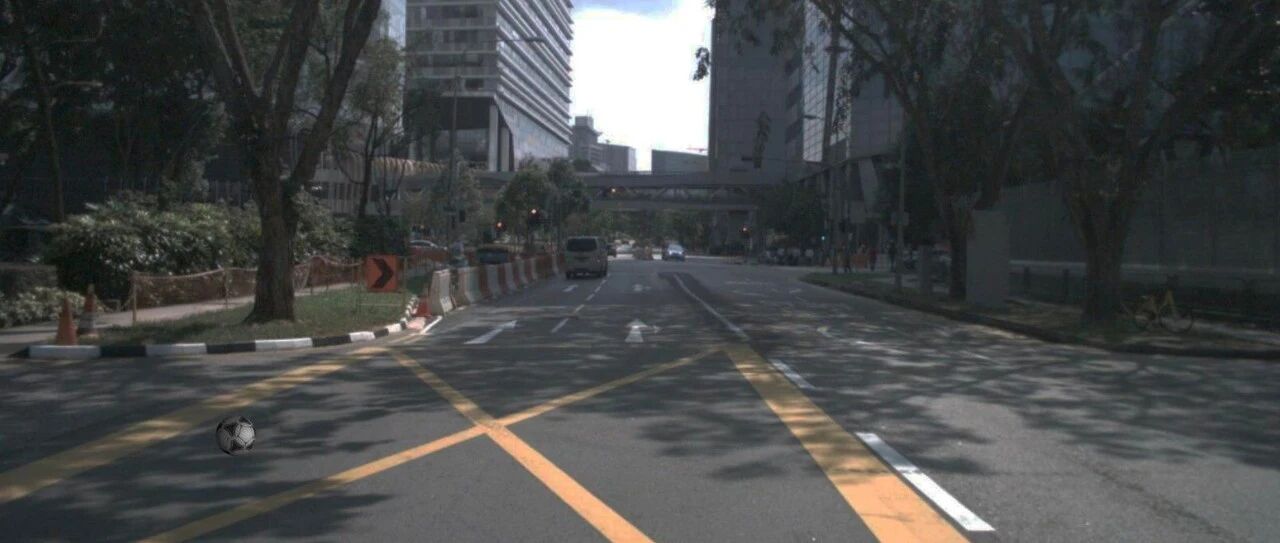
Core Insights - The article discusses the advancements in end-to-end autonomous driving, specifically focusing on the SeerDrive model, which aims to improve trajectory planning by incorporating bidirectional modeling of trajectory planning and scene evolution [1][3][4]. Group 1: SeerDrive Overview - SeerDrive introduces a bidirectional modeling paradigm that captures scene dynamics while allowing planning results to optimize scene predictions, creating a closed-loop iteration [3][4]. - The overall pipeline of SeerDrive consists of four main modules: feature encoding, future BEV world modeling, future perception planning, and iterative optimization [4]. Group 2: Challenges in Current Systems - Current one-shot paradigms in autonomous driving overlook dynamic scene evolution, leading to inaccurate planning in complex interactions [5]. - Existing systems fail to model the impact of vehicle behavior on the surrounding environment, which is crucial for accurate trajectory planning [5]. Group 3: Technical Components - Feature encoding transforms multimodal sensor inputs and vehicle states into structured features, laying the groundwork for subsequent modeling [8][9]. - Future BEV world modeling predicts scene dynamics by generating future BEV features, balancing efficiency and structured representation [10][13]. Group 4: Planning and Optimization - SeerDrive employs a decoupled strategy for planning, allowing current and future scenes to guide planning separately, thus avoiding representation entanglement [15]. - The iterative optimization process enhances the bidirectional dependency between trajectory planning and scene evolution, leading to improved performance [17]. Group 5: Experimental Results - SeerDrive achieved a PDMS score of 88.9 on the NAVSIM test set, outperforming several state-of-the-art methods [23]. - In the nuScenes validation set, SeerDrive demonstrated an average L2 displacement error of 0.43m and a collision rate of 0.06%, significantly better than competing methods [24]. Group 6: Component Effectiveness - The removal of future perception planning or iterative optimization resulted in a decrease in PDMS scores, indicating the importance of these components for performance enhancement [26]. - The design choices, such as the decoupled strategy and the use of anchored endpoints for future ego feature initialization, proved to be critical for achieving optimal results [30]. Group 7: Limitations and Future Directions - The BEV world model does not leverage the generalization capabilities of foundational models, which could enhance performance in complex scenarios [41]. - Future research may explore the integration of foundational models with planning to improve generalization while maintaining efficiency [41].
新华财经早报:10月15日
Xin Hua Cai Jing· 2025-10-14 23:31
Group 1: Economic Outlook and Policies - Premier Li Qiang emphasized the need to continuously expand domestic demand and strengthen the domestic circulation during a meeting with economic experts and entrepreneurs [1] - The IMF raised its global economic growth forecast for this year to 3.2%, while warning that tariffs are undermining growth prospects [3] - The National Development and Reform Commission reported that the average annual grain purchase volume in China will remain above 400 million tons during the 14th Five-Year Plan period, with market-based purchases accounting for over 90% [1] Group 2: Industry Developments - In the first nine months of 2025, China's production and sales of new energy vehicles both exceeded 10 million units, with year-on-year growth rates of 35.2% and 34.9%, respectively [1] - The China Futures Industry Association reported that the national futures market's trading volume in September was 770 million contracts, with a transaction value of 71.5 trillion yuan, showing a year-on-year decline in volume but an increase in value [1] - The market regulator approved the release of the national standard for "Sustainable Development of Cities and Communities," which aims to enhance livability in urban planning and management [1] Group 3: Corporate Announcements - Mindray Medical plans to issue H-shares and list on the Hong Kong Stock Exchange [6] - Shengzhong Mining intends to acquire 100% of Canadian Loncor for 261 million Canadian dollars [6] - Dongwu Securities expects a year-on-year net profit increase of 50% to 65% for the third quarter [6]

小马智行、文远知行两大自动驾驶龙头同日获港股IPO备案
Xin Lang Cai Jing· 2025-10-14 21:42
Core Insights - The article highlights the recent developments in the autonomous driving sector, particularly focusing on the dual listings of WeRide Inc. and Pony AI Inc. in Hong Kong, as well as the significant growth in revenue for WeRide Inc. and Pony AI Inc. [1][4] Company Developments - WeRide Inc. plans to issue up to 102,428,200 shares for its listing on the Hong Kong Stock Exchange, as approved by the China Securities Regulatory Commission [1] - Pony AI Inc. intends to issue up to 102,146,500 shares for its listing on the Hong Kong Stock Exchange, also receiving approval from the China Securities Regulatory Commission [1] - WeRide Inc. reported a revenue of 127 million yuan (approximately 17.5 million USD) for Q2 2025, marking a year-on-year increase of 60.8% [3] - Pony AI Inc. achieved a total revenue of 154 million yuan (approximately 21.5 million USD) in Q2 2025, reflecting a year-on-year growth of 75.9% [4][5] Business Performance - WeRide Inc.'s autonomous taxi business revenue reached 45.9 million yuan (approximately 6.3 million USD) in Q2 2025, showing a substantial year-on-year increase of 836.7% [3] - The share of autonomous taxi business revenue in WeRide's total revenue rose to 36.1%, the highest since 2021 [3] - Pony AI Inc. reported that its Robotaxi business revenue reached 10.9 million yuan (approximately 1.5 million USD) in Q2 2025, with a year-on-year growth of 157.8% [5] Global Expansion - WeRide Inc. has expanded its operations to 11 countries and over 30 cities, holding autonomous driving licenses in seven countries [2] - Pony AI Inc. has initiated Robotaxi services in major cities like Beijing, Shanghai, Guangzhou, and Shenzhen, covering over 2,000 square kilometers [4] - Both companies are actively pursuing international collaborations, with WeRide partnering with Grab in Southeast Asia and Pony AI collaborating with transportation companies in Qatar and Singapore [2][5] Industry Trends - The global autonomous driving market is projected to grow from approximately 158.3 billion USD in 2023 to 273.8 billion USD by 2025, reflecting a year-on-year growth of 29.97% [7] - The article emphasizes the increasing commercialization of autonomous driving services, with companies like WeRide and Pony AI leading the charge in urban areas [6]
文远知行20251014
2025-10-14 14:44
Summary of the Conference Call for 文远知行 Company Overview - 文远知行 operates one of the largest L4 autonomous driving fleets globally and has partnered with Uber to operate Robot Taxis in the Middle East, transitioning towards full automation [2][3][4] - The company plans to maintain a balanced focus on both domestic and international markets, with key operations in Beijing, Guangzhou, and Shanghai, and a strong emphasis on the Middle East, particularly Dubai and Riyadh [2][5] Key Insights and Arguments - **Market Pricing and Revenue**: The average price per kilometer in the Middle East is significantly higher than in China, approximately 7 to 8 RMB (1 to 1.1 USD) compared to about 2 RMB in major Chinese cities [2][4]. Daily order volume in the Middle East has surpassed the breakeven point of 12 orders [4]. - **Fleet Expansion Plans**: By 2026, the overall fleet is expected to grow to 3,000 to 5,000 vehicles, with Robot Taxis increasing to 2,000 to 3,000 units [2][5]. The five-year plan with Uber aims to cover 15 cities, reaching a scale of about 50,000 vehicles [2][8]. - **International Licensing**: 文远知行 has obtained autonomous driving licenses in seven countries, making it the company with the most such licenses globally [2][9]. - **Profitability Comparison**: Robot Taxis in the U.S. can generate annual revenues of 250,000 USD, while in China, the figure is only 40,000 to 50,000 USD [11][12]. This disparity drives the company's focus on international markets for higher profitability [11]. - **Operational Model**: The company employs a non-ownership fleet model, selling vehicles to platform partners or independent fleet operators, sharing 60% to 70% of the revenue, which enhances order volume and profitability [3][10]. Additional Important Points - **Technological Maturity**: The Robot Taxi technology is mature, allowing one remote safety operator to monitor ten vehicles [17]. The company is also developing a new L4 iteration that integrates with its existing L2+ solutions [25]. - **Future Revenue Projections**: The company anticipates achieving an annualized revenue of 1.5 billion USD within the next 1 to 3 years, with 1 billion USD expected from autonomous taxi services [28]. The projected annual service revenue could reach 1 billion USD when the fleet size hits 20,000 vehicles [25]. - **Global Market Strategy**: The choice to expand into overseas markets is driven by higher labor costs and favorable regulatory environments, particularly in developed countries and the Middle East [9][22]. The company has established a strong international reputation, which aids in market entry [23]. Conclusion 文远知行 is positioned as a leading player in the autonomous driving sector, with significant growth potential driven by international expansion, technological advancements, and a robust operational model. The company's current valuation appears low relative to its projected growth, making it a noteworthy investment opportunity [28].