
半导体

Search documents
国际商业机器公司取得具有不对称栅极叠置体的纳米片晶体管专利
Jin Rong Jie· 2026-02-13 02:23
Core Viewpoint - International Business Machines Corporation (IBM) has obtained a patent for a technology titled "Nanosheet Transistor with Asymmetric Gate Stacking," with the authorization announcement number CN115398648B and an application date of April 2021 [1]. Group 1 - The patent pertains to advanced semiconductor technology, specifically focusing on nanosheet transistors [1]. - The technology may enhance the performance and efficiency of electronic devices, potentially impacting the semiconductor industry [1].

中泰国际每日晨讯-20260213
ZHONGTAI INTERNATIONAL SECURITIES· 2026-02-13 02:22
Market Overview - On February 12, Hong Kong stocks opened lower and closed down, with the Hang Seng Index falling 233 points (0.8%) to close at 27,032 points[1] - The Hang Seng Tech Index dropped 91 points (1.6%) to close at 5,408 points, with total market turnover increasing to HKD 238.7 billion[1] - Southbound capital saw a net inflow of HKD 4.57 billion, down from the previous day's net inflow of HKD 4.82 billion[1] Company Performance - Tencent (700 HK) fell 2.3% to a six-month low, with a year-to-date decline of over 8% due to perceived lag in AI development compared to competitors like ByteDance and Alibaba[1] - SenseTime (20 HK) surged 6.7%, while Zhizhu (2513 HK) rose 28.7% after releasing a new flagship model[1] - Lenovo Group (992 HK) reported a 36% year-on-year increase in adjusted net profit for Q3, yet its stock price fell 4.6%[1] U.S. Market Insights - Initial jobless claims in the U.S. decreased from 232,000 to 227,000, slightly above expectations, while continuing claims rose to 1.862 million, exceeding the expected 1.85 million[2] - The Dow Jones Index fell 669 points (1.3%) to 49,451 points, the Nasdaq dropped 469 points (2.0%) to 22,597 points, and the S&P 500 declined by 108 points to 6,832 points[2] - Gold and silver prices fell by 3% and 8%, respectively, as investors awaited inflation data[2] Macro Dynamics - The China Passenger Car Association reported a 13.9% year-on-year decline in retail sales of passenger cars in January, with new energy vehicle sales down 20.0%[3] - The decline was attributed to market factors and adjustments in the new energy vehicle purchase tax policy[3] Industry Trends - In the consumer sector, Budweiser APAC (1876 HK) reported a 4.2% year-on-year decline in revenue for Q4, with an adjusted EBITDA drop of 24.7%, leading to a 5.2% stock price decrease[4] - The healthcare sector saw the Hang Seng Healthcare Index drop 1.4%, with WuXi Biologics (2269 HK) down 0.1% despite strong project acquisition capabilities[4] - The renewable energy and utilities sector experienced gains, with notable increases in stock prices for Dongfang Electric (1072 HK) by 12.4% and Harbin Electric (1133 HK) by 13.7%[5]
港股异动 | 华虹半导体(01347)绩后涨近3% 全年销售收入同比增长19.9% 各特色工艺平台均表现强劲
智通财经网· 2026-02-13 02:21
Group 1 - The core viewpoint of the article highlights that Huahong Semiconductor reported record sales revenue for Q4 2025, reaching approximately $660 million, with a year-on-year increase of 22.4% and a quarter-on-quarter increase of 3.9% [1] - The gross profit for Q4 2025 was $85.464 million, representing a year-on-year growth of 39.1% but a slight quarter-on-quarter decrease of 0.5% [1] - The net profit attributable to the parent company was $17.454 million, marking a return to profitability compared to the previous year, although it decreased by 32.2% quarter-on-quarter [1] Group 2 - For the full year 2025, the company achieved sales revenue of approximately $2.402 billion, reflecting a year-on-year growth of 19.9% [2] - The gross profit for the full year was approximately $283 million, with a year-on-year increase of 37.9% [2] - The net profit attributable to the parent company for the full year was $54.881 million, which is a decrease of 5.6% year-on-year, with earnings per share of $0.032 [1][2] Group 3 - The chairman and president of the company, Dr. Bai Peng, stated that the company maintained a high capacity utilization rate of 106.1% throughout the year, which is leading in the wafer foundry industry [2] - The growth in performance was supported by strong demand driven by AI and related products, as well as a recovery in domestic consumer demand [2] - The company optimized its product mix and improved cost efficiency, with strong performance in its specialty process platforms, particularly in standalone flash memory and power management platforms [2]
聚辰股份申请港交所主板上市,打造A+H双融资平台
Jing Ji Guan Cha Wang· 2026-02-13 02:21
Group 1 - The core viewpoint is that Juchen Technology has submitted its mainboard listing application to the Hong Kong Stock Exchange, aiming to create an A+H dual financing platform to seize opportunities in the storage industry, which may enhance the company's valuation expectations and liquidity attention [1] - The CEO indicated that the demand for DDR5 SPD chips is in a ramp-up phase, with significant volume expected in Q3 and Q4 of 2026, and the company is collaborating with Samsung Electronics to advance VPD chip design verification, expanding into the AI server and high-performance computing markets [1] Group 2 - The company's performance continues to grow, with operating revenue of 933 million yuan for the first three quarters of 2025, a year-on-year increase of 21.29%, and an adjusted net profit of 301 million yuan, up 25.9% year-on-year [2] - There is a structural improvement in profitability, with gross margin rising from 46.6% in 2023 to 59.8% in the first three quarters of 2025, and net margin increasing from 20.1% to 32.3% during the same period [2] - Growth drivers are primarily from the demand for SPD chips driven by servers and AI infrastructure, as well as the trend of domestic production of automotive-grade chips, although there is a concentration risk with the top five customers accounting for 59.3% of revenue in the first three quarters of 2025 [2] Group 3 - In the recent stock performance, Juchen Technology's stock price fluctuated by 0.48% over the last seven trading days, with a closing price of 149.22 yuan on February 12, 2026, reflecting a single-day increase of 0.72% [3] - The stock has seen a cumulative increase of 18.83% year-to-date, with a current price-to-earnings ratio (TTM) of 59.23, indicating market attention on the high prosperity cycle of storage chips [3] Group 4 - Industry analysis suggests that Juchen Technology benefits from the DDR5 technology iteration and the explosion of AI demand during the storage super cycle, with the SPD chip business being a core growth engine [4] - However, institutions like Goldman Sachs warn that rising storage prices may suppress consumer electronics demand, predicting a potential decline of 6%-10% in global smartphone shipments in 2026, which could pressure some of the company's consumer electronics chip business [4]

华虹半导体绩后涨近3% 全年销售收入同比增长19.9% 各特色工艺平台均表现强劲
Zhi Tong Cai Jing· 2026-02-13 02:19
Core Viewpoint - Huahong Semiconductor (01347) reported record sales revenue for Q4 2025, driven by strong demand in the global semiconductor market, particularly from AI-related products and a recovery in domestic consumer demand [1] Financial Performance - Sales revenue for Q4 2025 reached approximately $660 million, representing a year-on-year increase of 22.4% and a quarter-on-quarter increase of 3.9% [1] - Gross profit was $85.464 million, showing a year-on-year growth of 39.1% but a slight quarter-on-quarter decrease of 0.5% [1] - The net profit attributable to the parent company was $17.454 million, marking a return to profitability year-on-year, although it decreased by 32.2% quarter-on-quarter [1] Annual Performance - For the full year 2025, the company achieved sales revenue of approximately $2.402 billion, a year-on-year increase of 19.9% [1] - Gross profit for the year was around $283 million, reflecting a year-on-year growth of 37.9% [1] - The net profit attributable to the parent company was $54.881 million, which represents a year-on-year decrease of 5.6% [1] - Earnings per share stood at $0.032 [1] Operational Highlights - The average capacity utilization rate for the year was 106.1%, positioning the company at the forefront of wafer foundry enterprises [1] - The company optimized its product mix and implemented cost reduction measures, leading to strong performance across its specialty process platforms, particularly in standalone flash memory and power management platforms [1]
强一股份股价涨5.87%,嘉实基金旗下1只基金重仓,持有253股浮盈赚取4875.31元
Xin Lang Ji Jin· 2026-02-13 02:18
Group 1 - Strong One Semiconductor (Suzhou) Co., Ltd. is focused on semiconductor design and manufacturing, specializing in the research, design, production, and sales of probe cards for wafer testing, with 95.87% of its revenue coming from probe card sales [1] - The company's revenue breakdown includes 84.71% from 2D/2.5D MEMS probe cards, 8.25% from cantilever probe cards, and 2.57% from wafer test boards, among other categories [1] - As of February 13, the stock price of Strong One shares increased by 5.87% to 347.56 CNY per share, with a total market capitalization of 45.03 billion CNY [1] Group 2 - The Jiashi Zhongzheng Photovoltaic Industry ETF (014604) holds 253 shares of Strong One, representing 0.01% of the fund's net value, making it the eighth largest holding [2] - The fund has achieved a year-to-date return of 17.73% and a one-year return of 53.49%, ranking 166 out of 5569 and 653 out of 4295 respectively in its category [2] - The fund manager, Li Zhi, has been in position for over 8 years, with the best fund return during his tenure being 93.34% [3]
中企对荷方裁决“强烈不满”
Huan Qiu Wang· 2026-02-13 02:18
Core Viewpoint - The Amsterdam Enterprise Court upheld a previous decision to suspend the position of Nexperia's Chinese CEO, Zhang Xuezheng, allowing the European interim management team to remain in place and ordering a formal investigation into alleged mismanagement at Nexperia. This ruling has led to strong dissatisfaction from the company's controlling shareholder, China's Wingtech Technology, which aims to restore its full legal control and governance rights over Nexperia [1][2][5]. Group 1: Court Ruling and Reactions - The court's decision did not revoke prior temporary measures against Nexperia, nor did it restore Wingtech's legal control as a shareholder [2][11]. - The court has initiated an investigation that may take over six months, involving the examination of actions by Nexperia's chief legal officer, chief operating officer, and financial officer [2][11]. - Wingtech expressed extreme disappointment and dissatisfaction with the ruling, stating it would pursue all legal avenues to regain control [1][5]. Group 2: Impact on the Semiconductor Industry - The ongoing dispute has disrupted the supply of standardized chips crucial for automotive production, affecting major manufacturers like Honda and Mercedes-Benz, which have had to halt production of certain models [7][15]. - The investigation and court ruling are expected to prolong the struggle for control over Nexperia, exacerbating the existing chip supply crisis in the European automotive sector [7][15]. Group 3: Geopolitical Context - The situation highlights the geopolitical tensions between Europe and China, with the court's ruling potentially reigniting tensions in their economic relations [8][16]. - Analysts suggest that the ongoing control dispute could have broader implications for global supply chains, particularly in the semiconductor sector, which is vital for various industries [8][16].



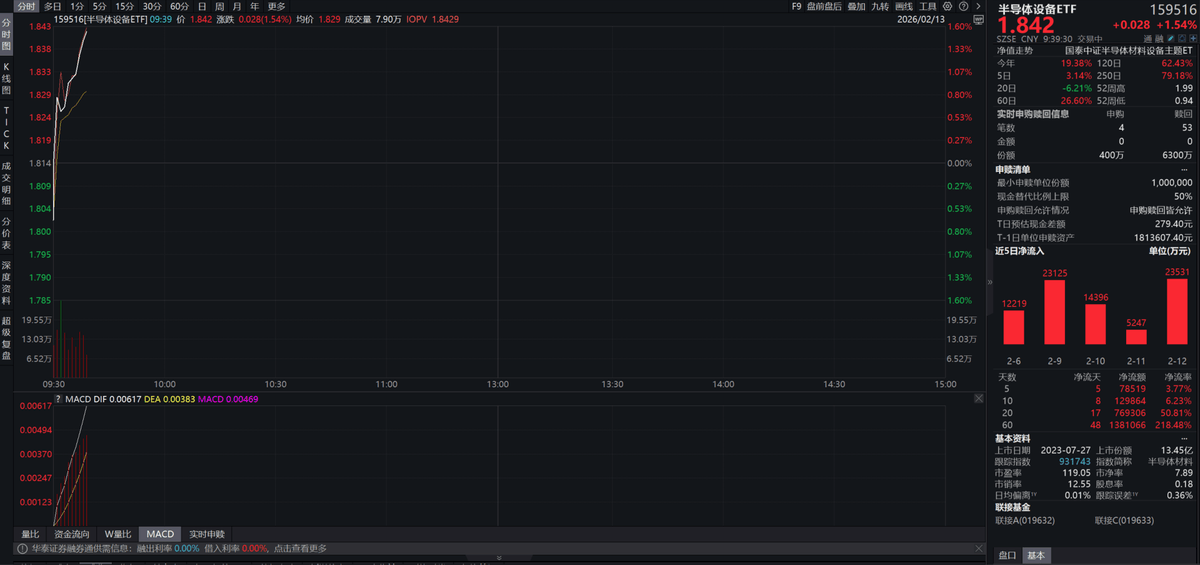
春节档大模型“超级周”来临,半导体设备ETF(159516)强势吸金
Mei Ri Jing Ji Xin Wen· 2026-02-13 02:18
Core Insights - The Chinese AI industry is experiencing a significant shift from "single-point breakthroughs" to "systematic iterations," as multiple domestic model manufacturers release flagship models simultaneously, enhancing market confidence in AI commercialization [1][3][4]. Group 1: Industry Developments - Major Chinese AI companies, including ByteDance, Zhipu, DeepSeek, and MiniMax, have launched new flagship models across various domains such as video generation, image generation, and programming, marking a collective advancement in the industry [1][3]. - Morgan Stanley has termed this phenomenon as the "Spring Festival release cycle," indicating that the simultaneous updates from multiple companies will accelerate market comparisons and shift market share towards the best performers [3][4]. Group 2: Market Dynamics - The perception of domestic large models has evolved from being "followers" to being competitive with global leaders in areas like coding and context handling, leading to increased willingness to pay and higher API workload retention rates [4]. - The marketing battle among AI applications during the Spring Festival has led to a surge in user engagement, validating the potential for explosive consumer traffic and creating a non-linear growth trajectory for inference computing demand [5][6]. Group 3: Long-term Trends - The AI investment narrative is shifting from "training-driven" to "inference-driven," with inference demand expected to become the main engine for computing growth starting in 2026, significantly expanding the market space compared to training [10][19]. - The supply side is undergoing generational upgrades, particularly in optical modules, with a projected demand increase of over tenfold for 1.6T optical modules by 2026 [12][19]. Group 4: Competitive Landscape - The commoditization of large models is leading to a redistribution of power in the platform layer, where differentiation is increasingly based on marketing capabilities, workflow ownership, and product iteration speed rather than just model strength [14][19]. - The semiconductor equipment sector is now closely tied to global AI computing cycles, with increased capital expenditures from overseas storage leaders driving expectations for domestic equipment companies [15][19]. Group 5: Investment Opportunities - The semiconductor equipment ETF (159516) is highlighted as a core investment vehicle, providing exposure to leading companies in the semiconductor equipment and materials sectors, with a current scale exceeding 20 billion [16][19].
SEMICON-KOREA现场直击-存储超级周期的投资机会和三星-海力士走访
2026-02-13 02:17
Summary of Key Points from the Conference Call Industry Overview - The consumer electronics market is expected to shrink, with mobile phone and PC shipments projected to decline by 6.7% and 10% respectively. However, the semiconductor market is forecasted to grow robustly, potentially reaching $1 trillion by 2026, with storage growth nearing 40% and logic chip growth exceeding 30% [2][3][21]. Core Insights and Arguments - The storage supercycle significantly enhances corporate profits, with DRAM prices expected to rise by 105% to 110% quarter-over-quarter in Q1, far exceeding the previous quarter's increase [2][5]. - The supply side of DRAM is projected to grow by approximately 20% this year, primarily driven by technological upgrades due to cleanroom space limitations. Major new capacity releases are not expected until 2027, indicating a continued supply-demand imbalance unless consumer electronics demand drops significantly [2][6][7]. - South Korea's semiconductor industry benefits from a national system and sustained investment, with Samsung expected to regain its lead in HBM4 technology through vertical integration and favorable diplomatic policies [2][8]. Pricing and Market Dynamics - The pricing model in the memory market is heavily influenced by the channel market, with significant price increases expected in Q1, ensuring strong performance for related companies even if shipment volumes remain unchanged [2][9]. - The semiconductor industry's valuation is currently low, but there is potential for expansion during upward cycles. For instance, the P/E ratios for Hynix, Samsung, and Micron are significantly lower than those of semiconductor equipment companies, suggesting that increased investor confidence could drive valuations higher [4][15]. Competitive Landscape - Samsung and Hynix have a competitive edge in HBM4 technology, utilizing logic-based die processes, while Micron continues to use traditional memory-based die, placing it at a disadvantage [4][11]. - Samsung's storage business is characterized by strong cyclicality, with potential operating profit margins exceeding 40% during peak periods. Current projections indicate a positive trend for Q1 profits compared to Q4 of the previous year [12]. Future Outlook - The global smartphone market's supply-demand balance hinges on a significant drop in terminal demand. A hypothetical 20% decrease in global smartphone sales could lead to substantial declines for other brands, particularly Chinese manufacturers [10]. - The development of advanced packaging technologies, such as CPO (Co-Packaged Optics), is gaining traction, with companies like Samsung and ASE emphasizing the integration of front-end design to enhance performance and efficiency [19][20]. Conclusion - The semiconductor industry, particularly in the storage segment, is poised for significant growth despite challenges in the consumer electronics market. The interplay of supply constraints, technological advancements, and competitive dynamics will shape the industry's trajectory in the coming years [2][3][21].

未知机构:2月12日复盘笔记智能电网AI电源液冷算力光通信燃气轮机等-20260213
未知机构· 2026-02-13 02:15
Summary of Key Points from Conference Call Records Industry Insights Smart Grid and Energy Storage - The Ministry of Commerce announced that consumers purchasing new cars during the 9-day Spring Festival holiday can apply for vehicle trade-in subsidies as per policy requirements [1] - The National Energy Administration is actively promoting the development of new energy storage and emerging industries, with a forward-looking layout for hydrogen energy and nuclear fusion energy [2][3] Electric Power Market - The implementation opinion on improving the national unified electricity market system proposes that by 2030, a basic national unified electricity market system will be established, with market-based trading accounting for approximately 70% of total electricity consumption [4] - According to customs data, China's transformer export value is expected to reach a record 64.6 billion yuan by 2025, a nearly 36% increase from the previous year, with the average export price per transformer rising to 205,000 yuan, an increase of about one-third [4] Liquid Cooling Technology - The leading liquid cooling server company, Vertiv, reported better-than-expected results in its Q4 FY2025 earnings, driving its stock price up by 24%, reaching a new historical high [4] Data Center and Energy Consumption - A surge in data center construction in the U.S. has led to an electricity shortage, with over 29 GW of natural gas power generation capacity under construction, more than doubling in one year [5] Fiber Glass and Electronic Materials - International composite and fiberglass leaders have raised prices for electronic cloth multiple times, with ordinary electronic cloth experiencing four price increases from October 2025 to February 2026 [6][8] Semiconductor Materials - The prices of key materials for the global semiconductor industry, such as sputtering targets, are expected to increase by 20%-30% in Q1 2026 [10] Space Photovoltaics - A supply-demand matching meeting for space photovoltaics was held, with companies discussing technology development, material applications, and manufacturing processes [11][12] Company-Specific Developments - Yike Technology announced a price increase for all cloud products and services starting March 1, 2026, due to rising costs in core hardware procurement and infrastructure [4] - Lumentum has secured several hundred million dollars in CPO-related orders, with expected revenue of approximately $50 million from CPO in Q4 2026, anticipating a significant surge in the first half of 2027 [5] Market Trends - The Shanghai Composite Index rose by 0.05%, the Shenzhen Component Index increased by 0.86%, and the ChiNext Index climbed by 1.32%, with a total trading volume exceeding 2.1 trillion yuan, an increase of over 100 billion from the previous day [4] - The price of praseodymium-neodymium oxide has continued to rise, reaching 800,000 yuan per ton, with a week-on-week increase of 9.9% and a month-on-month increase of 28.8% [15] Geopolitical and Economic Factors - The ongoing geopolitical tensions have led to heightened shipping rates, with the Middle East-China VLCC freight rates remaining above $120,000 [13]