光伏

Search documents
1个月内3家光伏企业被追债上亿元,原因何在
Xin Lang Cai Jing· 2026-01-27 22:08
无独有偶,"光伏组件第一股"亿晶光电(600537.SH)去年12月末公告,其滁州光伏项目因建设落地滞 后,项目合作方全椒县对公司发出听证通知,拟解除相关投资协议、追回1.4亿元出资款。 1月5日,棒杰股份(002634.SZ)亦公告收到法院《决定书》,对公司启动预重整,重整申请方为苏州 市一国企环秀湖逐光,该公司在2023年对棒杰股份子公司投资3亿元,后因棒杰股份无法按期完成回 购,对其提出3.26亿元索赔款。此外,棒杰股份在2023年与扬州经开区管委会、浙江衢州江山经济开发 区管委会分别签订的光伏相关合作建设项目,亦因市场环境变化在2025年陆续终止,被要求赔款1500万 元。 【#1个月内3家光伏企业被追债上亿元#,原因何在】随着光伏行业从拼装机,进入拼技术、成本与现金 流的淘汰赛,昔日扎堆签约的扩产项目开始遭遇履约考验。 *ST沐邦(维权)(603398.SH)日前公告,1月23日,梧州市人民政府下发行政决定书,责令公司在收 到决定书之日10日内,向广西梧州高新技术产业开发区管理委员会和粤桂合作特别试验区梧州管委会财 政金融局退回共5.1亿元的项目财政补助及建设扶持款,并支付5100万元违约金。 *S ...
市场监管总局表示 支持企业通过并购重组摆脱内卷式竞争
Zhong Guo Zheng Quan Bao· 2026-01-27 22:00
1月27日,市场监管总局召开2025年综合整治"内卷式"竞争十大重大案件专题新闻发布会。市场监管总 局反垄断二司副司长谢方在会上表示,投资并购是经营者通过市场化机制实现资源整合、优势互补及市 场出清的重要方式。市场监管总局坚持"快审不降质、严审不增负",加强汽车、光伏、锂电池等"内卷 式"竞争重要领域经营者集中审查,有效支持企业依法通过并购盘活闲置资产、提升经营效率,支持企 业通过并购重组走出"内卷式"竞争。 完善经营者集中审查制度规则 谢方表示,2025年共审结相关领域案件129起,所涉案件包括促进技术协同、实现优势互补,优化产能 布局、整合区域资源,盘活闲置产能、促进转型升级等多种类型。 ● 本报记者 董添 市场监管总局价监竞争局一级巡视员杨洪丰在会上表示,市场监管总局始终高度重视网络不正当竞争行 为监管工作,坚决贯彻党中央、国务院决策部署,切实强化反不正当竞争,持续规范网络市场竞争秩 序,推动平台经济规范健康发展。 在加强执法力度方面,市场监管总局部署开展2025年整治网络不正当竞争行为专项行动。聚焦党中央关 心、人民群众关注、违法行为高发的直播电商、老年人药品、保健品、光伏、汽车平台等重点领域、行 业 ...

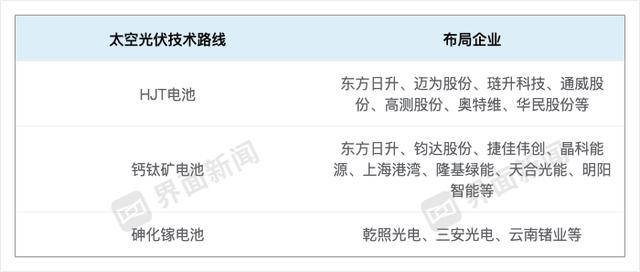
东方日升: 光伏产品未直接向商业航天卫星公司供货;迈为股份: 主要产品为太阳能电池丝网印刷设备
Mei Ri Jing Ji Xin Wen· 2026-01-27 21:48
Group 1 - Dongfang Risen announced that its stock price had deviated by 30.10% over two consecutive trading days, indicating abnormal trading conditions. The company clarified that its photovoltaic products are not directly supplied to commercial aerospace satellite companies, and the application of "space photovoltaic" is still in the exploratory stage with uncertainties in industrialization [1] - Maiwei Co. reported a cumulative stock price deviation of over 30% over three consecutive trading days, also indicating abnormal trading conditions. The company emphasized that its main products are solar cell production equipment, including screen printing equipment and heterojunction cell production lines, and warned investors about the potential impact of market heat on future business expansion [1][2] - Junda Co. stated that its stock price had deviated by 20% over three consecutive trading days, indicating abnormal trading conditions. The company confirmed that its operations are normal and that the new fields it is exploring are still in the technical exploration phase, facing uncertainties in market space and industrialization pace [1][3] Group 2 - The recent market interest in "space photovoltaic" concepts has led to increased heat in related sectors, prompting companies to remind investors to be cautious about speculative risks and to maintain rational investment approaches [2]



马斯克力推太空光伏 为何看上的是异质结技术?
Sou Hu Cai Jing· 2026-01-27 21:39
Core Viewpoint - Elon Musk's "space solar" plan has generated excitement in the domestic photovoltaic industry, with SpaceX and Tesla aiming to build a total of 200 GW solar capacity in the U.S. within three years, primarily for powering satellites and data centers [1] Group 1: Space Solar Power - Space solar power involves installing solar panels in space environments, which can provide power for spacecraft and potentially transmit electricity to the ground wirelessly [1] - The key advantage of space solar power over terrestrial solar power is its ability to generate electricity continuously, achieving 7-10 times more annual generation hours and energy density compared to ground-based systems [1] Group 2: Technology Pathways - The recognized pathways for achieving space solar power include three main technologies: Gallium Arsenide (GaAs), Heterojunction (HJT), and Perovskite batteries [2] - GaAs batteries are currently the mainstream technology for energy supply in satellites and space stations due to their high conversion efficiency and excellent radiation resistance [3] Group 3: Heterojunction Technology - Musk favors HJT technology, with SpaceX selecting P-type HJT as its solution for large-scale, low-cost production of space solar batteries [4] - HJT technology benefits from a mature silicon-based supply chain, significantly lowering manufacturing costs compared to GaAs, and its lightweight characteristics reduce launch costs, aligning with SpaceX's goals [7] Group 4: Market Dynamics - The market for HJT technology is currently competitive, with TOPCon technology dominating the terrestrial solar market with an 80% market share, while HJT faces challenges in scaling production [7] - HJT batteries have a production efficiency of over 24%, with theoretical maximum efficiency reaching 27.5%, and potential future enhancements through Perovskite layering could push efficiency above 30% [8] Group 5: Industry Impact - Following Musk's announcement, the photovoltaic equipment sector saw significant stock price increases, with companies like Maiwei Co., Ltd. experiencing substantial gains due to their position as a leading supplier of HJT production equipment [9] - Maiwei's stock rose for four consecutive trading days, reflecting market enthusiasm, with a reported revenue of 3.159 billion yuan from solar cell production equipment in the first half of 2025, accounting for 75% of its total revenue [9]

支持企业通过并购重组摆脱内卷式竞争
Zhong Guo Zheng Quan Bao· 2026-01-27 20:57
● 本报记者 董添 1月27日,市场监管总局召开2025年综合整治"内卷式"竞争十大重大案件专题新闻发布会。市场监管总 局反垄断二司副司长谢方在会上表示,投资并购是经营者通过市场化机制实现资源整合、优势互补及市 场出清的重要方式。市场监管总局坚持"快审不降质、严审不增负",加强汽车、光伏、锂电池等"内卷 式"竞争重要领域经营者集中审查,有效支持企业依法通过并购盘活闲置资产、提升经营效率,支持企 业通过并购重组走出"内卷式"竞争。 完善经营者集中审查制度规则 谢方表示,2025年共审结相关领域案件129起,所涉案件包括促进技术协同、实现优势互补,优化产能 布局、整合区域资源,盘活闲置产能、促进转型升级等多种类型。 谢方提出,十大重大案件中的中国石油集团济柴动力有限公司与宁德时代新能源科技股份有限公司新设 合营企业案就是一个典型的例子。2025年6月,市场监管总局收到该案经营者集中申报。双方设立合营 企业主要从事锂电池储能系统集成业务,产品主要供中石油体系内油田自用,目的在于围绕油田特定的 储能需求,开创"以场景定技术、以需求促创新"的合作方式,摆脱"内卷式"竞争。经过审查,市场监管 总局认为交易不会对相关市场产 ...
1个月内3家光伏企业被“追债”上亿元
Di Yi Cai Jing Zi Xun· 2026-01-27 15:57
Core Viewpoint - The photovoltaic industry is transitioning from assembly to a focus on technology, cost, and cash flow, leading to challenges in fulfilling expansion project commitments, as evidenced by recent financial disputes involving companies like *ST Muban and Yijing Photovoltaics [2][3]. Group 1: Company-Specific Issues - *ST Muban was ordered to return a total of 5.1 billion yuan in project financial subsidies and construction support funds to the Wuzhou government due to delays in project construction [2]. - Yijing Photovoltaics faced a similar situation where its project in Chuzhou was delayed, leading to a potential termination of investment agreements and a demand to return 140 million yuan [3]. - Bangjie Co. is undergoing pre-restructuring due to failure to complete a buyback agreement, resulting in a claim for 326 million yuan from a state-owned enterprise [3]. Group 2: Industry Trends - The photovoltaic industry experienced explosive growth in 2022, with total output value exceeding 1.4 trillion yuan, a year-on-year increase of over 95%, and production across various segments rising by more than 55% [3]. - Local governments have heavily supported the photovoltaic sector through financial subsidies, tax incentives, and land guarantees, which have played a crucial role in the industry's rapid scale-up [5]. - However, the rapid expansion has led to issues of overcapacity and risks associated with companies lacking relevant industry experience, as seen with *ST Muban and Bangjie Co. [6]. Group 3: Recommendations for Future Development - Experts suggest that local governments should shift from broad subsidies to innovation incentives, focusing resources on advanced technologies and mature smart manufacturing [7]. - There is a call for a transition from administrative intervention to market guidance, emphasizing the need for a fair competitive environment and the establishment of a standard system [7]. - The central government plans to address issues related to improper incentives in local investment attraction, aiming to create a unified national market and mitigate "involution" competition by clarifying regulations [7].



1个月内3家光伏企业被“追债”上亿元
第一财经· 2026-01-27 15:50
Core Viewpoint - The photovoltaic industry is transitioning from a phase of rapid expansion to one focused on technology, cost, and cash flow, leading to challenges in project fulfillment and increased scrutiny of expansion projects [3][4]. Group 1: Company Issues - *ST Muban (603398.SH) was ordered by the Wuzhou Municipal Government to return a total of 510 million yuan in project financial subsidies and construction support funds due to delays in project construction [3]. - Yichin Photovoltaic (600537.SH) faced a similar situation where its project in Chuzhou was delayed, leading to a notice from the local government to potentially terminate the investment agreement and reclaim 140 million yuan [4]. - Bangjie Co., Ltd. (002634.SZ) is undergoing pre-restructuring due to failure to complete a buyback agreement, resulting in a claim for 326 million yuan from a state-owned enterprise [4][5]. Group 2: Industry Context - The photovoltaic industry saw a significant boom in 2022, with total output value exceeding 1.4 trillion yuan, a year-on-year increase of over 95%, and production across various segments increasing by more than 55% [5]. - Local governments heavily supported the photovoltaic sector through financial subsidies, tax incentives, and land guarantees, which played a crucial role in the rapid scaling and technological advancement of the industry [6]. Group 3: Market Challenges - The rapid expansion led to issues of overcapacity and risks associated with companies lacking relevant industry experience, as seen with *ST Muban and Bangjie, which both entered the photovoltaic sector without prior expertise [7]. - Calls for production cuts and capacity control have emerged as the industry faces excess supply, highlighting the consequences of aggressive local government investment strategies [7]. Group 4: Recommendations for Future Development - Experts suggest that local governments should shift from broad subsidies to innovation incentives, focusing resources on advanced technologies and mature smart manufacturing enterprises [8]. - There is a need for a transition from administrative intervention to market guidance, establishing a fair competitive environment through improved standards and regulations [8]. - The central government plans to address issues of improper incentives in local investment strategies by clarifying guidelines for招商引资 (investment attraction) practices [8].

林洋能源2025年净利最高预降七成
Bei Jing Shang Bao· 2026-01-27 14:49
Core Viewpoint - LinYong Energy (601222) expects a significant decline in net profit for 2025, projecting a range of 225 million to 335 million yuan, representing a year-on-year decrease of 55.5% to 70.11% [1] Group 1: Performance Forecast - The company anticipates a net profit of 225 million to 335 million yuan for 2025, which is a substantial reduction compared to the previous year [1] - The expected decline in profit is attributed to cyclical fluctuations in the photovoltaic industry and ongoing construction of its new energy power station BT projects, which have not yet generated sales revenue [1] Group 2: Factors Affecting Performance - The photovoltaic cell market is experiencing a downward price trend, which is putting pressure on profit margins [1] - Adjustments in the pricing rules for electricity market transactions are causing temporary fluctuations in revenue stability [1] - In the energy storage sector, the company is focusing on quality improvement and efficiency strategies amid intense domestic competition, leading to a phased adjustment in project scale [1]

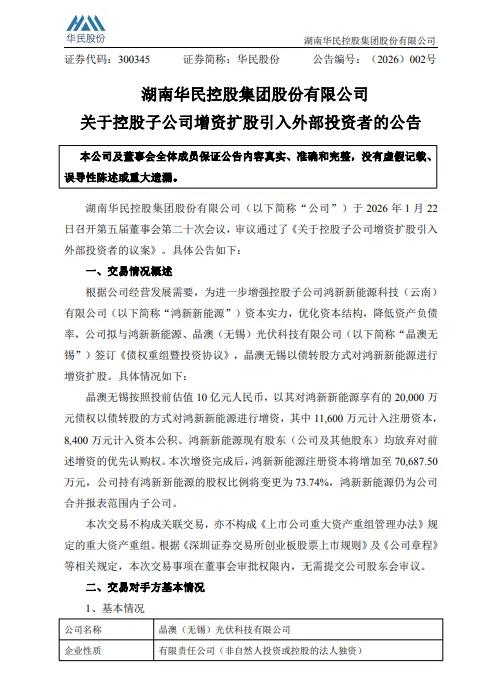
晶澳无锡对鸿新新能源债转股增资2亿元
Xin Lang Cai Jing· 2026-01-27 14:44
润阳股份之后,光伏又现又"债转股"案例。1月22日,华民股份(300345)召开第五届董事会第二十次 会议,审议通过了《关于控股子公司增资扩股引入外部投资者的议案》。 | 公司名称 | 晶澳(无锡)光伏科技有限公司 | | --- | --- | | | | | 企业性质 | 有限责任公司(非自然人投资或控股的法人独资) | 根据公司经营发展需要,为进一步增强控股子公司鸿新新能源科技(云南)有限公司(简称"鸿新新能 源")资本实力,优化资本结构,降低资产负债率,公司拟与鸿新新能源、晶澳(无锡)光伏科技有限 公司(简称"晶澳无锡")签订《债权重组暨投资协议》,晶澳无锡以债转股方式对鸿新新能源进行增资 扩股。 晶澳无锡按照投前估值10亿元人民币,以其对鸿新新能源享有的20,000万元债权以债转股的方式对鸿新 新能源进行增资,其中11,600万元计入注册资本,8,400万元计入资本公积。鸿新新能源现有股东(公司 及其他股东)均放弃对前述增资的优先认购权。本次增资完成后,鸿新新能源注册资本将增加至 70,687.50万元,公司持有鸿新新能源的股权比例将变更为73.74%,鸿新新能源仍为公司合并报表范围 内子公司。 截 ...

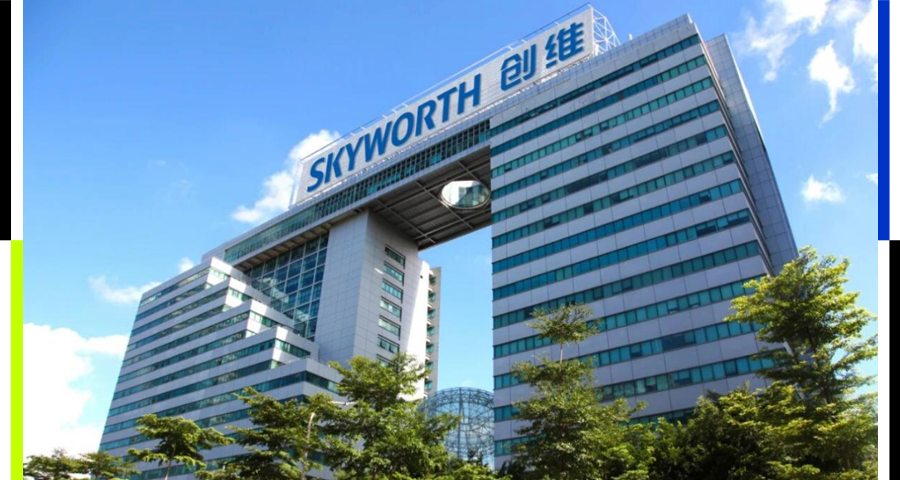
黄宏生「折腾」,创维「换挡」
3 6 Ke· 2026-01-27 14:20
Core Viewpoint - The article discusses the strategic shift of Skyworth Group from its traditional home appliance business to the emerging photovoltaic sector, highlighting the company's privatization plan and the anticipated growth of its solar business [5][15]. Group 1: Company Strategy - Skyworth Group is initiating a privatization process while planning to list its solar subsidiary, Skyworth Solar, on the Hong Kong Stock Exchange [5][12]. - The company has proposed a share buyback plan to facilitate this transition, offering shareholders the option to exchange shares for Skyworth Solar shares or cash [12][14]. - Following the announcement, Skyworth's stock price surged, indicating positive market sentiment towards the company's strategic move [7]. Group 2: Financial Performance - Skyworth's solar business is projected to surpass its traditional television business in revenue by 2025, with solar revenue expected to reach 138.36 billion yuan in the first half of 2025, a 53.5% increase year-on-year [25]. - In contrast, the smart home appliance segment showed only a 9.4% growth, with revenue of 170.44 billion yuan in the same period [31]. - The overall revenue for Skyworth Group in the first half of 2025 was 362.6 billion yuan, raising questions about achieving the ambitious 1,000 billion yuan target set by the founder [29][30]. Group 3: Market Dynamics - The photovoltaic industry has seen significant growth, with China's solar power generation increasing from 8.4 billion kWh in 2013 to 89.5 billion kWh in 2018, reflecting a booming market [17]. - Skyworth entered the solar market relatively late in 2020, but has quickly adapted by focusing on distributed solar solutions for residential customers, leveraging its existing distribution network [21][22]. - The competitive landscape in the smart appliance sector remains challenging, with issues such as product homogeneity and technological stagnation affecting growth prospects [34].