
媒体娱乐

Search documents
派拉蒙敌意收购WBD案可能重塑媒体行业格局
Xin Lang Cai Jing· 2025-12-12 15:49
Group 1 - Paramount Global (PARA) has launched a hostile takeover bid for Warner Bros. Discovery (WBD) at $30 per share, which is higher than Netflix's (NFLX) previous agreement valuing shares at $27.75 [1][2] - This acquisition attempt by Paramount Global could potentially reshape the media industry landscape [1][2]


What smart people are saying about Disney's licensing deal with OpenAI
Business Insider· 2025-12-12 05:39
Core Insights - Disney has entered a licensing agreement with OpenAI, allowing the use of its characters and intellectual property, while also investing $1 billion in OpenAI and purchasing ChatGPT Enterprise for its employees [1][2]. Group 1: Strategic Shift - This deal marks a significant change for Disney, which has traditionally been protective of its intellectual property [2][6]. - The partnership is seen as a way for Disney to address challenges posed by unauthorized use of its content and competition from platforms like YouTube [4][8]. Group 2: Revenue and Content Creation - The collaboration enables users to create content featuring Disney characters on OpenAI's Sora app, providing a scalable method for Disney to incorporate user-generated content into its ecosystem [5][10]. - The deal is viewed as a revenue-generating opportunity for Disney, allowing it to monetize the AI trend rather than combat it legally [12][16]. Group 3: Industry Perspectives - Experts suggest that this partnership is a watershed moment for AI and media licensing, emphasizing the importance of respecting copyright while embracing new technologies [6][7]. - Some analysts express concern that Disney may not be in the strongest position, as it is investing heavily in OpenAI without receiving a substantial licensing fee upfront [13][14]. Group 4: Future Implications - The deal raises questions about the acceptance of AI-generated user content on Disney+, as well as the potential for brand damage and misuse of intellectual property [15]. - Industry leaders believe that Disney's strategy of shaping participation in the evolving media landscape will be crucial for its future success [16].



重庆打造两大城市副中心,沐曦股份网上发行中签率仅0.03% | 财经日日评
吴晓波频道· 2025-12-10 01:49
Group 1: Nvidia and AI Chip Market - The U.S. government has allowed Nvidia to sell its H200 AI chips to China, with a 25% revenue share to be paid to the U.S. [2] - The H200 chip, while not as powerful as Nvidia's latest Blackwell chip, offers significant performance improvements over the older H20 chip and is still attractive to Chinese tech companies [2][3] - The easing of chip export restrictions may be temporary, and the growing domestic AI chip industry in China could limit Nvidia's bargaining power in the market [3] Group 2: Chongqing Urban Development - Chongqing plans to develop two major urban sub-centers, Wanxian and Yongchuan, to alleviate pressure on the main urban area and promote balanced regional development [4][5] - The main urban area is projected to account for 78.2% of the city's GDP and 68.4% of its population by 2024, highlighting the need for a more distributed urban structure [4] Group 3: Automotive Market Trends - In November, retail sales of new energy vehicles (NEVs) in China grew by 4.2% year-on-year, while overall passenger car sales fell by 8.1% [6][7] - The automotive market is expected to face significant growth pressures in 2026, particularly for the NEV sector, as companies struggle with profitability and cash flow [7] Group 4: Mu Xi Co., Ltd. IPO Results - Mu Xi Co., Ltd. had a low IPO subscription rate of 0.03%, despite a significant initial surge in stock price [8] - The company aims to focus on the cloud and edge computing markets, with funds raised from the IPO allocated for the development of its next-generation AI chips [8][9] Group 5: Pop Mart's Market Performance - Pop Mart's market value has decreased by over 180 billion HKD, with stock prices dropping significantly from their peak [10][11] - The company is expanding production capacity to meet demand but faces challenges in maintaining product scarcity, which is crucial for its brand appeal [11] Group 6: Paramount's Acquisition Offer - Paramount has made a cash offer of 108.4 billion USD to acquire Warner Bros. Discovery, aiming to strengthen its media portfolio [12][13] - This acquisition bid comes amid a competitive landscape for media assets, with Paramount seeking to bypass existing agreements between Netflix and Warner Bros. [12][13] Group 7: Walmart's Stock Exchange Move - Walmart has moved its listing from the New York Stock Exchange to NASDAQ, aiming to attract more investment by aligning with technology-focused indices [14][15] - The company is increasingly integrating technology into its operations, although it still primarily derives revenue from retail [14][15] Group 8: Market Overview - The stock market experienced fluctuations, with the Shanghai Composite Index falling by 0.37% amid a general decline in most sectors [16][17] - Despite some sectors showing resilience, the overall market sentiment remains low, indicating a period of adjustment and consolidation [17]


德勤《2026年前沿技术、智能媒体与通信行业预测报告》:AI的静默落地与全球技术主权的重构
欧米伽未来研究所2025· 2025-11-22 03:32
Core Insights - The article emphasizes that the technology industry is entering a more pragmatic and complex phase as the initial hype around generative AI subsides, with a focus on scaling applications through data governance, system integration, and compliance [2][3]. Group 1: AI Development and Market Dynamics - By 2026, the focus of AI development will shift significantly towards "inference," with two-thirds of global computing power dedicated to running AI models, surpassing the power used for model training [3]. - The rise of "passive" usage of generative AI embedded in existing applications will lead to a user base far exceeding that of standalone tools like ChatGPT, with AI-generated summaries in search engines expected to be used three times more frequently than independent Gen AI tools by 2026 [3]. Group 2: Enterprise Transformation and AI Agents - The core of enterprise transformation will be "Agentic AI," with a predicted market size of $45 billion by 2030 if interoperability and governance challenges are effectively addressed [4]. - Traditional SaaS models are expected to be disrupted, moving towards mixed pricing models based on outcomes or usage [4]. Group 3: Geopolitical Trends and Semiconductor Supply Chains - Technology sovereignty has become a central policy issue for governments, leading to accelerated efforts to establish independent digital infrastructures, particularly in AI computing power and semiconductors [5]. - Key technology trade restrictions are tightening, creating new supply chain bottlenecks, particularly around advanced manufacturing tools and technologies, which could impact a $300 billion AI chip market [5]. Group 4: Media and Content Production Trends - The media and entertainment industry is being reshaped by short videos and generative AI, with the rise of "micro-dramas" expected to double in revenue to $7.8 billion by 2026 [7]. - Video podcasts are projected to generate $5 billion in global advertising revenue by 2026, combining audio storytelling with visual elements [7]. Group 5: Telecommunications and Consumer Engagement - In developed markets, the marginal effects of technology upgrades are diminishing, leading to a shift in customer retention strategies from technical performance to brand value and service experience [6]. - By 2026, promotional strategies like free offers may prove more effective in retaining customers than emphasizing network performance [6].

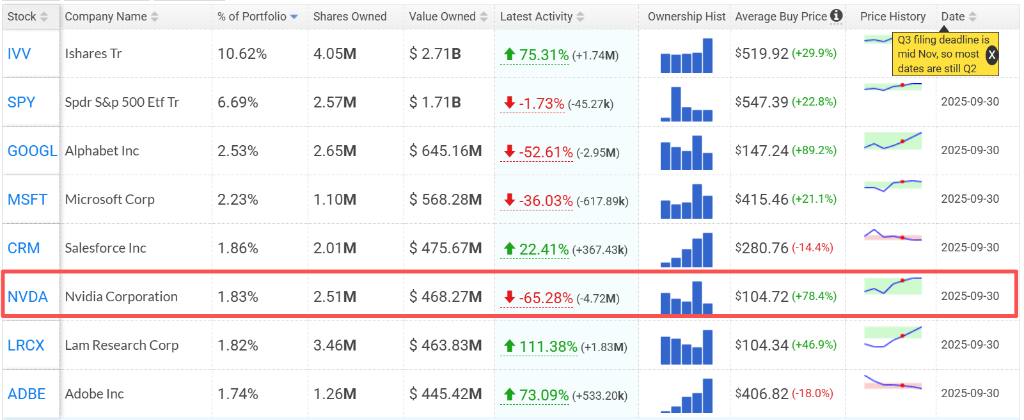
桥水Q3大砍英伟达持仓65%,谷歌、Meta持仓腰斩,加仓美国大盘指数,清仓新兴市场ETF
Hua Er Jie Jian Wen· 2025-11-14 13:04
Core Insights - The article discusses Ray Dalio's Bridgewater Associates significantly reducing its stake in Nvidia by 65.3% in Q3, indicating a strategic shift from trend-following to risk management [2][4] - Bridgewater has increased its holdings in major U.S. ETFs, reflecting a focus on stability and risk mitigation amid rising global debt and liquidity concerns [6][10] - The fund has also completely exited several key individual stock positions, suggesting a broader strategy to reduce exposure to non-core assets [8][12] Summary by Category Nvidia Holdings - Bridgewater's stake in Nvidia dropped from 723 million shares to 251 million shares, a reduction of 65.3% [2] - This shift follows a previous increase of over 150% in the second quarter, highlighting a rapid change in strategy [2] ETF Investments - Bridgewater has significantly increased its investment in U.S. ETFs, with the iShares Core S&P 500 ETF (IVV) now representing 10.62% of the portfolio and the SPDR S&P 500 ETF (SPY) at 6.69% [9][10] - The combined allocation to these ETFs exceeds 17%, indicating a move towards core assets that provide stability [6][9] Exiting Non-Core Assets - The fund has completely liquidated positions in 10 significant stocks, including Lyft, Spotify, and JPMorgan, while also reducing stakes in major tech companies like Amazon and Microsoft [8][12] - This strategy reflects a focus on high liquidity and stable assets, moving away from high-volatility sectors like AI and technology [10][12] New Investments - Despite the overall risk-reduction strategy, Bridgewater has made substantial increases in positions in companies like Netflix and MercadoLibre, indicating a search for undervalued recovery assets [13][15] - These investments are characterized by strong cash flows and lower volatility, contrasting with the high valuations of tech giants [13]
从设备到体验:生态系统合作推动中东和非洲消费科技市场的可持续增长
Canalys· 2025-10-20 01:03
Core Insights - The consumer technology market in the Middle East and Africa (MEA) is shifting from hardware to services, with media and entertainment spending expected to reach $36 billion by 2027, driven by ecosystem collaboration [1][12][16] - Hardware remains foundational, with revenue projected to grow from $32.9 billion in 2020 to approximately $41.9 billion by 2027, while media and entertainment spending is expected to nearly double from $18 billion to $36 billion during the same period [1][12] Market Trends - In some global markets, service revenue has already surpassed device sales, with the GCC market showing an average ARPU exceeding $20, creating space for bundled service models [2][12] - As of Q2 2025, MEA accounts for only 14% of global telecom operators' partnerships with OTT providers, despite a mobile user dominance [2][12] Ecosystem Collaboration - Ecosystem collaboration is leading the shift from product to experience, with manufacturers repositioning devices as service-driven "experience platforms" [4][12] - Bundled offerings, such as Samsung's foldable phones with Netflix, enhance user experience and create strategic opportunities for content providers [4][12] Bundled Service Models - The cost-sharing structure of bundled services varies by partnership type, with telecom-led collaborations typically having operators bear most costs [8][12] - Bundled packages enhance user retention for operators and provide differentiation for manufacturers while expanding reach for service providers [8][12] Role of Telecom Operators and Retailers - Telecom operators and retailers act as enablers in the ecosystem, using multi-layered service bundles to prevent ARPU decline and reduce churn [9][12] - Bundled packages in high ARPU markets offer significant profit margins, enhancing customer retention compared to standalone service purchases [9][12] Consumer Benefits - Bundled packages lower overall usage costs and provide better value compared to purchasing services separately, with convenience and cultural relevance being key factors [9][12] Market Dynamics - The MENA online video market is projected to grow over fivefold to $8.4 billion by 2029, necessitating a shift from subsidy-driven models to sustainable subscription systems [12][16] - The collaboration between manufacturers, telecom operators, and content providers is crucial for capturing long-term value in the evolving market landscape [13][16] Strategic Recommendations - Manufacturers should shift marketing focus from specifications to user experience, while telecom operators expand bundled offerings to mid-tier markets [16][17] - Retailers need to transition from hardware sales to becoming integral parts of the service ecosystem, leveraging partnerships with streaming or software providers [16][17] - Content providers should prioritize collaborations with telecom operators and manufacturers to achieve scale in a fragmented market [16][17]

摩根斯坦利策略首席:中国真正的“核心资产”不是茅台,而是它们
Sou Hu Cai Jing· 2025-10-08 02:13
Group 1 - The core viewpoint is that the current market rally is driven by strong corporate earnings rather than liquidity, indicating a shift from a "liquidity bull market" to an "earnings bull market" [3][6][20] - Corporate earnings have stabilized for three consecutive quarters, with the "Earnings Revision Breadth" indicator turning positive for the MSCI China Index in August, signaling a recovery in companies' profit-generating capabilities [4][25] - The market is experiencing significant internal differentiation, with hot sectors like technology, internet, finance, and biotechnology showing strong earnings growth, while traditional sectors like consumer goods and real estate are facing downward revisions [7][11][29] Group 2 - AI is not a bubble; leading companies in China are significantly undervalued compared to their U.S. counterparts, with the potential for substantial profit contributions from AI integration into their existing businesses [12][13][25] - The market is witnessing a fundamental shift in foreign investment, with over 90% of U.S. investors expressing plans to increase exposure to Chinese stocks, particularly in sectors where China has established global leadership [14][30] - Key sectors attracting foreign investment include humanoid robotics, automation, and biotechnology, indicating a strategic shift in how foreign investors view China from a mere emerging market to a core asset in the global tech race [15][16][30]

大摩首席:外资眼中,中国真正的“核心资产”不是茅台,而是它们
Sou Hu Cai Jing· 2025-10-07 12:52
Group 1 - Core Point 1: The current market rally is not merely driven by liquidity but is supported by improving corporate earnings fundamentals, as indicated by the positive Earnings Revision Breadth for the MSCI China Index in August [4][5][6][27]. - Core Point 2: Identifying the right sectors is crucial, with strong performance expected in technology, internet, finance, and biotechnology, while traditional sectors like consumer goods and real estate are facing downward revisions in earnings expectations [7][9][10][11][31]. - Core Point 3: AI is not a bubble; leading companies in China are significantly undervalued compared to their U.S. counterparts, with the potential for substantial growth as they leverage AI for business enhancement [12][13][14][15]. Group 2 - Core Point 4: Foreign investment interest in the Chinese stock market is increasing, particularly among U.S. investors, with over 90% expressing plans to increase their exposure to Chinese equities, focusing on sectors where China has established global leadership [16][17][18][32][33]. - Core Point 5: The market dynamics are shifting towards a more structured environment, emphasizing the need for investors to focus on companies with core competitiveness that can withstand economic cycles, rather than relying on macroeconomic trends [20][21][22][23][24].

摩根斯坦利首席Laura Wang:外资眼中,中国真正的“核心资产”不是茅台,而是它们
雪球· 2025-10-06 13:00
Group 1 - The core viewpoint is that the current market rally is driven by fundamental performance rather than liquidity, indicating a shift from a "liquidity bull market" to a "performance bull market" [6][7][22] - The "Earnings Revision Breadth" for the MSCI China Index turned positive in August, signaling that the number of companies with upward earnings revisions exceeds those with downward revisions, marking a recovery in corporate profitability [8][27] - The sectors showing strong performance include technology, internet, finance, and biotechnology, while traditional sectors like consumer goods and real estate are facing downward revisions in earnings expectations [10][11][12][31] Group 2 - The importance of selecting the right sectors is emphasized, with a recommendation to focus on "hot" sectors while avoiding "cold" ones, as the market is experiencing significant internal differentiation [9][10][12] - AI is not viewed as a bubble; instead, leading companies in this space are considered undervalued compared to their U.S. counterparts, presenting a significant investment opportunity [14][15][16] - Global investor interest in the Chinese stock market is rising, particularly among U.S. investors, with over 90% expressing plans to increase their exposure to Chinese stocks [17][18][33] Group 3 - The market dynamics are changing, moving towards a more structured market that requires deeper understanding and insight into specific industries rather than relying on macroeconomic trends [21][22] - Investors are encouraged to focus on companies with strong competitive advantages and the potential for growth, particularly in sectors like AI, automation, and biotechnology [19][20][24] - The upcoming consumption data from the Golden Week holiday and the 14th Five-Year Plan meeting are seen as potential catalysts for market movement [35][36]

浦银国际:盈利将成为下阶段行情主导力量 关注AI和出海主线
Zhi Tong Cai Jing· 2025-10-03 03:48
Core Viewpoint - The upcoming market trends will be driven by improving corporate earnings, with a focus on AI and overseas expansion as key investment themes [1][2]. Group 1: Market Trends - The liquidity-driven market rally is expected to continue into the fourth quarter, supported by anticipated interest rate cuts from the Federal Reserve and positive sentiment from potential U.S.-China meetings at the APEC summit [2][4]. - In September, external risks eased, leading to a rebound in Chinese stocks listed abroad, with the MSCI China Index rising by 6.1% and the Nasdaq Golden Dragon China Index increasing by 7.8% [3]. - The Hong Kong stock market is projected to perform well in the fourth quarter due to reduced uncertainties from U.S.-China trade negotiations and strong inflows from foreign and southbound capital [4]. Group 2: Earnings Outlook - Corporate earnings are expected to become the main driving force for the market, with major Chinese stock indices' earnings growth projected to reach double digits next year [5]. - After significant downward adjustments, earnings expectations for the MSCI China Index and the Hang Seng Index have stabilized, indicating that previous negative impacts have been accounted for [5]. Group 3: Investment Strategy - The investment strategy should focus on AI and overseas expansion, as these areas are likely to yield better returns amidst the ongoing market rotation [2][6]. - Recent market behavior shows a rotation of funds from crowded sectors like new consumption and innovative pharmaceuticals to undervalued technology sectors related to AI, indicating a shift in investor sentiment [6].