
建材家居

Search documents
11月BHI回落 全国建材家居市场进入传统淡季
Xin Hua Wang· 2025-12-17 05:57
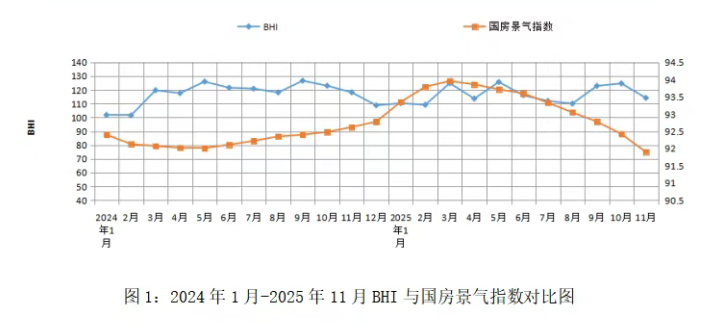
Core Viewpoint - The national building materials and home furnishings prosperity index (BHI) for November is 114.18, showing a month-on-month decline of 10.55 points and a year-on-year decline of 4.06 points, indicating a downturn in the market [1][2]. Group 1: Sales Performance - The sales revenue of large-scale building materials and home furnishing markets in November reached 129.63 billion, reflecting a month-on-month decrease of 12.85% and a year-on-year decrease of 5.75% [1]. - Cumulative sales from January to November 2025 amounted to 1,322.18 billion, representing a year-on-year decline of 3.24% [1]. Group 2: Market Analysis - The decline in sales in November aligns with seasonal trends, as the traditional home decoration off-season coincides with colder temperatures across the country [2]. - The manager confidence index, a leading indicator, increased to 99.11, up by 1.15 points month-on-month, indicating that the core sentiment of optimism regarding future market conditions remains unchanged [2]. Group 3: Recommendations - The China Building Materials Circulation Association suggests that companies should focus on core consumer needs, innovate products to break through homogenization, enhance service experiences, and transform business models to seize growth opportunities during the industry's transformation [2].

提质促升级 我国建材家居行业迈向高质量发展新阶段
Sou Hu Cai Jing· 2025-12-11 13:40
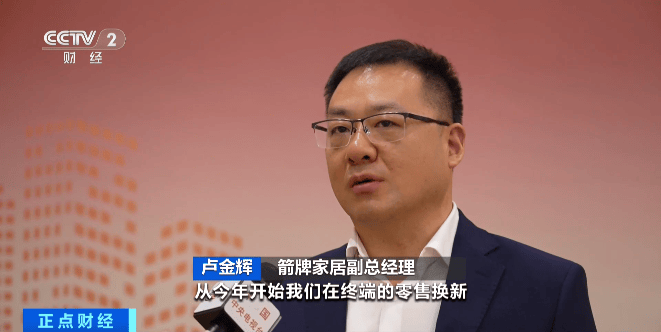
Core Insights - The building materials and home furnishing industry is experiencing accelerated product iteration driven by rising consumer demand for quality living, national policy guidance, and corporate innovation practices [1] Group 1: Market Trends - The demand for smart products is increasing significantly, with companies reporting double-digit sales growth year-on-year [3] - The industry is focusing on human-centered design, healthier low-carbon living environments, and smarter user experiences, creating new systematic and scalable development opportunities [5] Group 2: Government and Corporate Support - The government is providing subsidies of 15% to 20% for energy-saving and green products, while companies are also offering similar support [7] - The rise of smart home technology is enhancing convenience and promoting a comprehensive advancement in green, safe, and intelligent solutions [9]
万亿城市大洗牌!泉州逆袭重返20强,南通佛山“掉队”,合肥烟台狂飙!
Sou Hu Cai Jing· 2025-11-20 09:16
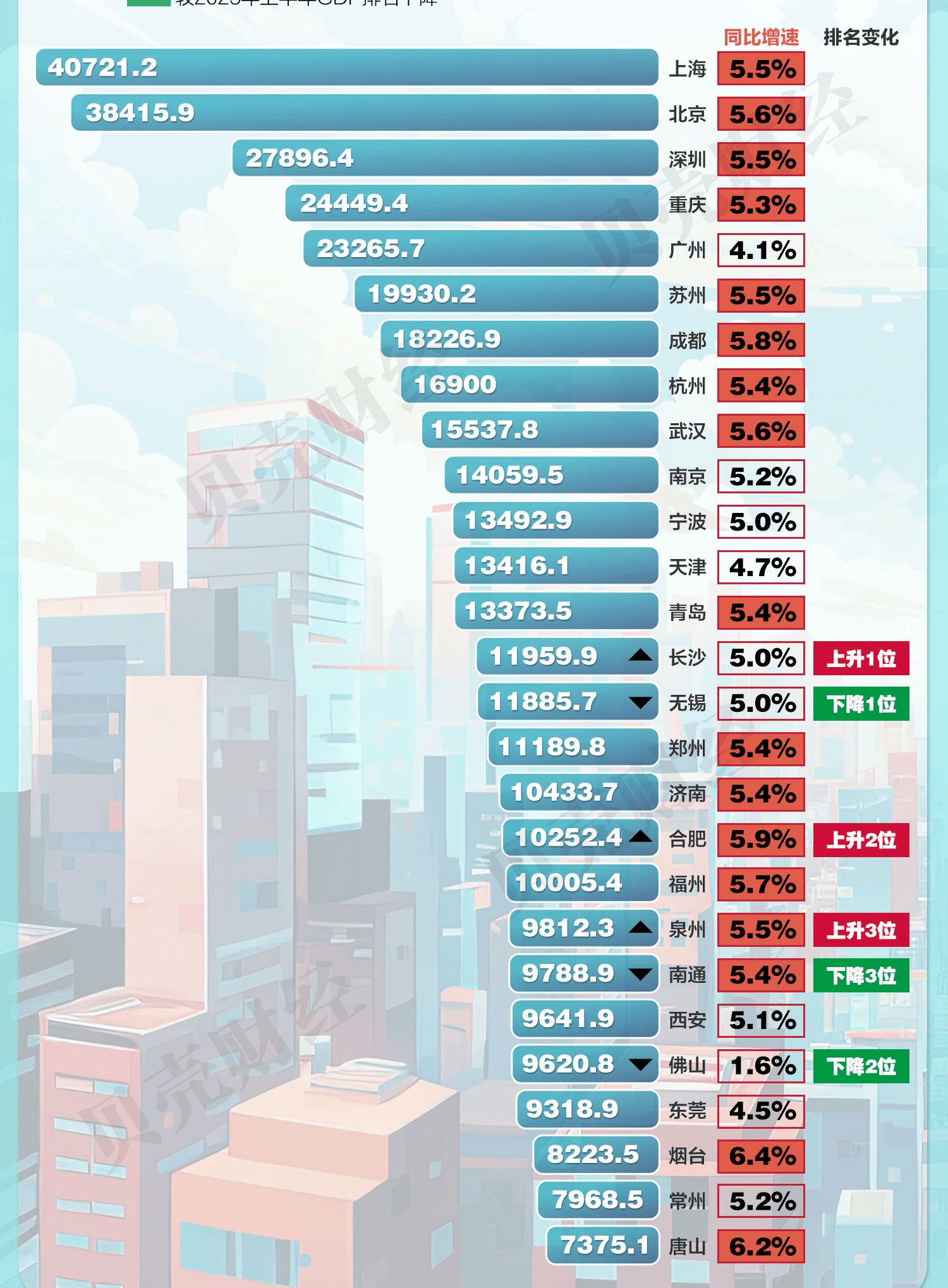
Core Insights - The economic performance of China's trillion-yuan cities has been revealed, with 27 cities reporting their GDP data for the first three quarters, showing a reshuffling in the economic landscape as 17 cities outpaced the national average growth rate [1] Economic Growth - Yantai leads with a GDP growth rate of 6.4%, followed closely by Tangshan at 6.2% and Hefei at 5.9%, indicating a trend where stronger cities continue to thrive [5] - Cities like Quanzhou, Jinan, and Dongguan also reported growth rates exceeding 5%, forming a "second tier" of economic performers [5] City Rankings - Quanzhou has made a significant comeback, re-entering the top 20 after surpassing Nantong, driven by a recovery in manufacturing and foreign trade [7] - Nantong has dropped out of the top 20 due to slowed growth, impacted by real estate and infrastructure investment challenges [7] - Hefei has risen to 18th place, benefiting from technological innovation and policy support, becoming a new growth engine in the Yangtze River Delta [7] Economic Scale - Shanghai has become the first city to exceed 4 trillion yuan in GDP, followed by Beijing with over 3.8 trillion yuan, while Shenzhen, Chongqing, and Guangzhou have surpassed 2 trillion yuan [8] - A total of 19 cities have now entered the "trillion-yuan club," indicating a strong economic foundation among these urban centers [8] Competitive Trends - The shifts in the rankings of trillion-yuan cities are attributed to technological empowerment and industrial upgrades, with Hefei excelling in integrated circuits and new energy sectors [9] - Yantai is transforming traditional industries like marine economy and green chemicals, while Quanzhou is leveraging its manufacturing strengths in textiles and home goods [9] - In contrast, Foshan is facing challenges due to a slowdown in traditional industries such as home appliances and ceramics, highlighting the need for new growth drivers [9] Conclusion - The competition among trillion-yuan cities is intensifying, with Shanghai and Beijing leading, while cities in the Yangtze River Delta and Pearl River Delta are in fierce competition [10] - The economic landscape is evolving, with cities needing to innovate and transform to avoid stagnation, as evidenced by the varying fortunes of Quanzhou, Nantong, and Hefei [10][11]
不出意外,11月起,中国或将迎来5大降价潮,建议大伙提前准备
Sou Hu Cai Jing· 2025-11-01 18:40
Group 1: Consumer Behavior and Market Trends - The upcoming "Double Eleven" shopping festival is anticipated as a crucial opportunity for merchants amid a shift towards more rational consumer spending [1] - Consumers are already sensing a price drop in the market, indicating a competitive environment for retailers [1] Group 2: Home Appliances - A significant price reduction in home appliances is underway, supported by a government subsidy program totaling 690 billion yuan for appliance replacement [3] - The price of large appliances like refrigerators and washing machines can drop by over 1,000 yuan when combined with the subsidy [3] Group 3: Building Materials and Home Furnishings - The building materials and home furnishings sector is experiencing a price drop as unsold inventory from September and October is cleared in November [5] - Despite a month-on-month increase in sales, the year-on-year decline of 8% in the building materials market has led to heavy discounting by brands [5] - The government’s replacement policy also applies to furniture and bathroom products, providing consumers with additional savings [5] Group 4: Essential Goods - Prices for essential goods, including pork and vegetables, have begun to decline, with expectations for this trend to continue into November [5] - Supermarkets are likely to offer bulk discounts on staple items, with rice prices potentially dropping by around 10 yuan for a 5-kilogram bag [5] Group 5: Automotive Market - The automotive market is also seeing a price decline, with both fuel and electric vehicles experiencing price drops in the first three quarters of the year [6] - To meet annual sales targets, many car manufacturers are offering direct discounts and additional services, with some electric vehicle models seeing discounts of up to 30,000 yuan [6] Group 6: Consumer Electronics - The consumer electronics sector is preparing for significant discounts during the "Double Eleven" event, with some products expected to be available at up to 50% off [6] - Laptops and tablets will see enhanced value through additional store coupons during the sales period [6]
讯推科技2025年赋能食博会,助力品牌营销增长
Zhong Guo Shi Pin Wang· 2025-10-24 07:52
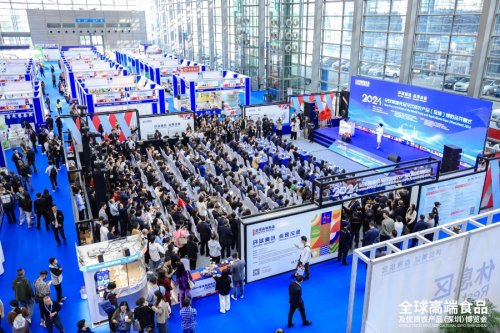
Group 1: Event Overview - The 2025 Global High-end Food and Quality Agricultural Products Expo will be held from October 22 to 24, 2025, at the Shenzhen Convention and Exhibition Center [1] - The expo aims to build a "big food" ecosystem, leveraging the industrial resource advantages of the Greater Bay Area, covering ten specialized exhibition areas [1] Group 2: Company Participation - XunTui Technology Co., Ltd. has become a comprehensive digital operation service provider for brands, participating in the expo to empower enterprises [3] - The company addresses the challenges faced by exhibitors in both domestic and international markets, including unstable international environments and changing domestic consumption structures [3] Group 3: Digital Marketing Solutions - XunTui Technology offers a comprehensive digital operation plan that includes various online marketing strategies such as Douyin operation promotion, WeChat video account promotion, Google SEO optimization, and overseas social media operation [3][6] - The company utilizes big data analysis to understand product characteristics and potential customer needs, providing customized execution plans for exhibitors [4] Group 4: Industry Impact - The marketing strategies implemented by XunTui Technology received recognition from exhibitors, indicating a successful expo that opened new online marketing channels for food enterprises [4] - The company has provided tailored online marketing solutions to over 10,000 enterprises across various industries, including intelligent manufacturing, new materials, and fast-moving consumer goods [6]
环球家居周报:第138届广交会启幕,盈峰20亿增持顾家,马可波罗正式启动申购……
Huan Qiu Wang· 2025-10-20 06:08
Group 1: Furniture Export and Market Trends - In the first three quarters, furniture exports reached 338.4 billion yuan, a year-on-year decrease of 3.9% [1] - In September, furniture exports amounted to 33.37 billion yuan, while lighting products and ceramics saw exports of 18.81 billion yuan and 10.52 billion yuan respectively [1] - The total sales revenue of furniture retail increased by 33.2% year-on-year, driven by the "old-for-new" national subsidy policy [3] Group 2: Home Decoration and Consumer Goods - The "old-for-new" policy led to a significant increase in home decoration consumer goods, with 3.324 million new products added, marking a year-on-year growth of 471.4% [2] - The sales revenue of home improvement materials, sanitary ware, and smart home products saw substantial growth due to the same policy [3] Group 3: Regional Industry Performance - In Zhejiang, the furniture industry achieved an output value of 73.949 billion yuan in the first eight months, with a total production of 181 million pieces, reflecting a year-on-year decline of 3.2% and 4.1% respectively [4] - The production of wooden furniture increased by 9.4%, while metal and soft furniture saw declines of 13.3% and 18.9% respectively [4] Group 4: Retail Market Dynamics - In September, the sales of national building materials and home furnishing markets increased by 23.84% month-on-month, with total sales for the first nine months at 1,044.801 billion yuan, a year-on-year decrease of 3.75% [5] - The market is entering a traditional peak season, supported by the effects of the "old-for-new" policy and holiday consumption [5] Group 5: Corporate Developments - Red Star Macalline's founder was appointed as a non-executive director, while a new deputy general manager was appointed [6] - Juran Home signed a strategic cooperation agreement with JD Mall to open a new store in Shenyang, expected to launch in 2026 [6] - Marco Polo officially launched its IPO with an expected fundraising of approximately 1.643 billion yuan [7] - Nanyang Dick publicly announced a crackdown on over 70 infringing online stores [8] - Kuka Home's fundraising application was accepted, with plans to raise up to 1.997 billion yuan for various projects [9] Group 6: New Market Entries and Investments - The Italian high-end bedding brand RINALDI opened its first store in China [12] - Construmart, a subsidiary of Oriental Yuhong, opened its 32nd store in Chile, enhancing customer experience [14] - Songlin Technology plans to invest an additional 30 million USD in its Vietnamese subsidiary, bringing total investment to 80 million USD [15]
9月全国建材家居市场整体呈现旺季平稳回升态势
Xin Hua Wang· 2025-10-17 02:54
Core Insights - The National Building Materials and Home Furnishing Prosperity Index (BHI) for September is 122.93, showing a month-on-month increase of 12.87 points but a year-on-year decrease of 3.75 points [1] - Sales in large-scale building materials and home furnishing markets reached 130.84 billion yuan in September, reflecting a month-on-month increase of 23.84% but a year-on-year decline of 8.02% [1] - Cumulative sales from January to September 2025 totaled 1,044.80 billion yuan, representing a year-on-year decrease of 3.75% [1] BHI Analysis - The BHI's increase is attributed to the traditional peak season of "Golden September and Silver October," with improved consumer sentiment driven by favorable weather and government subsidy policies [1] - The Manager Confidence Index stands at 159.64, down 3.83 points month-on-month, but remains above the neutral threshold of 50, indicating a generally optimistic outlook for the industry [1] Sales Capability Index - The highest month-on-month increase was observed in the Sales Capability Index, driven by the peak consumption season and the ongoing effects of the "old-for-new" consumption policy [2] - A dual incentive model of "government subsidies + enterprise discounts" has effectively stimulated consumer activity, leading to increased foot traffic and sales in key building materials and home furnishing markets [2] Policy Developments - A new policy document titled "Building Materials Industry Growth Stabilization Work Plan (2025-2026)" was jointly issued by six government departments, marking a shift from "maintaining scale" to "improving quality" in the industry [2] - The policy aims to facilitate a transition from traditional building materials to new material industries through capacity regulation, technological innovation, green transformation, and demand expansion [2] - Industry associations recommend that companies seize the policy window to accelerate structural adjustments and technological innovations to gain a competitive edge in the upcoming industrial transformation [2]
家居业一周|8月全国家具类零售额公布,欧派家居起诉苏宁置业
Bei Ke Cai Jing· 2025-09-22 11:43
Group 1: Industry Overview - In August, the national furniture retail sales reached 16.9 billion yuan, showing a year-on-year growth of 18.6%, significantly higher than the overall retail sales growth rate [2] - The cumulative growth of furniture retail sales from January to August was 22%, indicating a strong recovery in home consumption driven by policies like "old-for-new" exchanges [2] Group 2: Market Index - The national building materials and home furnishings prosperity index (BHI) for August was 110.06, reflecting a month-on-month decline of 1.96 points and a year-on-year decline of 8.08 points [3] - The sales revenue of large-scale building materials and home furnishing markets in August was 105.65 billion yuan, with a month-on-month decline of 7.16% and a year-on-year decline of 15.05% [3] - Cumulative sales from January to August were 913.96 billion yuan, showing a year-on-year decline of 3.10% [3] Group 3: Company News - Oppein Home Group has filed a lawsuit against Suning Real Estate for "contract disputes," with speculation that the issues may arise from project cooperation or payment discrepancies [4] - Kuka Group has undergone a name change to Hangzhou Deyejiajun Enterprise Management Co., Ltd., and now focuses on management consulting and sales, holding approximately 10.77% of Kuka Home's shares [5] - Golden Home is advancing its first phase of the production base project in Thailand, reallocating 150.48 million yuan of its fundraising to ensure timely payments for the project [6] - Love Space has officially reopened its flagship store in Beijing after a comprehensive upgrade, introducing nine service commitments to enhance customer satisfaction and transparency [7][8]

雅加达骚乱后,出海印尼的“淘金梦”要醒了吗?
Hu Xiu· 2025-09-07 13:39
Group 1 - The unrest in Jakarta was triggered by a housing subsidy proposal for lawmakers, highlighting the stark contrast between the elite's benefits and the struggles of the average citizen [2][7] - The economic disparity is significant, with lawmakers earning over $6,000 monthly compared to an average citizen's $190, exacerbated by government budget cuts in healthcare and education [7][8] - The protests quickly escalated, leading to arson at government buildings, a complete traffic shutdown in Jakarta, and a drop of over 3.6% in the stock market [8][9] Group 2 - Indonesia's economy, with a GDP of $1.45 trillion and a population of nearly 280 million, presents substantial growth opportunities, particularly in consumer markets [4][5] - The "Golden Indonesia 2045" vision aims for the country to become a developed economy and the fourth-largest consumer market globally by 2030, with a middle-class population of 75.8 million [5][6] - Chinese companies view Indonesia as a significant growth market, with bilateral trade expected to reach $147.8 billion in 2024, reflecting an annual growth rate of approximately 15% since 2001 [6] Group 3 - Despite the unrest, opportunities in industrial equipment and building materials are emerging, driven by local manufacturing needs and infrastructure projects [12][13] - The demand for building materials is fueled by large-scale infrastructure and real estate projects, as well as rising consumer spending due to urbanization and an expanding middle class [14][15] - The market is evolving, favoring companies that can integrate supply chains and provide B2B services, indicating a shift away from short-term speculative players [17][19]
富森美:拟中期分红2.69亿元 高比例派现凸显发展信心
Zhong Zheng Wang· 2025-08-28 11:53
Core Viewpoint - The company reported a decline in revenue and net profit for the first half of 2025, but maintained strong profitability and a healthy financial structure despite industry challenges [1][2]. Financial Performance - For the first half of 2025, the company achieved operating revenue of 649 million yuan, a year-on-year decrease of 11.55% [1]. - The net profit attributable to shareholders was 318 million yuan, down 6.35% year-on-year [1]. - As of June 30, total assets amounted to 6.73 billion yuan, with shareholders' equity at 5.62 billion yuan, indicating a healthy asset-liability structure and ample cash flow [1]. - The board proposed a cash dividend of 3.6 yuan per 10 shares (before tax), totaling 269 million yuan, which represents 84.59% of the net profit for the first half [1]. Strategic Initiatives - The company is actively responding to challenges in the building materials and home furnishing industry by implementing three core strategies: "Big Market Strategy," "Deep Operation Strategy," and "Innovation in Business Formats and Models" [1]. - In terms of merchant recruitment, the company adopted a "graded pricing" strategy to optimize brand structure and product mix, achieving comprehensive coverage of merchants and efficient resource integration [1]. - Operational improvements were made through brand optimization and empowering small and medium-sized merchants, fostering a collaborative ecosystem in the marketplace [1]. Marketing and Innovation - The company capitalized on the "national subsidy" policy, enhancing merchants' customer acquisition capabilities [2]. - In the first half of 2025, the company hosted three large-scale offline marketing events attracting over 80,000 participants, alongside three online thematic events with over 30 million content exposures and more than 40,000 order conversions [2]. - The company is advancing the innovation and upgrade of the Fushenmei Tianfu project, creating a new commercial platform that integrates smart living, aesthetic experiences, and design communication [2].
