
油气行业

Search documents
1-8月阿塞拜疆固定资产投资总额为66.9亿美元
Shang Wu Bu Wang Zhan· 2025-09-27 03:23
Group 1 - The total fixed asset investment in Azerbaijan for January to August 2025 is 113.7 billion manats (66.9 billion USD), showing a year-on-year decrease of 0.2% [1] - Investment in the oil and gas sector has decreased by 16.6%, while investment in the non-oil and gas sector has increased by 8% [1] - Of the total investment, 58 billion manats (34.1 billion USD) is allocated to production, accounting for 51% of the total; 38.2 billion manats (22.5 billion USD) is for the services sector, making up 33.6%; and 17.5 billion manats (10.3 billion USD) is for residential construction, representing 15.4% [1]
1-8月阿塞拜疆非油气行业产值同比增长4.8%
Shang Wu Bu Wang Zhan· 2025-09-27 03:23
Core Insights - Azerbaijan's industrial output for January to August 2025 reached 420 million manats (approximately 24.7 billion USD), reflecting a year-on-year decline of 1.2% [1] - The oil and gas sector experienced a decrease in output by 2.1%, while the non-oil sector saw an increase of 4.8% [1] Non-Oil Sector Performance - The non-oil sector's composition includes mining (61.2%), manufacturing (32.3%), electricity, gas, and steam production and distribution (5.5%), and water supply, waste management, and recycling (1%) [1] - Notable growth in the manufacturing sector includes: - Pharmaceutical manufacturing increased by 93.5% - Wood processing and wood products manufacturing grew by 85.6% - Textile industry expanded by 29% - Food manufacturing rose by 10.8% - Chemical manufacturing increased by 8.4% - Tobacco manufacturing grew by 8% - Rubber and plastic products manufacturing increased by 6.1% - Machinery manufacturing saw a slight increase of 0.7% [1]
中美会谈在即,出口投资机会再梳理
2025-07-28 01:42
Summary of Conference Call Notes Industry or Company Involved - Focus on the export market and the impact of US-China trade negotiations on various industries, particularly in the hand tools sector and companies like 权丰控股 (Qianfeng Holdings) and 浙江鼎力 (Zhejiang Dingli) [1][7][10] Core Points and Arguments - **US Consumer Market Demand**: The US consumer market shows robust demand supported by improved employee purchasing power, although trade negotiations and tariff adjustments pose risks to export companies [1][5] - **Hand Tools Industry**: The hand tools sector is characterized by low price sensitivity and stable demand from the US housing market, making it a reliable investment area. Interest rate cuts or the removal of capital gains taxes could further stimulate demand [1][6] - **Impact of Tariff Changes**: Tariff changes have varied impacts on companies, with those having a high domestic production ratio benefiting from adjustments. For instance, 权丰控股 has 60% of its capacity in China, positioning it well for potential tariff reductions [7][10] - **Manufacturing Reshoring**: The return of US manufacturing has led to order growth, but capacity constraints and high costs have limited revenue growth. Companies like 浙江鼎力 are expected to maintain stable revenue despite market fluctuations [9][10] - **Investment Opportunities**: Potential investment opportunities arise from tariff changes, particularly for companies with production concentrated in China, such as 凌霄泵业 (Lingxiao Pump Industry) [10] - **Overseas Market Demand**: There is a noticeable increase in demand for consumer goods like high-pressure washers and small generators in overseas markets, prompting companies to establish manufacturing facilities abroad to mitigate tax risks [2][15][14] Other Important but Possibly Overlooked Content - **Complex Tariff Structure**: The current US tariff structure on Chinese goods includes a combination of tariffs from 2018 and recent adjustments, leading to a comprehensive tax rate perceived at 55% [3] - **Manufacturing Development in Southeast Asia**: Southeast Asia and South Asia are emerging as manufacturing hubs, absorbing simple manufacturing from China and gradually moving towards more complex consumer goods production [16] - **Natural Gas Demand**: The growth in natural gas demand is offsetting declines in oil orders, benefiting companies like 杰瑞 (Jereh) and 牛威 (Nuiwei) [13] - **Global Competitiveness**: Companies are encouraged to focus on global competitiveness and overseas expansion, with a significant portion of profitable companies linked to international markets [11][19]
海外札记 20250623:美元短期反弹,并不意味趋势反转
Orient Securities· 2025-06-26 06:34
Group 1: Market Trends - The recent rebound of the US dollar does not indicate a trend reversal but rather a short-term reaction to geopolitical tensions and market conditions[6] - The dollar's rebound began on June 13, following the Israeli attacks, but has limited sustainability due to unchanged oil supply levels[12] - The market is currently experiencing crowded trades against the dollar, which may lead to short-term pressure on previously leading currencies and markets like Europe and Japan[21] Group 2: Economic Indicators - The US economy shows resilience, with GDP growth forecasts for 2025 and 2026 adjusted to 1.4% and 1.6% respectively, while unemployment rates are projected to rise to 4.5%[31] - Inflation expectations have been revised upwards, with PCE inflation projected at 3.0% for 2025, indicating persistent inflationary pressures[31] - The Federal Reserve maintained interest rates at 4.25%-4.50% during the June meeting, with market expectations for two rate cuts by the end of the year[28] Group 3: Geopolitical Risks - Ongoing geopolitical tensions, particularly the Israel-Palestine conflict, have contributed to market volatility and risk premiums in oil prices, with a $10 premium observed in crude oil prices[12] - The geopolitical landscape remains uncertain, impacting risk appetite and commodity prices, necessitating close monitoring of developments[39]
明天,全球市场悬了?
Ge Long Hui· 2025-06-22 10:07
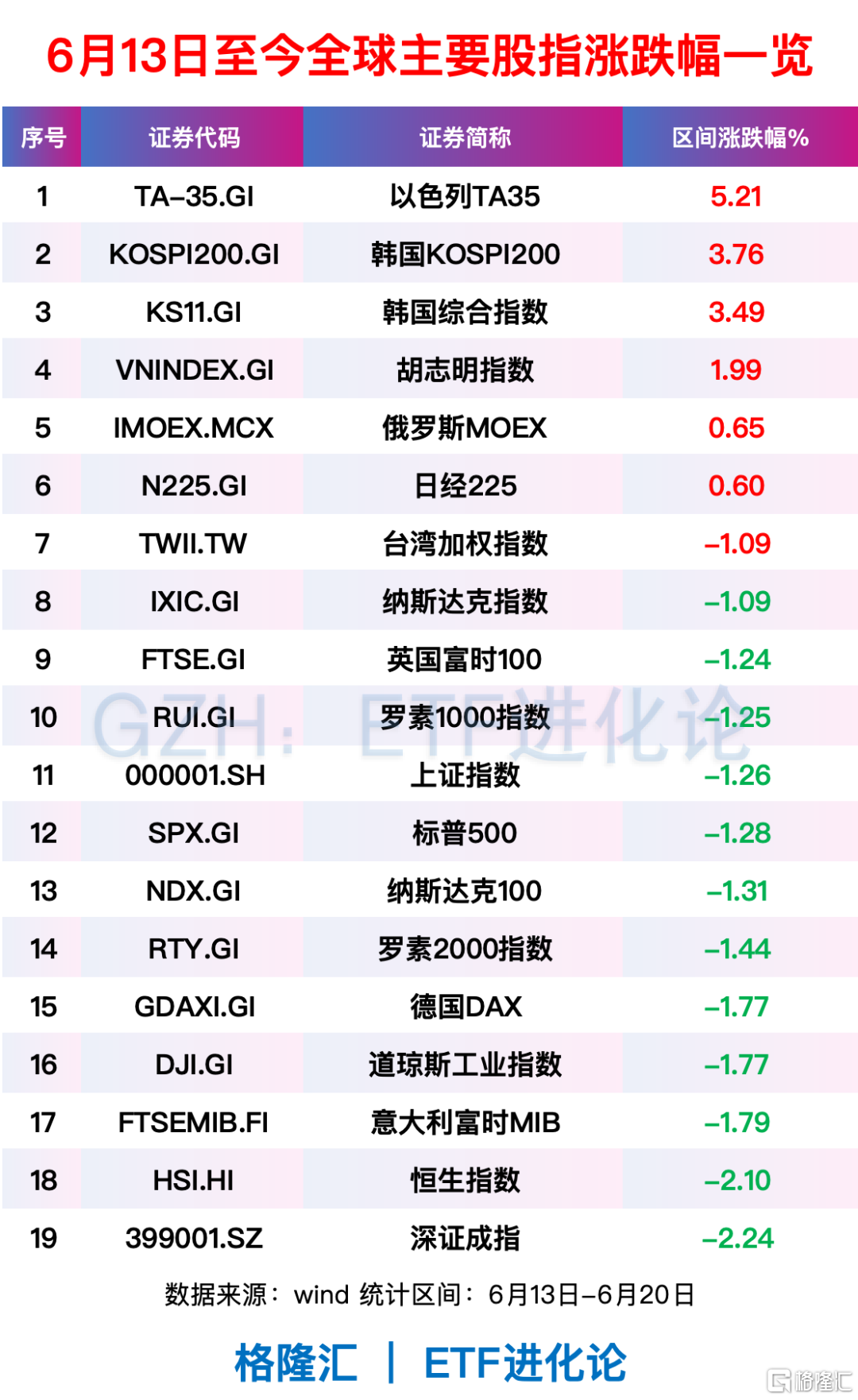
Group 1: U.S. Military Action - The U.S. conducted a significant military operation against Iran on June 21, targeting three nuclear facilities, marking the most severe action since the 1979 Iranian Revolution [1][10] - President Trump announced the completion of the strikes, claiming that Iran's Fordow nuclear facility "no longer exists" and indicated that further targets could be struck if peace is not achieved [10][12] Group 2: Market Reactions - Despite the escalating conflict, global asset markets showed resilience, with major stock indices like Israel's TA35 and South Korea's KOSPI200 recording gains of over 3% from June 13 to June 20 [2][3] - Oil prices initially surged due to the conflict, with Brent crude rising by 11.48% and WTI by 8.82% during the same period, although they later stabilized [6][12] Group 3: Energy Market Implications - Analysts predict that the U.S. strikes may lead to increased oil prices and a potential panic in global markets, with concerns about the strategic importance of the Strait of Hormuz for energy transport [13][15] - The market consensus suggests that any military action by the U.S. will be short-lived, as President Trump aims to keep gasoline prices manageable [16][17] Group 4: Gold Market Dynamics - The gold market experienced a rare decline during the conflict, with spot gold prices dropping below $3,370, despite initial spikes above $3,400 [6][22] - Analysts from Deutsche Bank and Citigroup anticipate that geopolitical risk premiums for gold may re-emerge, with predictions of gold prices peaking between $3,100 and $3,500 in Q3 2023 before declining [26]

特朗普,“签大单”!
第一财经· 2025-05-16 06:21
Core Viewpoint - The article discusses President Trump's recent Middle East visit, highlighting the signing of over $1 trillion in commercial agreements with Saudi Arabia, Qatar, and the UAE, aimed at strengthening economic cooperation and attracting investments to the U.S. [1][4] Group 1: Investment Commitments - Saudi Arabia committed to investing $600 billion in the U.S. over the next four years, although Trump sought to increase this to $1 trillion [4] - Qatar signed agreements worth over $243.5 billion, including a $96 billion deal for Boeing aircraft [4] - The UAE reached agreements exceeding $200 billion, covering aircraft purchases and energy projects [4] Group 2: Strategic Goals - Trump's visit aimed to enhance U.S.-Gulf relations and alleviate domestic political pressures by showcasing significant investment commitments [1][5] - The agreements are seen as a response to Trump's personality and political needs, reflecting Gulf leaders' understanding of his character [1][5] Group 3: Skepticism on Implementation - Analysts express doubts about the actual realization of the announced investment figures, suggesting they may be inflated or based on prior commitments [7][8] - Historical context indicates that previous agreements, such as the $350 billion deal from Trump's 2017 visit, have not been fully realized [7][8] - Economic data shows that U.S. exports to Saudi Arabia from 2017 to 2020 totaled only $92 billion, raising questions about the feasibility of the $600 billion commitment [8]
推进服务业扩大开放 鼓励现货交易场所模式创新
Qi Huo Ri Bao Wang· 2025-04-28 00:55
Group 1 - The Chinese government is accelerating the opening of the service industry amid rising unilateralism and protectionism globally, with a new comprehensive pilot work plan that includes 155 pilot tasks [1] - The work plan encourages the integration of advanced manufacturing and modern service industries to enhance international competitiveness, particularly through innovations in trading models such as capacity pre-sale and order transactions [1] - The establishment of a trading settlement system that aligns with international norms and promotes RMB-denominated products is emphasized to facilitate the efficient integration of manufacturing and services [1] Group 2 - Recent innovations in capacity pre-sale and order trading models on commodity trading platforms have addressed many challenges faced by enterprises and positively impacted the integration of manufacturing and services [2] - The Shanghai Steel Trading Center showcases how production capacities can be auctioned online, allowing sellers to secure customers and buyers to lock in prices, thus enhancing operational efficiency [2] - The "LNG Order Pass," set to launch in June 2024, represents a new order trading model in the oil and gas sector, aimed at improving market transparency and flexibility [2] Group 3 - The "LNG Order Pass" features characteristics such as price locking, dual fulfillment assurance, transparency, and competitive flexibility, which help enterprises manage market uncertainties and efficiently allocate resources [3] - By driving precise matching along the supply chain and embedding services into manufacturing, the integration efficiency of manufacturing and services can be significantly improved [3] - Innovations in trading models and enhanced service levels on commodity trading platforms can strengthen China's resource allocation influence in the global value chain, providing new infrastructure support for service industry expansion [3]