
高值耗材

Search documents
医药季度策略 - 医药开启2
2025-10-27 00:31
Summary of the Pharmaceutical Industry Conference Call Industry Overview - The pharmaceutical industry has entered the 2.0 phase, characterized by significant growth in the innovative drug market and a gradual move towards international markets [1][3] - High-value consumables and minimally invasive stents have begun sales in the U.S., while low-value consumables have achieved internationalization [1][3] - Surgical robots have exceeded global sales expectations, with some products like PET-CT reaching global leadership [1][4] Key Insights and Arguments - **Investment Opportunities in Innovative Drugs**: The innovative drug sector presents significant investment opportunities, with a market potential of 1.2 trillion RMB domestically and 1.8 trillion USD globally. Chinese companies are capable of entering this larger international market, particularly in ADC and bispecific antibody products [1][5] - **Advantages of Domestic Innovative Drug R&D**: Domestic R&D benefits from rich patient resources, low-cost clinical trials, and a strong pipeline reserve, with over 30% pipeline reserve in emerging fields like cell therapy and ADC [1][6] - **CRO Sector Investment Opportunities**: The CRO sector shows promising investment opportunities, with a significant increase in financing expected in 2025, particularly for clinical trials and early-stage R&D [1][7] - **CRO Performance and Future Demand**: In the first half of 2025, CRO companies performed well in overseas markets, with double-digit growth in orders. Domestic demand is expected to recover in 2026, despite weaker performance in 2025 due to project execution cycles [1][8] Additional Important Points - **Market Financing Trends**: Domestic primary market financing reached 660 million USD in August 2025, the highest monthly value in three years, with optimistic projections for the remainder of the year [1][9] - **High-Value Consumables Market Trends**: By 2026, the high-value and low-value consumables markets are expected to complete centralized procurement, with the most significant price pressure having passed. Focus areas include fast-growing surgical fields and products with high foreign investment ratios [1][12] - **Challenges and Opportunities in Medical Equipment**: The medical equipment sector faces challenges due to procurement stagnation from anti-corruption measures, but there is potential for recovery in late 2024. Companies like Mindray and new industry players are expanding into overseas markets, indicating growth potential [1][13]
华创医药2025年重点研究成果与会议合集
华创医药组公众平台· 2025-09-19 12:00
Core Viewpoint - The Chinese innovative drug industry is gradually catching up with Europe and the United States in terms of technology, with some targets and technical pathways already leading globally. The number and value of new drugs authorized for overseas markets continue to increase, leading to world-class pricing and non-linear investment elasticity. The domestic market is experiencing strong growth in demand, with domestic new drug sales continuing to rise, and several innovative pharmaceutical companies have turned losses into profits, entering a stable growth phase [2]. Group 1: Innovative Drugs - The innovative drug sector is witnessing a significant increase in sales driven by strong domestic demand, with a number of innovative companies achieving profitability [2]. - The trend of domestic innovative drugs going overseas is accelerating, with increasing numbers and values of new drug authorizations [2]. - The pricing power of innovative drugs is improving, reflecting the global competitiveness of Chinese pharmaceutical companies [2]. Group 2: High-Value Medical Consumables - The orthopedic sector is expected to see mild price reductions due to continued domestic substitution and accelerated overseas business progress [2]. - The neurosurgery and neurointervention fields are experiencing stable growth post-collection, with new products being launched [2]. - The high-value consumables market is expected to benefit from ongoing domestic replacement and the introduction of new products [2]. Group 3: Medical Devices - The medical device sector is seeing a recovery in bidding prices, with ongoing high-speed growth in bidding data this year [2]. - Companies are entering a phase of inventory reduction, with performance expected to improve in the second half of the year [2]. - The low-value consumables sector is experiencing product upgrades and accelerated expansion into overseas markets [2]. Group 4: Blood Products - The supply side of the blood products industry is concentrating on central state-owned enterprises, gradually clearing the competitive landscape [2]. - The demand side is expected to see continuous upgrades to new products, with industry sentiment gradually improving [2]. Group 5: API (Active Pharmaceutical Ingredients) - The API sector is benefiting from the end of a capital expenditure peak, with three growth logic points driving upward trends: new high-end market products, integrated consolidation and overseas expansion, and cost-leading CDMO [2]. - Leading companies in the API sector are expected to see explosive growth in revenue and profits [2]. Group 6: CXO (Contract Research Organization) - The CXO sector is witnessing a recovery in A+H financing activity, with multiple significant business developments enhancing market confidence [2]. - The focus is on optimizing the supply-side landscape and increasing market share for leading CRO companies [2]. Group 7: Traditional Chinese Medicine and Retail Pharmacy - The traditional Chinese medicine sector is showing signs of recovery, with friendly pricing for new drugs and ongoing observation of collection progress [2]. - The retail pharmacy sector is influenced by the pace of supply-side clearing and business model upgrades, with expectations of increased store closures in the second half of 2025 [2]. Group 8: Research and Development Services - The domestic innovative drug business development is heating up, likely driving downstream demand recovery [2]. - The overseas market presents significant growth opportunities for domestic companies, leveraging cost-effectiveness and service differentiation [2].






华创医药 | 2025年我们做了什么
华创医药组公众平台· 2025-09-18 03:41
Core Viewpoint - The Chinese innovative drug industry is gradually catching up with Europe and the United States in terms of technology, with some targets and technical pathways already leading globally. The number and value of new drugs authorized for overseas markets continue to increase, leading to world-class pricing and non-linear investment elasticity. The domestic market is experiencing strong growth in demand, with domestic new drug sales continuing to rise, and several innovative pharmaceutical companies have turned losses into profits, entering a stable growth phase [2]. Group 1: Innovative Drugs - The innovative drug sector is witnessing a significant increase in sales driven by strong domestic demand, with a number of innovative companies achieving profitability [2]. - The trend of domestic innovative drugs going overseas is accelerating, with increasing numbers and values of new drug authorizations [2]. - The industry is positioned for a "Davis double" effect, where both performance and valuation are expected to improve [2]. Group 2: High-Value Medical Consumables - The orthopedic sector is expected to see mild price reductions, while domestic replacements continue to grow, and overseas business progresses rapidly [2]. - The neurosurgery and neurointervention fields are stabilizing after centralized procurement, with new products expected to contribute to growth [2]. Group 3: Medical Devices - The medical device sector is experiencing a high-speed growth in bidding data, with companies entering a destocking phase, which is expected to improve performance in the second half of the year [2]. - The low-value consumables sector is seeing continuous product upgrades and accelerated expansion into overseas markets [2]. Group 4: Blood Products - The supply side of the blood products industry is increasingly concentrated among state-owned enterprises, leading to a clearer competitive landscape [2]. - The demand side is expected to upgrade towards new products, gradually improving the industry's overall health [2]. Group 5: API (Active Pharmaceutical Ingredients) - The industry is at an upward turning point due to the end of a capital expenditure peak, combined with three growth drivers: new high-end market products, integrated consolidation and overseas expansion, and cost-leading CDMO [2]. - Leading companies are expected to see explosive growth in revenue and profits in the medium term [2]. Group 6: CXO (Contract Research Organization) - The CXO sector is seeing a revival in A+H financing activity, with multiple significant business developments enhancing market confidence [2]. - The focus is on optimizing the supply-side landscape and increasing market share for leading CRO companies [2]. Group 7: Traditional Chinese Medicine and Retail Pharmacy - The traditional Chinese medicine sector is showing signs of recovery, with friendly pricing for new drugs, while the retail pharmacy sector is influenced by supply-side adjustments and business model upgrades [2]. - The performance of offline pharmacies is expected to improve in the second half of 2025, with leading chains like YaoXingTang making progress in store upgrades [2]. Group 8: Research Reports - A series of in-depth research reports on various companies and sectors within the pharmaceutical and medical device industries have been published, highlighting their growth potential and market positioning [3][4].


中信证券:医药板块涨势还远未结束 主升浪有望中长期持续
智通财经网· 2025-09-11 00:27
Core Viewpoint - The pharmaceutical sector in A-shares and Hong Kong stocks is expected to see a significant recovery in the first half of 2025, driven by major policy optimizations in medical insurance, a strong recovery in hospital demand, and returns from innovation [1] Pharma Sector - The pharmaceutical sector's revenue and net profit growth rates for the first half of 2025 are -4.04% and -0.50% respectively, with traditional and generic drug companies facing revenue pressure due to centralized procurement policies [2] - Companies with a high proportion of innovative drugs are benefiting from rapid commercialization, maintaining good growth [2] - The sector's R&D expense ratio is 12.69%, up 0.29 percentage points from the first half of 2024, indicating a commitment to innovation [2] - The gross margin and net margin for the sector are 66.83% and 20.73%, respectively, showing improvement due to the higher proportion of high-margin innovative drug revenues [2] Biotech Sector - The biotech sector's revenue growth rate is 14.12%, with a significant contribution from BD licensing income [3] - Many biotech companies are achieving operational profitability through drug commercialization, with companies like BeiGene and Innovent Biologics leading the way [3] - The sector is expected to showcase innovative products at international conferences, indicating a strong presence in global innovation [3] Medical Devices - The medical device sector's revenue and net profit growth rates for the first half of 2025 are -5.11% and -17.99%, respectively, due to policy disruptions and delayed procurement funding [4] - Despite the overall decline, certain sub-sectors show promise, with expectations of a turning point in Q3 2025 [5] CRO and CDMO - The CRO sector's revenue growth is 14.05%, with net profit growth of 18.34%, benefiting from a recovery in overseas investment and innovation [8] - The CDMO sector's revenue growth is 10.34%, with strong demand for projects in drug development and production [9] Blood Products - The blood products sector's revenue growth is 0.64%, with net profit declining by 13.06%, but long-term growth remains strong due to increasing domestic supply [12] Internet Healthcare - The internet healthcare sector is experiencing a significant upward trend, with a revenue growth rate of 16.31% and a net profit growth rate of 134.16%, indicating a shift towards profitability [18]

我们怎么看医药中报
2025-09-04 14:36
Summary of the Conference Call on the Pharmaceutical Industry Industry Overview - The pharmaceutical industry experienced a profit decline in 2019 due to centralized procurement policies, but demand growth during the pandemic provided some relief. By the first half of 2025, segments such as innovative drugs, pharmaceutical commerce, and CXO showed positive growth, although overall profit levels continued to decline [1][2]. Key Insights and Arguments - **Centralized Procurement Impact**: The centralized procurement of medical consumables began in 2020, leading to negative revenue growth for two consecutive quarters by Q4 2023. However, Q1 2024 saw a return to positive revenue growth, indicating a stabilization in high-value consumables [3][4]. - **Sector Performance**: The chemical preparations sector saw significant revenue declines in Q3 and Q4 of 2023, directly linked to centralized procurement policies. The medical consumables sector has faced revenue and profit pressures since 2022, with in vitro diagnostics (IVD) expected to face challenges starting Q4 2024 [5][6]. - **Future Outlook**: The worst period for the pharmaceutical industry is believed to be over, with price issues being resolved. The price levels are relatively low compared to international markets, and a return to positive growth is anticipated in Q2 2025, potentially leading to an overall positive growth for the year [6][7]. Segment-Specific Insights - **CXO Sector**: The CXO sector is divided into demand-driven and supply-driven enterprises. The latter has benefited from the recovery of overseas markets, while domestic demand-driven companies are beginning to show signs of recovery, as evidenced by the performance of companies like Tigermed and Northstar [7][8]. - **IVD Sector**: The IVD sector is under significant pressure due to policy impacts, with a notable 20% decline in Roche's domestic luminescence business. The overall industry growth rate is approximately -15% [12][13]. - **Medical Equipment**: The medical equipment sector has faced continuous declines since Q4 2023, but signs of recovery were noted in the first half of 2025, with companies like United Imaging and Mindray showing varying degrees of recovery [17][18]. Additional Important Points - **High-Value Consumables**: The high-value consumables sector has undergone multiple rounds of centralized procurement, leading to stable or improved performance for many companies. The gross margin levels for high-value consumables have reached a bottom, with certain products like artificial crystals beginning to see the effects of procurement policies [19][20]. - **Internationalization of Domestic Companies**: Domestic high-value consumables companies are enhancing their international capabilities, with significant clinical data published and FDA certifications obtained for products aimed at the U.S. market [23]. - **Market Competition**: The competition in the luminescence industry is intense, particularly among companies outside the top three, which are resorting to price cuts to gain market share, resulting in significant declines in gross margins [13][14]. This summary encapsulates the key points discussed in the conference call regarding the pharmaceutical industry, highlighting the challenges and opportunities within various segments.
国信证券:反内卷,更要买高门槛资产
Zhi Tong Cai Jing· 2025-08-15 00:25
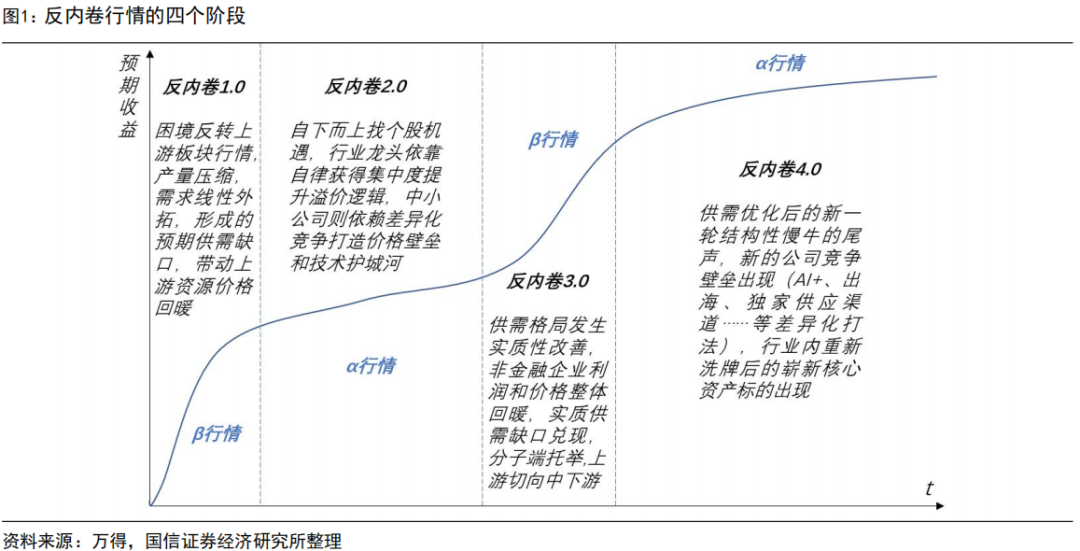
Core Viewpoint - The report from Guosen Securities emphasizes the importance of focusing on investment opportunities that are immune to "involution," highlighting three high-barrier sectors: monopolistic industries like public utilities and rare earths, industries with exclusive products and global competitiveness in hard technology, and sectors where AI accelerates the replacement of repetitive tasks [1][2][3]. Group 1: High-Barrier Industries - Monopolistic barrier assets, such as public utilities (electricity, water) and strategic rare resources (like rare earths), effectively avoid intense market competition and provide stable cash flow and pricing power, making them excellent defensive investments [2][11]. - Global competitive assets are characterized by technological innovation and product exclusivity, allowing companies to successfully expand into overseas markets and create unique advantages, primarily found in high-end manufacturing and hard technology sectors [2][11]. - AI-driven efficiency revolution assets are transforming traditional industries by replacing repetitive labor, significantly enhancing productivity and accelerating the "involution" process in certain sectors [3][19]. Group 2: Market Phases of "Involution" - The "involution" market is currently transitioning from the first phase (involution 1.0) to the second phase (involution 2.0), where the focus shifts from broad industry recovery to individual stock selection based on self-discipline and competitive differentiation [4][6]. - The first phase is characterized by supply-side contraction leading to a supply-demand gap, benefiting upstream resource sectors like steel and coal [4][6]. - The second phase sees a focus on high-quality companies that can achieve market share and profitability recovery through strict production discipline, while smaller firms must innovate and create unique competitive advantages [4][6]. Group 3: Long-Term Investment Strategy - The long-term strategy emphasizes investing in industries with natural high barriers to entry, which can provide stable and higher returns compared to short-term "involution" opportunities [11][13]. - Historical data indicates that monopolistic industries, such as public utilities and strategic rare resources, have shown resilience and sustained performance compared to emerging industries that have faced downturns [11][13]. - The report suggests prioritizing sectors with high entry barriers, such as public utilities and strategic resources, which offer stable cash flows and are less affected by economic cycles [11][13].
国泰海通证券-产业策略:2025下半年医药产业政策展望,保基本、强创新-250710
GUOTAI HAITONG SECURITIES· 2025-07-10 07:42
Investment Rating - The report does not explicitly state an investment rating for the industry Core Insights - The policy direction focuses on "ensuring basic needs and strengthening innovation," aiming to enhance accessibility and affordability of medical products and services while promoting innovation across the pharmaceutical industry [4][7] - The support for innovative drugs continues to increase, with measures to enhance their quality development and integration into insurance systems [12][13] - The report highlights the ongoing collection and procurement processes for various drug categories, including generic drugs, traditional Chinese medicine, and high-value consumables, indicating a trend towards optimization and expansion [21][24][31] Summary by Sections 1. Top-Level Design Direction - The central government has issued guidelines to enhance social security and improve public services, particularly in the healthcare sector, emphasizing the need for equitable access to medical resources [7][8] 2. Support for Innovative Drugs - The National Healthcare Security Administration (NHSA) and the National Health Commission have released measures to support the high-quality development of innovative drugs, including multi-channel payment systems and international promotion [12][13] - The introduction of a separate payment mechanism for long-term and high-cost drugs is being implemented in various provinces, enhancing accessibility for patients [14][16] 3. Generic Drugs - The report anticipates optimization of the rules for the 11th batch of drug procurement, which is expected to take place in 2025, focusing on quality and price adjustments [21][23] 4. Traditional Chinese Medicine - The procurement rules for traditional Chinese medicine are becoming clearer, with expectations for quality improvements and market expansion [24][26] 5. High-Value Consumables - The report notes that most high-value consumable procurement has been completed, with ongoing attention to key product renewals and the expansion of procurement coverage [31][32] 6. In Vitro Diagnostics (IVD) - The report discusses the dual approach of alliance procurement and service price governance, indicating a comprehensive strategy to enhance the IVD sector [35][38] 7. Industry Regulation - Regulatory measures are being strengthened to guide high-quality development in the healthcare sector, including ongoing efforts to combat corruption and ensure compliance among medical institutions and retail pharmacies [8][9] 8. Real-Time Medical Insurance Settlement - The NHSA plans to implement real-time settlement of basic medical insurance funds by the second half of 2025, which is expected to alleviate cash flow pressures for medical institutions [9][10]