
创投

Search documents
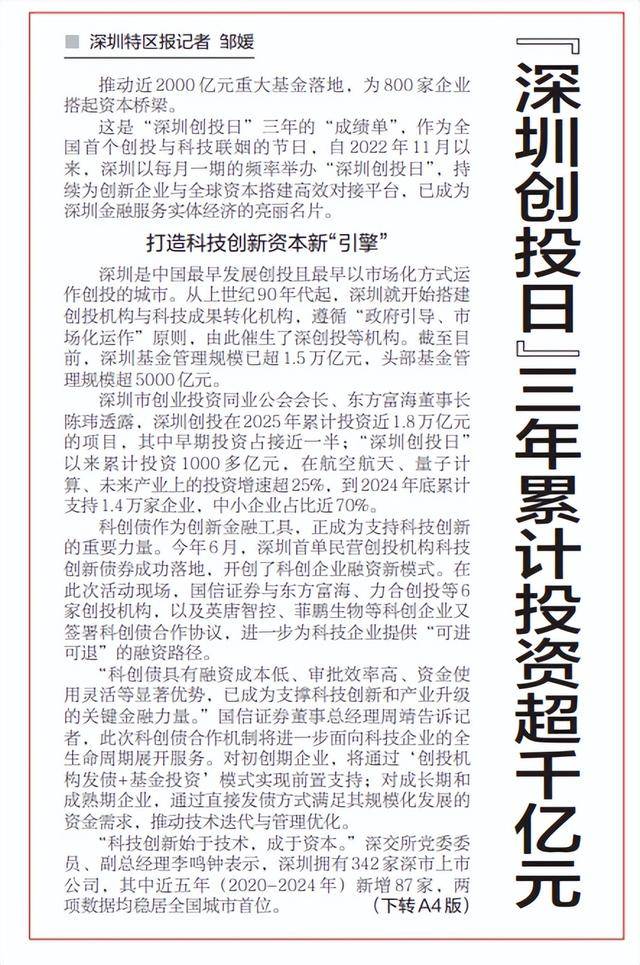
【深圳特区报】“深圳创投日”三年累计投资超千亿元
Sou Hu Cai Jing· 2025-11-06 23:42
Group 1 - Shenzhen has successfully established a significant capital bridge for approximately 800 enterprises, with nearly 200 billion yuan in major funds launched since the inception of "Shenzhen Venture Capital Day" in November 2022 [1] - The city has a fund management scale exceeding 1.5 trillion yuan, with leading funds managing over 500 billion yuan [5] - The cumulative investment since the launch of "Shenzhen Venture Capital Day" has surpassed 100 billion yuan, with investments in aerospace, quantum computing, and future industries growing at over 25% [5] Group 2 - The introduction of "Science and Technology Innovation Bonds" is becoming a crucial financial tool to support technological innovation, with the first bond successfully issued in June [5] - The bond mechanism aims to provide flexible financing paths for technology enterprises throughout their lifecycle, with a focus on early-stage support and direct bond issuance for growth and mature companies [5] - Shenzhen has 342 listed companies on the Shenzhen Stock Exchange, with 87 new companies added in the past five years, leading the nation [6] Group 3 - A total of over 900 billion yuan in medium to long-term funds has been launched, including bank-affiliated financial asset investment company (AIC) funds, insurance private equity funds, and seed funds for technological innovation [6][7] - The AIC funds, totaling 370 billion yuan, will focus on strategic emerging industries such as artificial intelligence, semiconductors, and biomedicine [6] - Three large insurance private equity funds have been established in Shenzhen, with a total scale of 494 billion yuan, highlighting the role of insurance capital as a stable source of funding for technological innovation [7]

“深圳创投日”三周年:超900亿基金群落地,助力科技发展
Nan Fang Du Shi Bao· 2025-11-06 15:21
Group 1 - The "Shenzhen Venture Capital Day" celebrated its third anniversary with a focus on the "AI Era," attracting nearly 200 representatives from various sectors including government, finance, and technology [1] - Over the past three years, the event has hosted more than 30 themed activities, connecting over 800 companies and facilitating nearly 200 billion yuan in fund deployment, establishing itself as a hub for global innovation resources and capital [1] Group 2 - Three categories of funds were announced at the event, with a total scale exceeding 90 billion yuan, aimed at providing robust capital support for technological innovation [3] - The bank AIC fund has reached a cumulative deployment of 37 billion yuan, focusing on strategic emerging industries such as AI, semiconductors, and biomedicine [3] - Insurance private equity funds in Shenzhen have totaled 49.4 billion yuan, providing stable long-term funding for technological innovation [3] - The seed fund group has proposed 27 funds with a total scale of 4.136 billion yuan, targeting early-stage innovative projects [3] Group 3 - The Shenzhen Stock Exchange aims to support local enterprises in broadening financing channels through the bond market and knowledge property transactions [4] - Since the launch of the "Science and Technology Innovation Board," 28 companies in Shenzhen have issued 61 technology innovation bonds, totaling 71.345 billion yuan [5] - The Qianhai Equity Exchange Center has served 18,000 companies and facilitated 20 companies to list on domestic and overseas exchanges [5] Group 4 - Shenzhen has released a work plan to attract global sovereign funds, proposing 10 policies and 24 specific measures to engage with top sovereign funds worth 15 trillion dollars [6] - The Shenzhen Venture Capital Industry White Paper (2000-2025) was published, highlighting Shenzhen's unique ecosystem of "government guidance and market-oriented operation" in the venture capital market [6] - Industry leaders discussed trends in AI, emphasizing the importance of data accumulation, operating system development, and intelligent robot interaction as current value opportunities [6]
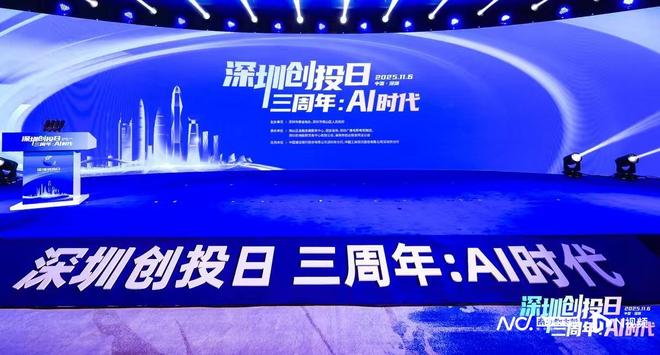
深圳创投日三周年活动成功举办 超900亿基金群落地赋能AI时代科创
Zheng Quan Shi Bao Wang· 2025-11-06 14:56
Group 1 - The "Shenzhen Venture Capital Day" has successfully facilitated the connection between innovative enterprises and global capital, resulting in the establishment of over 90 billion yuan in medium to long-term funds, significantly boosting Shenzhen's "20+8" industrial system [1] - Since its inception in November 2022, the event has hosted 34 themed activities and nearly 100 regular roadshows, attracting over 7,112 venture capital institutions and facilitating nearly 200 billion yuan in major fund agreements [1] - The recent event highlighted the launch of over 90 billion yuan in medium to long-term funds, covering the entire growth cycle of technology enterprises, and complementing the previously announced 7 billion yuan AIC mother fund [1] Group 2 - Shenzhen has made significant strides in the field of technology bonds, with the successful issuance of the first private venture capital institution's technology innovation bond, marking a new financing model for tech enterprises [2] - As of the end of October, 28 companies in Shenzhen have issued 61 technology innovation bonds, with a total issuance scale of 71.345 billion yuan, establishing a strong financial support system for technological innovation [2] - The regional equity market has seen the signing of multiple cooperation agreements, with 557 companies listed on the "specialized, refined, distinctive, and innovative" board, facilitating efficient capital market access for small and medium-sized enterprises [2]
三周年:2000亿元!
Shen Zhen Shang Bao· 2025-11-06 12:45
Core Insights - The "Shenzhen Venture Capital Day" has successfully hosted 34 themed events and nearly 100 regular roadshow activities over three years, attracting over 7,112 venture capital institutions globally and facilitating nearly 200 billion yuan in major fund signings [1][5] - The event showcased Shenzhen's strategic layout and achievements in promoting high-quality development in the venture capital industry, with a focus on the "20+8" industrial tracks [1][5] Fundraising Achievements - The 2025 annual major fund recruitment results were announced, with total fund sizes exceeding 900 billion yuan, including bank-affiliated financial asset investment companies, insurance private equity funds, and a group of seed funds for scientific innovation [2][3] - The bank-affiliated AIC funds focus on strategic emerging industries, totaling 370 billion yuan, while insurance private equity funds reached 494 billion yuan [3] - A total of 27 seed funds for scientific innovation were established, with a combined scale of 41.36 billion yuan, targeting hard technology projects in fields such as artificial intelligence and quantum information [3] Innovative Financing Models - Following the successful launch of the first private venture capital institution's technology innovation bonds in June, new cooperation agreements for technology innovation bonds were signed at the event, providing flexible financing pathways for tech companies [4] - The technology innovation bond mechanism aims to support companies throughout their lifecycle, offering preemptive support for startups and direct bond issuance for growth and mature companies [4] Market Impact and Future Outlook - Shenzhen's fund management scale has surpassed 1.5 trillion yuan, with leading funds managing over 500 billion yuan, reflecting the city's robust venture capital ecosystem [5] - The Shenzhen venture capital sector has invested nearly 1.8 trillion yuan in projects, with early-stage investments accounting for nearly half, and a significant focus on aerospace, quantum computing, and future industries [5] - The capital market in China is expected to increase by 100 trillion yuan over the next decade, with Shenzhen venture capital playing a crucial role in fostering research and development and expanding overseas markets [6] Event Highlights - Six specialized sub-forums were held, focusing on various sectors such as AI, intelligent manufacturing, and new energy materials, providing precise matching platforms for innovative projects [7] - The event was co-hosted by multiple government and financial institutions, emphasizing the collaborative effort in promoting Shenzhen as a global venture capital center [7]
张江高科(600895):业绩稳健增加,创投龙头投资收益大增
Haitong Securities International· 2025-11-04 01:59
Investment Rating - The report assigns an "Outperform" rating to the company [4][13]. Core Insights - The company is a key developer in Zhangjiang Science City and the only listed entity among its operators, benefiting from abundant resources in the area. Future investment returns are expected to be promising [4][13]. - In the first three quarters of 2025, the company's performance showed growth, with strong investment profit momentum. The expected EPS for 2025 is RMB 0.72, and the RNAV is RMB 50.13, leading to a fair value estimate of RMB 55.14 [4][13]. - Revenue for the first three quarters of 2025 reached RMB 2.00 billion, a year-on-year increase of 19.09%, while net profit attributable to shareholders was RMB 617 million, up 20.66% [4][13]. Financial Summary - The company achieved a net profit of RMB 948 million in 2023, with projections of RMB 982 million in 2024 and RMB 1,122 million in 2025, reflecting a growth rate of 15.3%, 3.6%, and 14.2% respectively [3][6]. - The total assets as of September 2025 were RMB 59.40 billion, an increase of 1.72% from the previous year-end, with net assets attributable to shareholders at RMB 14.76 billion, up 6.36% [4][13]. - Investment profit for the first three quarters of 2025 was RMB 696 million, a significant increase of 885.61% year-on-year [4][13]. Real Estate Performance - Real estate sales revenue for the first three quarters of 2025 was RMB 1.13 billion, representing a year-on-year increase of 24.81%. The company had no new real estate project reserves during this period [4][13]. - The total leased real estate area as of September 2025 was 1.87 million square meters, with rental income of RMB 861 million, up 13.31% year-on-year [4][13].

英诺求变,科创基金新起航
投中网· 2025-11-03 06:26
Core Viewpoint - In the evolving landscape of early-stage investment, Inno Angel is adapting its strategy by launching dual-brand operations with the Inno Angel Fund and the Inno Tech Innovation Fund to address the challenges of high valuations in quality projects and the funding needs of tech entrepreneurs [3][4][5] Group 1: Strategic Shift - Inno Angel is transitioning to a dual-brand operation to balance early-stage investment and hard technology opportunities, with a focus on early-stage groundwork and high-potential project investments [4][5] - The Inno Tech Innovation Fund aims to increase investment amounts and deepen industry empowerment, while the Angel Fund emphasizes quick decision-making and early-stage investments [5][10] Group 2: Fund Performance and Structure - The Inno Tech Innovation Fund has successfully raised its second phase and is structured to enhance investment efficiency, with independent pre-investment teams for both funds [5][10] - Historical performance shows that the first phase of the Tech Innovation Fund is nearing a DPI of 1, with significant valuation increases for invested companies [10][11] Group 3: Market Positioning and Focus - The Inno Tech Innovation Fund targets companies with valuations under 1 billion, focusing on new-generation information technology and intelligent manufacturing sectors [10][11] - The fund's strategy includes a significant allocation of 70% to early-stage projects and 30% to growth-stage projects, ensuring risk diversification and enhanced returns [11] Group 4: Unique Differentiation - Inno Angel has developed a multi-layered system of "cognition, connections, and ecosystem" to identify and capture under-the-radar projects [13][16] - The firm emphasizes deep empowerment of portfolio companies, positioning itself as a "co-founder" rather than just a financial backer [17][19] Group 5: Trust and Transparency - Inno Angel has established a trust system with LPs through transparent operations and a commitment to shared risks and rewards, enhancing long-term relationships [19][20] - The firm’s culture promotes values of transparency, curiosity, kindness, simplicity, and joy, which resonate with its investment philosophy [19][20]

内地资本新潮涌动 创投机构跨过香江
Zhong Guo Zheng Quan Bao· 2025-11-02 20:16
Core Insights - The article discusses the strategic movement of mainland venture capital firms towards Hong Kong, highlighting the establishment of new funds and the acquisition of necessary licenses to facilitate this transition [1][2][4]. Group 1: Fund Establishments and Collaborations - CMC Capital and HKIC have jointly established the "CMC AI Creative Fund," focusing on generative AI applications in the creative industry, with a total investment of $130 million in LiblibAI's Series B funding [2]. - The Gobi-Redbird Innovation Fund (Gobi-RIF) was created by Hong Kong University, HKIC, and Gobi Capital to support early-stage startups incubated by the university, aiming to commercialize cutting-edge academic research [3][4]. Group 2: Investment Focus and Goals - Gobi-RIF will invest in 15 to 20 startups over 7-8 years, targeting sectors such as biotechnology, Industry 4.0, AI, robotics, and fintech, with three companies already receiving funding [4]. - CMC Capital aims to leverage Hong Kong's international data environment and policy advantages to establish the city as a hub for GenAI innovation in Asia [3]. Group 3: Licensing and Regulatory Developments - Several mainland VC and PE firms, including Bohua Capital and Jiangyuan Investment, have successfully obtained Hong Kong's SFC licenses for securities advice and asset management, marking significant steps towards internationalization [5][6]. - The article notes that many VC firms are in the process of setting up offices in Hong Kong to enhance their international investment capabilities [6]. Group 4: Market Trends and Opportunities - The Hong Kong stock market has shown strong performance, with the Hang Seng Index and Hang Seng Tech Index both rising approximately 30% this year, boosting confidence in the primary market [8]. - The Hong Kong government is actively promoting the innovation and technology sector, with initiatives aimed at establishing the city as an international innovation and technology center [8].
500亿,浙江超级基金诞生
投资界· 2025-11-02 07:59
Core Viewpoint - The establishment of the Zhejiang Social Security Science and Technology Innovation Fund, with an initial scale of 500 billion yuan, signifies a new impetus for technological innovation in Zhejiang, aiming to create a high-level industrial ecosystem [2][5]. Investment Strategy - The Zhejiang Social Security Science and Technology Innovation Fund is designed to serve national development as a market-oriented fund, with contributions from the National Social Security Fund, Zhejiang Province, and Agricultural Bank of China [5][6]. - The fund will adopt a "mother fund leading + specialized fund deepening" model to promote market-oriented, legal, and professional investment operations, becoming a key vehicle for accelerating technological innovation in Zhejiang [5][6]. Fund Structure - The fund plans to establish six specialized funds, including the Zhejiang New Industry Science and Technology Mother Fund and the Zhejiang Major Project Direct Investment Fund, to enhance Zhejiang's competitive industries and foster emerging sectors [6][10]. - The fund aims to provide long-term and patient capital support for national development and innovation in Zhejiang, facilitating the emergence of new productive enterprises and advancing the integration of technological and industrial innovation [6][10]. Ecosystem and Environment - Zhejiang has been recognized for its favorable business environment, which encourages innovation and supports the integration of technology and industry, as evidenced by the implementation of policies aimed at deepening this integration by 2030 [8][9]. - The province's government has committed to optimizing the innovation ecosystem, with significant investments in technology innovation reaching over 700 billion yuan, including more than 150 billion yuan from government sources [9][10]. Investment Activity - In 2023, Zhejiang's venture capital ecosystem has become increasingly active, with the establishment of the Zhejiang Science and Technology Mother Fund, which has quickly set up 37 sub-funds and invested in 110 projects [9][10]. - The province has seen a rise in the number and scale of newly raised funds, with 447 funds completing new rounds of fundraising in the first half of 2025, reflecting a year-on-year increase of 15.8% in quantity and 26.0% in scale [11].

VC变成了高利贷
虎嗅APP· 2025-11-01 02:47
Core Viewpoint - The article discusses the significant differences between the venture capital (VC) investment practices in Silicon Valley and China, particularly focusing on the prevalence of "bet-on agreements" or "valuation adjustment mechanisms" (VAM) in China, which are often seen as a form of gambling rather than a neutral financial term [4][5][9]. Group 1: Differences in Investment Practices - In Silicon Valley, less than 5% of VC agreements include buyback clauses, while over 90% of VC investments in China contain such clauses, typically with a 3-year term [4][6]. - The term "对赌协议" (bet-on agreement) reflects the nature of the Chinese investment ecosystem, where it is viewed as a high-stakes gamble between entrepreneurs and investors [4][5]. - The lack of buyback agreements in Silicon Valley is attributed to a more balanced risk-sharing mechanism through preferred stock, which provides investors with liquidation preferences and anti-dilution rights [6][9]. Group 2: Exit Strategies and Market Conditions - Silicon Valley investors have multiple exit options, with only 20% of exits being through IPOs, while many are through acquisitions by major tech companies [7][9]. - In contrast, 2024 saw a significant decline in IPOs in China, with the total fundraising amount dropping to 67.353 billion yuan, the lowest in nearly a decade [8][11]. - Approximately 65% of acquisition transactions in China involved companies with no prior public financing records, indicating a disconnect between the VC investment landscape and the acquisition market [7][11]. Group 3: The Rise of Buyback Agreements - In 2024, there were 1,741 buyback events involving 1,687 project companies and 978 investment institutions, marking an 8.5% increase year-on-year [11][15]. - The increasing reliance on buyback agreements is seen as a response to the tightening exit channels, with many funds facing pressure to provide returns to limited partners (LPs) [12][11]. - The trend of buybacks has shifted from being a last resort to becoming a mainstream exit strategy, as other avenues have become less viable [15][19]. Group 4: Market Innovations and Solutions - New solutions are emerging, such as third-party buyouts where investors can transfer shares to third parties at a price that includes principal plus an annual interest rate of 8%-10% [15][17]. - S funds, which are designed to acquire illiquid shares from VC/PE investors, are gaining traction, allowing original investors to recover some capital without resorting to litigation [15][17]. - Local government funds are also stepping in to acquire difficult-to-exit projects, providing a safety net for the investment ecosystem [17][19]. Group 5: Systemic Challenges and Future Outlook - The article highlights systemic issues in the Chinese investment landscape, where the pressure for quick exits leads to a reliance on buyback agreements, creating a cycle of financial strain for entrepreneurs [12][13]. - The potential introduction of personal bankruptcy laws and tax reforms could provide much-needed relief for entrepreneurs facing overwhelming debt due to failed investments [18][19]. - Despite these innovations, the fundamental problems of a congested IPO market and a stagnant acquisition landscape remain unresolved, indicating that the market is still searching for sustainable solutions [19].

VC变成了“高利贷”
3 6 Ke· 2025-10-31 11:54
Core Insights - The article discusses the significant differences between the venture capital (VC) investment practices in Silicon Valley and China, particularly focusing on the prevalence of "Valuation Adjustment Mechanism" (VAM) or "bet-on agreements" in China compared to their rarity in Silicon Valley [1][2][3] Group 1: Differences in Investment Practices - In Silicon Valley, less than 5% of VC agreements include buyback clauses, while over 90% of VC investments in China contain such clauses, typically with a 3-year term [1][2] - The term "对赌协议" (bet-on agreement) is a unique Chinese concept that reflects the competitive nature of the investment ecosystem, contrasting with the neutral term "VAM" used in the U.S. [1][2] - Silicon Valley investors utilize preferred stock with liquidation preferences and anti-dilution rights, providing a more balanced risk-sharing mechanism compared to the debt-like nature of buyback agreements in China [3][4] Group 2: Exit Strategies and Market Conditions - In Silicon Valley, 80% of exits occur through acquisitions rather than IPOs, with major tech companies frequently acquiring startups, while in China, 65% of acquisitions involve companies without prior public financing [3][4] - The IPO market in China is facing significant challenges, with 2024 seeing the lowest fundraising total in nearly a decade at 67.35 billion yuan, while the U.S. Nasdaq continues to see substantial IPO activity [4][5] - The tightening of exit channels in China has led to an increase in buyback events, with 1,741 occurrences in 2024, marking an 8.5% increase from the previous year [5][9] Group 3: Systemic Issues and Responses - The pressure from Limited Partners (LPs) in China, often government-backed, necessitates the inclusion of buyback clauses due to strict exit timelines, which do not align with the longer development cycles of many innovative companies [6][8] - The trend of buybacks has shifted from being a protective mechanism to resembling fixed-income products, indicating a fundamental change in the nature of equity investments in China [6][8] - New solutions are emerging, such as S funds that acquire illiquid shares from VC/PE investors, allowing for a more flexible exit strategy [9][10] Group 4: Future Directions and Innovations - The introduction of flexible buyback terms and the establishment of S funds are part of a broader market correction, aiming to address the systemic failures in funding, exit strategies, and legal frameworks [10][12] - Legislative proposals, such as personal bankruptcy laws, are being discussed to provide legal protections for entrepreneurs, potentially alleviating the burden of personal debt from failed ventures [12][13] - The ongoing exploration of new investment tools, such as convertible bonds, reflects a shift towards more adaptable financial instruments that can better accommodate the realities of the Chinese market [12][13]