
工业制造

Search documents
本届广交会拥有高新技术等称号的优质企业首次突破一万家 一场新质生产力与智能制造结合的贸易盛会
Ren Min Ri Bao· 2025-10-15 22:09
Core Insights - The 138th China Import and Export Fair (Canton Fair) opened in Guangzhou, Guangdong, from October 15 to November 4, featuring a record exhibition area of 1.55 million square meters and over 74,600 booths, with more than 32,000 participating companies, including approximately 3,600 first-time exhibitors [1] Group 1: Exhibition Overview - The fair is divided into three phases, with the first phase themed "Advanced Manufacturing," covering an exhibition area of 520,000 square meters and hosting around 12,000 participating companies [1] - The first phase includes five sectors: electronic appliances, industrial manufacturing, lighting and electrical, hardware tools, and vehicles, showcasing a combination of new production capabilities and smart manufacturing [1] Group 2: Focus Areas and Innovations - The first phase emphasizes "new" trends, focusing on areas such as "new three samples," industrial automation, smart manufacturing, and new energy vehicles, creating a complete advanced manufacturing ecosystem from components to complete machines [1] - Notable intelligent products featured include an intelligent microgrid energy management system that improves energy efficiency by 40%, AI+AR smart glasses with real-time translation and AR navigation, and a bionic quadruped robot designed for cleaning multi-story buildings [2] Group 3: International Participation - The import exhibition attracted 210 companies from 27 countries and regions, including significant participation from 124 companies from 16 Belt and Road Initiative countries, accounting for about 60% of the exhibitors [2] - The fair also saw active participation from overseas buyers, with 101 foreign delegations attending and 12 leading domestic and international companies setting up procurement service areas for trade discussions [2]
第138届广交会参展企业超3.2万家
Bei Jing Shang Bao· 2025-10-15 15:54
Core Insights - The 138th China Import and Export Fair (Canton Fair) commenced on October 15, 2023, in Guangzhou, setting new records with over 74,600 exhibition booths and more than 32,000 participating companies [1][2] - The fair is divided into three phases, with the first phase focusing on "advanced manufacturing," covering an exhibition area of 520,000 square meters and featuring approximately 12,000 exhibitors [1] - A significant portion of the participating companies, over 10,000, are recognized as high-tech, specialized, or champions in their respective fields, accounting for 34% of the total export exhibitors [1][2] Exhibition Highlights - The fair is expected to showcase over 1 million new products developed in the past year, nearly 1.1 million products with independent intellectual property rights, and around 800,000 products making their debut at the fair [1] - New sections include a smart medical area featuring 47 companies showcasing surgical robots and wearable devices, as well as a service robot area with 46 leading industry firms displaying cutting-edge products like humanoid robots and robotic dogs [1][2] Attendance and Market Trends - Pre-registered professional buyers and leading purchasing companies are expected to exceed last year's figures, with over 240,000 buyers registered as of October 13, marking a 10% increase [2] - The number of top purchasing companies attending is projected to surpass 400 [2] - In the first three quarters of the year, China's exports of mechanical and electrical products reached 12.07 trillion yuan, a 9.6% increase, representing 60.5% of total exports, with notable growth in high-tech products [2]
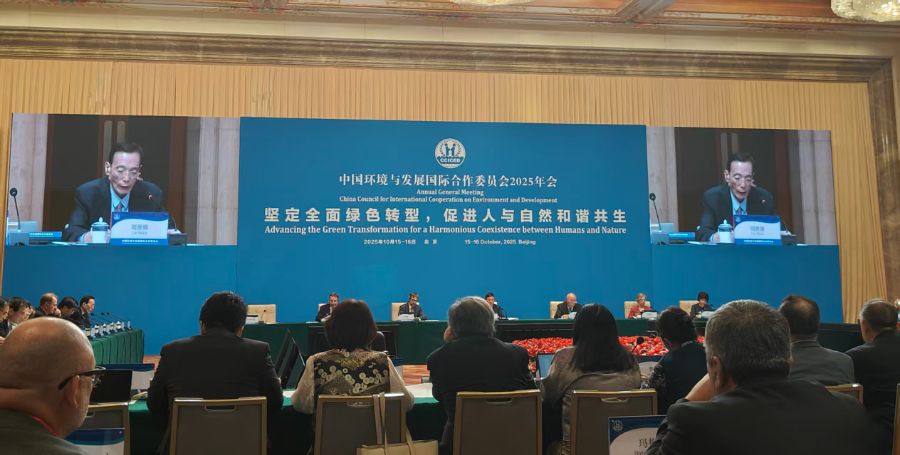
国合会年会提六大政策建议 聚焦绿色需求、绿色消费等
2 1 Shi Ji Jing Ji Bao Dao· 2025-10-15 15:39
Core Insights - The article discusses the policy recommendations presented by the China Environment and Development International Cooperation Committee (CEDD) for the Chinese government, focusing on green transformation and sustainable development strategies for the upcoming "15th Five-Year Plan" period [1][2]. Group 1: Policy Recommendations Overview - The recommendations are categorized into six areas, comprising a total of 22 specific policy suggestions aimed at enhancing green demand, technological support, green consumption, supply chain finance, energy transition, and high-level openness [2][3]. Group 2: Green Demand Expansion - Accelerate the construction of a new power system, aiming to stop new coal power installations and achieve a renewable energy generation share of 33%-38% by 2030 [3]. - Improve industrial electrification, targeting an electrification rate exceeding 34% by the end of the "15th Five-Year Plan" [3]. - Establish a comprehensive carbon reduction mechanism, expanding the coverage of the carbon market to include industries like chemicals and aviation [3]. Group 3: Technological Support and Ecosystem - Enhance coordination between renewable energy development and ecological protection [5]. - Promote high-quality development of the blue economy, integrating sustainable marine energy into national and local development plans [5]. - Establish a proactive climate adaptation governance system to build climate-resilient socio-ecological systems [5]. Group 4: Sustainable Production and Consumption - Strengthen the top-level design of the circular economy, setting specific goals for resource productivity and recycling rates [6]. - Promote solid waste management in synergy with the circular economy, encouraging pilot projects for "waste-free cities" [6]. - Accelerate the cultivation of the recycled materials market through consumer incentives and digital technology integration [6]. Group 5: Supply Chain Finance for Low-Carbon Innovation - Drive green innovation in supply chains through the financing needs of leading enterprises [7]. - Encourage financial institutions to incorporate carbon emission indicators into their services [7]. - Promote debt replacement tools linked to the retirement of high-carbon assets to support low-carbon transitions [7]. Group 6: Just Transition in Traditional Energy Regions - Develop the coal triangle area as a national low-carbon transition demonstration zone, focusing on inclusive employment support [8]. - Establish zero-carbon trade zones centered on new energy systems and carbon removal technologies [8]. - Enhance diversified funding support for low-carbon and disruptive technology innovations [8]. Group 7: High-Level Openness and International Cooperation - Strengthen international cooperation mechanisms for green development, establishing a global green development initiative [9]. - Create a risk management system for overseas green financing [9]. - Participate constructively in building an international green financial system, increasing climate investment scales [9].
国合会年会提六大政策建议,聚焦绿色需求、绿色消费等
2 1 Shi Ji Jing Ji Bao Dao· 2025-10-15 12:32
Core Viewpoint - The China Environment and Development International Cooperation Committee (CEDD) has proposed 22 specific policy recommendations to the Chinese government, focusing on achieving carbon neutrality and sustainable development during the 14th and 15th Five-Year Plans [1][2]. Group 1: Policy Recommendations Overview - The recommendations are categorized into six areas: green demand, technological support, green consumption, supply chain finance, energy transition justice, and high-level opening-up [2][3]. Group 2: Green Demand - Accelerate the construction of a new power system, aiming to stop new coal power installations and achieve a 33%-38% share of wind and solar power generation by 2030 [3]. - Enhance industrial electrification, targeting an electrification rate of over 34% by the end of the 15th Five-Year Plan [3]. - Establish a comprehensive carbon reduction mechanism and expand the coverage of the carbon market to include industries like chemicals and aviation [3][4]. Group 3: Technological Support - Strengthen the coordination between renewable energy development and ecological protection [5]. - Promote the establishment of a multilateral cooperation mechanism for biodiversity [7]. - Accelerate the development of a sustainable blue economy and integrate it into national and local development plans [8]. Group 4: Circular Economy - Enhance the top-level design of the circular economy, setting specific goals for resource productivity and recycling rates [10]. - Promote solid waste management in conjunction with circular economy initiatives [10]. - Encourage consumer choices towards more circular products through labeling and subsidy mechanisms [10]. Group 5: Supply Chain Finance - Drive green innovation in supply chains through the green demands of leading enterprises [11]. - Encourage financial institutions to incorporate carbon emission indicators into their services [11]. - Promote debt replacement tools linked to the retirement of high-carbon assets [11]. Group 6: Just Transition for Traditional Energy Regions - Develop the coal triangle area into a national low-carbon transition demonstration zone [12]. - Establish zero-carbon trade zones focusing on new energy systems and carbon removal technologies [12]. - Create a diversified funding support system for low-carbon and disruptive technology innovations [12]. Group 7: High-Level Opening-Up - Strengthen international cooperation mechanisms for green development and establish a global green development initiative [13]. - Develop a risk management system for overseas green financing [14]. - Participate in building an international green finance system, increasing climate investment through multilateral banks [14].

永和智控:10月10日召开董事会会议
Mei Ri Jing Ji Xin Wen· 2025-10-13 11:46
Core Viewpoint - Yonghe Intelligent Control announced a temporary board meeting to discuss the public transfer of 51% equity and debt of Puluo New Energy Technology (Taixing) Co., Ltd. [1] Company Summary - Yonghe Intelligent Control's revenue composition for the first half of 2025 is as follows: Industrial sector accounts for 89.41%, medical services and others account for 10.57%, and photovoltaic cell production accounts for 0.02% [1] - As of the report date, Yonghe Intelligent Control has a market capitalization of 2.2 billion yuan [1]

制造+服务”,如何加出新活力
Xin Hua She· 2025-10-13 01:16
Core Viewpoint - The implementation plan for service-oriented manufacturing aims to enhance its role in high-quality development of the manufacturing industry by 2028, including the establishment of 20 standards, creation of 50 leading brands, and development of 100 innovation hubs [1] Group 1: Definition and Importance of Service-oriented Manufacturing - Service-oriented manufacturing involves the integration of service elements into manufacturing, transitioning from merely selling products to offering "products + services" [1] - Various service-oriented manufacturing models, such as customized services and lifecycle services, are widely adopted, enhancing product value [1] - Companies like Shaanxi Blower Group and Haier have successfully shifted towards service-oriented models, with Haier's scenario brand achieving over 5.1 billion yuan in transaction volume last year [1] Group 2: Challenges in Transitioning to Service-oriented Manufacturing - The transition to service-oriented manufacturing is complex, facing challenges such as weak supply capabilities for key technologies, an incomplete standard system, and difficulties in statistical monitoring [2] Group 3: Policy Support for Service-oriented Manufacturing - The implementation plan targets weaknesses in technology, standards, application scenarios, and industrial ecology, aiming to unleash the vitality of business entities and stimulate innovation [3] Group 4: Future Potential of Service-oriented Manufacturing - Service-oriented manufacturing has significant potential for stabilizing growth and expanding domestic demand, enhancing competitiveness and innovation in the manufacturing sector [4] - It addresses the shift in consumer demand from functional satisfaction to experience prioritization, contributing to a more comprehensive consumer experience [4] - The successful realization of service-oriented manufacturing's potential requires a collaborative effort, particularly a shift in manufacturing companies' operational thinking towards a customer-centric approach [4]
大行科工股东将股票存入中信建投(国际)证券 存仓市值5924.48万港元
Zhi Tong Cai Jing· 2025-10-10 00:57
Group 1 - The major shareholder of Daheng Technology (02543) deposited shares into CITIC Securities (601066) with a market value of HKD 59.2448 million, representing 12.4% of the total [1] - Daheng Technology announced the issuance and allocation of 1.121 million H-shares on October 9, 2025, at an issue price of HKD 49.5 per share due to the exercise of the over-allotment option [1]

刘强东冲刺第五个IPO,要做企业版京东
Sou Hu Cai Jing· 2025-10-01 04:05
Core Insights - JD Industrial, a subsidiary of Liu Qiangdong's enterprises, is preparing for an IPO in Hong Kong, marking another significant milestone for the company [2] - The company focuses on enterprise e-commerce, providing industrial products and supply chain management solutions [5][12] - JD Industrial has achieved a valuation of $6.7 billion following its latest funding round, indicating strong investor interest and growth potential [9] Company Overview - JD Industrial was established in 2013 as part of JD's enterprise business and became an independent entity in 2017 [3] - The company offers a wide range of industrial products, including safety equipment and cleaning supplies, and has integrated digital procurement solutions for its clients [5][7] Business Model - JD Industrial operates primarily through a self-operated model, platform model, and service model, with self-operated sales accounting for 94% of its revenue [7][8] - The company has reported a transaction scale exceeding 20 billion yuan in the past three years, with projected revenues of 28.8 billion yuan for 2024 [7] Financial Performance - The company has shown a positive trend in sustainable operating profits, transitioning from a loss of 1.27 billion yuan in 2022 to a profit of 762 million yuan in 2024 [8] - The gross margin for product sales is around 10%, while service revenue boasts a much higher margin of 90% [8] Investment and Valuation - JD Industrial has attracted significant external investment, including $250 million in its first funding round and $100 million from Middle Eastern investors in its latest round, tripling its valuation in three years [9][11] - Major investors include Sequoia Capital and GGV Capital, with Sequoia holding a 4.7% stake, making it the largest external shareholder [11] Strategic Importance - The IPO is part of JD's broader strategy to establish a diversified portfolio of companies across various sectors, all centered around supply chain management [15] - JD Industrial's integration with JD's logistics network enhances its service offerings, providing efficient logistics solutions to its clients [13]
Why Income Investors View Illinois Tool Works (ITW) as a Value Dividend Stock
Yahoo Finance· 2025-09-29 16:46
Group 1 - Illinois Tool Works Inc. (ITW) is recognized as one of the 11 Best Value Dividend Stocks to buy currently [1] - The company operates in the global industrial manufacturing sector across seven segments, including automotive components and food service equipment, utilizing an "80/20 Front-to-Back" strategy to focus on profitable customers and products [2] - ITW has prioritized efficiency, customer-driven innovation, and disciplined portfolio management, divesting non-core units to enhance focus and allowing divisions to tailor solutions to customer needs [3] Group 2 - On August 4, ITW announced a 7.3% increase in its quarterly dividend to $1.61 per share, extending its dividend growth streak to 53 years, which positions it as a strong value stock with dividends [4] - As of September 26, ITW's stock has a dividend yield of 2.47% [4]

拱墅区第十届大运河集体婚礼科技人才专场启动征集
Hang Zhou Ri Bao· 2025-09-25 03:08
Group 1 - The collective wedding in Gongshu District will focus on technology talent, integrating traditional and modern elements to create a unique experience for new residents and young entrepreneurs [1][2] - The event is part of Gongshu's initiative to promote a "sweet economy," which combines cultural heritage with modern wedding practices, enhancing regional development and attracting talent [2][3] - This year's wedding will take place at the Hangzhou Esports Ecological Park, a new urban landmark that reflects the integration of culture, leisure, and technology [4][6] Group 2 - The event aims to recruit 10 couples, particularly welcoming young talents from technology companies and research institutions, providing them with comprehensive wedding services [5] - The wedding will feature interactive elements such as heart rate competitions and a unique digital marriage certificate, showcasing the blend of AI and traditional practices [4][5] - The initiative is designed to connect urban memories, human emotions, and future aspirations, emphasizing the importance of young talents in city development [6]