
智能家电

Search documents
【图解】市场监管总局批准发布 2项智能家电国家标准
Zhong Guo Jing Ji Wang· 2025-11-18 08:24
市场监管总局批准发布 2项智能家电国家标准 24 2 17 15 15 15 11 11 12 1 儿口, 叩吻童官芯同(凹豕你年安) 拟 阳 。 布《智能家用电器的智能化技术要求和评价 第1部分: 通用要求》(GB/T 28219.1- 2025)、《智能家用电器应用场景 第1部 分: 通用要求》 (GB/T 46505.1-2025) 国家标准,将于2026年5月1日正式实施。 《智能家用电器的智能化技术要求和评价 第1部分:通用要求》 要求智能家电需具备数据管理、人机交互、 智能控制、智能运维等关键能力,并建立L1 至L5五级智能等级评价体系,通过综合评分 划分等级,消费者一眼就能判断产品智能程 度。同时,要求企业明确标注智能功能的具 体效用、网络接入方法、信息安全风险提示 等信息,让消费者用得更加便利。 《智能家用电器应用场景 第1部分: 通用要求》 规定了环境管理、健康管理、能源资源管理 等9类智能家电典型应用场景的实现方式和 技术要求,为产品研发和生态互联提供了清 晰框架。以环境管理场景为例,要求温度波 动不超过±2℃、颗粒物洁净空气量实测值不 低于标称值的90%,并规定了卧室与客厅区 域的噪声上 ...

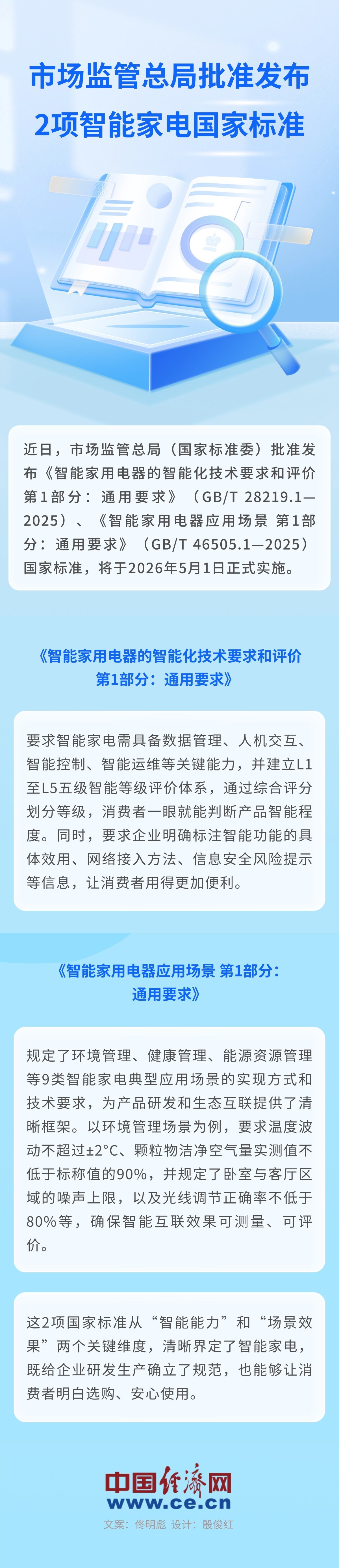
这两项智能家电国家标准,明年5月起实施
Jing Ji Wang· 2025-11-18 00:24
《智能家用电器应用场景 第1部分:通用要求》国家标准,规定了环境管理、健康管理、能源资源 管理等9类智能家电典型应用场景的实现方式和技术要求,为产品研发和生态互联提供了清晰框架。以 环境管理场景为例,要求温度波动不超过±2°C、颗粒物洁净空气量实测值不低于标称值的90%,并规定 了卧室与客厅区域的噪声上限,以及光线调节正确率不低于80%等,确保智能互联效果可测量、可评 价。 《智能家用电器的智能化技术要求和评价 第1部分:通用要求》国家标准,要求智能家电需具备数 据管理、人机交互、智能控制、智能运维等关键能力,并建立L1至L5五级智能等级评价体系,通过综 合评分划分等级,消费者一眼就能判断产品智能程度。同时,要求企业明确标注智能功能的具体效用、 网络接入方法、信息安全风险提示等信息,让消费者用得更加便利。 近日,市场监管总局(国家标准委)批准发布《智能家用电器的智能化技术要求和评价 第1部分: 通用要求》(GB/T 28219.1—2025)、《智能家用电器应用场景 第1部分:通用要求》(GB/T 46505.1 —2025)等国家标准,将于2026年5月1日正式实施。这2项国家标准从"智能能力"和"场景效果 ...
市场监管总局批准发布《智能家用电器的智能化技术要求和评价 第1部分:通用要求》国家标准
Jing Ji Guan Cha Wang· 2025-11-17 02:28
经济观察网据央视新闻客户端报道,市场监管总局批准发布《智能家用电器的智能化技术要求和评价第 1部分:通用要求》国家标准,要求智能家电须具备数据管理、人机交互、智能控制、智能运维等关键 能力,并建立L1至L5五级智能等级评价体系,通过综合评分划分等级,消费者一眼就能判断产品智能 程度。同时,要求企业明确标注智能功能的具体效用、网络接入方法、信息安全风险提示等信息,让消 费者用得更加便利。 ...
市场监管总局批准发布《智能家用电器应用场景 第1部分:通用要求》国家标准
Jing Ji Guan Cha Wang· 2025-11-17 02:28
经济观察网据央视新闻客户端报道,市场监管总局批准发布《智能家用电器应用场景第1部分:通用要 求》国家标准,规定了环境管理、健康管理、能源资源管理等9类智能家电典型应用场景的实现方式和 技术要求,为产品研发和生态互联提供了清晰框架。以环境管理场景为例,要求温度波动不超过±2℃、 颗粒物洁净空气量实测值不低于标称值的90%,并规定了卧室与客厅区域的噪声上限,以及光线调节正 确率不低于80%等,确保智能互联效果可测量、可评价。 ...
市场监管总局批准发布2项智能家电国家标准 明年5月起实施
Yang Shi Xin Wen· 2025-11-17 02:13
《智能家用电器应用场景第1部分:通用要求》国家标准,规定了环境管理、健康管理、能源资源管理 等9类智能家电典型应用场景的实现方式和技术要求,为产品研发和生态互联提供了清晰框架。以环境 管理场景为例,要求温度波动不超过±2℃、颗粒物洁净空气量实测值不低于标称值的90%,并规定了卧 室与客厅区域的噪声上限,以及光线调节正确率不低于80%等,确保智能互联效果可测量、可评价。 (文章来源:央视新闻) 记者今天了解到,市场监管总局批准发布《智能家用电器的智能化技术要求和评价第1部分:通用要 求》《智能家用电器应用场景第1部分:通用要求》等国家标准,将于2026年5月1日正式实施。这2项国 家标准从"智能能力"和"场景效果"两个关键维度,清晰界定了智能家电的技术要求,既给企业研发生产 确立了规范,也能够让消费者明白选购、安心使用。 《智能家用电器的智能化技术要求和评价第1部分:通用要求》国家标准,要求智能家电须具备数据管 理、人机交互、智能控制、智能运维等关键能力,并建立L1至L5五级智能等级评价体系,通过综合评 分划分等级,消费者一眼就能判断产品智能程度。同时,要求企业明确标注智能功能的具体效用、网络 接入方法、信息安 ...
聚焦三大赛道,中山市乡村青年创业大赛即将启动
Nan Fang Du Shi Bao· 2025-11-15 12:57
Core Points - The Zhongshan Rural Youth Entrepreneurship Competition aims to stimulate innovation and entrepreneurship among rural youth, aligning with the "Hundred Million Thousand Project" to gather significant support for rural revitalization [1][5][7] Group 1: Competition Overview - The competition is themed "Create and Share Hundreds of Millions, Build Dreams in New Countryside" and will take place from mid-November 2025 to January 2026 [1] - It features a multi-dimensional platform for showcasing achievements, storytelling, entrepreneurial competition, and brand promotion [1][5] - The competition will adopt a three-tier evaluation process involving town and street recommendations, city-level assessments, and final evaluations [3][4] Group 2: Competition Tracks - The competition includes three main tracks: Modern Agriculture, New Quality Productivity, and Rural Leisure Tourism [3][4] - The Modern Agriculture track encourages innovation in agricultural production, processing, circulation, and sales, focusing on traditional local products and the introduction of new agricultural varieties [3][4] - The New Quality Productivity track aims to strengthen collective village economies and promote traditional industries through digital transformation and the development of emerging industries [4] - The Rural Leisure Tourism track focuses on enhancing the quality and uniqueness of rural tourism, promoting new business models such as rural homestays and eco-tourism [4] Group 3: Support and Incentives - The competition integrates resources from various departments to provide comprehensive support for participants, including awards and recognition for outstanding projects [6][8] - Awards include the "Top Ten Rural Youth Entrepreneurship Pioneers" and various other recognitions, along with post-competition support services [6] - Media channels will be utilized to enhance the visibility and impact of entrepreneurial projects and participants [6] Group 4: Participation Requirements - Participants must be aged between 18 and 45, with a focus on those actively engaged in rural revitalization and entrepreneurship [8] - All projects must be registered within Zhongshan and comply with relevant laws and regulations, demonstrating positive economic and social impacts [8]

海尔集团董事局主席周云杰:未来通过构建AI能力 形成智慧家庭、大健康、工业机器人三大产业生态
Ge Long Hui· 2025-11-15 00:56
Core Insights - The dialogue at the 17th Entrepreneur Conference in Wuhan focused on embracing a new world dominated by AI, featuring discussions among industry leaders on cutting-edge AI topics [1] Company Strategy - Haier Group's Chairman, Zhou Yunjie, outlined the company's future strategy, which includes three main sectors: smart home, big health, and industrial robotics [1] - The smart home sector encompasses smart appliances, smart living solutions, and home robots [1] - The big health sector involves biomedicine and medical equipment [1] - Haier aims to build an industrial ecosystem by developing AI computing capabilities around these three sectors [1]


智能家电打响“生态战”
Jing Ji Guan Cha Wang· 2025-11-14 05:13
Core Insights - The Chinese home appliance industry is entering an era of whole-home intelligence, with traditional appliance manufacturers and tech companies competing fiercely in this new landscape [1][2] Group 1: Market Dynamics - Traditional appliance companies like Midea, Gree, Haier, and Hisense are seeking new growth points through AI technology, product line expansion, and internationalization [1] - Tech companies such as Huawei and Xiaomi are intensifying competition in the appliance market by leveraging their established smart ecosystem advantages [1][2] Group 2: Consumer Behavior - Consumers are increasingly opting for smart appliances, with a notable shift from foreign brands to domestic brands, reflecting a growing expectation for intelligent features [3][4] - The demand for whole-home smart systems is primarily driven by high-end customers, while budget constraints limit broader consumer adoption [3][7] Group 3: Technological Advancements - Major appliance brands have developed independent smart systems, enhancing their products with AI capabilities, particularly in high-end models [2][5] - The evolution from "passive response" to "active service" in smart appliances is exemplified by Midea's AI system, which can proactively adjust settings based on user needs [5][6] Group 4: Industry Trends - The smart home market in China is projected to grow at double-digit rates from 2023 to 2025, with significant interest in smart security, lighting, and audio-visual products [7][8] - The boundaries of the home appliance industry are becoming increasingly blurred, with a trend towards integrating home appliances into a broader home ecosystem [8][9] Group 5: Competitive Landscape - Leading companies in the appliance sector include Gree, Midea, Haier, Hisense, and TCL, but the competition is shifting towards providing intelligent services rather than just hardware [8][9] - The release of technological potential in the appliance sector is expected to reshape the global competitive landscape, positioning Chinese appliance manufacturers more favorably in international markets [9]

让AI帮忙购物,靠谱吗?
吴晓波频道· 2025-11-14 00:29
Core Insights - The article emphasizes that the AI shopping experience does not necessarily lead to better or cheaper products, but rather focuses on enhancing consumer satisfaction during the shopping process [2][75]. - The recent Double Eleven shopping festival showcased various new AI features across e-commerce platforms, indicating a shift towards AI-driven shopping assistance [3][4]. AI Shopping Features - Major e-commerce platforms like Taobao, JD, and Douyin have introduced AI functionalities such as price comparison, product search, and personalized shopping lists [3][4]. - A survey revealed that 67% of consumers prefer using AI for price comparisons, while 56% want AI to help them understand products better [6]. AI Comparison Testing - A test was conducted using three AI models (DeepSeek, Doubao, and Tongyi Qianwen) to evaluate their performance in price comparison and product recommendations [7][9]. - The results showed that Tongyi Qianwen and Doubao provided specific product recommendations, while DeepSeek offered a broader range of options without specific suggestions [12][15]. Price Analysis and Recommendations - The article discusses the reasons behind significant price drops during the Double Eleven sales, including brands sacrificing profit for volume and government subsidies [22]. - Recommendations for specific products were provided, such as the Ecovacs T80S and the Roborock P20, highlighting their features and pricing strategies [23][25]. Consumer Understanding and Decision-Making - The article highlights that consumers often struggle to understand product specifications and seek solutions to their specific needs [27][28]. - AI models successfully identified consumer needs and provided tailored recommendations based on household scenarios [30][32]. Shopping Strategy and Execution - A detailed shopping strategy was outlined for purchasing pet supplies, emphasizing the importance of leveraging platform discounts and promotions [43][44]. - The article suggests that AI can enhance the shopping experience by providing comprehensive guides and recommendations, although it still faces challenges in data accuracy and consumer trust [50][56]. Limitations of AI Shopping Assistants - The article points out that AI shopping assistants currently face issues such as data inaccuracies and a lack of consumer trust due to discrepancies in product recommendations [54][59]. - It suggests that while AI can improve efficiency, it may not fully replace the need for human judgment in shopping decisions [74][75].



小度与海尔智慧家庭达成战略合作
Xin Lang Cai Jing· 2025-11-13 11:42
Core Insights - Baidu Technology and Haier Smart Home have officially announced a strategic partnership focused on deep collaboration across three dimensions: ecology, scenarios, and technology [1] Group 1: Strategic Collaboration - The partnership will leverage Baidu's multimodal AI assistant, Super Baidu, to enhance joint efforts [1] - Both companies will work on building foundational capabilities by integrating Super Baidu with Haier's UhomeOS system [1] - There will be a joint research and development initiative for domain-specific large models [1]