
水泥

Search documents
每周股票复盘:青松建化(600425)获准发行10亿元科创债
Sou Hu Cai Jing· 2026-01-31 18:44
Core Viewpoint - Qingsong Jianhua (600425) has received approval from the China Securities Regulatory Commission (CSRC) to issue up to 1 billion yuan in technology innovation corporate bonds, which is expected to enhance its financial flexibility and support future growth initiatives [1] Company Performance - As of January 30, 2026, Qingsong Jianhua's stock closed at 4.59 yuan, reflecting a 0.44% increase from the previous week's closing price of 4.57 yuan [1] - The stock reached a weekly high of 4.67 yuan on January 26 and a low of 4.46 yuan on January 27 [1] - The company's current total market capitalization stands at 7.366 billion yuan, ranking 10th out of 21 in the cement sector and 2625th out of 5184 in the A-share market [1] Bond Issuance - The CSRC has granted approval for Qingsong Jianhua to publicly issue technology innovation corporate bonds with a total face value not exceeding 1 billion yuan [1] - The approval is valid for 24 months from the date of registration, allowing the company to issue the bonds in tranches during this period [1] - The company will proceed with the issuance in accordance with legal regulations, the approval document, and shareholder authorization, while fulfilling relevant information disclosure obligations [1]

江西万年青水泥股份有限公司2025年年度业绩预告
Zhong Guo Zheng Quan Bao - Zhong Zheng Wang· 2026-01-30 23:28
一、本期业绩预计情况 1、业绩预告期间:2025年1月1日至2025年12月31日。 2、业绩预告情况:预计净利润为正值且属于同向上升50%以上情形 (1)以区间数进行业绩预告的 单位:万元 ■ 二、与会计师事务所沟通情况 登录新浪财经APP 搜索【信披】查看更多考评等级 本公司及董事会全体成员保证信息披露的内容真实、准确、完整,没有虚假记载、误导性陈述或重大遗 漏。 本次业绩预告相关数据是公司财务部门初步测算的结果,未经会计师事务所审计。公司已就业绩预告有 关事项与年报审计会计师事务所进行了预沟通,公司与会计师事务所在本报告期的业绩预告方面不存在 分歧。 三、业绩变动原因说明 报告期内,受房地产和基础设施投资增速放缓等因素影响,水泥市场需求整体收缩,行业供需关系更趋 失衡,市场竞争日趋激烈。面对严峻的外部环境,公司积极推进精益管理与"三基"建设,持续优化生产 运营,并加大资产处置与盘活力度,有效推动了生产成本的下降。然而,受产品销售价格下行影响,成 本降幅未能完全抵消价格下滑带来的压力,导致公司扣除非经常性损益后的净利润出现亏损。2025年预 计与搬迁补偿相关的非经常性损益对归属于上市公司股东的净利润影响约 ...

万年青:预计2025年归属于上市公司股东的净利润2350万元至3500万元
Mei Ri Jing Ji Xin Wen· 2026-01-30 12:49
每经头条(nbdtoutiao)——中国无人驾驶"军团","武装"阿布扎比 每经AI快讯,万年青1月30日晚间发布业绩预告,预计2025年归属于上市公司股东的净利润2350万元至 3500万元,比上年同期增长78.46%~165.79%,基本每股收益0.0306元~0.0456元。 (记者 曾健辉) ...
建材行业双周报(2026/01/16-2026/01/29):部分消费建材产品再次提价,行业盈利持续修复可期-20260130
Dongguan Securities· 2026-01-30 11:14
Investment Rating - The report maintains a "Market Weight" rating for the building materials industry, indicating that the industry index is expected to perform within ±10% of the market index over the next six months [49]. Core Insights - The building materials industry is experiencing a recovery in profitability, with some consumer building materials products seeing price increases due to rising raw material costs [2][5]. - The cement sector is expected to show resilience in profitability, supported by significant infrastructure projects and urban renewal initiatives in 2026, despite a projected decline in cement production in 2025 [4][41]. - The glass and fiberglass sectors are undergoing structural adjustments, with a focus on high-end products and green transformation, while traditional segments face challenges from real estate market weaknesses [42][43]. - The consumer building materials segment is witnessing a trend of price stabilization and recovery, driven by demand for renovation and urban renewal, despite a slowdown in new construction [44]. Summary by Sections Cement Industry - In Q1 2026, cement companies are expected to implement significant production cuts, with an average shutdown period of 46 days nationwide, aimed at balancing supply and demand [4][41]. - The average cost of P.O42.5 bulk cement is reported at 197 RMB/ton, with a gross profit margin of 17% [4]. - The industry is projected to recover gradually, contingent on effective supply-side policies and infrastructure investment [4][41]. Glass and Fiberglass - The flat glass market is expected to stabilize as production capacity is controlled and environmental standards are enforced, although demand remains weak due to real estate sector challenges [42]. - The fiberglass industry is in a recovery phase, with a focus on eliminating inefficient capacity and enhancing production quality through technological upgrades [43]. Consumer Building Materials - Major companies like Keshun and Sankeshu have announced price increases due to rising costs of raw materials, indicating a trend towards price recovery in the sector [44]. - The demand for renovation and urban renewal is expected to drive growth, while leading companies are enhancing their market share through brand strength and service improvements [44]. Recommended Stocks - The report suggests focusing on companies with strong fundamentals and high dividend yields, including Shangfeng Cement, Tapa Group, and Huaxin Cement [4][45].


碳中和系列:“十五五”碳达峰决胜期,政策深化下的投资机遇
Changjiang Securities· 2026-01-30 10:54
Investment Rating - The report indicates a positive investment outlook for the carbon neutrality sector, emphasizing the emergence of multi-layered and long-term investment opportunities driven by the "dual carbon" strategy and the deepening of the national carbon market [3][11]. Core Insights - The transition towards a green economy in China has moved from conceptual advocacy to a substantive phase, creating a systematic investment landscape centered around four dimensions: energy system restructuring, industrial green premium, carbon reduction technology expansion, and the rise of supporting services [3][11]. Summary by Sections Carbon Peak and Neutrality Policy Framework - The "14th Five-Year Plan" and "15th Five-Year Plan" are critical periods for achieving carbon peak goals, with a comprehensive "1+N" policy system established to guide the transition [9][18]. - The energy consumption dual control is transitioning to carbon emission dual control, with a three-phase approach leading to comprehensive implementation by 2025 [9][22]. Market-Based Emission Reduction Mechanism - The carbon market's core mechanism is to guide carbon pricing through quotas, CCER, and green certificates [10][31]. - By the end of 2025, the cumulative transaction volume in the national carbon market is expected to reach 860 million tons, with a transaction value of 58.12 billion yuan and an average price of 67.6 yuan per ton [42][43]. Investment Strategy: Four-Dimensional Industrial Opportunities - The dual carbon process will create multi-layered, long-cycle investment opportunities across four dimensions: 1. **Energy System Restructuring**: Focus on new power systems, emphasizing photovoltaic and wind power technology advancements, and integrating non-electric applications like green hydrogen [11]. 2. **Industrial Green Premium**: The internalization of carbon costs is reshaping high-energy-consuming industries, providing cost advantages to companies with low-carbon processes [11]. 3. **Carbon Reduction Technology Breakthroughs**: Technologies in hard-to-abate sectors are entering a phase of scale, with significant demand for energy-saving equipment and recycling technologies [11]. 4. **Emergence of Carbon Management Services**: The assetization of carbon is driving demand for carbon monitoring, accounting platforms, and professional services to help companies manage risks and optimize assets [11].
万年青:2025年全年净利润同比预增78.46%—165.79%
2 1 Shi Ji Jing Ji Bao Dao· 2026-01-30 10:33
南财智讯1月30日电,万年青发布年度业绩预告,预计2025年全年归属于上市公司股东的净利润为2350 万元—3500万元,同比预增78.46%—165.79%;预计2025年全年归属于上市公司股东的扣除非经常性损 益的净利润为-23000万元—-13000万元。报告期内,受房地产和基础设施投资增速放缓等因素影响,水 泥市场需求整体收缩,行业供需关系更趋失衡,市场竞争日趋激烈。面对严峻的外部环境,公司积极推 进精益管理与"三基"建设,持续优化生产运营,并加大资产处置与盘活力度,有效推动了生产成本的下 降。然而,受产品销售价格下行影响,成本降幅未能完全抵消价格下滑带来的压力,导致公司扣除非经 常性损益后的净利润出现亏损。2025年预计与搬迁补偿相关的非经常性损益对归属于上市公司股东的净 利润影响约1.6亿元至2.2亿元,最终归属于上市公司股东的净利润约2350万元至3500万元。 ...
万年青:预计2025年净利润同比增长78.46%-165.79%
Xin Lang Cai Jing· 2026-01-30 10:28
万年青公告,预计2025年度净利润为2350万元至3500万元,同比增长78.46%至165.79%。2025年预计与 搬迁补偿相关的非经常性损益对归属于上市公司股东的净利润影响约1.6亿元至2.2亿元,最终归属于上 市公司股东的净利润约2350万元至3500万元。 ...
水泥板块1月30日跌1.14%,金隅集团领跌,主力资金净流出3.68亿元
Zheng Xing Xing Ye Ri Bao· 2026-01-30 09:00
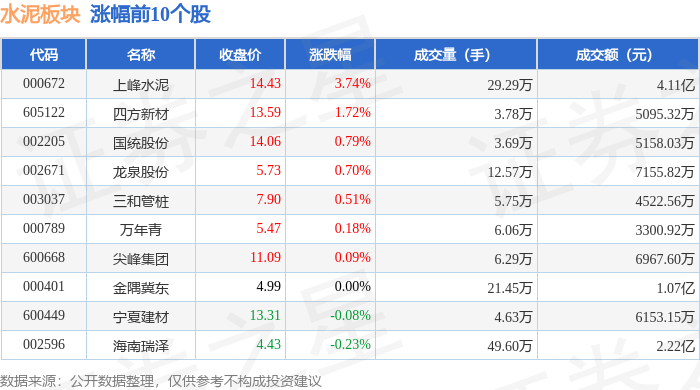
Market Overview - The cement sector experienced a decline of 1.14% on January 30, with Jinju Group leading the drop [1] - The Shanghai Composite Index closed at 4117.95, down 0.96%, while the Shenzhen Component Index closed at 14205.89, down 0.66% [1] Individual Stock Performance - The following stocks in the cement sector showed notable performance: - Shangfeng Cement (000672) closed at 14.43, up 3.74% with a trading volume of 292,900 shares and a turnover of 411 million yuan [1] - Sifang New Material (605122) closed at 13.59, up 1.72% with a trading volume of 37,800 shares and a turnover of 50.95 million yuan [1] - Guotong Co. (002205) closed at 14.06, up 0.79% with a trading volume of 36,900 shares and a turnover of 51.58 million yuan [1] - Longquan Co. (002671) closed at 5.73, up 0.70% with a trading volume of 125,700 shares and a turnover of 71.56 million yuan [1] - Other stocks such as Wan Nian Qing (000789) and Jianfeng Group (600668) showed minimal changes [1] Capital Flow Analysis - The cement sector saw a net outflow of 368 million yuan from main funds, while retail investors contributed a net inflow of 426 million yuan [2] - The following stocks had significant capital flow: - Huaxin Cement (600801) experienced a net outflow of 48.97 million yuan from main funds [3] - Tower Group (002233) had a net inflow of 8.47 million yuan from main funds [3] - Wan Nian Qing (000789) saw a net inflow of 6.44 million yuan from main funds [3] - Other stocks like Ningxia Building Materials (600449) and Sanhe Yingshao (003037) showed mixed capital flows [3]

天山股份:2025年全年预计净亏损600.00亿元—750.00亿元
2 1 Shi Ji Jing Ji Bao Dao· 2026-01-30 08:49
Core Viewpoint - Tianshan Co. forecasts a significant net loss for 2025, estimating a loss of between 60 billion to 75 billion yuan for the year, with a loss excluding non-recurring items projected between 70 billion to 85 billion yuan [1] Group 1: Business Performance - The cement market in China is expected to experience a decline in demand due to reduced real estate investment and negative growth in fixed asset investment, leading to a decrease in cement production by 6.9% year-on-year, totaling 1.693 billion tons for 2025 [1] - The company is focusing on optimizing its production organization and improving technical and economic indicators while advancing international development, resulting in increased international revenue and profits [1] - Despite a decline in sales volume, the comprehensive cost of cement clinker has decreased year-on-year, leading to an increase in gross profit margin for cement clinker [1] - The cost of ready-mixed concrete has decreased due to lower raw material prices, with the reduction in unit costs exceeding the decline in unit selling prices, resulting in a year-on-year increase in gross profit [1] - Aggregate gross profit has decreased year-on-year due to declines in both sales volume and selling prices [1] Group 2: Impairment Provisions - The company is conducting capacity replacement work on its production lines in accordance with the "Construction Materials Industry Stabilization Growth Work Plan (2025-2026)" and other relevant policy documents, which involves the exit of certain production capacities [1] - An assessment of potential impairment of non-current assets related to the capacity exit is underway, with preliminary estimates indicating an impairment amount between 4.2 billion to 5.7 billion yuan, subject to final confirmation in the 2025 annual report [1]
安徽:跨境投融资便利化助力企业“走出去”
Xin Hua Cai Jing· 2026-01-30 06:50
Core Viewpoint - Anhui Province is enhancing the efficiency of domestic enterprises in overseas financing through unified management standards, simplified processes, and optimized fund usage mechanisms, with a focus on supporting globalization efforts [1] Group 1: Overseas Financing - By 2025, five enterprises from Anhui are expected to go public overseas, raising a total of $15.17 billion [1] - Anhui is actively supporting major enterprises like Jianghuai, Chery, and Conch to participate in the integrated currency pool pilot, aiding their global expansion [1] Group 2: Trade Facilitation - Anhui is leveraging financial tools to stabilize foreign trade, allowing more quality enterprises to benefit from trade settlement and document review conveniences [1] - By the end of 2025, the province is projected to handle a total of 138,000 trade facilitation transactions, amounting to $189.2 billion [1] Group 3: Foreign Exchange Reform - In recent years, Anhui has made significant strides in foreign exchange business reform, improving the efficiency of enterprises in cross-border receipts and payments [1] - By the end of 2025, seven banks in Anhui will be included in the pilot program, serving 892 first-class clients and processing cross-border payment transactions worth $19.27 billion for these clients [1]