
消费品行业

Search documents
刚刚发布:49.3%
中国基金报· 2025-07-31 02:42
Group 1: Manufacturing PMI Overview - In July, the Manufacturing Purchasing Managers' Index (PMI) was 49.3%, a decrease of 0.4 percentage points from the previous month, indicating a decline in manufacturing activity [2][21][22] - The production index was 50.5%, down 0.5 percentage points, while the new orders index was 49.4%, down 0.8 percentage points, suggesting a slowdown in market demand [6][22] - Large enterprises maintained expansion with a PMI of 50.3%, while medium-sized enterprises improved to 49.5%, and small enterprises decreased to 46.4% [5][23][24] Group 2: Non-Manufacturing PMI Overview - The Non-Manufacturing Business Activity Index was 50.1%, a decrease of 0.4 percentage points, but still above the critical point, indicating continued expansion [11][25] - The service sector's business activity index was stable at 50.0%, while the construction sector's index fell to 50.6%, down 2.2 percentage points due to adverse weather conditions [14][25] - The business activity expectation index for non-manufacturing was 55.8%, indicating optimism among most enterprises regarding market development [17][25] Group 3: Comprehensive PMI Overview - The Comprehensive PMI Output Index was 50.2%, a decrease of 0.5 percentage points, but still indicating overall expansion in production and business activities [20][26] - The manufacturing production index and non-manufacturing business activity index were 50.5% and 50.1%, respectively, contributing to the comprehensive index's performance [26]


最新PMI数据发布
Zhong Guo Zheng Quan Bao· 2025-07-31 02:36
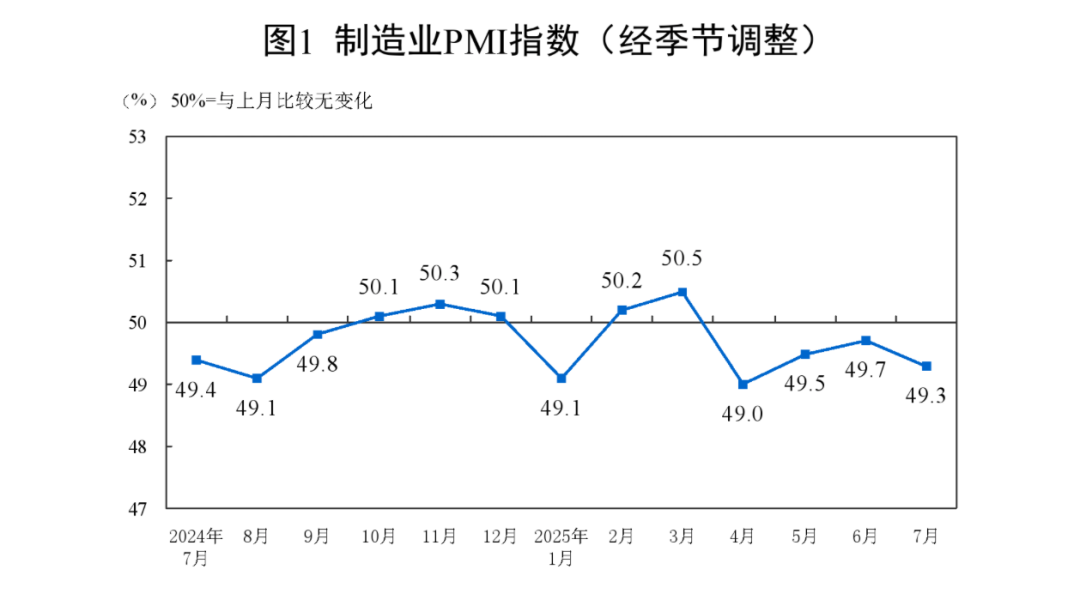
国家统计局7月31日发布数据显示,7月份,制造业采购经理指数(PMI)为49.3%,比上月下降0.4个百分点;非制造业商务活动指数和综合PMI产出指数 分别为50.1%和50.2%,比上月下降0.4和0.5个百分点,均持续高于临界点,我国经济总体产出保持扩张。 制造业PMI有所回落 "7月份,受制造业进入传统生产淡季,部分地区高温、暴雨洪涝灾害等因素影响,PMI降至49.3%,制造业景气水平较上月回落。"国家统计局服务业调查 中心高级统计师赵庆河表示。 图片来源:国家统计局 非制造业商务活动指数保持扩张 数据显示,7月份,非制造业商务活动指数为50.1%,比上月下降0.4个百分点,仍高于临界点。 图片来源:国家统计局 赵庆河表示,服务业商务活动指数总体稳定。7月份,服务业商务活动指数为50%,比上月略降0.1个百分点。从行业看,在暑期假日效应带动下,与居民 出行和消费相关的铁路运输、航空运输、邮政、文化体育娱乐等行业商务活动指数位于60.0%以上高位景气区间,业务总量较快增长。从市场预期看,7 月份,业务活动预期指数为56.6%,比上月上升0.6个百分点,表明多数服务业企业对市场预期较为乐观。 建筑业商务活动 ...
国家统计局:7月制造业采购经理指数有所回落 非制造业商务活动指数保持扩张
Di Yi Cai Jing· 2025-07-31 01:50
Core Viewpoint - In July, the manufacturing Purchasing Managers' Index (PMI) decreased to 49.3%, while the non-manufacturing business activity index and the composite PMI output index were 50.1% and 50.2%, respectively, indicating a continued expansion of the overall economic output in China despite a slight decline from the previous month [1][5]. Group 1: Manufacturing PMI Analysis - The manufacturing PMI fell to 49.3% in July, down 0.4 percentage points from the previous month, influenced by seasonal production slowdowns and adverse weather conditions [2]. - The production index remained in the expansion zone at 50.5%, while the new orders index decreased to 49.4%, indicating a slowdown in market demand [2]. - Large enterprises maintained expansion with a PMI of 50.3%, while medium-sized enterprises improved to 49.5%, and small enterprises saw a decline to 46.4% [3]. - New momentum in the manufacturing sector was observed, with the equipment manufacturing and high-tech manufacturing PMIs at 50.3% and 50.6%, respectively, both above the critical point [3]. Group 2: Non-Manufacturing PMI Analysis - The non-manufacturing business activity index was 50.1%, down 0.4 percentage points from the previous month, but still above the critical point [4]. - The service industry business activity index remained stable at 50.0%, with significant growth in sectors related to travel and consumption, such as railway and air transport [4]. - The construction industry business activity index fell to 50.6%, impacted by adverse weather conditions, with a corresponding decrease in the business activity expectation index to 51.6% [4]. Group 3: Composite PMI Output Index - The composite PMI output index was 50.2%, down 0.5 percentage points from the previous month, indicating overall expansion in production and business activities [5].
国家统计局:7月份制造业采购经理指数有所回落 非制造业商务活动指数保持扩张
Guo Jia Tong Ji Ju· 2025-07-31 01:46
Group 1: Manufacturing Sector - The manufacturing Purchasing Managers' Index (PMI) decreased to 49.3% in July, down 0.4 percentage points from the previous month, indicating a decline in manufacturing activity due to seasonal factors and adverse weather conditions [2][3] - The production index remained in expansion at 50.5%, while the new orders index fell to 49.4%, reflecting a slowdown in market demand [2] - Large enterprises maintained expansion with a PMI of 50.3%, while medium-sized enterprises improved to 49.5%, and small enterprises decreased to 46.4% [3] Group 2: Price Trends - The price index for major raw materials increased, with the purchasing price index at 51.5% and the factory price index at 48.3%, marking the first rise above the critical point since March [2] - Industries such as petroleum, coal, and black metal processing saw significant increases in their purchasing and factory price indices, indicating improved market prices [2] Group 3: Non-Manufacturing Sector - The non-manufacturing business activity index was at 50.1%, down 0.4 percentage points from the previous month, but still above the critical point [4] - The service sector's business activity index remained stable at 50.0%, with strong performance in transportation and tourism-related industries, while real estate and residential services lagged [4] - The construction business activity index fell to 50.6% due to adverse weather conditions, with a corresponding decrease in market expectations [4] Group 4: Overall Economic Outlook - The comprehensive PMI output index was at 50.2%, down 0.5 percentage points from the previous month, indicating overall economic expansion despite a slowdown [5][6] - The manufacturing production index and non-manufacturing business activity index were reported at 50.5% and 50.1%, respectively, contributing to the overall expansion [6]
国家统计局:7月受制造业进入传统生产淡季等因素影响,制造业景气水平较上月回落
Guo Jia Tong Ji Ju· 2025-07-31 01:39
Manufacturing Sector - In July, the Manufacturing Purchasing Managers' Index (PMI) decreased to 49.3%, down 0.4 percentage points from the previous month, indicating a decline in manufacturing activity due to seasonal factors and adverse weather conditions [2][3] - The production index remained in expansion at 50.5%, while the new orders index fell to 49.4%, reflecting a slowdown in market demand [3] - Large enterprises maintained expansion with a PMI of 50.3%, while medium-sized enterprises improved to 49.5%, and small enterprises decreased to 46.4% [4] - The price index showed an upward trend, with the main raw materials purchasing price index rising to 51.5%, marking the first increase above the critical point since March [3][4] - New momentum in the manufacturing sector is evident, with the equipment manufacturing PMI at 50.3% and high-tech manufacturing PMI at 50.6%, both above the critical point [4] Non-Manufacturing Sector - The Non-Manufacturing Business Activity Index stood at 50.1%, down 0.4 percentage points from the previous month, but still above the critical point [5] - The service sector's business activity index was stable at 50.0%, with significant growth in transportation and tourism-related industries, while real estate and residential services lagged [5][6] - The construction sector's business activity index fell to 50.6%, influenced by adverse weather conditions, with a corresponding decrease in market expectations [6] Composite PMI - The Composite PMI Output Index decreased to 50.2%, down 0.5 percentage points from the previous month, indicating overall expansion in production and business activities [7] - The manufacturing production index and non-manufacturing business activity index were recorded at 50.5% and 50.1%, respectively, both indicating continued expansion [7]
国家统计局:装备制造业和高技术制造业PMI分别为50.3%和50.6% 均持续高于临界点
news flash· 2025-07-31 01:37
国家统计局数据显示,7月份,受制造业进入传统生产淡季,部分地区高温、暴雨洪涝灾害等因素影 响,PMI降至49.3%,制造业景气水平较上月回落。从重点行业看,装备制造业和高技术制造业PMI分 别为50.3%和50.6%,均持续高于临界点,高端装备制造业保持扩张;消费品行业PMI为49.5%,比上月 下降0.9个百分点;高耗能行业PMI为48.0%,比上月上升0.2个百分点,景气度有所改善。 ...
6月份PMI继续回升,景气水平保持扩张
Zhong Guo Chan Ye Jing Ji Xin Xi Wang· 2025-07-03 23:52
Core Insights - In June, China's manufacturing PMI rose to 49.7%, indicating a recovery in manufacturing demand and overall economic resilience, supported by effective economic policies [1][2] - The non-manufacturing business activity index stood at 50.5%, while the comprehensive PMI output index reached 50.7%, both showing improvements compared to the previous month [1] Manufacturing Sector - The manufacturing PMI indicates that 11 out of 21 surveyed industries are in the expansion zone, an increase of 4 from the previous month, suggesting an overall improvement in manufacturing sentiment [2] - The production index and new orders index were at 51.0% and 50.2%, respectively, both showing month-on-month increases, reflecting accelerated production activities and improved market demand [2] - Large enterprises reported a PMI of 51.2%, up 0.5 percentage points, while medium-sized enterprises saw a PMI of 48.6%, up 1.1 percentage points, indicating a positive trend in business sentiment [2] Non-Manufacturing Sector - The construction business activity index rose to 52.8%, up 1.8 percentage points, driven by a significant recovery in civil engineering projects, which indicates a faster pace of infrastructure construction [4] - The service sector business activity index slightly decreased to 50.1%, attributed to the fading effects of holiday consumption, particularly in retail, transportation, and hospitality [4] Future Outlook - The service and construction sectors maintain optimistic business activity expectations, with indices at 56.0% and 53.9%, respectively, indicating a positive outlook for industry development [4] - Analysts expect that with continued policy support and potential new measures, the manufacturing PMI is likely to improve further in the second half of the year [5]
★多项先行指标向好 经济运行有望延续平稳态势
Zhong Guo Zheng Quan Bao· 2025-07-03 01:56
Group 1 - In May, China's manufacturing Purchasing Managers' Index (PMI) rose by 0.5 percentage points to 49.5%, indicating an improvement in manufacturing sentiment [1] - The increase in manufacturing PMI is attributed to the sustained implementation of growth-stabilizing policies, including monetary measures such as interest rate cuts [1][2] - The production index in May was 50.7%, up 0.9 percentage points, indicating accelerated manufacturing activity, while the new orders index rose to 49.8%, up 0.6 percentage points [1] Group 2 - High-tech manufacturing PMI stood at 50.9%, remaining in the expansion zone for four consecutive months, while equipment manufacturing and consumer goods PMIs were 51.2% and 50.2%, respectively, both showing improvement [2] - The production expectation index for manufacturing enterprises was 52.5%, up 0.4 percentage points, reflecting stable confidence in market development [2] - New export orders and import indices were 47.5% and 47.1%, respectively, both showing increases of 2.8 and 3.7 percentage points compared to the previous month [2] Group 3 - From May 19 to May 25, monitored ports completed a cargo throughput of 27,134.8 million tons, a 2.8% increase, and a container throughput of 656.4 thousand TEUs, up 3.63% [3] - The rebound in export container freight indices and sustained high levels of port cargo throughput suggest a potential for continued export growth in May [3] - Analysts expect exports to maintain resilience in the second quarter, with high growth rates anticipated [3] Group 4 - The current international environment remains complex, necessitating continued efforts in stabilizing growth policies to solidify the economic recovery [3] - There is a call for increased government investment in public goods to boost market demand and corporate orders, which would support production and employment [3] - New incremental policies are expected to be introduced to further support economic stability and high-quality development [4]
6月份PMI数据出炉 我国经济景气水平总体保持扩张
Zheng Quan Ri Bao· 2025-06-30 16:12
6月30日,国家统计局服务业调查中心和中国物流与采购联合会发布了中国采购经理指数。数据显示,6 月份,制造业采购经理指数(PMI)、非制造业商务活动指数和综合PMI产出指数分别为49.7%、50.5% 和50.7%,比5月份上升0.2个百分点、0.2个百分点和0.3个百分点,三大指数均有所回升,我国经济景气 水平总体保持扩张。 与此同时,价格指数回升。主要原材料购进价格指数和出厂价格指数分别为48.4%和46.2%,均比5月上 升1.5个百分点,制造业市场价格总体水平有所改善。 "从两个价格指数的变化趋势来看,近期制造业上游原料端和下游产品端的价格走势协同性较好。5月 份、6月份,购进价格指数和出厂价格指数同向变化,变化幅度相当。"文韬说。 分行业看,三大重点行业继续扩张。装备制造业、高技术制造业和消费品行业PMI分别为51.4%、50.9% 和50.4%,均连续两个月位于扩张区间。其中,装备制造业生产指数和新订单指数均高于53.0%,相关 行业产需两端较为活跃。高耗能行业PMI为47.8%,比5月份上升0.8个百分点,景气水平有所改善。 文韬表示,下半年我国经济将重点推进"强内"和"稳外"工作。"强内"是继 ...
6月PMI数据点评:站在需求的十字路口
Changjiang Securities· 2025-06-30 14:15
Group 1: PMI Data Insights - The manufacturing PMI for June rose to 49.7%, exceeding the Bloomberg consensus expectation of 49.6%[3] - The increase in PMI was driven by improvements in both supply and demand, with the new orders index rising to 50.2% and the production index to 51%[11] - However, the sustainability of this improvement is questionable, as employment demand decreased month-on-month and production expectations slightly declined[3] Group 2: Demand and Supply Dynamics - Demand expansion is not uniform across industries, with small enterprises experiencing a contraction in orders, while high-tech manufacturing remains flat[11] - Among 15 sub-industries, only 7 showed improvement compared to May, indicating a lack of widespread demand expansion[11] - Price pressures persist, with the factory price index at 46.2% and major raw material purchase price index at 48.4%, reflecting ongoing downward pressure on prices[11] Group 3: Sectoral Performance - The non-manufacturing PMI increased to 50.5%, primarily due to a rise in the construction PMI to 52.8%, while the service sector PMI fell to 50.1%[11] - Infrastructure orders are shifting towards expansion, which may help offset export downturn pressures[11] - The real estate market shows weak economic expectations, as indicated by second-hand housing prices and futures prices, necessitating policy support for growth[11]