
科技金融

Search documents
中国人民银行副行长朱鹤新:加快科技公共信息开放共享 优化科技金融发展环境
Xin Hua Cai Jing· 2025-05-22 11:46
具体来看,一是要提升政银企对接效率。对点多面广的广大科技型中小企业,通过在全国范围内推 广"创新积分制",并优化创新积分评价办法,为科技型中小企业精准画像,旨在帮助金融机构准确识别 和挖掘更多科技含量的企业,让金融活水流入到科技型中小企业中去。 (文章来源:新华财经) "而对于一些国家重大的科技任务,我们将建立融资对接推荐机制,推动科技产业部门梳理重点项目和 企业信息,引导金融机构'点对点'地提供多元的融资支持。"朱鹤新说。 二是加快科技公共信息开放共享。人民银行将联合科技部加强科技公共信息共享的政策指引,为各地扩 大科技信息共享提供标准。同时,利用地方征信平台和有关金融服务信息平台等渠道,加强公共数据、 产业数据等各类信息的归集整合,创新数据授权运用和查询获取方式,为金融机构投融资决策提供信息 数据的支撑。 新华财经北京5月22日电(记者翟卓闫鹏)中国人民银行副行长朱鹤新22日在国新办新闻发布会上表 示,推进科技金融工作,不光要有政策举措,还要有配套措施,下一步将从加快科技公共信息开放共享 等三方面下功夫,进一步优化科技金融发展环境。 三是推动加大科技金融风险的补偿力度。在朱鹤新看来,财政政策对激励引导金融 ...
国务院新闻办召开新闻发布会,详解七部门推出科技金融政策举措
Guan Cha Zhe Wang· 2025-05-22 10:59
近日,科技部会同中国人民银行、国家金融监管总局、中国证监会、国家发展改革委、财政部、国务院 国资委等七部门联合印发了《加快构建科技金融体制 有力支撑高水平科技自立自强的若干政策举措》 (以下简称《政策举措》),旨在通过系统性部署和安排,加快突破金融支持高水平科技自立自强的难 点堵点,为科技创新提供强有力的金融支撑。 5月22日下午,国务院新闻办公室举行新闻发布会,科技部副部长丘勇围绕《政策举措》出台背景和重 点内容进行了详细介绍,中国人民银行副行长兼国家外汇局局长朱鹤新、金融监管总局新闻发言人及政 策研究司司长郭武平、中国证监会首席风险官兼发行司司长严伯进参会并现场回答了记者的提问。 对于政策制定背景,丘勇介绍,党的二十届三中全会明确指出,要构建与科技创新相适应的科技金融体 制,加强对国家重大科技任务和中小型企业的金融支持。中央金融工作会以及去年6月份召开的全国科 技大会也强调,要做好科技金融这篇大文章,引导金融资本投资早、投小、长期投硬科技。在此背景 下,七部门联合印发《政策举措》,旨在以科技创新需求侧为牵引,加快突破金融支持科技创新的难点 堵点,推动科技金融体制的系统性改革。 丘勇在发布会上表示,这次印发 ...
央行回应证券时报提问:希望推动加大科技金融风险补偿力度
证券时报· 2025-05-22 09:46
2025年5月22日(星期四)下午,国务院新闻办公室举行新闻发布会,请科技部副部长邱勇,中国人民银行副行 长、国家外汇局局长朱鹤新,金融监管总局新闻发言人、政策研究司司长郭武平,中国证监会首席风险官、发行 监管司司长严伯进介绍科技金融政策有关情况,并答记者问。 证券时报记者提问:"我们看到 《加快构建科技金融体制 有力支撑高水平科技自立自强的若干政策举措》中有一些关 于科技金融的配套政策,请问接下来将会从哪些方面推动这些举措的落实落细?" END 朱鹤新表示,推进科技金融工作,光有政策举措还是不够的,还要有一些配套措施才能发挥更大的作用。下一步在进 一步优化科技金融发展环境上还要下功夫,具体体现在三个方面: 一是要提升政银企对接的效率。对点多面广的广大科技型中小企业,通过在全国范围内推广"创新积分制",并优化创 新积分评价办法,为科技型中小企业精准画像,主要目的是帮助金融机构准确识别和挖掘更多科技含量的企业,让金 融活水流入到我们科技型中小企业当中去。对于一些国家重大的科技任务,我们将建立融资对接推荐机制,推动科技 产业部门梳理重点项目和企业信息,引导金融机构"点对点"地提供多元的融资支持。这是分了两块,一块 ...


刚刚!央行、证监会等四部门发声,事关科技金融!全文来了→
证券时报· 2025-05-22 09:46
四部门重磅发声。 2025年5月22日(星期四)下午,国务院新闻办公室举行新闻发布会,请科技部副部长邱勇,中国人民银行副 行长、国家外汇局局长朱鹤新,金融监管总局新闻发言人、政策研究司司长郭武平,中国证监会首席风险官、 发行监管司司长严伯进介绍科技金融政策有关情况,并答记者问。 朱鹤新在回答证券时报记者提问时表示,希望推动加大科技金融的风险补偿力度。财政政策对于激励引导金融 机构支持科技创新具有重要作用。央行将配合好财政部门,用好用足贷款贴息、风险补偿等政策,有效发挥政 府性融资担保体系的作用。 来看看发布会具体内容: 科技部 将充分发挥牵头部门作用 进一步细化构建科技金融体制任务分工 邱勇表示,近期七部门发布的《加快构建科技金融体制 有力支撑高水平科技自立自强的若干政策举措》(以 下简称《政策举措》)是实现科技和金融"双向奔赴"的基础性、引领性制度安排,科技部将充分发挥牵头部门 作用,进一步细化任务分工,明确实施节点,推动《政策举措》的落地实施和尽早见效。 科技金融机制要求强化科技与金融协同、央地联动 发挥财税政策对金融投资的引导作用 邱勇表示,发展科技金融是一项复杂的系统工程,需要各方协同发力,要求强化科 ...

寇明婷:创新科技金融工具,培育新质生产力
Sou Hu Cai Jing· 2025-05-21 22:43
Group 1 - The core viewpoint of the article is the introduction of a comprehensive set of 15 specific policies aimed at addressing the shortcomings in China's technology financing system, focusing on "full-chain coverage, multi-level collaboration, and localized innovation" [1][2][3] - The establishment of a "National Venture Capital Guidance Fund" is intended to leverage government funds to attract more social capital into the technology innovation sector, while optimizing the evaluation mechanism for state-owned venture capital [1][2] - The "Innovation Points System" proposed in the policies aims to quantify the innovation capabilities of small and medium-sized technology enterprises using big data and AI, thereby reducing financing costs and alleviating the financial burden on these companies [2][3] Group 2 - The policies emphasize the need for a combination strategy of "patient capital injection, precise tool adaptation, and open ecological collaboration" to strengthen financial support for strategic emerging industries and future industries [3] - To address regional and industrial resource allocation imbalances, the policies propose the establishment of regional pilot zones and the use of special bonds and technology insurance trials to enhance regional development [3][4] - The article highlights the importance of creating a supportive environment for technology enterprises to overcome the "valley of death" in their growth, promoting a transition of financial capital towards "patient capital" [3][4] Group 3 - The article points out potential systemic imbalances in the implementation of technology finance policies due to their cross-departmental and multi-functional nature, which may lead to issues such as policy fragmentation and lack of coordination [4][5] - It emphasizes the need for a national technology finance data platform to support the evaluation of intellectual property and credit systems, which are crucial for the success of financial products like intellectual property pledge loans [5][6] - The article warns against the over-reliance on traditional financial incentives such as subsidies and tax breaks, advocating for institutional innovations to foster a market-driven approach to technology financing [6]
以股债联动为抓手进一步激发科创活力
Zheng Quan Ri Bao· 2025-05-21 17:20
Core Viewpoint - The recent policy initiative by multiple government departments emphasizes the importance of capital markets in supporting technological innovation, aiming to enhance the "technology-industry-finance" cycle and stimulate innovation vitality [1] Group 1: Stock-Debt Linkage - Stock-debt linkage facilitates a diversified financing structure for companies, allowing for tailored capital solutions based on their development stages, such as equity financing for high-risk startups and bond financing for mature firms [1][2] - This linkage is expected to lower the trial-and-error costs associated with technological innovation by providing better funding support and risk-sharing mechanisms [2] Group 2: Financing Data and Trends - As of the end of 2024, there are 1,767 companies listed on the Sci-Tech Innovation Board, Growth Enterprise Market, and Beijing Stock Exchange, with 581 of these companies raising nearly 1 trillion yuan in total financing [3] - From 2021 to 2024, the issuance of Sci-Tech bonds has significantly increased, with amounts of 16.66 billion yuan, 102.84 billion yuan, 364.54 billion yuan, and 613.686 billion yuan respectively, cumulatively providing over 1 trillion yuan in financing support to 335 companies, with the proportion of these bonds in total corporate bonds rising from 0.4% to 15.53% [3] Group 3: Support for Disruptive Innovation - The stock-debt linkage is anticipated to enhance the support for disruptive technological innovations, which require substantial R&D investment and stable financial backing [4] - This approach is expected to attract patient capital that understands technology, thereby fostering the development of groundbreaking technologies that are crucial for high-quality economic growth [4]
泰安将出台科技贷款新政,最高贴息300万助力企业创新
Qi Lu Wan Bao Wang· 2025-05-21 12:26
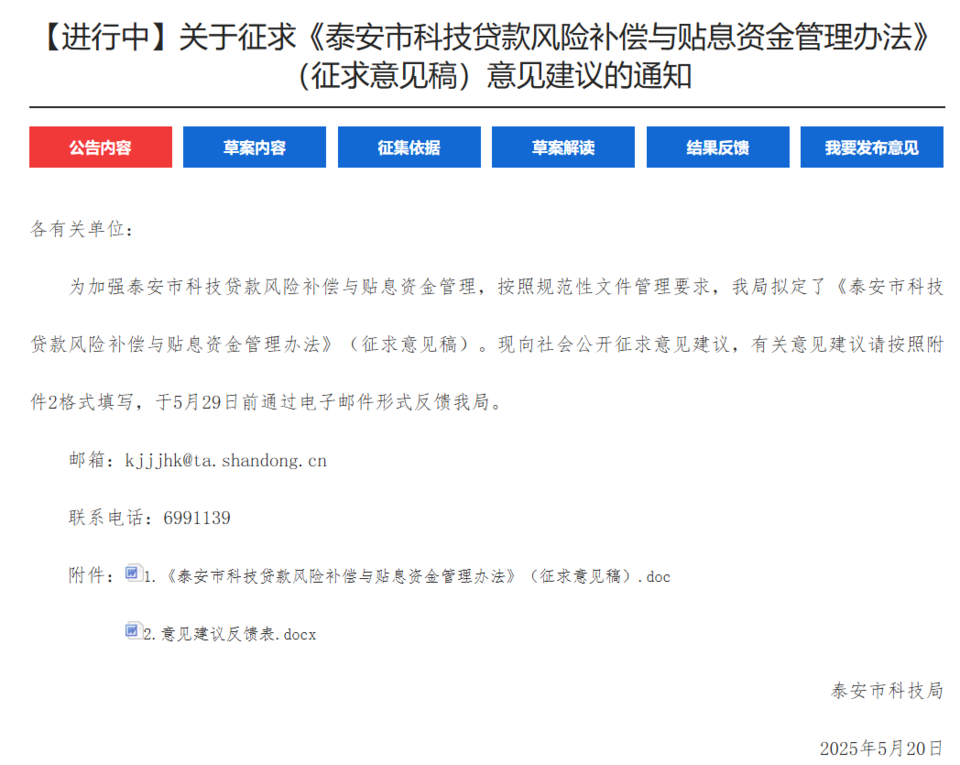
Core Viewpoint - The policy aims to enhance financial support for technology-oriented small and medium-sized enterprises (SMEs) in Tai'an by reducing lending risks for banks and financing costs for companies through a new risk compensation and interest subsidy management approach [1][3]. Group 1: Policy Details - The Tai'an Science and Technology Bureau has released a draft for public consultation regarding the "Risk Compensation and Interest Subsidy Management Measures for Science and Technology Loans" [1]. - The policy includes significant measures such as a maximum interest subsidy of 3 million yuan for major project transformations under the "Double Ten Project" [1][3]. Group 2: Risk Compensation Mechanism - The risk compensation mechanism involves shared responsibility among the provincial, municipal, and banking sectors, with a risk-sharing ratio of 35% from the provincial government, 35% from the municipal government, and 30% from the banks [3]. - For early-stage and startup technology SMEs assessed through the "Kyrongxin" platform, the maximum risk compensation can reach up to 90% for credit loan principal losses [3]. Group 3: Interest Subsidy Details - The interest subsidy is provided on a post-subsidy basis, with Tai'an offering an additional 20% subsidy on top of the provincial level, capping individual enterprise subsidies at 250,000 yuan [3]. - For projects under the "Double Ten Project," the maximum interest subsidy can reach up to 3 million yuan [3]. Group 4: Application and Oversight - Applications for risk compensation and interest subsidies must be submitted annually, with specific procedures outlined for banks and enterprises to follow [4]. - The policy includes strict oversight measures to prevent fraudulent activities, with penalties for those who misappropriate funds or fail to report accurately [4].
七部门发文培育未来产业 AI赛道迎来布局良机
Zhong Zheng Wang· 2025-05-19 07:09
Group 1 - The Ministry of Science and Technology and six other departments have issued policies to accelerate the construction of a technology finance system, introducing 15 measures to channel more financial resources into technological innovation [1] - Key highlights of the 15 policy measures include top-level design for a new technology finance ecosystem, establishment of a "National Venture Capital Guiding Fund" to promote the transformation of major technological achievements into productive forces, and optimization of state-owned venture capital assessments to unleash investment vitality [1] - AI is increasingly recognized as a strategic focal point in global technological competition, with the potential for multiple catalysts in the AI sector as policies and regulations are implemented [1] Group 2 - The Sci-Tech Innovation Board Artificial Intelligence ETF closely tracks the Sci-Tech AI Index, which selects large market capitalization companies from the Sci-Tech Innovation Board, covering sectors such as computers, chips, software, and services [2] - The Robotics ETF Fund tracks the CSI Robotics Index, which includes sample stocks from system solution providers, digital workshop and production line integrators, automation equipment manufacturers, and related companies to reflect the performance of the robotics industry [2] - The Hong Kong Technology 30 ETF tracks the Hang Seng Hong Kong Stock Connect China Technology Index, with significant representation from the information technology, discretionary consumption, industrial, and telecommunications sectors, indicating a high technology content [2]
为科技创新注入更强金融动力(专家谈)
Ren Min Ri Bao· 2025-05-18 22:02
科技金融是实现科技与金融双向促进,推动新质生产力发展的重要支撑。金融"五篇大文章"中,科技金 融位居首位。 近年来,从中央到地方,一系列支持科技创新的金融举措加速落地,我国金融支持科技创新的深度和广 度不断提升。目前,我国已经初步形成银行信贷、资本市场、债券市场和创业投资等多层次、多元化的 科技金融服务体系。 如何为科技创新注入更强的金融动力,记者采访了国家金融与发展实验室副主任杨涛。 记者:如何满足科技企业和科技创新的金融服务需求? 杨涛:为科技创新提供更好金融服务,至少应该考虑以下两方面问题。第一,兼顾科技企业与科技创新 活动。一方面,各类科技企业是科技创新的核心力量,只有满足好科技企业的各种金融需求,才能在微 观层面上保障中国特色自主创新的顺利推进。另一方面,传统产业与企业相对缺乏科技创新能力,获得 科技金融支持的可能性相对低,如果能通过加强金融服务激发传统产业与企业的创新活力,就可能使科 技强国建设获得更广泛的基础。 杨涛:首先,要以系统化思维推动科技金融体制改革。一则,构建同科技创新相适应的科技金融体制, 更需推动供给侧结构性改革,不应该静态、片面地追求特定金融产品的规模与数量,要更加动态平衡、 结 ...

关税博弈阶段性缓和,美国通胀仍在下行
Southwest Securities· 2025-05-18 00:30
ooo[Table_ReportInfo] 2025 年 05 月 16 日 证券研究报告•宏观定期报告 宏观周报(5.12-5.16) 关税博弈阶段性缓和,美国通胀仍在下行 摘要 [Table_Summary] 一周大事记 国内:加快构建科技金融体制,持续推进城市更新。5 月 13 日,中国-拉美 和加勒比国家共同体论坛第四届部长级会议在北京举行,同日,中国和巴西发 布关于强化携手构建中巴命运共同体的联合声明,未来我国自巴西进口有望持 续增加,中国企业向巴西出海投资的步伐也有望加快;14 日,科技部联合中 国人民银行等七部门发布《加快构建科技金融体制 力支撑高水平科技自立自 强的若干政策举措》,提出 15 项具体措施,推动金融资源精准投向科技创新 领域;同日,国家发展改革委主任郑栅洁主持召开民营企业座谈会,围绕经济 形势、稳就业稳经济政策落实等议题,系统回应民营企业关切,释放了强化政 策执行、法治保障和战略引导的积极信号;15 日,中办、国办印发《关于持 续推进城市更新行动的意见》,系统部署八大任务与六大支撑保障措施,城市 更新改造后续或将获得更多财政和融资等方面的支持。 相关研究 请务必阅读正文后的重要声 ...