
高技术制造

Search documents
7月经济发展“进”的步伐稳健(锐财经)
Ren Min Ri Bao· 2025-08-15 19:39
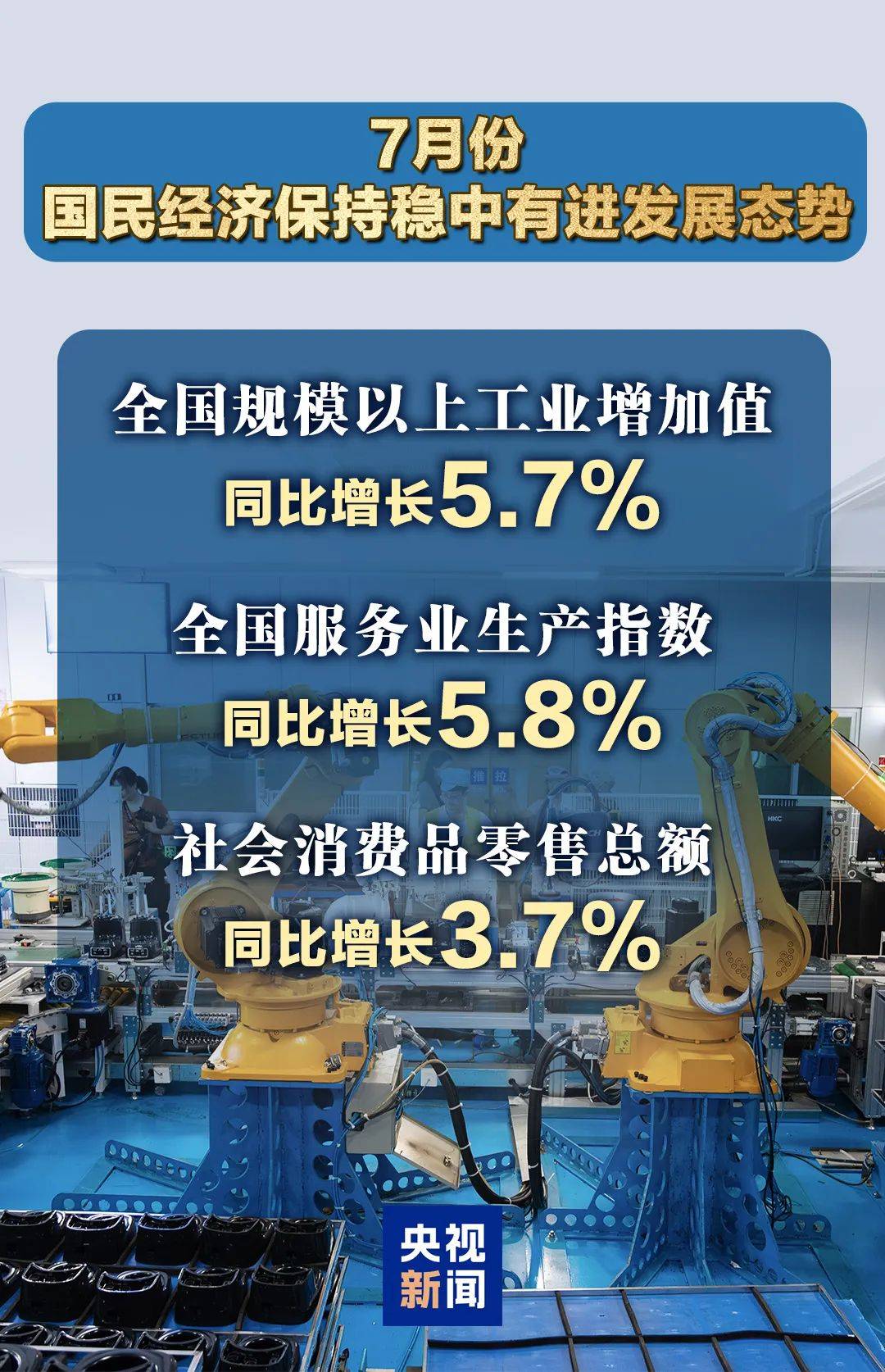
Economic Performance Overview - In July, the industrial added value above designated size increased by 5.7% year-on-year, indicating stable growth in production supply [1][2] - The total retail sales of consumer goods rose by 3.7% year-on-year, reflecting a steady increase in consumption [1][2] - The total import and export of goods grew by 6.7% year-on-year, showing resilience in foreign trade [1][2] Production and Investment - The equipment manufacturing sector saw a significant increase, with added value rising by 8.4% in July, outpacing the overall industrial growth [2] - High-tech manufacturing also performed well, with a year-on-year increase of 9.3% in added value [3] - Investment in water conservancy and electricity has rapidly increased, driven by large-scale equipment updates [7] Consumer Market Dynamics - The consumer market is supported by policies aimed at boosting consumption, with a combined growth of approximately 5% in retail sales of goods and services from January to July [4] - Specific categories such as home appliances and cultural products saw substantial growth, with retail sales increasing by 28.7% and 13.8% respectively in July [4] - The service retail sector experienced robust growth, particularly in tourism and cultural services, with double-digit growth rates in several categories [4] Future Outlook - The economic foundation remains strong, with ongoing macroeconomic policies expected to support stable growth [6][7] - The International Monetary Fund has raised its forecast for China's economic growth by 0.8 percentage points, indicating increased confidence from the international community [7] - Continued efforts to enhance consumption and diversify foreign trade markets are anticipated to further stabilize economic performance [7]
7月份国民经济数据公布,一起看看→
Sou Hu Cai Jing· 2025-08-15 04:26
Economic Overview - The Chinese government is implementing more proactive macro policies to promote economic growth, with a focus on building a unified national market [1] - The national economy is showing a steady growth trend, with production and demand continuing to rise, and overall employment and prices remaining stable [1] Industrial Performance - Industrial production has seen rapid growth, with the industrial added value for large-scale enterprises increasing by 5.7% year-on-year and 0.38% month-on-month in July [3] - The equipment manufacturing sector's added value grew by 8.4% year-on-year, while high-tech manufacturing saw a 9.3% increase, outperforming the overall industrial growth by 2.7 and 3.6 percentage points respectively [3] Service Sector Growth - The service sector is also experiencing robust growth, with the service production index rising by 5.8% year-on-year in July [4] Consumer Market Trends - Retail sales continue to grow, with the total retail sales of consumer goods reaching 38,780 billion yuan, marking a year-on-year increase of 3.7% [5] - The macro policies are showing effectiveness, helping the national economy to overcome adverse impacts from complex external environments and extreme domestic weather conditions, demonstrating strong resilience and vitality [5]

国家统计局:前7月全国固投同比增1.6%,房地产开发投资降12%
Guan Cha Zhe Wang· 2025-08-15 02:39
Group 1: Industrial Production - In July, the industrial added value of large-scale enterprises increased by 5.7% year-on-year and 0.38% month-on-month [1] - The manufacturing sector grew by 6.2%, with equipment manufacturing and high-tech manufacturing increasing by 8.4% and 9.3% respectively [1] - The profit of large-scale industrial enterprises from January to June was 34,365 billion yuan, a year-on-year decrease of 1.8% [1] Group 2: Service Industry - In July, the service production index increased by 5.8% year-on-year, with significant growth in information transmission, finance, and business services [2] - The business activity index for the service industry was at 50.0%, indicating stable activity levels [2] - From January to July, the service production index grew by 5.9% year-on-year [2] Group 3: Market Sales - In July, the total retail sales of consumer goods reached 38,780 billion yuan, a year-on-year increase of 3.7% [3] - Online retail sales amounted to 86,835 billion yuan, growing by 9.2% year-on-year, with physical goods online retail accounting for 24.9% of total retail sales [3] - The retail sales of household appliances and audio-visual equipment increased by 28.7% year-on-year [3] Group 4: Fixed Asset Investment - From January to July, fixed asset investment (excluding rural households) was 288,229 billion yuan, a year-on-year increase of 1.6% [4] - Manufacturing investment grew by 6.2%, while real estate development investment decreased by 12.0% [4] - High-tech industries such as aerospace and information services saw significant investment growth of 33.9% and 32.8% respectively [4] Group 5: Trade and Exports - In July, the total import and export value reached 39,102 billion yuan, a year-on-year increase of 6.7% [5] - Exports grew by 8.0% year-on-year, while imports increased by 4.8% [5] - Private enterprises accounted for 57.1% of total imports and exports, with a growth rate of 7.4% [5] Group 6: Employment - The urban surveyed unemployment rate in July was 5.2%, showing a seasonal increase [6] - The average working hours for employees in enterprises was 48.5 hours per week [6] - The unemployment rate for local registered labor was 5.3%, while for migrant labor it was 5.1% [6] Group 7: Consumer Prices - In July, the Consumer Price Index (CPI) remained flat year-on-year, with a month-on-month increase of 0.4% [7] - Core CPI, excluding food and energy, rose by 0.8% year-on-year, indicating a slight increase in inflationary pressure [7] - The Producer Price Index (PPI) for industrial producers decreased by 3.6% year-on-year [7] Group 8: Overall Economic Outlook - The macroeconomic policies have shown effectiveness, maintaining a stable growth trend despite external challenges [8] - The focus remains on stabilizing employment, businesses, and market expectations while promoting domestic demand [8] - The government aims to implement policies thoroughly to ensure steady and healthy economic development [8]
【奋楫前行•强国建设新高度】制造业由大到强攀高向优
Zhong Guo Jing Ji Wang· 2025-08-14 08:43
Core Viewpoint - China's manufacturing industry has significantly enhanced its comprehensive strength and international influence during the "14th Five-Year Plan" period, maintaining its position as the world's largest manufacturing nation for 15 consecutive years, with an annual manufacturing value added exceeding 30 trillion yuan [2]. Group 1: Manufacturing Strength - China's manufacturing industry has ranked first globally in the production of over 200 major industrial products [2]. - The country has the most complete industrial categories and systems in the world, leveraging its existing foundation to reshape new advantages and unleash new momentum in manufacturing [2]. Group 2: Innovation and Technology - The number of high-tech enterprises reached 463,000 in 2024, 1.7 times that of 2020, with over 570 industrial enterprises entering the global R&D investment top 2500, accounting for nearly one-fourth [4]. - Major landmark achievements in technology, such as 5G communication equipment and large LNG ships, are continuously emerging, showcasing China's leading position globally [4][5]. - The annual production of integrated circuits increased by 72.6% compared to the end of the "13th Five-Year Plan," adding approximately 190 billion pieces [5]. Group 3: Industrial Structure Optimization - The proportion of value added from high-tech manufacturing and equipment manufacturing has increased, with high-tech manufacturing accounting for 16.3% in 2024, up from 15.1% in 2020 [6]. - The density of industrial robots has risen from 246 units per 10,000 people in 2020 to 470 in 2023, indicating a trend towards greater automation [6]. Group 4: Green Transformation - By 2024, there are 6,430 national-level green factories, contributing to approximately 20% of the total manufacturing output value [7]. - The sales volume of new energy vehicles reached 12.866 million units in 2024, which is 9.4 times that of 2020 [7]. Group 5: Emerging Industries - New emerging industries, represented by new energy vehicles, lithium batteries, and photovoltaic products, have seen exports surpassing 100 billion yuan [8]. - The technology level and market competitiveness in fields such as low-altitude economy, biomedicine, and high-end equipment have significantly improved [8].

中国有充足信心实现今年经济增长目标——经济航船稳健前行
Xin Hua Wang· 2025-08-12 06:04
Economic Overview - China's economy is facing complex international challenges, including a slowing global recovery and rising trade protectionism, but overall economic operation remains stable with positive developments [1] - The government has implemented a series of macroeconomic policies to boost market confidence and stimulate economic growth [1] Consumer and Investment Trends - The consumer market shows vitality, with significant growth in consumption and investment; retail sales increased by 3.5% year-on-year from January to October, while fixed asset investment grew by 3.4% [4] - The winter sports sector is experiencing a boom, with over 385 million people expected to participate in ice and snow leisure tourism during the 2023-2024 season [3] - New energy vehicles (NEVs) have seen substantial growth, with production and sales reaching 9.779 million and 9.75 million units respectively, marking a year-on-year increase of 33% and 33.9% [3] Industrial Development - The industrial sector is showing robust growth, with the added value of industrial enterprises above designated size increasing by 5.8% year-on-year from January to October [4] - High-tech manufacturing is accelerating, with a 9.4% year-on-year increase in high-tech manufacturing value added in October [6] Policy Impact and Market Confidence - The government's "combination punch" of policies has led to increased market activity, with new housing transactions rising by 3.9% year-on-year in October, marking the first increase after eight months of decline [7] - Financial institutions are optimistic about China's economic policies, with many raising their growth forecasts for 2024 [7] Future Outlook - The long-term positive trend of China's economy remains unchanged, supported by favorable conditions in development dynamics, market space, and policy backing [8] - The government is committed to implementing significant reforms to ensure sustained economic recovery and maintain its role as a key driver of global economic growth [9]
权威数读|5.4%!向新向好、开局良好
Xin Hua Wang· 2025-08-12 05:57
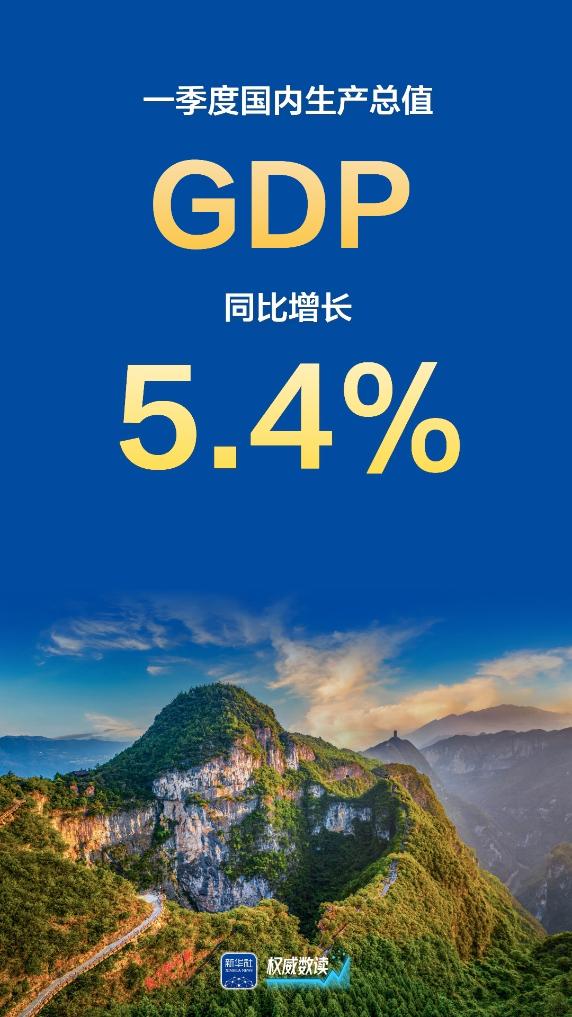
Economic Overview - The GDP for the first quarter of this year is 318,758 billion yuan, showing a year-on-year growth of 5.4% and a quarter-on-quarter increase of 1.2% [1][2] Agricultural Sector - The agricultural production situation is favorable, with the value added in agriculture (planting) increasing by 4.0% year-on-year [6] - The total output of pork, beef, mutton, and poultry is 25.4 million tons, reflecting a year-on-year growth of 2.0% [6] Industrial Sector - The industrial value added for large-scale enterprises increased by 6.5% year-on-year, accelerating by 0.7 percentage points compared to the previous year [9] - The equipment manufacturing industry saw a value added growth of 10.9%, while high-tech manufacturing increased by 9.7% [9] - Production of new energy vehicles, 3D printing equipment, and industrial robots grew by 45.4%, 44.9%, and 26.0% respectively [9] Service Sector - The value added in the service sector increased by 3% year-on-year, accelerating by 3 percentage points compared to the previous year [12] - Key sectors such as information transmission, software and IT services, leasing and business services, transportation, warehousing, and postal services, as well as wholesale and retail, showed significant growth [12] Consumer Market - The total retail sales of consumer goods reached 124,671 billion yuan, with a year-on-year growth of 4.6%, which is an acceleration of 1.1 percentage points compared to the previous year [15] - Online retail sales amounted to 36,242 billion yuan, reflecting a year-on-year increase of 7.9% [15] Investment Trends - National fixed asset investment (excluding rural households) reached 103,174 billion yuan, with a year-on-year growth of 4.2% [18] - Infrastructure investment grew by 5.8%, while manufacturing investment increased by 9.1% [18] - Investment in high-tech industries rose by 6.5% [18] Trade Performance - The total value of goods imports and exports was 103,013 billion yuan, showing a year-on-year growth of 1.3% [21] - Private enterprises' imports and exports increased by 5.8%, accounting for 56.8% of the total, which is a 2.4 percentage point increase from the previous year [21] Price Stability - The Consumer Price Index (CPI) decreased by 0.1% year-on-year, while the core CPI, excluding food and energy, rose by 0.3% [24] - The Producer Price Index (PPI) for industrial producers fell by 2.3% year-on-year [24] Employment Situation - The average urban survey unemployment rate was 5.3% at the end of the first quarter [27] - The total number of rural laborers working outside their hometowns reached 18.795 million, reflecting a year-on-year growth of 1.1% [27]
经济学家解读2025上半年中国经济关键词(经济形势理性看)
Ren Min Ri Bao· 2025-08-10 22:00
Core Viewpoint - China's economy has shown strong vitality and resilience in the first half of the year, with a GDP growth of 5.3%, positioning it as a leader among major economies despite global uncertainties [3][4]. Economic Performance - The GDP growth of 5.3% in the first half of the year reflects China's robust economic performance amid complex international conditions [3][4]. - The social retail sales increased by 5.0%, indicating a positive consumer sentiment [5]. - Exports grew by 7.2%, with high-end equipment exports increasing by over 20% [5]. Policy Measures - The Chinese government has implemented proactive fiscal and monetary policies to stabilize the economy, including measures to boost domestic demand and support key industries [4][5]. - Policies such as the replacement of old consumer goods and infrastructure investment have contributed to economic stability [5]. Technological Innovation - The manufacturing sector has seen significant growth, with high-tech manufacturing value added increasing by 9.5% [7]. - R&D expenditure as a percentage of GDP reached nearly 2.7%, surpassing the EU average, which supports innovation and digital transformation [5][9]. Domestic Market Dynamics - The domestic market's vastness provides significant resilience, with consumption in lower-tier cities showing strong growth potential [11]. - The contribution of domestic demand to GDP growth was 68.8%, highlighting the importance of internal circulation [16]. International Trade - Despite global trade challenges, China's foreign trade maintained a strong performance, with imports and exports exceeding 10 trillion yuan for nine consecutive quarters [13]. - The export of machinery and electrical products grew by 9.5%, indicating a shift towards high-value and green products [13]. Corporate Environment - The number of business entities in China exceeded 191 million, reflecting a stable business environment and increased entrepreneurial activity [20]. - Enterprises are increasingly focusing on innovation and adapting to market demands, with significant growth in exports from private and foreign enterprises [22]. Social Welfare and Economic Growth - The government has prioritized social welfare, with social security and employment expenditures increasing by 9.2% [26]. - The per capita disposable income of residents grew by 5.4%, contributing to improved consumer confidence and spending [27].

关注政策组合拳落地效果
Sou Hu Cai Jing· 2025-08-10 20:52
Economic Growth - China's GDP grew by 5.3% year-on-year in the first half of the year, with the first quarter at 5.4% and the second quarter at 5.2% [1] - The primary industry increased by 3.7%, the secondary industry by 5.3%, and the tertiary industry by 5.5%, indicating a shift towards a service-oriented economy [1] Consumption and Trade - Consumer demand and foreign trade are key drivers of economic growth, with high-tech products expanding consumption scenarios [2] - The rise of smart home products has met consumer demand for intelligent living, boosting related product consumption [2] Investment Trends - Fixed asset investment nominally grew by 2.8% year-on-year, with actual growth at 5.3% after adjusting for price factors, indicating a disparity between nominal and actual growth [3] - Manufacturing investment increased by 7.5%, while real estate development investment fell by 11.2%, reflecting a cautious investment climate [3][4] Industrial Performance - Industrial output for large enterprises grew by 6.4%, with significant increases in equipment manufacturing (10.2%) and high-tech manufacturing (9.5%) [8] - New industries and technologies are positively impacting China's overall economic competitiveness and are expected to reshape the global industrial division [8] Consumer Price Index - The Consumer Price Index (CPI) decreased by 0.1% year-on-year, while the Producer Price Index (PPI) fell by 2.8%, indicating subdued demand in both consumption and investment [8][9] - The core CPI rose by 0.7%, suggesting potential inflationary pressures that need to be monitored [8]
工业大省挑大梁 制造业“含新量”持续提升
Zheng Quan Shi Bao· 2025-08-07 18:22
Core Insights - The industrial economy of major provinces in China is showing robust growth, with GDP growth rates ranging from 4.2% to 5.8% in the first half of the year, driven by industrial upgrades, innovation, and green transformation [1][2] - Strategic emerging industries and traditional industries undergoing deep transformation are growing significantly faster than other sectors, becoming key drivers of high-quality economic development [1][2] Industrial Growth and Performance - Major provinces like Guangdong, Jiangsu, Shandong, Zhejiang, Sichuan, Henan, and Anhui have seen industrial added value growth rates above or close to the national average, with Henan and Anhui leading at 8.4% [2] - Anhui's industrial performance is particularly strong, with manufacturing growth at 10.4%, driven by equipment manufacturing (16.7%) and high-tech manufacturing (23.6%) [2] - The production of industrial robots in Anhui surged by 93.3%, while integrated circuits and computer-related manufacturing also showed significant growth [2] High-Tech and Emerging Industries - High-tech industries are experiencing explosive growth across major provinces, with Guangdong's high-tech products like new energy vehicles and lithium batteries seeing increases of 14.7% and 42.2% respectively [3] - Zhejiang's industrial economy is transitioning towards high-tech and intelligent manufacturing, with high-tech manufacturing and digital economy sectors growing by 12.7% and 12.0% respectively [3] Investment in Industrial Upgrades - Industrial investment is crucial for high-quality development, with Henan's industrial investment growing by 25.9% in the first half of the year, significantly outpacing overall investment growth [4][5] - Zhejiang also reported strong industrial investment growth, with manufacturing investment increasing by 10.1% [5] Regional Development Strategies - Different provinces are exploring unique development paths based on their industrial foundations and resource endowments, contributing to a diversified industrial landscape in China [6] - Guangdong focuses on electronic information, Jiangsu and Zhejiang on high-end equipment and digital economy, while Shandong emphasizes advanced manufacturing [6] - The differentiated development strategies help avoid homogenization and create complementary industrial synergies [6]
上半年 “以旧换新”新扩围的手机等通信设备零售同比增长25.4%|数据看板
Sou Hu Cai Jing· 2025-08-04 23:51
Group 1 - The core viewpoint of the articles highlights the steady growth of national enterprise sales revenue in the first half of the year, driven by various positive factors [1] - Manufacturing industry sales revenue growth outpaced the overall national enterprise growth by 1.5 percentage points, supported by tax incentives and policies [1] - High-tech industries saw a significant sales revenue increase of 14.3% year-on-year, indicating the continuous expansion of innovative sectors [1] - The digital economy's core industry sales revenue grew by 10.1%, reflecting the accelerated integration of digital and real economies [1] - The "Two New" policies have shown clear effectiveness, with machinery equipment purchases increasing by 11.1% year-on-year [1] - Retail sales of home appliances, such as televisions and refrigerators, surged by 45.3% and 56.6% respectively, driven by consumer demand [1] Group 2 - The construction of a unified national market is progressing steadily, with inter-provincial sales accounting for 40.7% of national enterprise sales revenue, an increase of 0.6 percentage points from the previous year [2]