信息传输

Search documents
一揽子增量政策实施效果如何?税收数据揭示经济向好态势
Yang Shi Xin Wen· 2025-10-26 03:57
Core Insights - The implementation of a comprehensive set of incremental policies since September 26 last year has led to a steady recovery in both invoice sales and tax revenue, indicating a strengthening economic outlook in China [1][2] Group 1: Tax Revenue and Invoice Sales - The growth rate of national enterprise sales revenue has shown a steady increase, with quarterly growth rates from Q3 last year to Q3 this year recorded at 0.4%, 2.6%, 2.1%, 3.1%, and 4.4% respectively [2] - Tax revenue has turned positive after seven months of negative growth, with a cumulative increase in tax revenue since February this year, showing month-on-month growth of 2.6% and 6.9% in Q2 and Q3 respectively [2][6] Group 2: Capital Market Tax Revenue - Tax revenue related to the capital market has maintained a high growth rate, with a year-on-year increase of 56.8% in capital market service tax revenue, and a 110.5% increase in securities transaction stamp duty [3] - The total market value of A-share companies surpassed 100 trillion yuan in August, and the Shanghai Composite Index reached a ten-year high in September, with average daily stock trading volumes of 2.3 trillion yuan and 2.4 trillion yuan in August and September respectively [3] Group 3: Improvement in Business Conditions - The manufacturing sector has seen a year-on-year tax revenue growth of 5.4%, accounting for 31% of total tax revenue, with high-end manufacturing sectors like railway, shipbuilding, and aerospace experiencing a tax revenue increase of 31.5% [4] - In Dalian, the automotive manufacturing sector reported a sales revenue of 68.69 billion yuan, a year-on-year increase of 21%, while equipment and raw material purchases grew by 33.6% [5] Group 4: Emerging Industries and Consumption - The information transmission, software, and IT services sectors have seen tax revenue growth of 15.3%, while scientific research and technical services have grown by 13.2% [5] - Consumer goods sectors, particularly home appliances, have experienced significant sales growth, with retail sales of refrigerators and televisions increasing by 55.4% and 35.3% respectively [7]
江苏前三季度服务业经济平稳增长,发展质效持续提升
Yang Zi Wan Bao Wang· 2025-10-25 09:05
Core Insights - Jiangsu Province's service industry added value reached 56,119 billion yuan in the first three quarters of the year, showing a year-on-year growth of 5.6% and accounting for 54.6% of the regional GDP, an increase of 0.9 percentage points from the previous year [1] - The contribution rate of the service industry to economic growth was 56.1%, driving a 3.0 percentage point increase in regional GDP [1] Group 1: Productive Service Industry - The productive service industry provided strong support, with revenue from large-scale productive service enterprises growing by 9.0% year-on-year from January to August, contributing 6.2 percentage points to the growth of the province's large-scale service industry [2] - Business service revenue increased by 15.6% year-on-year, continuing its rapid growth [2] Group 2: Emerging Service Industry - In the first three quarters, the value added of information transmission, software, and IT services grew by 8.9%, while scientific research and technical services increased by 6.3% year-on-year [3] - From January to August, revenue from large-scale high-tech service industries grew by 7.5%, contributing 3 percentage points to the growth of large-scale service industries [3] - The internet and related services, as well as software and IT services, saw revenue growth of 15.0% and 11.1% year-on-year, respectively [3] - Internet information services grew by 17.8%, contributing 0.6 percentage points to the growth of large-scale service industries [3] - Revenue from research and experimental development and technology promotion services grew by 19.9% and 21.9% year-on-year, respectively, contributing 0.8 percentage points to large-scale service industry growth [3] Group 3: Cultural, Sports, and Tourism Consumption Market - The cultural, sports, and tourism consumption market showed increased vitality, with significant growth in performances, sports events, and tourism [4] - From January to August, revenue from large-scale art performance venues and museums grew by 10.7% and 20.2% year-on-year, respectively [4] - The sports service industry grew by 13.0%, with sports organizations and facility management increasing by 27.9% and 10.0% year-on-year, respectively [4] - Revenue from travel agencies and related services grew by 11.9%, while the entertainment industry saw a 9.2% increase in revenue [4]
用电量创新高 从电力账单看“算力新城”拔节生长
Ge Long Hui A P P· 2025-10-25 00:54
Core Insights - Gansu Qingyang is one of the eight key nodes in China's "East Data West Computing" initiative, with significant changes in local electricity consumption patterns observed since the project's launch [1] - The electricity consumption related to computing in Qingyang was nearly zero before 2022, but has since increased significantly, with monthly growth rates in electricity consumption ranking among the highest in Gansu this year [1] - The completion of the "East Data West Computing" project has driven local tertiary industry investment growth by nearly 20%, with over 5,900 digital economy enterprises now connected to Qingyang [1] - More than 450 subsidiary companies have established operations in the area, and the number of regulated enterprises in information transmission, software, and IT services has increased to 10, with a year-on-year revenue growth of 78.4% [1]
前三季度广东GDP达105176.98亿元 同比增长4.1%
Zhong Guo Xin Wen Wang· 2025-10-24 12:00
Economic Overview - Guangdong's GDP reached 105,176.98 billion RMB in the first three quarters, with a year-on-year growth of 4.1% [1] - The primary industry added value was 3,838.50 billion RMB, growing by 4.5% year-on-year [1] - The secondary industry added value was 39,270.75 billion RMB, with a year-on-year increase of 2.7% [1] - The tertiary industry added value was 62,067.73 billion RMB, showing a year-on-year growth of 4.9% [1] Industrial Performance - Industrial production in Guangdong showed a recovery, with a 3.5% year-on-year increase in the added value of industrial enterprises above designated size [2] - Key industries such as computer, communication, and other electronic equipment manufacturing grew by 7.5% year-on-year [2] - The electrical machinery and equipment manufacturing sector increased by 6.3% year-on-year [2] - The automotive manufacturing industry saw an 8.2% year-on-year growth [2] New Energy and High-Tech Industries - New momentum industries performed well, with advanced manufacturing and high-tech manufacturing added value growing by 5.4% and 6.4% year-on-year, respectively [2] - Production of industrial robots, service robots, civilian drones, and 3D printing equipment increased by 33.7%, 15.2%, 44.8%, and 40.3% year-on-year, respectively [2] - Production of new energy vehicles, lithium-ion batteries for energy storage, wind turbine generators, and solar cells grew by 24.6%, 37.6%, 55.8%, and 75.3% year-on-year, respectively [2] Service Sector and Consumption - The added value of the service industry increased by 4.9% year-on-year [2] - Revenue in the information transmission, software, and IT services sector grew by 9.5% year-on-year [2] - Revenue in transportation, warehousing, and postal services increased by 6.6% year-on-year [2] - Retail sales of consumer goods in Guangdong grew by 2.8% year-on-year, with online retail through public networks increasing by 16.2% [2] Economic Outlook - Overall, Guangdong's economic operation remained stable in the first three quarters [2] - The external environment is becoming more complex and severe, with insufficient domestic effective demand [2] - The foundation for sustained economic recovery needs to be strengthened [2]
人民财评:新动能后劲足,服务业释放多重发展活力
Ren Min Wang· 2025-10-24 10:12
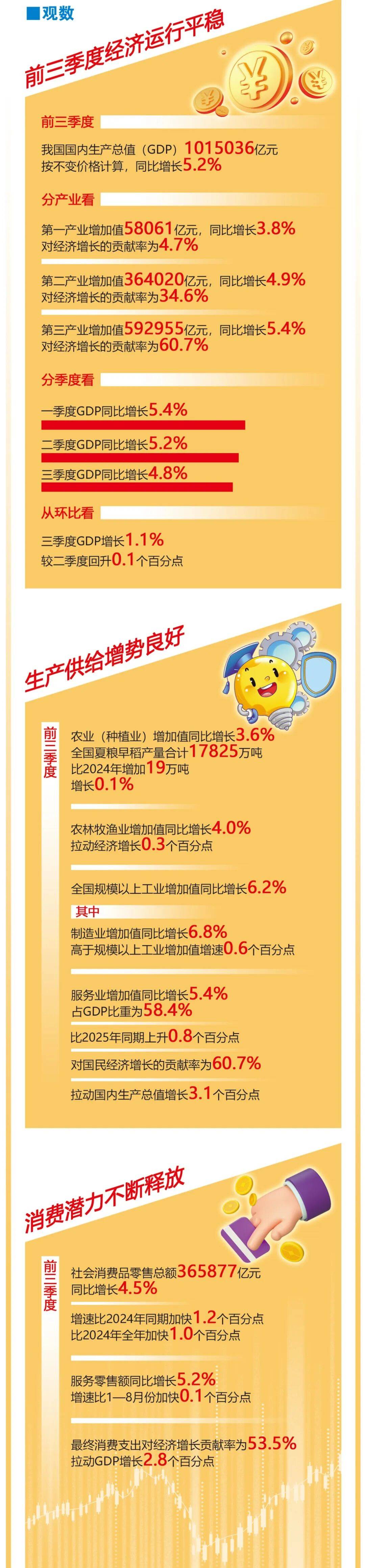
Core Insights - The service industry in China has shown significant growth, contributing 60.7% to the national economic growth in the first three quarters of the year [1] - The value added by the service sector reached 592,955 billion yuan, with a year-on-year growth of 5.4% [1] - The service sector's share of GDP increased to 58.4%, up 0.8 percentage points from the previous year [1] Group 1: Service Industry Growth - The service industry has become increasingly important in the national economy, with rapid growth in service consumption driving a structural shift towards a service-oriented economy [1] - The information transmission, software, and IT services sector saw a year-on-year increase of 11.2%, with a production index of 12.8% in September [2] - High-tech service industry investments grew by 6.1%, with information service investment surging by 33.1% [2] Group 2: Consumer Trends and Service Upgrades - Service retail sales increased by 5.2%, outpacing goods retail growth by 0.6 percentage points, indicating a shift towards consumer preference for experiences and quality [3] - The tourism and performance sectors experienced significant growth, with e-commerce transactions for tourism services rising over 20% [3] - The service trade's import and export grew by 7.4%, with travel service exports skyrocketing by 57.6% [3] Group 3: International Confidence in Service Sector - The actual use of foreign capital in the service industry reached 366.19 billion yuan, accounting for over 70% of total foreign capital usage, reflecting strong international confidence [3] - The number of foreign visitors eligible for visa-free entry increased by 52.1%, indicating a growing interest in "China tours" [3] Group 4: Future Outlook - The service industry is expected to continue its stable operation and quality improvement, with the integration of more quality services and new technologies enhancing consumer experience [4]
2025年前三季度宏观政策“三策合一”研究报告
Sou Hu Cai Jing· 2025-10-24 08:51
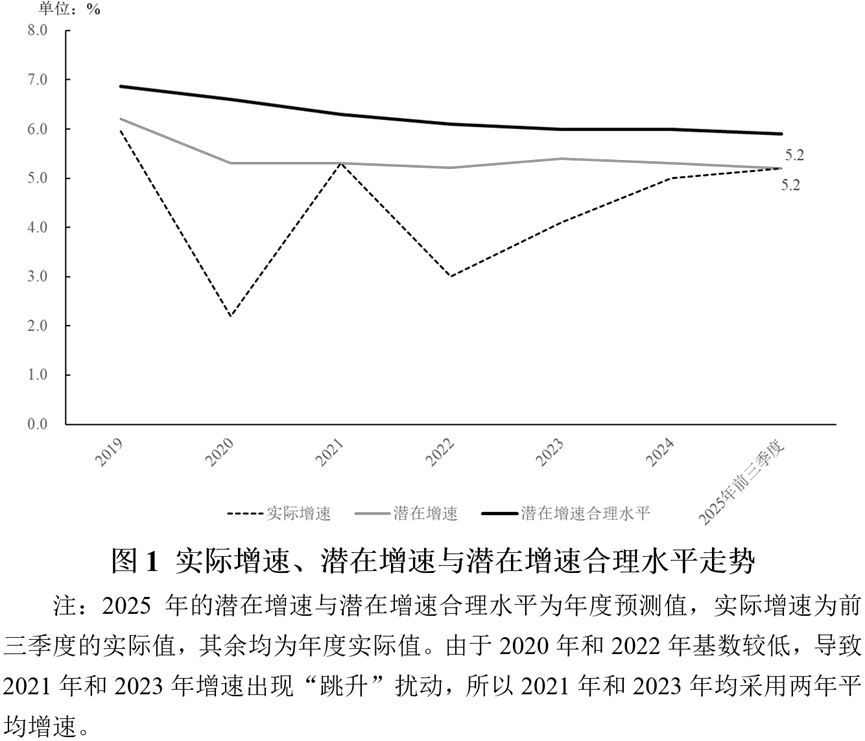
Core Viewpoints - The main contradiction in the current macroeconomic environment is insufficient domestic demand, particularly in consumer spending, highlighting the strategic importance of enhancing consumption [2][9] - It is recommended to maintain the actual GDP growth rate above the potential growth rate of 5.2% for 2025 and set the 2026 GDP growth target around 5% to signal stability [2][37] - A gradual approach to price level control is suggested, aiming for a three-step process to achieve a core CPI growth target of 2% over two to three years [2][38] Macroeconomic Overview - The GDP growth rate for the first three quarters of 2025 is 5.2%, aligning closely with the potential growth rate, indicating a stable economic operation [6] - Industrial profits have shown positive improvement, with a 0.9% year-on-year increase in profits for large industrial enterprises from January to August 2025 [7] - The service sector has also experienced growth, with a 5.4% year-on-year increase in value added, particularly in modern service industries [8] Current Economic Contradictions - The primary contradiction in the macroeconomy is on the demand side, characterized by insufficient consumer demand, with retail sales growth slowing to 4.5% year-on-year in the first three quarters [9][11] - Investment demand has also declined, with fixed asset investment showing a -0.5% year-on-year growth, a drop of 3.3 percentage points from the first half of the year [9] Macroeconomic Policy Evaluation - The monetary policy index for the first three quarters of 2025 is 44.0, indicating a slight increase in policy strength, with M2 growth at 8.4% by the end of September [12] - The fiscal policy index stands at 57.9, reflecting an increase in fiscal policy strength, with public budget expenditure growing by 3.1% year-on-year [13] - The overall efficiency of stabilization policies is rated at 50.0, showing a positive trend in policy effectiveness [26] Policy Recommendations - It is advised to enhance stabilization policies to address the lack of effective domestic demand, with a focus on both monetary and fiscal measures [38] - Growth policies should prioritize the development of new productive forces, with an emphasis on employment-friendly industrial policies [39] - Structural policies need to optimize investment, industrial, and income distribution structures to better balance total supply and demand [39]

前三季度浙江GDP同比增长5.7%
Guo Ji Jin Rong Bao· 2025-10-24 06:06
Economic Overview - Zhejiang Province's GDP for the first three quarters reached 68,495 billion yuan, with a year-on-year growth of 5.7% at constant prices [1] - The primary industry added value was 1,735 billion yuan, growing by 3.7%; the secondary industry added value was 26,086 billion yuan, growing by 5.2%; and the tertiary industry added value was 40,674 billion yuan, growing by 6.0% [1] Agricultural Sector - The agricultural, forestry, animal husbandry, and fishery sectors saw a value-added growth of 3.8% [1] - Vegetable production increased by 3.7%, while total meat production (pork, beef, lamb, poultry) decreased by 5.2% to 855,000 tons [1] - Egg production rose by 11.0% to 322,000 tons, and milk production increased by 4.2% to 166,000 tons [1] - Total aquatic product output was 4,258,000 tons, growing by 5.2% [1] Industrial Sector - The industrial added value for large-scale enterprises grew by 7.1%, with private enterprises contributing 76.2% to this growth [2] - Among 37 major industrial categories, 28 saw an increase in added value, with a growth rate of 75.7% [2] - Key manufacturing sectors such as automotive, computer communication electronics, and instruments saw increases of 17.7%, 16.5%, and 13.6% respectively [2] - High-tech manufacturing and digital economy core industries grew by 12.4% and 11.6% respectively [2] Investment Trends - Fixed asset investment decreased by 3.8%, but excluding real estate development, it grew by 7.7% [3] - Manufacturing investment increased by 10.7%, with significant growth in automotive (34.2%) and general equipment (24.9%) [3] - Infrastructure investment rose by 7.9%, accounting for 27.5% of total investment, an increase of 3.0 percentage points year-on-year [3] Consumer Market - Total retail sales of consumer goods reached 28,408 billion yuan, with a year-on-year growth of 5.2% [3] - Retail sales through public networks grew by 23.4%, indicating a strong shift towards online shopping [3] - Significant growth was observed in the sales of home appliances (57.0%) and communication equipment (64.2%) [3] Price Trends - The Consumer Price Index (CPI) decreased by 0.2% year-on-year, with four categories of goods and services experiencing price increases [4] - The Producer Price Index (PPI) for industrial producers fell by 2.0% year-on-year [4] Employment and Income - The urban surveyed unemployment rate averaged 4.7%, with 925,000 new urban jobs created [5] - Per capita disposable income for residents reached 54,653 yuan, a nominal increase of 4.7% [5] - Urban residents' income was 63,079 yuan, while rural residents' income was 36,383 yuan, reflecting a nominal growth of 4.2% and 5.3% respectively [5]
GDP增长5.2%,解码中国经济“三季报”
3 6 Ke· 2025-10-24 02:47
Core Insights - China's GDP for the first three quarters grew by 5.2% year-on-year, indicating a steady economic performance amidst a complex international environment [1][2] - The quarterly GDP growth rates showed a mild recovery trend: 5.4% in Q1, 5.2% in Q2, and 4.8% in Q3, with a quarter-on-quarter growth of 1.1% in Q3, suggesting a gradual accumulation of internal economic momentum [1][2] Economic Overview - The total GDP reached 10,150.36 billion yuan, with a growth rate that outpaced both the previous year and the same period last year by 0.2 and 0.4 percentage points respectively, maintaining a leading position among major global economies [2] - Industrial production demonstrated strong resilience, with a 6.2% year-on-year increase in the added value of industrial enterprises above designated size, particularly in equipment manufacturing and high-tech manufacturing, which grew by 9.7% and 9.6% respectively [2] - The service sector also showed steady recovery, with a 5.4% year-on-year increase in added value, led by the information transmission, software, and IT services sector, which grew by 11.2% [2] Consumption and Employment - The consumer market continued to recover, with total retail sales of consumer goods growing by 4.5% year-on-year, driven by strong sales in essential and some upgraded goods, with categories like food, sports and entertainment products, and jewelry seeing retail growth rates exceeding 10% [2][3] - The policy of replacing old consumer goods with new ones has shown significant effects, with retail sales in categories such as home appliances, furniture, and communication equipment also growing around 20% [3] - Employment and prices remained stable, with an average urban unemployment rate of 5.2% and a slight decrease of 0.1% in the Consumer Price Index (CPI) year-on-year [3] New Growth Drivers - New economic drivers are accelerating, with the added value of the lithium-ion battery manufacturing industry growing by 29.8% and the production of new energy vehicles increasing by 29.7% [3] - The total import and export volume reached 33,607.8 billion yuan, with a year-on-year growth of 4.0%, and private enterprises' imports and exports grew by 7.8%, accounting for 57.0% of the total [3] Expert Insights - Experts noted that the economic growth rate is relatively high compared to global standards, with the IMF predicting a global growth rate of 3.2% for 2025 [4] - Recommendations for enhancing consumer capacity include improving wage determination mechanisms and increasing the proportion of labor remuneration in initial distribution [5] - The importance of innovation and R&D investment is emphasized, with R&D intensity increasing from 1.91% in 2012 to 2.68% in 2024, and a significant rise in the share of basic research funding [5][6]
5.5%!上海经济展现强大韧性活力
Jie Fang Ri Bao· 2025-10-23 09:21
Core Insights - Shanghai's economy demonstrated strong resilience and vitality with a GDP growth rate of 5.5% in the first three quarters, surpassing the national average by 0.3 percentage points [1][2] - The industrial sector showed significant improvement, with industrial value-added increasing by 5.2% year-on-year and the output of strategic emerging industries contributing to 44.1% of the total industrial output [2] - The financial and information services sectors experienced robust growth, with the information transmission and software services growing by 15.5% and the financial sector by 9.8% [2] Economic Performance - Shanghai's GDP reached 40,721.17 billion yuan, with the primary industry growing by 0.9%, the secondary industry by 3.9%, and the tertiary industry by 5.9% [1] - Fixed asset investment increased by 6.0%, while the total retail sales of consumer goods amounted to 12,302.77 billion yuan, reflecting a year-on-year growth of 4.3% [2] Consumer and Price Trends - The Consumer Price Index (CPI) remained stable compared to the previous year, with a core CPI increase of 0.6% when excluding food and energy prices [3] - The average disposable income for residents reached 69,220 yuan, marking a 4.3% increase year-on-year, while the urban unemployment rate averaged 4.2% [3]
智库·数据丨“数”览2025年前三季度国民经济“成绩单”
Sou Hu Cai Jing· 2025-10-23 07:06
Economic Growth Overview - In the first three quarters of 2025, China's GDP reached 10,150.36 billion yuan, with a year-on-year growth of 5.2% [17] - The GDP growth in the third quarter was 1.1%, a slight increase of 0.1 percentage points from the second quarter [3][17] - The contribution of the primary industry to economic growth was 4.7%, while the secondary industry contributed 34.6%, and the tertiary industry contributed 60.7% [17] Consumption and Retail - Final consumption expenditure contributed 53.5% to economic growth, driving GDP up by 2.8 percentage points [4][13] - The total retail sales of consumer goods reached 365,877 billion yuan, with a year-on-year growth of 4.5%, accelerating by 1.2 percentage points compared to the same period in 2024 [4][18] - Service retail sales increased by 5.2%, showing a continuous acceleration in growth [4][18] Investment Trends - National fixed asset investment (excluding rural households) totaled 371,535 billion yuan, a year-on-year decrease of 0.5% [6][18] - Excluding real estate development investment, fixed asset investment grew by 3.0%, indicating a shift towards more promising sectors [6][18] - Infrastructure investment rose by 1.1%, while manufacturing investment increased by 4.0% [6][18] Foreign Trade Performance - The total import and export value reached 336,078 billion yuan, with a year-on-year growth of 4.0% [8][18] - Exports amounted to 199,450 billion yuan, increasing by 7.1%, while imports slightly decreased by 0.2% to 136,629 billion yuan [8][18] - The contribution of net exports to GDP growth was 1.5 percentage points, with a contribution rate of 29.0% [8][18] Industrial and Service Sector Developments - The added value of the industrial sector increased by 6.2%, with manufacturing growing by 6.8%, outpacing the overall industrial growth rate [3][17] - The high-tech manufacturing sector saw a 9.6% increase in added value, contributing 24.7% to the growth of the industrial sector [14][18] - The information transmission, software, and IT service industries reported a revenue growth of 12.1%, surpassing the overall service sector growth by 4.4 percentage points [10][18]