
智能电动汽车

Search documents
小米前三季度经调净利已超去年总额 汽车业务首季盈利
Xin Jing Bao· 2025-11-18 12:57
Core Insights - Xiaomi Group reported Q3 revenue of 113.1 billion yuan, a year-on-year increase of 22.3%, marking the fourth consecutive quarter of exceeding 100 billion yuan [2] - Adjusted net profit reached 11.3 billion yuan, up 80.9% year-on-year, setting a new historical high [2] - The smart electric vehicle and AI innovation business segment generated revenue of 29 billion yuan, with a year-on-year increase of over 199% [2] Financial Performance - For the first three quarters, total revenue reached 340.4 billion yuan, nearing last year's total, with adjusted net profit of 32.8 billion yuan, surpassing last year's total [3] - Smartphone business showed steady growth with global shipments of 43.3 million units, achieving year-on-year growth for nine consecutive quarters [3] - Internet services revenue in Q3 was 9.4 billion yuan, a year-on-year increase of 10.8%, with a gross margin of 76.9% [5] Business Segments - The smartphone and AIoT segment generated revenue of 84.1 billion yuan, with smartphone revenue at 46 billion yuan [3] - The IoT and lifestyle consumer products segment grew steadily, with Q3 revenue of 27.6 billion yuan, a year-on-year increase of 5.6% [3] - Xiaomi's AIoT platform connected over 1 billion IoT devices, with users having five or more connected devices reaching 21.6 million, a year-on-year increase of 26.1% [3] Electric Vehicle Development - Xiaomi's electric vehicle segment achieved significant breakthroughs, with Q3 revenue reaching 29 billion yuan [6] - The first SUV model, Xiaomi YU7, launched on June 26, received over 200,000 pre-orders within three minutes [6] - In Q3, Xiaomi delivered over 100,000 vehicles, setting a new quarterly record, with total deliveries exceeding 260,000 units for the year [7] R&D Investment - Xiaomi's R&D investment for the first three quarters reached 23.5 billion yuan, with Q3 investment at 9.1 billion yuan, a year-on-year increase of 52.1% [8] - The company aims to invest over 30 billion yuan in R&D this year, focusing on core technologies such as chips and systems to build competitive barriers [8]


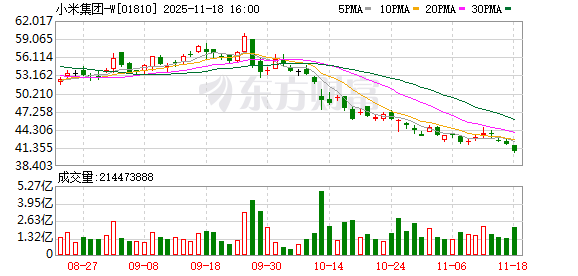
小米第三季营收1131亿:汽车收入290亿,实现季度盈利,将提前完成全年交付目标
3 6 Ke· 2025-11-18 12:25
Core Viewpoint - Xiaomi Group reported significant growth in revenue and profit for the first nine months of 2025, indicating strong operational performance and strategic investments in AI and IoT sectors [2][19]. Financial Performance - For the first nine months of 2025, Xiaomi's revenue reached 340.37 billion RMB, a 32.5% increase from 256.9 billion RMB in the same period last year [2]. - Operating profit for the same period was 41.672 billion RMB, up 166.9% from 15.613 billion RMB year-on-year [2]. - Adjusted net profit was 32.817 billion RMB, reflecting a 73.5% increase compared to 18.918 billion RMB in the previous year [2]. Quarterly Performance - In Q3 2025, Xiaomi's revenue was 1131.21 billion RMB, a 22.3% increase from 925 billion RMB year-on-year, but a slight decline of 2.4% from the previous quarter [4]. - Gross profit for Q3 2025 was 25.936 billion RMB, up 37.4% from 18.881 billion RMB year-on-year [4]. - The operating profit for Q3 2025 was 15.110 billion RMB, a 150.1% increase from 6.041 billion RMB year-on-year [6]. R&D and Innovation - Xiaomi's R&D expenditure reached 91 billion RMB in Q3 2025, a 52.1% increase year-on-year, with total R&D spending for the first nine months at 235 billion RMB [7][11]. - The number of R&D personnel reached a record high of 24,871 [7]. Business Segments - The smartphone and AIoT segment generated 841 billion RMB in Q3 2025, with smartphone revenue at 460 billion RMB and global smartphone shipments of 43.3 million units, a 0.5% increase year-on-year [12]. - IoT and lifestyle products revenue was 276 billion RMB in Q3 2025, a 5.6% increase year-on-year, with a gross margin of 23.9% [13]. - Internet services revenue for Q3 2025 was 94 billion RMB, up 10.8% year-on-year, with advertising revenue at 72 billion RMB, a 17.4% increase [16]. Automotive and AI Innovations - The smart electric vehicle and AI segment reported revenue of 290 billion RMB in Q3 2025, with a significant year-on-year growth of over 199% [19]. - Xiaomi's automotive division delivered over 100,000 vehicles in Q3 2025, with total deliveries exceeding 260,000 units for the year [19].

小米汽车业务首次单季盈利 预计本周可完成全年交付目标
Zheng Quan Shi Bao Wang· 2025-11-18 12:05
Core Insights - Xiaomi's automotive division achieved its first quarterly profit of approximately 700 million yuan, marking a significant milestone for the company [1] - The company reported a third-quarter revenue of 113.1 billion yuan, a year-on-year increase of 22.3%, and a record net profit of 11.3 billion yuan, up 80.9% year-on-year [1] - Xiaomi's total revenue for the first three quarters reached 340.4 billion yuan, nearing last year's total, with adjusted net profit exceeding last year's total at 32.8 billion yuan [1] Automotive Business - The automotive and AI innovation segment generated revenue of 29 billion yuan, a year-on-year increase of over 199%, with smart electric vehicle revenue accounting for 28.3 billion yuan [1] - In the third quarter, Xiaomi delivered over 100,000 new vehicles, bringing total deliveries for the first three quarters to over 260,000 units [2] - Xiaomi's automotive division is on track to meet its annual delivery target of 350,000 units [1] Smartphone and IoT Business - The smartphone and AIoT segment generated revenue of 84.1 billion yuan, with smartphone revenue at 46 billion yuan, showing growth for nine consecutive quarters [2] - Xiaomi's global smartphone shipments reached 43.3 million units in the third quarter, maintaining a strong position in both domestic and international markets [2] - The IoT and lifestyle products segment reported revenue of 27.6 billion yuan, a year-on-year increase of 5.6%, with over 1 billion connected IoT devices [3] High-End Market Strategy - Xiaomi is accelerating its high-end strategy across various product categories, achieving a significant increase in market share in the high-price segment of smartphones [3] - In the high-end smartphone segment (priced between 4,000 and 6,000 yuan), Xiaomi's market share reached 18.9%, an increase of 5.6 percentage points year-on-year [3] - The company is also establishing a high-end product matrix in the electric vehicle sector, with its models SU7 and YU7 leading sales in their respective categories [3] Research and Development - Xiaomi's R&D investment for the first three quarters reached 23.5 billion yuan, nearing the total planned investment for 2024, with expectations to exceed 30 billion yuan for the year [3] - The third quarter saw a record R&D expenditure of 9.1 billion yuan, a year-on-year increase of 52.1%, reflecting the company's commitment to transitioning from an "internet company" to a "hardcore technology company" [3]
小米集团(01810) - 2025 Q3 - 电话会议演示
2025-11-18 11:30
Financial Performance - Group revenue reached RMB 113.1 billion, a YoY increase of 22.3%[11] - Gross profit margin increased to 22.9%, up 2.5 percentage points YoY[11] - Adjusted net profit reached RMB 11.3 billion, a significant YoY increase of 80.9%[11] - Smart EV, AI and other new initiatives revenue reached RMB 29.0 billion, a substantial YoY increase of 199.2%[11] Smartphone and AIoT Business - Global smartphone shipments ranked among the top 3 for 21 consecutive quarters, with a market share of 13.6%[14] - Premium smartphone sales in Chinese Mainland increased to 24.1% of total smartphone units sold, a YoY increase of 4.1 percentage points[14] - IoT and lifestyle products revenue reached RMB 27.6 billion, up 5.6% YoY[85] Smart EV Initiatives - Delivered 108,796 Smart Electric Vehicles, representing a YoY increase of 173.4%[18] - Smart EV sales revenue reached RMB 28.3 billion, up 197.9% YoY[89] User Growth and AI - Global MAU reached 741.7 million[21] - Number of connected devices reached 1,035.5 million[26] R&D Investment - R&D expenses reached RMB 9.1 billion in Q3 2025[31]
全品类高端化战略加速兑现,小米汽车首次实现单季盈利
2 1 Shi Ji Jing Ji Bao Dao· 2025-11-18 11:13
Core Viewpoint - Xiaomi Group has successfully implemented its high-end strategy across various product categories, achieving significant revenue growth and profitability in its automotive segment for the first time in a single quarter [1][3]. Financial Performance - In Q3 2025, Xiaomi reported total revenue of 113.1 billion yuan, a year-on-year increase of 22.3%, and an adjusted net profit of 11.3 billion yuan, up 80.9% [1]. - The company's R&D investment reached 23.5 billion yuan in the first three quarters of the year, nearing the total for the entire year of 2024 [1]. Business Segments - The smartphone segment saw a slight revenue decline from 47.5 billion yuan to 46 billion yuan, a decrease of 3.1%, primarily due to a drop in average selling price (ASP) [2]. - The IoT and lifestyle products segment grew from 26.1 billion yuan to 27.6 billion yuan, a 5.6% increase, driven by global sales of wearable devices [2]. - Internet services revenue increased from 8.5 billion yuan to 9.4 billion yuan, a growth of 10.8%, largely due to strong performance in advertising [3]. - The smart electric vehicle segment experienced a remarkable revenue increase of 197.9%, rising from 9.5 billion yuan to 28.3 billion yuan, with vehicle deliveries increasing by 173.4% [3]. Cost and Investment - Sales and marketing expenses rose to 8.3 billion yuan, a 32.3% increase, reflecting expansion efforts in retail and advertising [3]. - R&D spending in Q3 reached 9.1 billion yuan, a 52.1% increase, with total R&D investment expected to exceed 30 billion yuan for the year [3]. Workforce and Market Position - As of September 30, 2025, Xiaomi's R&D personnel count reached a record high of 24,871 [4]. - Xiaomi's stock price closed at 40.78 HKD per share on November 18, 2025, with a total market capitalization of 1.06 trillion HKD [4].
小米最新业绩公布
2 1 Shi Ji Jing Ji Bao Dao· 2025-11-18 10:58
Core Insights - Xiaomi Group reported a revenue of 113.12 billion RMB for Q3 2025, representing a year-on-year growth of 22.3% [1] - The adjusted net profit for Q3 2025 was 11.31 billion RMB, showing a significant increase of 80.9% year-on-year [1] - For the first three quarters of 2025, the total revenue reached 340.37 billion RMB, up 32.5% compared to the same period last year, with an adjusted net profit of 32.82 billion RMB, reflecting a 73.5% increase [1] Business Segments - In Q3 2025, the revenue from the mobile and AIoT segment was 84.1 billion RMB, which is a slight increase of 1.6% year-on-year [1] - The revenue from the smart electric vehicle and AI innovation segment reached a record high of 29 billion RMB, marking a substantial growth of 199.2% year-on-year [1] - For the first time, the smart electric vehicle and AI innovation segment achieved operational profitability in a single quarter, with an operating income of 700 million RMB [1] Automotive Deliveries - Xiaomi's automotive division is on track to meet its annual delivery target of 350,000 units, with over 100,000 vehicles delivered in Q3 2025 [1] - Cumulatively, more than 260,000 vehicles have been delivered in the first three quarters of 2025 [1]
小米最新业绩公布
21世纪经济报道· 2025-11-18 10:51
Group 1 - The core viewpoint of the article highlights Xiaomi Group's significant revenue and profit growth in Q3 2025, with a revenue of 113.12 billion RMB, representing a year-on-year increase of 22.3%, and an adjusted net profit of 11.31 billion RMB, up 80.9% [1] - For the first three quarters of 2025, Xiaomi's total revenue reached 340.37 billion RMB, marking a 32.5% year-on-year growth, while the adjusted net profit was 32.82 billion RMB, reflecting a 73.5% increase [1] - In terms of business segments, the revenue from the mobile and AIoT segment in Q3 2025 was 84.1 billion RMB, showing a slight growth of 1.6%, while the revenue from the smart electric vehicle and AI innovation segment reached a record high of 29 billion RMB, with a remarkable growth of 199.2% [1] - The smart electric vehicle and AI innovation segment achieved its first quarterly operating profit in Q3 2025, with an operating income of 700 million RMB [1] - Xiaomi's automotive division is on track to meet its annual delivery target of 350,000 vehicles, with over 100,000 new car deliveries in Q3 and a total of more than 260,000 deliveries in the first three quarters of 2025 [1]

小米集团第三季度总营收1131亿元 汽车首次实现单季盈利
Xin Hua Cai Jing· 2025-11-18 10:49
Core Insights - Xiaomi Group reported a total revenue of 113.1 billion yuan for Q3 2025, marking a year-on-year increase of 22.3% and exceeding 100 billion yuan for four consecutive quarters [2] - Adjusted net profit reached 11.3 billion yuan, reflecting a significant year-on-year growth of 80.9% [2] Revenue Breakdown - The automotive segment achieved over 100,000 deliveries in the quarter, marking its first profitable quarter, with revenue from smart electric vehicles and AI-related innovations reaching 29 billion yuan, a year-on-year increase of over 199% [4] - Smartphone revenue amounted to 46 billion yuan, with a shipment volume of 43.3 million units, continuing a nine-quarter streak of year-on-year growth [4] - The IoT and lifestyle products segment generated 27.6 billion yuan in revenue, with a gross margin of 23.9%, an increase of 3.2 percentage points year-on-year [4] R&D Investment - In the first three quarters, Xiaomi invested 23.5 billion yuan in research and development, with the number of R&D personnel reaching a historical high [4] - The company allocated 9.1 billion yuan for R&D in the latest quarter, with an expectation to exceed 30 billion yuan in total R&D investment for the year [4]
雷军划重点:小米2025Q3当季新车交付108796台
Sou Hu Cai Jing· 2025-11-18 10:31
Core Insights - Xiaomi's Q3 2025 financial report shows significant growth in electric vehicle deliveries and overall revenue, indicating a strong performance in the automotive sector and innovative business areas [4][6]. Financial Performance - Total revenue reached 113.1 billion yuan, exceeding 100 billion yuan for four consecutive quarters, with a year-on-year growth of 22.3% [6]. - Adjusted net profit was 11.3 billion yuan, reflecting a substantial year-on-year increase of 80.9% [6]. Electric Vehicle Segment - Revenue from smart electric vehicles and AI-related innovative businesses amounted to 29 billion yuan, with 108,796 new vehicles delivered in the quarter [6]. - Cumulative vehicle deliveries reached 265,967 units, with Q1, Q2, and Q3 deliveries recorded at 75,869, 81,302, and 108,796 units respectively [4]. Research and Development - R&D investment totaled 9.1 billion yuan, marking a year-on-year increase of 52.1%, with an expected total investment exceeding 30 billion yuan for the year [6]. - The total number of R&D personnel stands at 24,871 [6]. Product Launches - Xiaomi announced the upcoming release of the enhanced version of its end-to-end assisted driving system, Xiaomi HAD, at the Guangzhou Auto Show [4].
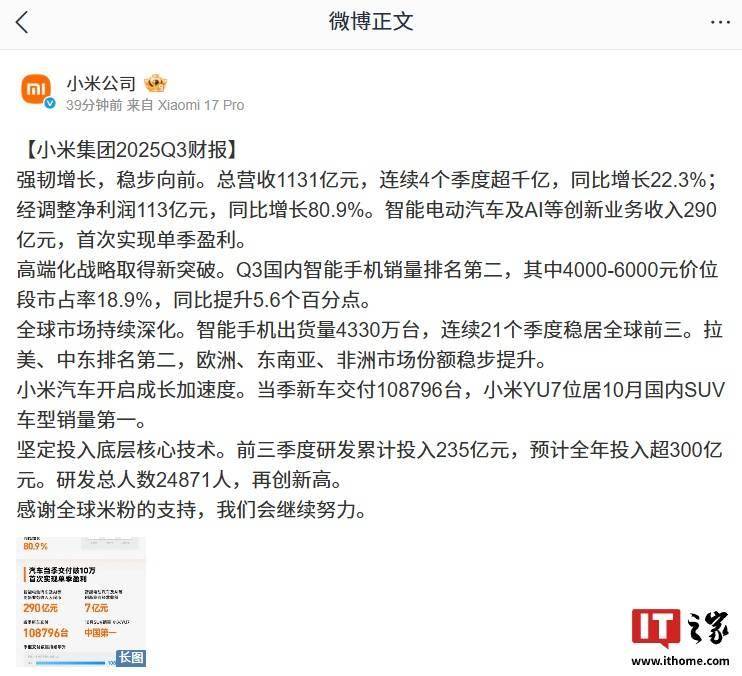
小米季度营收1131亿:手机收入承压,汽车业务首次盈利
Guan Cha Zhe Wang· 2025-11-18 10:27
Core Insights - Xiaomi Group reported Q3 revenue of 113.1 billion yuan, a year-on-year increase of 22.3%, marking the fourth consecutive quarter of exceeding 100 billion yuan in revenue [1] - Adjusted net profit reached 11.3 billion yuan, up 80.9% year-on-year, achieving a historical high [1] - The company faced significant stock price declines, with a nearly 30% drop from September highs, making it the largest decliner in the Hang Seng Tech Index [1] Revenue Breakdown - The smartphone and AIoT segment generated revenue of 84.1 billion yuan, with smartphone revenue at 46 billion yuan, a decline of 3.2% year-on-year, but with shipment volume increasing for nine consecutive quarters [1][2] - IoT and lifestyle products revenue was 27.6 billion yuan, up 5.6% year-on-year, while internet services revenue reached 9.4 billion yuan, a 10.8% increase, with overseas internet revenue hitting a record high of 3.3 billion yuan [1][2] - The innovative business segment, including smart electric vehicles and AI, reported revenue of 29 billion yuan, with smart electric vehicle revenue at 28.3 billion yuan, and the segment achieved a positive operating profit of 700 million yuan for the first time [1] Market Performance - Xiaomi's global smartphone shipments reached 43.3 million units in Q3, marking a nine-quarter consecutive year-on-year growth [2] - In the high-end price segment (4,000-6,000 yuan) in mainland China, Xiaomi's market share increased to 18.9%, up 5.6 percentage points year-on-year [2] User Engagement and R&D Investment - The internet services business achieved a gross margin of 76.9%, with global monthly active users reaching 742 million and 187 million in mainland China as of September 30 [2] - R&D investment for the first three quarters totaled 23.5 billion yuan, nearing the total for the previous year, with an expected annual investment exceeding 30 billion yuan [2] Technological Advancements - Xiaomi launched the "Xiaomi-MiMo-Audio" voice open-source model, achieving few-shot generalization in the voice domain [3] - The company has established smart manufacturing capabilities across three major sectors: smartphones, automobiles, and smart home appliances [3]