
种植业

Search documents
中共中央 国务院关于锚定农业农村现代化 扎实推进乡村全面振兴的意见
Xin Lang Cai Jing· 2026-02-03 10:28
Core Viewpoint - The document outlines the Chinese government's strategic plan for agricultural modernization and rural revitalization, emphasizing the importance of enhancing agricultural productivity, ensuring food security, and improving the living standards of farmers as part of the broader goal of achieving socialist modernization by 2026 [1][2]. Group 1: Agricultural Production and Quality Enhancement - The plan aims to stabilize grain production at approximately 1.4 trillion jin (700 million tons) and implement a new round of actions to enhance grain production capacity [1]. - It emphasizes the need to improve the quality and efficiency of agricultural production, including optimizing crop varieties and enhancing food safety measures [1][2]. - The document highlights the importance of protecting arable land and improving soil quality through strict management and innovative agricultural practices [1][2]. Group 2: Support for Farmers and Employment - The strategy includes establishing a robust support system for farmers, focusing on price stabilization, subsidies, and insurance to encourage grain production [2]. - It aims to enhance employment opportunities for farmers through organized labor output and support for rural entrepreneurship [2][3]. - The plan also emphasizes the need for targeted assistance to prevent poverty and ensure sustainable income growth for rural populations [2][3]. Group 3: Infrastructure and Public Services - The document outlines plans for improving rural infrastructure, including water supply, electricity, and transportation systems to enhance living conditions in rural areas [3][4]. - It stresses the importance of providing quality public services, such as education and healthcare, to support rural development and improve the overall quality of life [3][4]. - The strategy includes measures to promote ecological protection and environmental sustainability in rural areas [3][4]. Group 4: Governance and Leadership - The plan calls for strengthening the leadership of the Communist Party in rural revitalization efforts, ensuring that all levels of government are aligned with the strategic goals [4]. - It emphasizes the need for effective governance mechanisms to facilitate the implementation of rural policies and enhance community participation in decision-making [4]. - The document highlights the importance of combating corruption and improving the integrity of rural governance to ensure the success of revitalization initiatives [4].
全文|中共中央 国务院关于锚定农业农村现代化 扎实推进乡村全面振兴的意见
Xin Lang Cai Jing· 2026-02-03 10:26
Core Viewpoint - The document outlines the Chinese government's strategic plan to modernize agriculture and rural areas, emphasizing the importance of achieving agricultural modernization as a foundation for overall national modernization during the 14th and 15th Five-Year Plans. It highlights the need for comprehensive rural revitalization and the strengthening of agricultural production capabilities, food security, and farmer livelihoods. Group 1: Agricultural Production Capacity and Quality - The grain production target is set to stabilize at approximately 1.4 trillion jin (700 million tons) [2][23] - The plan includes a new round of actions to enhance grain production capacity, focusing on improving agricultural practices and optimizing production structures [2][23] - There is a commitment to promote diverse food supply systems and enhance the quality of agricultural products, including livestock and dairy [2][23] Group 2: Land and Soil Management - Strict measures will be implemented to protect arable land and ensure balanced land use, including the establishment of special plans for land protection [3][24] - The government aims to combat illegal land use and improve soil quality through various initiatives, including high-standard farmland construction [3][24] Group 3: Agricultural Technology and Innovation - The strategy emphasizes the need for agricultural technology innovation, including the development of key agricultural technologies and the promotion of smart farming solutions [4][25] - There will be a focus on enhancing agricultural research and education to foster talent in the agricultural sector [4][25] Group 4: Disaster Prevention and Mitigation - The plan includes strengthening the agricultural disaster prevention and mitigation system, enhancing monitoring and early warning capabilities for extreme weather [5][26] - Infrastructure improvements for flood control and drought response are also prioritized [5][26] Group 5: Support for Farmers and Rural Development - A comprehensive support system will be established to prevent poverty and ensure food security, with a focus on financial stability and resource allocation [6][27] - The government will enhance monitoring and assistance for vulnerable populations to prevent poverty recurrence [6][27] Group 6: Employment and Income Generation - The strategy aims to optimize employment support for farmers, including vocational training and job matching services [10][31] - There will be initiatives to promote rural consumption and improve infrastructure to support local economies [10][31] Group 7: Infrastructure and Public Services - The plan includes significant investments in rural infrastructure, including water supply, electricity, and transportation [12][33] - Enhancements in public services such as education and healthcare are also outlined to improve the quality of life in rural areas [12][34] Group 8: Ecological and Cultural Development - The strategy emphasizes ecological protection and the promotion of sustainable agricultural practices to enhance rural environments [14][32] - Cultural initiatives will be implemented to foster community values and improve rural social cohesion [15][32] Group 9: Governance and Leadership - The document stresses the importance of strong leadership and governance in rural revitalization efforts, with a focus on enhancing the capabilities of local party organizations [20][21] - There will be a systematic approach to improve the effectiveness of rural policies and ensure accountability [20][21]
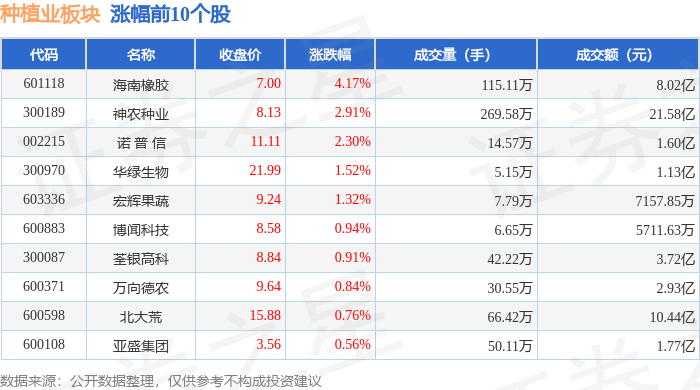
种植业板块2月3日涨0.9%,海南橡胶领涨,主力资金净流出2.36亿元
Zheng Xing Xing Ye Ri Bao· 2026-02-03 08:56
Core Viewpoint - The planting industry sector experienced a 0.9% increase on February 3, with Hainan Rubber leading the gains, while the overall market indices also showed positive performance [1]. Group 1: Market Performance - The Shanghai Composite Index closed at 4067.74, up 1.29% [1]. - The Shenzhen Component Index closed at 14127.1, up 2.19% [1]. Group 2: Individual Stock Performance - Hainan Rubber (601118) closed at 7.00, up 4.17%, with a trading volume of 1.1511 million shares and a turnover of 800.2 million yuan [1]. - Shennong Seed Industry (300189) closed at 8.13, up 2.91%, with a trading volume of 2.6958 million shares and a turnover of 2.158 billion yuan [1]. - Noposion (002215) closed at 11.11, up 2.30%, with a trading volume of 145,700 shares and a turnover of 160 million yuan [1]. - Hualu Biological (300970) closed at 21.99, up 1.52%, with a trading volume of 151,500 shares and a turnover of 113 million yuan [1]. - Honghui Zhaoshu (603336) closed at 9.24, up 1.32%, with a trading volume of 77,900 shares and a turnover of 71.5785 million yuan [1]. Group 3: Fund Flow Analysis - The planting industry sector saw a net outflow of 236 million yuan from main funds, while retail investors contributed a net inflow of 236 million yuan [2]. - The main funds showed a net inflow in stocks like Jinhai Seed Industry (002041) with 25.402 million yuan, while others like Hualu Biological (300970) experienced a net outflow of 6.1731 million yuan [3].


黑龙江省资本市场跟踪双周报-20260203
Jianghai Securities· 2026-02-03 06:31
证券研究报告·黑龙江省资本市场跟踪报告 2026 年 2 月 3 日 江海证券研究发展部 执业证书编号:S1410524040001 机械军工行业研究组 黑龙江省资本市场跟踪双周报 — — 分析师:张诗瑶 (2026.1.18-2026.1.31) 投资要点: 江海证券有限公司及其关联机构在法律许可的情况下可能与本报告所分析的企业存在业务关系,并且继续寻求发展这些关系。因此,投资者应当考虑到本公司可能存在影响本报告客观性的 利益冲突,不应视本报告为投资决策的唯一因素。 敬请参阅最后一页之免责条款 黑龙江省资本市场跟踪报告 1. 江海证券-黑龙江省资本市场跟踪-黑龙 江省资本市场跟踪双周报— (2025.12.21-2026.1.3)–2026.01.05 2. 江海证券-黑龙江省资本市场跟踪-黑龙 江省资本市场跟踪双周报— (2025.12.7-2025.12.20)–2025.12.22 3. 江海证券-黑龙江省资本市场跟踪-黑龙 江省资本市场跟踪双周报— (2025.11.23-2025.12.6)–2025.12.08 4. 江海证券-黑龙江省资本市场跟踪-黑龙 江省资本市场跟踪双周报— (2025.1 ...
下一个资源品——农产品?怎么选?
2026-02-03 02:05
Summary of Conference Call on Agricultural Sector Industry Overview - The conference focused on the agricultural sector, particularly the investment opportunities in agricultural products and the implications of global trends such as de-globalization and food security [1][2]. Key Points and Arguments Strategic Importance of Agricultural Products - Agricultural products are positioned as a strategic priority in the context of global resource and energy security, emphasizing food security as a critical national strategy [1]. - The agricultural sector is expected to become a significant investment opportunity in the A-share market, alongside resource and energy products [1]. Weather Impact on Supply and Prices - The emergence of a weak La Niña phenomenon has led to extreme weather conditions affecting major production areas, which may impact supply and price trends for certain agricultural products [2]. Investment Opportunities in Agricultural Chains - The investment landscape in agriculture is divided into two main chains: planting and breeding. The planting chain is deemed more urgent and important due to the backdrop of food security [2][3]. - The planting chain is currently at a historical low in profitability, suggesting a potential turning point for companies involved in seed production and agricultural inputs [3]. Seed Industry Outlook - The seed industry is expected to see a recovery starting in 2026, with potential revenue and profit improvements. The sector may experience a "Davis Double Play" effect, where both valuation and profitability increase [4]. Breeding Industry Dynamics - The breeding industry operates under a fully market-driven pricing mechanism. Future growth is anticipated to be driven by two main themes: growth in breeding and a new cycle of development [5]. - The breeding sector is entering a 3.0 era characterized by increased scale and efficiency, with leading companies achieving significant cost advantages through breeding and feed management [6][7]. International Expansion of Breeding Sector - The international expansion of the breeding sector is highlighted as a key growth area, with Chinese companies increasingly participating in global supply chains [7][8]. - Notable companies are planning IPOs and expansions into overseas markets, indicating a robust growth trajectory [8]. New Cycles in Animal Protein - The new cycle in animal protein is expected to prioritize beef over pork and dairy, with beef production showing significant potential for growth [9][10]. - The pork industry is facing challenges, with expectations of price declines post-holiday season due to oversupply [11][30]. Dairy and Poultry Sector Insights - The dairy sector is nearing the end of a production cycle, with expectations of price recovery in 2026. The demand for dairy products is anticipated to exceed market expectations [12][13]. - The poultry sector is under scrutiny due to potential disruptions from avian influenza, with critical monitoring needed in early 2026 [14][15]. Additional Insights - The conference emphasized the importance of monitoring grain prices, particularly corn and wheat, which are influenced by weather conditions and market dynamics [16][19]. - The soybean market, particularly for soybean meal, is experiencing price increases despite high inventory levels, driven by external factors and market sentiment [20][21][22]. - The overall investment strategy in the agricultural sector should focus on high-quality assets and companies with cost advantages, especially in the context of ongoing market fluctuations and potential downturns [34]. Conclusion - The agricultural sector presents a complex landscape of opportunities and challenges, with significant potential for growth in both planting and breeding chains. Investors are encouraged to focus on companies with strong fundamentals and strategic positioning in the market [36][37].


华泰证券:当前通胀预期回升,有望对种植链形成催化
Sou Hu Cai Jing· 2026-02-02 23:54
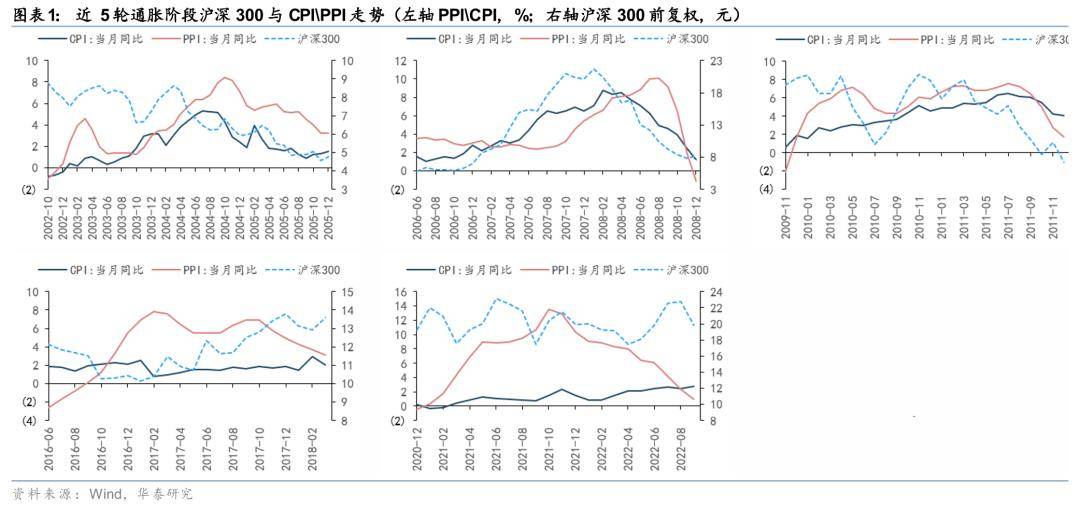
1月至今,布伦特原油期货价格上涨约16%,伴随国内核心通胀指标2025H2延续修复趋势,通胀预期有所提升。复盘来看,在近五轮通胀周期中,由于原 油价格联动、库存消化、宽货币政策及黑天鹅事件催化,种植链现货价格上涨动力强,板块投资收益相对沪深300超额表现突出。且截至2025Q4,农业/种 植板块基金持仓占比1.18%/0.07%,分别处于近五年分位数的8%/12%,处于配置低位,建议加强配置。 复盘来看种植链在通胀周期超额收益明显 我们对近五轮通胀周期进行复盘, 2003-2005年、2006-2008年、2009-2012年CPI\PPI同步回升,股票市场则在CPI超过2%左右位置时往往开启主升浪,并 且明显早于CPI\PPI高点结束,而2015-2018年、2021-2022年PPI单侧回升,股票市场呈现结构性变化。因此前三轮我们选取大盘启动前三个月为起点,CPI 高点为终点,后两轮我们选取PPI快速回升至高点区间进行行业涨跌幅对比,发现种植业、农产品加工板块往往具备较为明显的超额收益,五轮通胀期间 合计相对沪深300超额收益达140pct、126pct,其中玉米种子公司、种植公司受益于粮价上涨表现突出, ...

越南永隆省大力发展绿色、循环农业
Shang Wu Bu Wang Zhan· 2026-02-02 16:01
Core Insights - The article discusses the efforts of Vinh Long Province in Vietnam to promote agricultural modernization through technology and digital transformation, aiming for sustainable and green development in agriculture [1][2] Group 1: Technological and Digital Transformation - Vinh Long Province is implementing the 57th Resolution of the Central Committee of the Communist Party regarding technological innovation and digital transformation in agriculture [1] - The province aims for 15%-20% of agricultural production area to utilize high-tech by 2030, creating smart production areas and traceability systems throughout the value chain [1] - Advanced technologies such as variety improvement, biotechnology, mechanization, automation, and smart management are increasingly applied, reducing costs and enhancing resource efficiency [1] Group 2: Agricultural Development and Sustainability - The province is focusing on green agriculture and circular economy development, emphasizing reduced chemical fertilizer use and increased application of organic fertilizers and bioproducts [2] - Vinh Long's main agricultural products are rice and coconuts, with over 9,200 households registered in the "1 Million Hectares of Quality Low-Carbon Rice Sustainable Development Plan," aiming for at least 50,000 hectares by 2030 [2] - The coconut industry targets an area of approximately 132,000 hectares by 2030, with 50% being organic coconuts, leveraging the carbon credit potential of coconut trees [2]
2026江苏两会|在赵亚夫的引导下,曾经的的哥今成“葡萄大王”!
Xin Lang Cai Jing· 2026-02-02 14:55
他梦想把果园变成公园,让劳动变成亲近自然的运动,实现"四季有花、四季有果"。"花儿盛开,蝴蝶 自来,蜜蜂自来",在张奎峰看来,这不仅是对"绿水青山就是金山银山"的实践,也是农业人为实现"双 碳"目标贡献的力量。 转自:扬子晚报 "咱农民其实是'最富有的人'——每天闻着花香、听着鸟语,呼吸着新鲜空气,吃着自家种的新鲜果 蔬,享受四季轮换的美好……" 2月2日报到现场,来自句容市白兔镇的省人大代表,致富果业专业合作社社长、党支部书记张奎峰一番 真诚而充满泥土芬芳的发言,诉说着"新农人"的骄傲。 从的哥到"新农人":一次转身,十五年扎根 2010年之前,张奎峰还是一名普通的出租车司机。一次偶然的机会,他在镇江农科院看到了赵亚夫老师 的事迹,被特色高效农业深深吸引,当即决定回乡创业,梦想"通过种植高效农业带领乡亲们共同致 富"。 这一转身,就是十五年。 如今,他不仅成为了"葡萄大王",还荣获全国优秀农民工、江苏省劳动模范等称号,当选省人大代表, 更亲眼见证家乡通过发展特色农业焕然一新。"越来越多的乡亲们实现了增收致富。"他感慨,"农业是 充满希望的朝阳产业,农民是值得骄傲与尊重的职业。" 师从赵亚夫:让果园变公园,农 ...
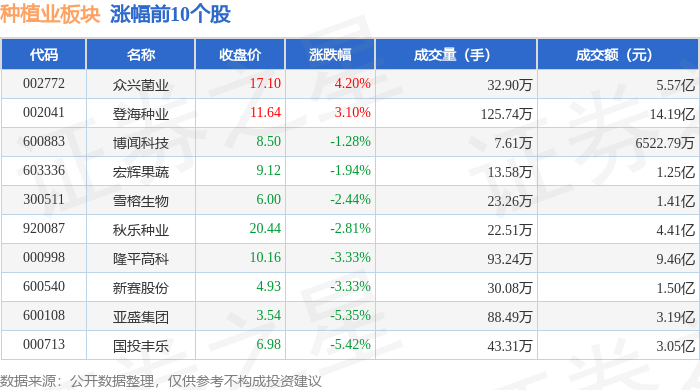
种植业板块2月2日跌6.54%,荃银高科领跌,主力资金净流出2.37亿元
Zheng Xing Xing Ye Ri Bao· 2026-02-02 09:07
Market Overview - The planting industry sector experienced a decline of 6.54% on February 2, with Zhuan Yin Gao Ke leading the drop [1] - The Shanghai Composite Index closed at 4015.75, down 2.48%, while the Shenzhen Component Index closed at 13824.35, down 2.69% [1] Individual Stock Performance - Notable gainers included: - Zhongxing Junye (002772) with a closing price of 17.10, up 4.20% and a trading volume of 329,000 shares, totaling 557 million yuan [1] - Yihai Zhongye (002041) closed at 11.64, up 3.10% with a trading volume of 1.2574 million shares, totaling 141.9 million yuan [1] - Significant decliners included: - Zhuan Yin Gao Ke (300087) closed at 8.76, down 15.93% with a trading volume of 939,300 shares, totaling 843 million yuan [2] - Bei Da Huang (600598) closed at 15.76, down 9.94% with a trading volume of 1.051 million shares, totaling 168.5 million yuan [2] Capital Flow Analysis - The planting industry sector saw a net outflow of 237 million yuan from main funds, while retail investors contributed a net inflow of 158 million yuan [2] - Key stocks with significant capital flow include: - Yihai Zhongye (002041) with a net inflow of 111 million yuan from main funds, but a net outflow of 1.15 million yuan from retail investors [3] - Nongfa Zhongye (600313) had a net inflow of 95.4 million yuan from main funds, but a net outflow of 77.5 million yuan from retail investors [3]


行业轮动ETF策略周报-20260202
金融街证券· 2026-02-02 06:41
Report Summary 1. Report Industry Investment Rating - Not mentioned in the provided content 2. Core Viewpoints of the Report - The Financial Street Securities Research Institute constructs a strategy portfolio based on industry and thematic ETFs, referring to the strategy reports "Strategy Portfolio Report under Industry Rotation: Quantitative Analysis from the Perspective of Industry Style Continuity and Switching" (20241007) and "Research on the Overview and Allocation Methods of the Stock - type ETF Market: Taking the ETF Portfolio Based on the Industry Rotation Strategy as an Example" (20241013) [2] - From 20260126 - 20260130, the cumulative net return of the strategy was approximately - 0.24%, and the excess return relative to the CSI 300 ETF was approximately - 0.39%. From October 14, 2024, to the present, the cumulative out - of - sample return of the strategy was approximately 44.34%, and the cumulative excess return relative to the CSI 300 ETF was approximately 19.78% [3] - In the week of February 2, 2026, the model recommends allocating sectors such as refining and trading, cement, and industrial metals. In the next week, the strategy will newly hold products such as Building Materials ETF, Non - Ferrous Metals ETF, and Real Estate ETF, and continue to hold products such as Petrochemical ETF, Chemical ETF, and Gold Stocks ETF [12] 3. Summary by Relevant Catalog 3.1 Strategy Portfolio Information - The strategy portfolio includes ETFs such as Petrochemical ETF (159731), Building Materials ETF (159745), Non - Ferrous Metals ETF (512400), etc. Each ETF has information such as market value, holding status, heavy - held Shenwan industries and their weights, as well as weekly and daily timing signals. For example, the Petrochemical ETF has a market value of 16.60 billion yuan, and the heavy - held industry is refining and trading with a weight of 27.28%, and both the weekly and daily timing signals are 1 [3] 3.2 Performance Tracking - During 20260126 - 20260130, the cumulative net return of the strategy was about - 0.24%, and the excess return relative to the CSI 300 ETF was about - 0.39%. From October 14, 2024 to now, the cumulative out - of - sample return of the strategy was about 44.34%, and the cumulative excess return relative to the CSI 300 ETF was about 19.78% [3] 3.3 Portfolio Adjustment - In the week of February 2, 2026, the strategy will add holdings of Building Materials ETF, Non - Ferrous Metals ETF, Real Estate ETF, etc., and continue to hold Petrochemical ETF, Chemical ETF, Gold Stocks ETF, etc. Some previously held ETFs such as Mining ETF, Communication ETF, etc. will be removed from the portfolio [3][11][12]