贸易

Search documents
“一个极具动荡的时代”:全球经济前路不确定性加剧
Xin Lang Cai Jing· 2025-12-19 10:36
Group 1 - The global economy is showing resilience despite challenges such as trade wars, mineral shortages, and tensions between the US and China, exceeding previous expectations [4][22] - The current era is characterized as highly turbulent, influenced by the AI revolution, rapid population aging, climate change, and a retreat from democratic norms and international order [5][6] - The chaotic economic policy-making in various countries is complicating the ongoing transformation [7][22] Group 2 - In the US, contradictory policy statements from the White House are causing uncertainty, with recent tariff changes impacting various food products and threatening new tariffs on rice from India and China [7][24] - The US public debt has surged to a historic high of 125% of GDP, with plans to utilize $250 billion in tariff revenue for financial support to farmers and taxpayers [24] - The stock market has seen significant gains driven by AI companies, raising concerns about potential market crashes [24] Group 3 - European countries are lagging in economic growth compared to other developed economies, with the EU's share of the global economy shrinking amid fierce competition from the US and China [24][25] - The EU faces challenges in advancing key policies due to differing national priorities and pressures, exemplified by the recent postponement of a long-awaited trade agreement involving South American countries [25] - High energy prices and competition from Chinese goods are constraining local producers and manufacturers in Europe [25] Group 4 - The ongoing Russia-Ukraine conflict is prompting European governments to increase fiscal spending and military expenditures, further escalating debt levels [27] - China's economic influence continues to grow, with a $1 trillion annual trade surplus indicating that US tariff policies have not diminished China's trade dominance [27] - The International Monetary Fund has raised China's annual economic growth forecast to 5%, highlighting the resilience of its export-driven growth model [27] Group 5 - The global trade order, long dominated by the US, is being disrupted, leading to increased uncertainty and cost pressures in the global economy [30] - The rise of temporary bilateral trade agreements is causing businesses to worry about raw material sourcing and compliance costs [30] - The COVID-19 pandemic has exposed vulnerabilities in global supply chains, with ongoing political shifts potentially introducing more instability [30][31]

封关正式启动,海南板块全线“爆发”
Huan Qiu Lao Hu Cai Jing· 2025-12-19 10:21
Group 1 - The Hainan stock sector experienced a significant surge, with the Hainan Free Trade Zone index rising by 5.33% and 29 constituent stocks collectively increasing, driven by the official launch of the island-wide closure operation on December 18 [1] - The core regulatory model of the closure operation focuses on "opening up the first line, controlling the second line, and allowing freedom within the island," with key policies including the expansion of the "zero tariff" product range, optimization of trade management measures, clarification of port layout and passage rules, and strengthening the implementation of tax incentives [1] - The launch of the island-wide closure operation marks a critical milestone in the construction of the Hainan Free Trade Port, opening new development opportunities for various industries, particularly in tourism, trade, transportation, finance, duty-free shopping, and high-end healthcare [1] Group 2 - Four categories of companies are expected to benefit significantly: those with substantial foreign trade operations in Hainan, infrastructure companies benefiting from Free Trade Port construction, tourism-related companies gaining from expanded duty-free shopping, and local enterprises enjoying "zero tariff, low tax rate, and simplified tax system" policies [2] - Industries closely aligned with the closure policies, such as tourism and trade, are poised for certain development opportunities, with companies like China Duty Free Group, Hainan Development, and Hainan Airlines expected to leverage consumption benefits from duty-free business layouts [3] - Transportation companies like Hainan Airlines and Haixia Co. can capitalize on their route and hub advantages to share in the growth of traffic, while healthcare companies like Kangzhi Pharmaceutical and Hainan Haiyao can reduce costs and increase efficiency through zero tariff policies [3]
平潭发展尾盘直线跳水上热搜!公司董秘最新回应
Di Yi Cai Jing· 2025-12-19 10:19
Core Viewpoint - The stock of Pingtan Development has experienced significant volatility, with a sharp increase in price that has raised concerns about its divergence from the company's fundamentals [2][3]. Group 1: Stock Performance and Market Reaction - Pingtan Development's stock has seen a surge since October 17, recording 16 instances of price limits and increasing its market capitalization from approximately 5.6 billion to around 26.3 billion [2]. - The stock's rapid rise has been characterized by a "hot potato" phenomenon, where early speculative investors have taken profits, leading to a shift in trading dynamics towards retail investors and some active short-term traders [2]. - On December 19, the stock price increased by over 6% before experiencing a sharp decline of more than 7% in the closing hours [4]. Group 2: Company Fundamentals and Financial Performance - Pingtan Development, established in 1993, is a key player in the agricultural and forestry sectors in Fujian Province, operating nearly 30 subsidiaries across various industries [5]. - The company has reported consecutive years of losses, with projected revenues for 2022, 2023, 2024, and the first three quarters of 2025 being 1.175 billion, 1.233 billion, 1.563 billion, and 1.03 billion respectively, while net profits for the same periods are -229 million, -308 million, -117 million, and 31 million [5]. - Despite the ongoing losses, there is an expectation that the company may turn profitable in the near future [5].


解读中央经济工作会议•述评 | 中国经济提质增效为中亚国家发展创造广阔机遇
Xin Lang Cai Jing· 2025-12-19 09:13
Group 1 - The core viewpoint of the Central Economic Work Conference emphasizes the policy tone of "seeking progress while maintaining stability and improving quality and efficiency" as China transitions from the "14th Five-Year Plan" to the "15th Five-Year Plan" [1] - The conference highlights the importance of "domestic demand as the main driver," "innovation-driven development," and "opening up to the outside world" as key tasks for economic growth [1] Group 2 - China is constructing a domestic demand-driven growth system, which provides stable and diverse market opportunities for Central Asian countries, with a focus on boosting consumption and increasing residents' income [2] - In the first five months of this year, trade between China and the five Central Asian countries reached 286.42 billion yuan, a year-on-year increase of 10.4%, with imports from these countries growing by 21% [2] Group 3 - The conference underscores the significance of innovation as the primary driving force for development, aligning with Central Asian countries' needs for industrial upgrading and digital transformation [4] - Cooperation in areas such as smart agriculture, digital payments, 5G communication, and smart cities is flourishing, promoting digital upgrades in local industries [4] Group 4 - China is committed to opening up and promoting win-win cooperation across multiple fields, establishing a solid institutional guarantee for China-Central Asia cooperation [7] - By June 2025, China's investment in Central Asian countries is expected to exceed 30 billion USD, with completed contract revenues in engineering projects reaching 75.6 billion USD, covering various sectors including energy, agriculture, infrastructure, and digital economy [7]

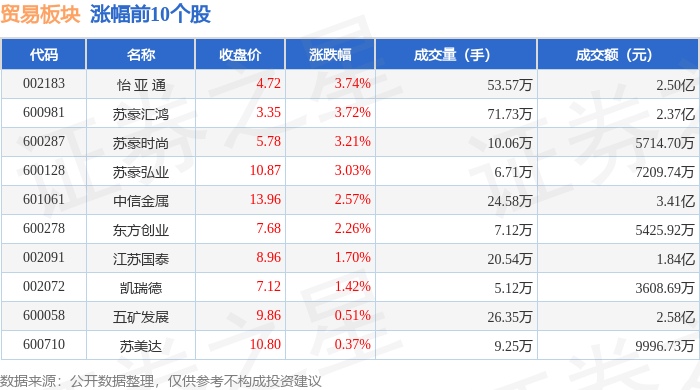
贸易板块12月19日涨1.76%,怡亚通领涨,主力资金净流出2.09亿元
Zheng Xing Xing Ye Ri Bao· 2025-12-19 09:11
Core Insights - The trade sector experienced a rise of 1.76% on December 19, with Yi Yatong leading the gains [1] - The Shanghai Composite Index closed at 3890.45, up 0.36%, while the Shenzhen Component Index closed at 13140.22, up 0.66% [1] Trade Sector Performance - Yi Yatong (002183) closed at 4.72, with a gain of 3.74% and a trading volume of 535,700 shares, amounting to a transaction value of 250 million yuan [1] - Other notable performers included: - Shisuo Huihong (600981) at 3.35, up 3.72% with a transaction value of 237 million yuan [1] - Chimon Fashion (600287) at 5.78, up 3.21% with a transaction value of 57.15 million yuan [1] - CITIC Metal (601061) at 13.96, up 2.57% with a transaction value of 341 million yuan [1] Capital Flow Analysis - The trade sector saw a net outflow of 209 million yuan from institutional investors, while retail investors contributed a net inflow of 195 million yuan [2] - Notable capital flows included: - CITIC Metal (601061) with a net inflow of 40.75 million yuan from institutional investors [3] - Yi Yatong (002183) with a net inflow of 22.84 million yuan from institutional investors [3] - Jiangsu Guotai (002091) with a net inflow of 15.18 million yuan from institutional investors [3]


海南“封关”运作正式启动!普通人能薅到啥福利?
Sou Hu Cai Jing· 2025-12-19 04:17
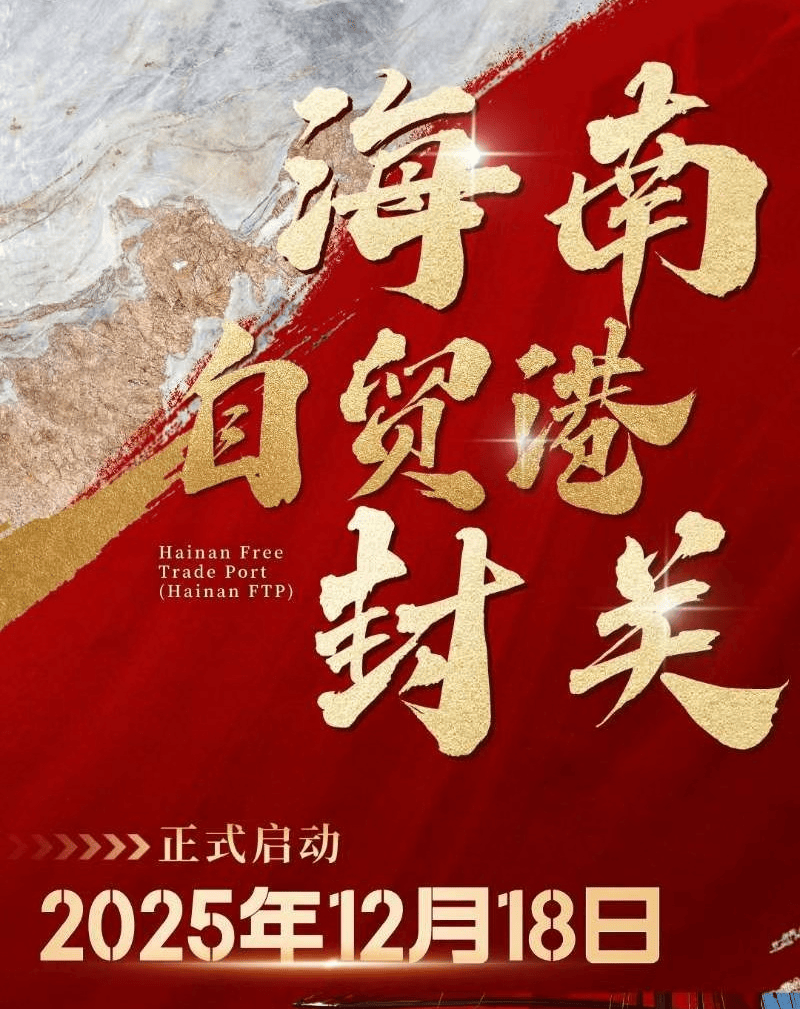
Core Viewpoint - The official launch of the Hainan Free Trade Port's full island closure operation marks a new development phase characterized by "closure operation and high openness," which is expected to bring significant benefits to individuals and opportunities for businesses [1][3]. Group 1: Policy Changes and Economic Impact - The "closure" does not mean restrictions on entry but rather designates the entire island as a "special regulatory area," allowing for free movement of people while regulating goods [3][9]. - A significant expansion of the "zero tariff" list will occur, increasing from 1,900 to approximately 6,600 items, covering 74% of product categories, which will enhance consumer access to affordable imported goods [7][10]. - The implementation of a "dual 15%" tax incentive policy will benefit eligible enterprises and key talents, reducing corporate income tax to 15% [11][10]. Group 2: Benefits for Individuals and Businesses - Individuals will experience lower prices for imported goods, improved medical services, and increased employment and entrepreneurial opportunities due to the new policies [13][7]. - For entrepreneurs, the Hainan closure policy offers a tailored business environment with low tax burdens, high freedom, and strong incentives, making it an attractive location for future investments [9][13]. - The simplified foreign investment negative list allows for equal treatment of domestic and foreign investments, significantly lowering costs for businesses importing equipment and raw materials [10][9]. Group 3: Specific Industry Opportunities - The policy encourages specific industries such as tourism, modern services, high-tech industries, and tropical agriculture to benefit from reduced corporate tax rates [11][10]. - The ability to import raw materials at zero tariffs and process them on the island, with tax exemptions on value-added products, creates a favorable environment for manufacturing and processing trade enterprises [10][9].
盐城港拟3100万元出售前海明天供应链(深圳)有限公司51%股权
Zhi Tong Cai Jing· 2025-12-18 13:57
Core Viewpoint - Yancheng Port (08310) announced the sale of a 51% stake in Qianhai Tomorrow Supply Chain (Shenzhen) Co., Ltd. by its wholly-owned subsidiary Dafeng Port and Shun International Investment Co., Ltd. to Sheyang Jinport Logistics Co., Ltd. for RMB 31 million [1] Group 1 - The target company is registered in China and primarily engages in trade and supply chain management services [1] - The sale will allow the group to recover capital from the equity and reallocate the funds to its core business [1] - By concentrating resources on core competencies, the group aims to avoid inefficiencies caused by resource dispersion, enhance its core competitiveness, and establish a more solid foundation for sustainable development [1]
建发股份接待70家机构调研,包括睿远基金、东方财富证券、东方证券、东吴证券等
Jin Rong Jie· 2025-12-18 12:52
Group 1 - The core viewpoint of the news is that Jianfa Co., Ltd. has made significant progress in expanding its supply chain operations, with notable partnerships and a stable profit outlook despite global economic challenges [1][2]. - Jianfa Co., Ltd. reported a recent stock price of 9.35 yuan, down 1.37% from the previous trading day, with a total market capitalization of 27.111 billion yuan [1]. - The company achieved over 5.2 billion USD in signed agreements during the November Import Expo, collaborating with seven global enterprises in key agricultural products [1]. Group 2 - The supply chain operations of Jianfa Co., Ltd. are expected to maintain a net profit range of 3.3 to 4 billion yuan from 2021 to 2024, with a return on equity (ROE) exceeding 15% [2]. - The company has developed a risk control system characterized by "professionalization, stratification, and process orientation," and has established a global supply chain service network covering over 170 countries [2]. - Jianfa Co., Ltd. is actively exploring the application of AI and other new technologies in its supply chain operations, enhancing its risk control and daily management activities [2]. Group 3 - Ruiyuan Fund, which participated in the recent research, focuses on value investment and has five funds under management, with one fund showing a 59.95% growth over the past year [3].

盐城港(08310)拟3100万元出售前海明天供应链(深圳)有限公司51%股权
智通财经网· 2025-12-18 12:21
Core Viewpoint - Yancheng Port (08310) announced the sale of a 51% stake in Qianhai Tomorrow Supply Chain (Shenzhen) Co., Ltd. by its wholly-owned subsidiary Dafeng Port and Shun International Investment Co., Ltd. to Sheyang Jinport Logistics Co., Ltd. for RMB 31 million [1] Group 1 - The target company is registered in China and primarily engaged in trade and supply chain management services [1] - The sale will allow the group to recover capital from the equity and reallocate the funds to its core business [1] - By concentrating resources on core competencies, the group aims to avoid inefficiencies caused by resource dispersion, enhance its core competitiveness, and establish a more solid foundation for sustainable development [1]
打破认知!海南封关不是隔绝,而是中国新时代开放的“关键落子”
Sou Hu Cai Jing· 2025-12-18 12:08
Core Viewpoint - The launch of the Hainan Free Trade Port's full island closure operation is a strategic move by China to enhance high-level openness to the outside world, rather than a means of isolation from the mainland [1][3]. Group 1: Policy Changes - The term "closure" refers to establishing a regulatory boundary between Hainan and foreign countries, not between Hainan and the mainland, allowing for continued free movement of people and goods within China [3]. - Hainan will become a "special zone" with policies such as duty-free imports, tax incentives for processing and value-added sales, and enhanced trade liberalization [3][5]. - This transformation positions Hainan as China's largest "super open test field," facilitating the import of foreign raw materials for processing and re-exporting to the mainland without tariffs [3][5]. Group 2: Economic Opportunities - The new policies will attract global resources to Hainan, making it a strategic hub connecting domestic and international markets, thus expanding China's openness from "points" to "lines" and then to "areas" [3][5]. - Consumers in Hainan will benefit from a wider variety of affordable imported goods, enhancing the shopping experience without the need to travel abroad [5]. - The influx of domestic and international businesses will create numerous job opportunities in sectors such as cross-border trade, high-end tourism, digital economy, and high-tech industries [5]. Group 3: Strategic Implications - The full closure operation sends a clear signal to the world that China's doors to openness will continue to expand, even amid a complex international environment [5][7]. - Hainan's development is expected to drive high-quality growth in the South China region and provide a replicable model for high-level openness across the country [5][7]. - The initiative aims to elevate Hainan from a "tourist island" to an "open highland," contributing significantly to China's modernization efforts [7].