
保险业

Search documents
资讯早班车-2026-01-28-20260128
Bao Cheng Qi Huo· 2026-01-28 01:36
投资咨询业务资格:证监许可【2011】1778 号 期货研究报告 资讯早班车-2026-01-28 一、 宏观数据速览 | 发布日期 | 指标日期 | 指标名称 | 单位 | 当期值 | 上期值 | 去年同期值 | | --- | --- | --- | --- | --- | --- | --- | | 2026-01-19 | 2025/12 | GDP:不变价:当季同比 | % | 4.5 | 4.8 | 5.4 | | 2025-12-31 | 2025/12 | 制造业 PMI | % | 50.1 | 49.8 | 50.1 | | 2025-12-31 | 2025/12 | 非制造业 PMI:商务活动 | % | 50.2 | 50.0 | 52.2 | | 2026-01-15 | 2025/12 | 社会融资规模:当月值 | 亿元 | 22075 | 35299 | 28537 | | 2026-01-15 | 2025/12 | M0:同比 | % | 10.2 | 11.5 | 13.0 | | 2026-01-15 | 2025/12 | M1:同比 | % | 3.8 | 7.2 ...
基金早班车丨千亿港股ETF现身,公募南下布局再提速
Jin Rong Jie· 2026-01-28 00:36
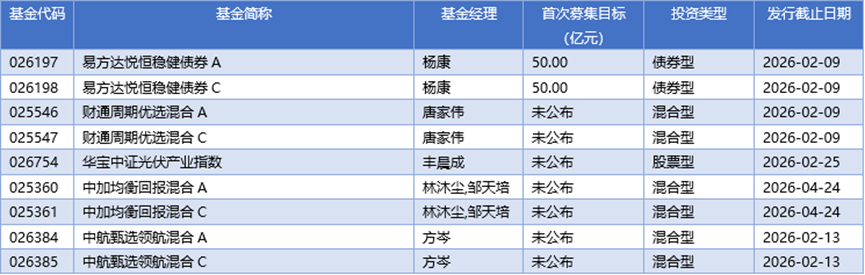
Group 1 - Hong Kong stocks have become a core battleground for public offerings at the beginning of the year, with 26 new Hong Kong stock-themed products reported since 2026, focusing on technology, pharmaceuticals, and cyclical sectors [1] - Hong Kong-themed ETFs have seen a net inflow of nearly 30 billion yuan this year, with the Fuguo Hong Kong Stock Connect Internet ETF being the first to exceed 100 billion yuan in assets [1] - The combination of low valuations and favorable policies is expected to lead to continued inflows of southbound capital, accelerating the expansion of Hong Kong's financial products [1] Group 2 - On January 27, a total of 9 new funds were launched, primarily mixed and bond funds, with the E Fund Yueheng Stable Bond A aiming to raise 5 billion yuan [2] - In the context of A-share market fluctuations, stock ETFs have seen significant trading volume, with a noticeable shift in funds; the CSI 300 ETF and the CSI 1000 ETF experienced net outflows of 336.9 billion yuan and 78 billion yuan respectively [2] - Meanwhile, resource and technology sector-themed ETFs have attracted a combined net inflow of 158.5 billion yuan, indicating a shift from broad-based to high-growth sector investments [2] Group 3 - China Life recently announced plans to establish a pension industry fund and a Yangtze River Delta private equity fund, with a total subscription scale of nearly 12.5 billion yuan [2] - Insurance capital has been increasingly allocated to private equity and other equity assets, with regulatory encouragement for long-term capital entering the market, leading to a diversified investment approach [2]

布局未来增长极 险资加速投资“养老+科创”赛道
Zhong Guo Zheng Quan Bao· 2026-01-28 00:15
Group 1 - The core viewpoint of the news is that China Life Insurance Company is investing nearly 12.5 billion yuan in two major investment plans targeting the elderly care industry and the sci-tech industry in the Yangtze River Delta region, reflecting a trend of insurance capital accelerating its layout in equity investments and diversifying its asset allocation [1][4] Group 2 - China Life plans to invest approximately 8.492 billion yuan to establish the "Beijing Guoshou Elderly Care Industry Equity Investment Fund Phase II," focusing on mergers and acquisitions of existing elderly care real estate projects and expanding new elderly care real estate projects, with a total subscription amount of 8.5 billion yuan and a duration of 15 years [2] - The company has already established a systematic development path in the elderly care sector, with operations in 17 cities and 20 elderly care projects, and manages a total scale of 50 billion yuan in health and elderly care funds [2] Group 3 - The second investment involves a planned contribution of 4 billion yuan to establish the "Hui Zhi Yangtze River Delta (Shanghai) Private Equity Fund Partnership," with a total subscription amount of 5.0515 billion yuan, focusing on artificial intelligence and biomedicine sectors [3] Group 4 - The dual investment strategy in elderly care and sci-tech sectors by China Life is indicative of the broader trend of insurance capital exploring diversified equity investments, extending beyond traditional sectors into technology innovation, healthcare, and green energy [4] - Other leading insurance companies are also taking substantial actions, such as China Pacific Insurance's establishment of a 50 billion yuan fund aimed at supporting state-owned enterprise reforms and modern industrial system construction [4] Group 5 - The increase in insurance capital's equity investments is influenced by industry dynamics and proactive policy guidance, with equity investment assets reaching 1.92 trillion yuan by the end of 2024, accounting for 6.35% of total investments, and showing a year-on-year growth of nearly 13% [5] - The macro environment, characterized by low interest rates and new accounting standards, is driving insurance capital to seek long-term stable returns through equity investments aligned with national development strategies [5][6]

湾财晚报|刘强东给老家送礼!村民们骑三轮车提货;广铁预测春节客流高峰时段;去年房地产贷款余额少了近万亿
Nan Fang Du Shi Bao· 2026-01-27 15:05
刘强东给老家送年货,村委会广播通知村民:骑三轮车来拉年货 1月27日,刘强东老家宿迁光明村村委会通过广播喊话村民领年货。"明天下午先来村口看演出,有咱自己村的村晚,后天29号早上10点,正式开始发年 货!今年给每家每户的年货还是特别实在,大家备好人手,三轮车、小推车,能用的都用上!" "小年"火车票开售!广铁预测2月7日现客流高峰 去年我国房地产贷款余额减少近万亿,普惠小微贷增长明显 1月27日,中国人民银行发布2025年四季度金融机构贷款投向统计报告。据中国人民银行统计,2025年四季度末,金融机构人民币各项贷款余额271.91万 亿元,同比增长6.4%,全年人民币贷款增加16.27万亿元。其中,普惠小微贷款余额同比增长11.1%,增速比各项贷款高4.7个百分点;房地产贷款余额同 比下降1.6%,全年减少9636亿元;不含个人住房贷款的消费性贷款余额同比增长0.7%。 长达18年的印度与欧盟的自由贸易协议谈判,终于落定。据央视新闻,当地时间1月27日,印欧领导人在新德里举行会晤。印度总理莫迪宣布,印度和欧 盟达成自由贸易协定。 欧盟委员会称,印度给予欧盟的关税减免将大幅改善欧盟出口产品的市场准入。例如,汽车 ...


瑞众人寿保险增持青岛啤酒股份20万股 每股作价约49.97港元
Zhi Tong Cai Jing· 2026-01-27 10:57
Group 1 - The core point of the article is that 瑞众人寿保险 has increased its stake in 青岛啤酒 by purchasing 200,000 shares at a price of 49.9658 HKD per share, totaling 9.9932 million HKD [1] - After the purchase, 瑞众人寿保险's total holdings in 青岛啤酒 amount to approximately 39.374 million shares, representing a 6.01% ownership stake [1]

瑞众人寿保险增持青岛啤酒股份(00168)20万股 每股作价约49.97港元
智通财经网· 2026-01-27 10:55
Group 1 - The core point of the article is that 瑞众人寿保险 has increased its stake in 青岛啤酒股份 by purchasing 200,000 shares at a price of 49.9658 HKD per share, totaling 9.9932 million HKD [1] - After the purchase, 瑞众人寿保险's total holdings in 青岛啤酒股份 amount to approximately 39.374 million shares, representing a 6.01% ownership stake [1]
宋绍富获批出任锦泰保险总经理
Xin Lang Cai Jing· 2026-01-27 08:43
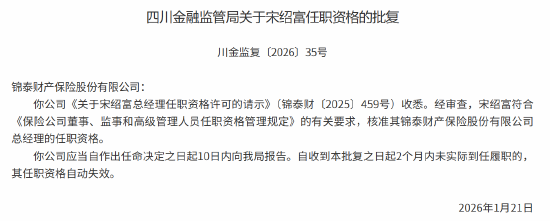
1月27日金融一线消息,四川金融监管局发布批复,核准宋绍富锦泰财产保险股份有限公司总经理的任 职资格。 1月27日金融一线消息,四川金融监管局发布批复,核准宋绍富锦泰财产保险股份有限公司总经理的任 职资格。 据锦泰保险官网高级管理人员简历显示,宋绍富,1972年4月生,博士研究生,正高级经济师。曾就职 于邮电部第五研究所、大唐电信光通信分公司、太平财产保险有限公司;2011年1月至2018年12月历任 锦泰财产保险股份有限公司营业总部总经理、四川分公司总经理、总公司渠道管理部总经理、市场部总 经理、成都分公司总经理等职务;2019年1月至2023年7月任锦泰财产保险股份有限公司副总经理,任职 批准文号为银保监复〔2018〕324号;2020年9月至2023年7月任锦泰财产保险股份有限公司首席信息 官;2021年5月至今任锦泰财产保险股份有限公司首席投资官;2023年7月至今任锦泰财产保险股份有限 公司副总经理(主持工作),任职批准文号为川银保监复〔2023〕186号;2024年11月任锦泰财产保险 股份有限公司党委副书记。 责任编辑:秦艺 据锦泰保险官网高级管理人员简历显示,宋绍富,1972年4月生,博士研究 ...
宝鸡监管分局同意北大方正人寿宝鸡中心支公司变更营业场所
Jin Tou Wang· 2026-01-27 03:46
二、北大方正人寿保险有限公司应按照有关规定及时办理变更及许可证换领事宜。 2026年1月21日,国家金融监督管理总局宝鸡监管分局发布批复称,《北大方正人寿保险有限公司陕西 分公司关于宝鸡中心支公司变更营业场所的请示》(北大方正人寿陕字〔2026〕10号)收悉。经审核,现 批复如下: 一、同意北大方正人寿保险有限公司宝鸡中心支公司将营业场所变更为:陕西省宝鸡市渭滨区高新大道 58号B区1号楼5楼01室。 ...
洪丕正:香港去年金融业表现非常强劲 股票市场等多个领域显著增长
Zhi Tong Cai Jing· 2026-01-27 02:37
Core Viewpoint - The chairman of the Hong Kong Financial Development Council,洪丕正, highlighted the unprecedented challenges faced globally last year, prompting investors to reassess their portfolios and seek better asset allocation to mitigate risks from policy changes [1] Group 1: Role of Hong Kong - Hong Kong played a crucial role in assisting international investors to diversify investments from mature markets to emerging markets [1] - The city also helped mainland investors to allocate assets globally, showcasing its role as a bridge in the international financial landscape [1] Group 2: Financial Sector Performance - The financial services sector is vital to Hong Kong's economy, with unique advantages such as a highly internationalized market, robust regulatory framework, and close ties with mainland China [1] - The overall performance of Hong Kong's financial industry was strong last year, with significant growth observed in various sectors including the stock market, IPOs, banking, insurance, wealth management, and family offices [1] Group 3: Future Outlook - The Financial Development Council will continue to play its role by actively proposing forward-looking policy recommendations to ensure the competitiveness of Hong Kong's financial industry [1] - There is an ongoing effort to promote Hong Kong as the preferred financial platform to global investors and financial institutions [1]
广东:加快提升金融业规模能级 进一步加强未来产业布局
Zhong Guo Zheng Quan Bao· 2026-01-26 23:23
在加快构建更加强大的现代化产业体系方面,报告明确,加快新兴产业发展壮大和未来产业成形成势。 做大做强新能源、新材料、智能网联汽车、智能机器人、医药和医疗器械、航空航天、集成电路、低空 经济、生物制造等新兴产业,培育更多新兴支柱产业。进一步加强未来产业布局,大力发展第六代移动 通信、具身智能、细胞与基因治疗、脑科学与脑机接口、氢能及先进核能、深海探测、量子科技等重点 细分产业,加快成形成势。 在加快培育和发展新质生产力方面,报告提出,加强原始创新和关键核心技术攻关。强化有组织的创 新,全链条推动量子科技、脑科学与脑机接口、人工智能、智能机器人、集成电路、工业母机等领域关 键核心技术攻关取得突破。加强基础研究战略性、前瞻性、体系化布局。 报告表示,2025年是中国式现代化进程中具有重要意义的一年,也是广东改革发展历程中很不平凡的一 年。2025年,广东省经济运行稳中有进、稳中向好,地区生产总值增长3.9%、总量连续37年居全国首 位;地方一般公共预算收入增长3%;货物进出口增长4.4%,贡献了全国24.1%的增量;规上工业企业达 7.6万家、增加值增长3%。 报告提出,坚定不移深化改革,充分激发全社会创新创造活力 ...