核能

Search documents
匈牙利与美国签署液化天然气采购协议
Yang Shi Xin Wen· 2025-12-16 20:09
Group 1 - Hungary's Ministry of Foreign Affairs and Trade announced a 5-year LNG procurement agreement with Chevron for a total of 2 billion cubic meters [1] - Under the agreement, Chevron will supply Hungary with 400 million cubic meters of LNG annually, marking the first inclusion of US LNG in Hungary's energy supply [1] - Hungary has also signed contracts with Westinghouse for nuclear fuel supply to the Paks Nuclear Power Plant, with plans to start operations between 2028 and 2029 [1] Group 2 - The Paks Nuclear Power Plant, Hungary's only nuclear facility, accounts for approximately half of the country's electricity generation [2] - The US has granted Hungary a waiver from sanctions related to energy purchases from Russia, as part of a commitment made by Hungarian Prime Minister Orban during a meeting with President Trump [2] - Hungary plans to purchase approximately $600 million worth of LNG from the US and strengthen cooperation in nuclear energy and defense [2]


当中国押注“人类终极能源”,美国却在押短期选票,格局高下立判
Sou Hu Cai Jing· 2025-12-14 03:47
Group 1 - The core of the article emphasizes that the future of civilization hinges on solving the energy problem of "infinite, clean, and controllable" energy, with nuclear fusion being the key solution [4][6] - Nuclear fusion is characterized as a civilization-level project that requires national will and long-term commitment, rather than just a scientific endeavor [8][12] - The article highlights that the U.S. struggles with long-term patience for projects like nuclear fusion, leading to a reliance on private capital and fragmented research efforts [12][14][15] Group 2 - China is positioned to invest in nuclear fusion due to its historical understanding of energy's critical role in industrial security and technological sovereignty [17][19] - The article argues that the true measure of success in nuclear fusion will be the ability to replicate successful outcomes consistently, rather than achieving isolated breakthroughs [21][24] - The talent flow towards national projects in China indicates a strong commitment to long-term investment in nuclear fusion, contrasting with the U.S. approach [28][29] Group 3 - The article discusses the geopolitical implications of nuclear fusion, suggesting that its successful implementation could fundamentally alter global energy dynamics and reduce the leverage of traditional energy powers [31][32] - The competition in nuclear fusion is framed as a test of societal readiness for long-term planning, contrasting China's long-termism with the U.S.'s short-term focus [34][35] - The conclusion posits that the nation willing to invest patiently and consistently in nuclear fusion will ultimately shape the future of energy and civilization [37]
超60家核心单位 高温气冷堆现代产业链联盟正式成立
Zhong Guo Jing Ji Wang· 2025-12-13 00:48
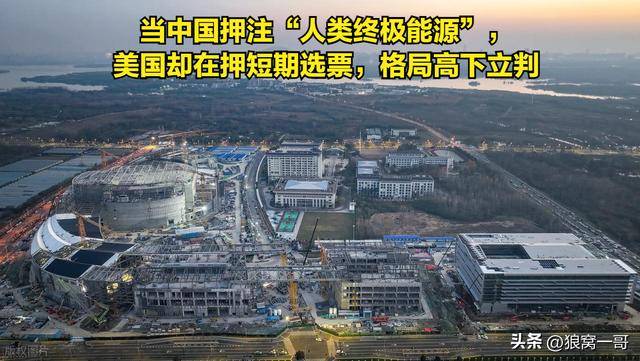
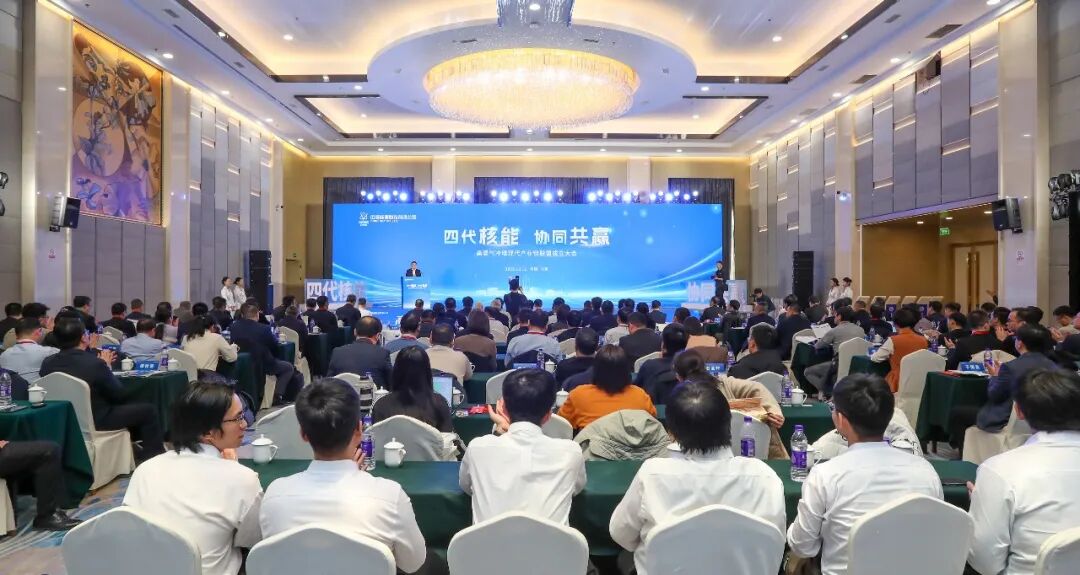
Core Viewpoint - The establishment of the High-Temperature Gas-Cooled Reactor (HTGR) Modern Industrial Chain Alliance marks a significant step in China's industrialization and collaborative innovation in fourth-generation nuclear energy technology [1][6]. Group 1: Alliance Formation and Objectives - The HTGR Modern Industrial Chain Alliance was officially launched on December 11, initiated by China National Nuclear Corporation, China Huaneng Group, and Tsinghua University [1]. - The alliance aims to create a strategic community with shared goals, responsibilities, benefits, and value creation [1][3]. - The alliance's charter was signed during the establishment meeting, which also included a proposal for promoting the HTGR industry through party-building initiatives [3]. Group 2: Key Participants and Contributions - Over 60 core units from the upstream and downstream of the industrial chain are involved, focusing on six critical areas: research and design, fuel manufacturing, equipment manufacturing, construction and debugging, operation and maintenance, and overseas markets [6]. - Key speeches were delivered by representatives from China National Nuclear Power Co., Harbin Electric Group, and other significant players in the industry [3]. Group 3: Technological and Market Development - The alliance will enhance cooperation across the HTGR industry chain, breaking down barriers and establishing strategic partnerships among enterprises [7]. - The focus will be on diversifying the use of HTGR technology beyond electricity generation to include heating and hydrogen production, contributing to a zero-carbon comprehensive energy system [6]. - The HTGR is recognized for its inherent safety, multi-purpose capabilities, and modular flexibility, with China having mastered all core technologies and intellectual property related to HTGR [6][7].


中国铀业:由公司保障华能核电的天然铀供应
Zheng Quan Ri Bao Wang· 2025-12-12 08:42
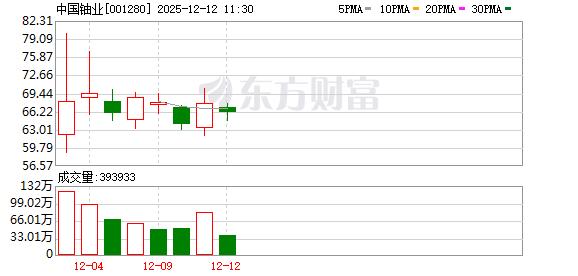
证券日报网讯12月12日,中国铀业(001280)在互动平台回答投资者提问时表示,公司已与华能核电签 署协议约定由公司保障华能核电的天然铀供应。 ...
12月12日主题复盘 | 指数放量回升,航天板块再度爆发,智能电网、核聚变等也有不俗表现
Xuan Gu Bao· 2025-12-12 08:36
Market Overview - The market experienced a rebound with all three major indices rising, driven by strong performances in sectors such as controlled nuclear fusion, electric grid equipment, and commercial aerospace [1] - Notable stocks that hit the daily limit include China Nuclear Engineering, China National Machinery, and others in the nuclear fusion sector [1] Sector Highlights Aerospace - The aerospace sector continued its upward trend with multiple stocks hitting the daily limit, including Aerospace Power and Shunhao Co [3] - A successful launch of the Long March 12 rocket on December 12, which deployed 16 low-orbit satellites, has boosted confidence in the domestic commercial aerospace industry [3] - The upcoming launch of Long March 12A in December 2025 is expected to further enhance the sector's prospects [3] Smart Grid - The smart grid concept saw significant gains, with stocks like Zhongchao Holdings and Tongguang Cable hitting the daily limit [7] - Nvidia is set to hold a closed-door summit to address potential power shortages in data centers, which could impact the smart grid sector [7] Nuclear Fusion - The nuclear fusion sector experienced a surge, with companies like China National Machinery and China First Heavy Industries seeing substantial stock increases [11] - The Central Economic Work Conference emphasized the importance of green transformation and energy system construction, which aligns with the nuclear fusion industry's growth [11] - The global nuclear fusion market is projected to approach $500 billion by 2030, indicating strong future growth potential [13] Investment Insights - The commercial aerospace market is expected to grow significantly, driven by advancements in reusable rocket technology and the miniaturization of satellites, which lower costs and expand applications [6] - The smart grid sector is poised for growth as AI development and energy policies evolve, with increasing demand for gas turbines and related technologies [10] - The nuclear fusion industry is anticipated to enter a phase of significant investment and development by 2027, benefiting core suppliers in the sector [13]

中核国际午后涨超12% 可控核聚变近期迎密集催化
Zhi Tong Cai Jing· 2025-12-12 06:03
Core Viewpoint - China Nuclear International (02302) saw a significant increase of over 12%, currently trading at 5.28 HKD with a transaction volume of 7.63 million HKD, driven by positive market forecasts for the nuclear fusion sector [1] Group 1: Market Forecasts - The International Energy Agency predicts that the global nuclear fusion market could approach 500 billion USD (3.5 trillion RMB) by 2030 [1] - Guojin Securities reports that the Hefei BEST fusion project has seen monthly tenders exceeding 2 billion RMB, indicating a positive outlook for accelerated nuclear fusion tenders [1] Group 2: Policy and Industry Developments - The Central Economic Work Conference emphasized the need to advance energy-saving and carbon-reduction transformations in key industries, alongside the development of a national energy strategy and the expansion of green electricity applications [1] - The BEST project in Hefei is entering a critical phase, with tendering activity expected to accelerate as the project progresses [1]
港股异动 | 中核国际(02302)午后涨超12% 可控核聚变近期迎密集催化
智通财经网· 2025-12-12 05:56
Core Viewpoint - The global nuclear fusion market is projected to approach $500 billion (3.5 trillion RMB) by 2030, indicating significant growth potential in the sector [1] Company Performance - Zhonghe International (02302) saw its stock price increase by over 12%, reaching HKD 5.28, with a trading volume of HKD 7.6319 million [1] Industry Insights - The Central Economic Work Conference emphasized the need to advance energy-saving and carbon-reduction transformations in key industries, alongside the development of a strong energy nation plan and the acceleration of a new energy system [1] - Guojin Securities reported that the Hefei BEST fusion project has seen monthly bidding exceed 2 billion RMB, indicating a positive outlook for accelerated nuclear fusion bidding [1] - In November, the BEST bidding scale was at least 2 billion RMB, and as the Hefei BEST project enters a critical phase, there is optimism regarding the acceleration of the BEST fusion project bidding [1]
A股可控核聚变股爆发,中国核建等多股涨停
Ge Long Hui A P P· 2025-12-12 05:31
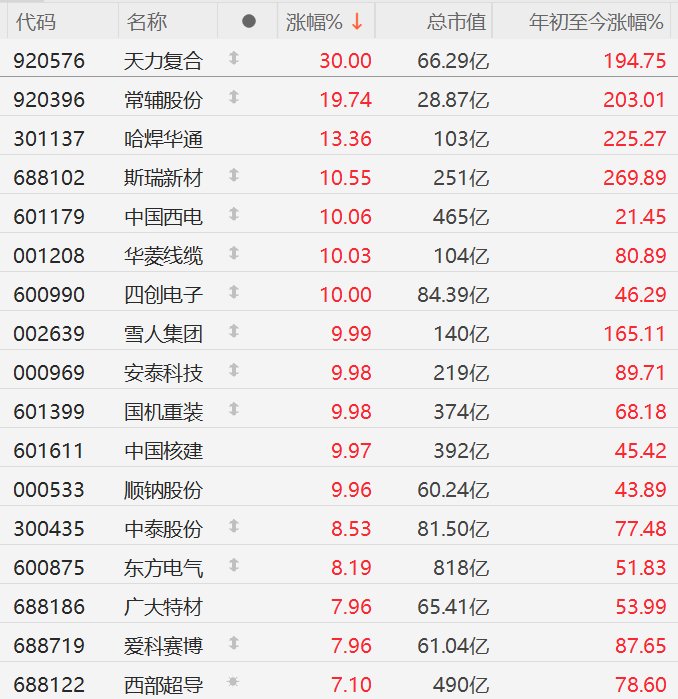
Core Viewpoint - The A-share market is experiencing significant gains in stocks related to controllable nuclear fusion, with several companies reaching their daily price limits and showing substantial year-to-date performance increases [1][2]. Group 1: Stock Performance - Tianli Composite (920576) reached a 30% increase, with a total market value of 6.629 billion and a year-to-date increase of 194.75% [2] - Changfu Co., Ltd. (920396) saw a 19.74% rise, with a market value of 2.887 billion and a year-to-date increase of 203.01% [2] - Haotian Technology (301137) increased by 13.36%, with a market value of 10.3 billion and a year-to-date increase of 225.27% [2] - Srey New Materials (688102) rose by 10.55%, with a market value of 25.1 billion and a year-to-date increase of 269.89% [2] - China West Electric (601179) increased by 10.06%, with a market value of 46.5 billion and a year-to-date increase of 21.45% [2] - Other notable performers include Huadong Cable (10.03% increase), Sichuan Chuang (10% increase), and Snowman Group (9.99% increase) [1][2]. Group 2: Market Trends - The overall trend in the A-share market indicates a strong bullish sentiment, particularly in the controllable nuclear fusion sector, as evidenced by the formation of MACD golden cross signals [1]. - Companies such as Guotai Heavy Industries and China Nuclear Engineering also showed significant gains, with increases around 9.97% and 9.96% respectively [2]. - The performance of these stocks reflects a growing investor interest in the nuclear fusion industry, suggesting potential for further investment opportunities [1][2].


可控核聚变股爆发,中国核建等多股涨停
Ge Long Hui· 2025-12-12 05:26
Core Viewpoint - The A-share market saw significant gains in stocks related to controlled nuclear fusion, with several companies reaching their daily limit increases, indicating strong investor interest and potential growth in this sector [1][2]. Group 1: Stock Performance - Tianli Composite reached a 30% increase, with a total market value of 6.629 billion and a year-to-date increase of 194.75% [2] - Changfu Co. saw a nearly 20% rise, with a market value of 2.887 billion and a year-to-date increase of 203.01% [2] - Ha Welding Huaton increased by over 13%, with a market value of 10.3 billion and a year-to-date increase of 225.27% [2] - Srey New Materials rose over 10%, with a market value of 25.1 billion and a year-to-date increase of 269.89% [2] - China XD Electric, Hualing Cable, Sichuan Chuang Electronics, Snowman Group, Antai Technology, China National Heavy Machinery, China Nuclear Engineering, and Shun Sodium Co. all reached a 10% increase [1][2]. Group 2: Additional Notable Stocks - Zhongtai Co. and Dongfang Electric increased by over 8%, with market values of 8.15 billion and 81.8 billion respectively [2] - Guoda Special Materials and Aike Saibo both saw increases of nearly 8%, with market values of 6.541 billion and 6.104 billion respectively [2] - Western Superconducting experienced a 7.1% increase, with a market value of 49 billion [2].
中国铀业:公司已与华能核电签署协议,约定由公司保障华能核电的天然铀供应
Mei Ri Jing Ji Xin Wen· 2025-12-12 04:17
(文章来源:每日经济新闻) 每经AI快讯,有投资者在投资者互动平台提问:公司前五大客户销售占比超 77%,其中中核集团占比 近50%,关联交易占比较高,未来在开拓华能、国电投等其他核电集团客户方面,是否有明确的进展和 目标? 中国铀业(001280.SZ)12月12日在投资者互动平台表示,公司已与华能核电签署协议,约定由公司保 障华能核电的天然铀供应。 ...